Table of Contents
Introduction: Attila the Hun – Beyond the Scourge of God
Few historical figures evoke as visceral a reaction as Attila the Hun. Known to later Christian writers as the "Scourge of God," Attila ruled the Hunnic Empire at its zenith from 434 to 453 CE, commanding the most formidable military force in Europe during the twilight years of the Western Roman Empire. His campaigns stretched from the Central Asian steppes to Gaul, from the Danube frontier to the very gates of Rome. The terror he inspired was so profound that contemporaries interpreted his conquests as divine punishment for a sinful world.
Yet Attila’s legacy extends far beyond destruction. His invasions accelerated the transformation of Europe from classical antiquity into the early medieval patchwork of competing kingdoms. Population movements triggered by the Huns redrew the continent’s ethnic and political map. His diplomacy and warfare shaped the course of Western civilization, influencing the fall of the Roman Empire, the rise of Germanic kingdoms, and even the authority of the medieval papacy.
To understand Attila is to look beyond the caricature of a mindless barbarian and examine a complex leader who wielded both military might and subtle statecraft. This study guide explores the origins of the Huns, Attila’s rise to power, his major campaigns, his death and the collapse of his empire, and his enduring cultural impact. It draws on the most reliable primary source—the fragments of the historian Priscus, an Eastern Roman diplomat who visited Attila’s court—alongside modern archaeological and scholarly interpretations.
The Huns: Origins, Migrations, and Military System
Mysterious Origins and the Journey West
The Huns burst into European consciousness around 370 CE, but their origins remain debated. Most scholars connect them to the Xiongnu, a nomadic confederation that menaced China’s northern borders from the 3rd century BCE onward. After Chinese campaigns defeated the northern Xiongnu around 90 CE, some groups migrated westward across the steppes, absorbing other peoples and evolving into the Huns of European records. The linguistic link is still contested, but genetic and archaeological evidence supports a steppe origin with east Eurasian ancestry.
Archaeological finds—including cauldrons, mirrors, and distinctive composite bows—reveal that the Huns practiced artificial cranial deformation, binding infants’ heads to create elongated skulls. This custom, found in multiple Hunnic burial sites, marked them as distinct and likely heightened their fearsome reputation. Their material culture shows influences from Persian, Chinese, and steppe traditions, indicating far-reaching trade networks rather than isolation. The Huns were not a single ethnic tribe but a confederation of diverse groups held together by military success and the charisma of their leaders.
Why the Huns Were So Effective
The Hunnic military system gave them decisive advantages over Roman and Germanic opponents:
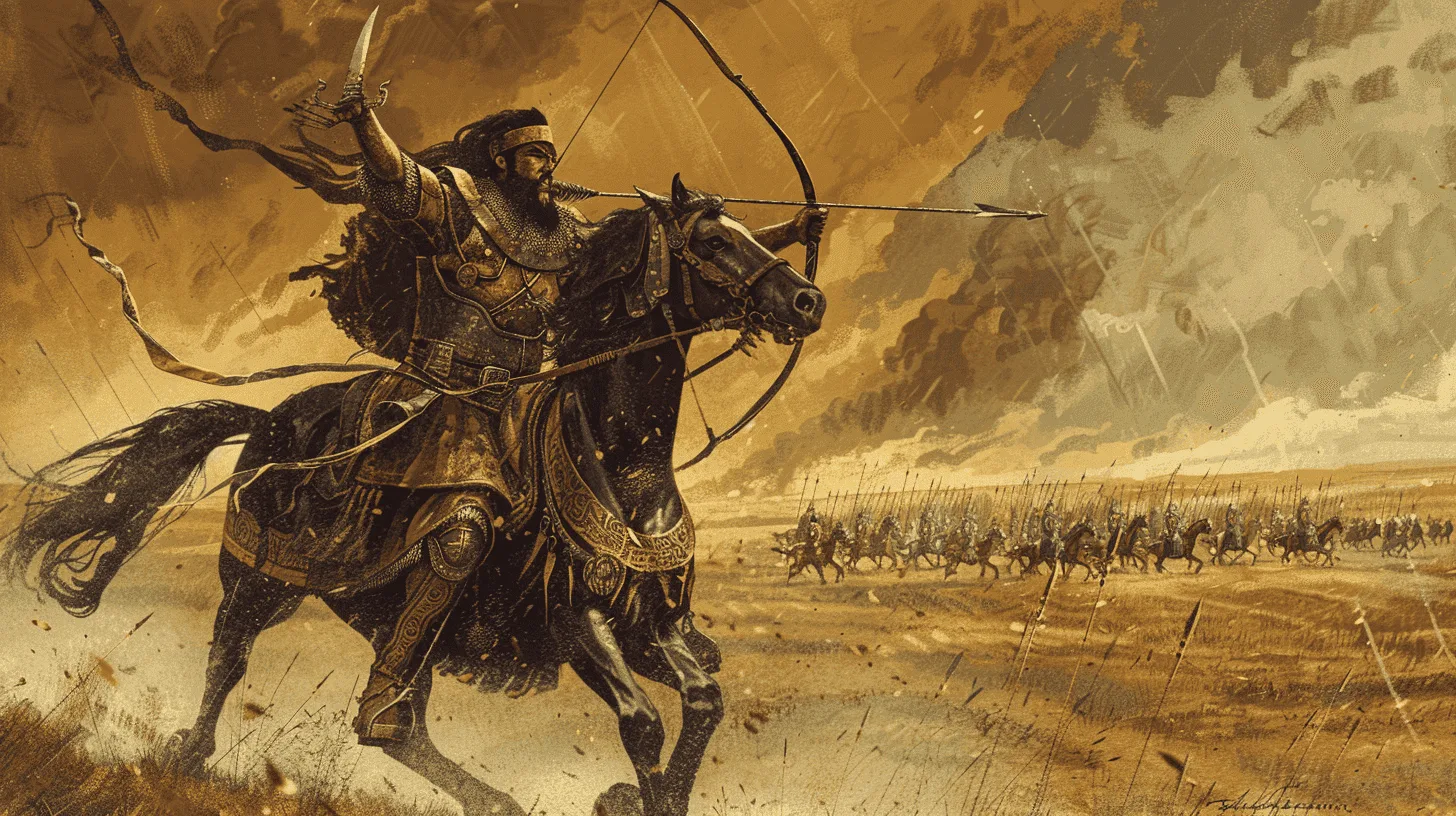
- Superior horsemanship: Huns lived on horseback, enabling unmatched mobility. They could cover up to 100 kilometers a day, outpacing Roman supply lines.
- The composite bow: A short, powerful bow made from layers of wood, horn, and sinew—effective at long range from horseback. It delivered deadly volleys at over 150 meters.
- Tactical flexibility: Fluid cavalry tactics—feigned retreats, encirclements, and hit-and-run attacks—overwhelmed infantry-heavy armies trained for set-piece battles.
- Psychological warfare: Deliberately cultivated terror through appearance, speed, and sudden raids. Roman authors describe the Huns as "flashing swords" and "boiling with rage."
- Multiethnic armies: Incorporating Goths, Gepids, Alans, and others for specialized capabilities. Some subject peoples provided heavy infantry or engineers for sieges.
- Logistical simplicity: Nomadic lifestyle meant they lived off the land without complex supply trains. Their horses provided milk, blood, and transport.
These advantages made the Huns nearly invincible in open battle. Only fortifications, coalition armies, or exploitation of their weakness in siege warfare could check them. The Battle of the Catalaunian Plains in 451 CE would prove that carefully coordinated resistance could stop a Hunnic offensive.
Attila’s Rise to Power
Early Life and Joint Rule with Bleda
Born around 406 CE into the Hunnic royal family, Attila initially shared power with his brother Bleda after their uncle Ruga’s death in 434 CE. The brothers cooperated in renegotiating treaties with the Eastern Roman Empire at Margus (modern Požarevac, Serbia), demanding increased tribute and the return of Hunnic refugees. In the early 440s they launched joint campaigns into the Balkans, capturing cities and extracting wealth. Bleda, according to Priscus, was a capable leader fond of court jesters and luxury, while Attila cultivated austerity and discipline.
Consolidation of Sole Authority
Around 445 CE, Bleda died under suspicious circumstances—likely murdered on Attila’s orders. According to later chroniclers, Attila killed him during a hunt. Once sole ruler, Attila transformed the Hunnic confederation into a more centralized empire. He imposed strict discipline, demanded absolute loyalty, and organized campaigns of unprecedented scale. Contemporary sources say he housed his court in a large wooden palace at a permanent encampment somewhere in the Carpathian Basin (likely modern Hungary).
Priscus’s account of an embassy to Attila in 448/9 CE provides a rare glimpse of his character. He describes Attila as short, stocky, with a large head, deep-set eyes, a flat nose, and a thin beard. In contrast to his chieftains who used gold and silver vessels, Attila ate from a wooden plate and drank from a plain cup. This austerity—whether genuine or calculated—reinforced his charismatic authority and bound his followers through shared hardship.
Attila’s leadership combined personal magnetism, strategic use of terror, diplomatic sophistication, and a meritocratic approach to military command. He calibrated tribute demands to keep pressure on Rome without destroying its ability to pay. He also maintained a network of spies and hostages across the empire, ensuring intelligence flowed into his court.
Major Military Campaigns
Devastating the Eastern Roman Empire (441–447 CE)
Attila’s campaigns against the Eastern Romans demonstrated Hunnic superiority. In 441–442 CE, forces swept through Danube provinces, capturing Viminacium, Singidunum (modern Belgrade), and Naissus (modern Niš, birthplace of Constantine). Priscus describes the ruins of Naissus with its churches plundered and the streets overgrown. Peace negotiations in 443 CE brought increased tribute—from 350 pounds of gold annually to 2,100 pounds.
In 447 CE, Attila launched an even deeper invasion. A major earthquake had weakened Constantinople’s walls, so the Eastern Romans were desperate. Hunnic forces captured over seventy cities in the Balkans, including Marcianopolis, Philippopolis, and Arcadiopolis. They reached within sight of Constantinople itself, but lacked the siege capability to take the Theodosian Walls. Emperor Theodosius II agreed to humiliating terms: annual tribute of 2,100 pounds of gold, arrears of 6,000 pounds, and a five-day buffer zone south of the Danube.
These campaigns extracted enormous wealth, demonstrated Roman weakness, and secured Attila’s southern frontier. The Eastern Empire would spend years rebuilding.
The Gallic Campaign and Battle of the Catalaunian Plains (451 CE)
In 451 CE, Attila turned westward. The immediate pretext was a letter from Honoria, sister of Western Emperor Valentinian III, who offered herself in marriage to Attila along with half the empire as dowry (though this was likely a desperate plea to escape an arranged marriage). Leading perhaps 30,000–100,000 warriors (ancient records vary wildly), Attila crossed the Rhine and swept through Gaul. He burned Metz, Reims, and Strasbourg. Orléans held out until a coalition army arrived—commanded by the Roman general Flavius Aetius and Visigothic King Theodoric I. Aetius had spent years as a hostage among the Huns and knew their tactics.
The armies met at the Battle of the Catalaunian Plains (near modern Châlons-en-Champagne), often called one of the most important battles of late antiquity. The fighting was brutal and seesawing. Theodoric was killed in the melee, but his Visigoths continued fighting under his son Thorismund. The Hunnic center pushed back the Roman right flank, but when night fell the battle ended indecisively. Attila withdrew in good order, reportedly prepared to burn himself on a funeral pyre if defeated.
Though not a decisive defeat, the battle stopped the Hunnic advance into Gaul and damaged Attila’s aura of invincibility. It also showed that the old Roman-Visigothic alliance could still function as a bulwark.
Invasion of Italy and the Meeting with Pope Leo I (452 CE)
Undeterred, Attila invaded Italy in 452 CE. He first besieged Aquileia, the largest city in the region. The siege lasted months; according to legend, Attila was about to abandon it when he saw storks carrying their young from the city—a sign that Aquileia was doomed. The city fell and was razed so completely that its ruins were barely traceable later. Other cities—Padua, Verona, Milan—surrendered or were captured.
As Attila prepared to march on Rome, Pope Leo I met him near Mantua and persuaded him to withdraw. While later legends added visions of Saints Peter and Paul threatening Attila with divine punishment, practical factors likely influenced the king: plague had broken out in his army, supply shortages loomed, the Eastern Roman emperor Marcian was launching attacks across the Danube, and Attila had received substantial tribute. Leo’s embassy saved Rome and greatly enhanced papal prestige, forever linking the papacy with the defense of Western Christendom. The famous 16th-century fresco by Raphael in the Vatican celebrates this meeting.
Death and the Collapse of the Hunnic Empire
Attila’s Sudden Death (453 CE)
In 453 CE, Attila died unexpectedly on his wedding night with a new bride named Ildico. The historian Priscus, the most reliable source for this event, reports that Attila suffered a severe nosebleed while drunk and choked on his own blood. The anticlimactic end—death from a nosebleed while in a stupor—contrasted sharply with his fearsome reputation. Many contemporaries suspected murder, but no evidence supports that. His sudden death created a power vacuum that his heirs could not fill.
Funeral and Succession Crisis
His body was buried in three nested coffins (gold, silver, iron) at a secret location; the grave workers were killed to protect the secret. No trace has ever been found, despite centuries of treasure hunting. The burial itself was spectacular: the Huns mourned with feasts, games, and a ritual lamentation called strava. Attila left several sons (Ellac, Dengizich, Ernak) and no clear succession plan. Within a year, subject peoples rebelled.
Rapid Disintegration
At the Battle of Nedao (454 CE), a Germanic coalition led by the Gepid king Ardaric defeated the Huns. Ellac was killed. The empire fragmented: Gepids claimed the Carpathian Basin, Ostrogoths regained independence, and remaining Huns dissolved into small groups. Dengizich tried to reestablish Hunnic power but was defeated in 469 CE; his head was displayed in Constantinople as a trophy. By 470 CE, Attila’s empire, built entirely on personal authority and successful raids, had vanished.
It was a classic case of a steppe confederation that could not survive without a charismatic leader at its head.
Cultural and Historical Legacy
The Scourge of God: Christian Interpretation
The title “Scourge of God” (Flagellum Dei) was applied by Christian writers who interpreted Hunnic devastation as divine punishment for sin. This theodicy served to explain suffering, call for repentance, and bolster ecclesiastical authority—especially after Pope Leo’s successful embassy in 452. Gregory of Tours, writing in the 6th century, expanded the legend with supernatural embellishments. Attila himself was probably indifferent to this framing; he remained a pagan who tolerated Christians and others in his realm. His court hosted Arian Christian missionaries, and he even allowed a Gothic Christian embassy to attend his wedding feast.
Accelerating the Fall of the Western Roman Empire
While the Western Empire’s decline had multiple structural causes—economic, administrative, and military—Attila’s campaigns were a decisive accelerant. Massive tribute payments drained imperial coffers at a time when tax revenues were shrinking. The loss of productive provinces like Gaul and North Africa (the latter taken by Vandals in 439) undercut the tax base further. The Hunnic invasions also disrupted trade routes and agricultural production. Most importantly, Attila shattered the myth of Roman invincibility, encouraging other barbarian groups like the Vandals, Suevi, and Burgundians to challenge imperial authority with confidence.
The final deposition of the last Western emperor, Romulus Augustulus, in 476 CE was almost anticlimactic after the devastation wrought by Attila’s campaigns.
Foundations of Medieval Europe
The population movements triggered by the Huns—the so-called "Migration Period"—led to the establishment of Germanic kingdoms across the former Roman provinces: Visigoths in Iberia, Ostrogoths in Italy, Franks in Gaul, Vandals in North Africa, Anglo-Saxons in Britain. These kingdoms blended Roman administrative structures with Germanic traditions, with the Catholic Church providing continuity and legitimacy. The Hunnic pressure had forced the Romans to rely more heavily on foederati (allied barbarian troops), which eventually blurred the line between empire and kingdom. This synthesis formed the basis of medieval European civilization.
Military and Strategic Influence
Attila’s cavalry-centric warfare influenced later medieval armies, in which heavy cavalry became dominant. His use of composite forces, psychological tactics, and intelligence gathering set precedents for steppe warriors like the Mongols under Genghis Khan. Military historians have often compared Attila to Genghis Khan and Subutai, recognizing sophisticated strategic thinking behind the "barbarian" label. The Hunnic pattern of extracting tribute through terror and developing a multiethnic coalition remains a textbook case of nomadic empire-building.
Historiography and Modern Images
Attila has been portrayed variously across history. In medieval Germanic legend (the Nibelungenlied), he appears as the generous and noble King Etzel. Hungarian nationalists in the 19th century claimed him as a national ancestor, while Enlightenment thinkers used him as a symbol of the "destructive barbarian." Today, scholarship emphasizes his rationality and diplomatic savvy. The Priscus fragments, preserved in later Byzantine writers, are the most valuable near-contemporary source, offering a nuanced view of Hunnic court life and diplomacy.
Modern archaeology continues to refine our understanding of Hunnic material culture and daily life.
Further Resources for Study
Readers interested in deeper exploration of Attila and the Migration Period can consult the following authoritative sources:
- The Metropolitan Museum of Art – The Huns – Overview of Hunnic art and artifacts.
- World History Encyclopedia – Attila the Hun – A detailed, openly accessible article with citations.
- History Today – Behind the Attila Myth – Analysis of the legend and historical reality.
- Curious Fox Learning – Educational resources for ancient and medieval history.
Conclusion: Understanding Attila’s Complex Legacy
Attila the Hun was neither the demon of Christian legend nor the romantic hero of nationalist myth. He was a brilliant military strategist, a pragmatic ruler, and a diplomatic operator who exploited Roman weaknesses to extract maximum tribute while avoiding pitched battles against superior coalitions. His empire, however, depended entirely on his personal authority and collapsed rapidly after his sudden death—a cautionary tale about the limits of charismatic leadership.
His enduring symbolic power—whether as the Scourge of God, the Germanic Etzel, or the Hungarian national ancestor—shows how fear and memory shape history. Fifteen centuries later, Attila remains a figure through whom we explore the clash of civilizations, the fragility of imperial power, and the profound impact one individual can have on the course of world events. The study of Attila forces us to look beyond stereotypes and consider the complex realities behind the "barbarian" label. In doing so, we not only understand the past more clearly but also gain perspective on how later generations use the past to define themselves.