Table of Contents
Historical Context: The Rivalry That Made the Crossing Necessary
To grasp why Hannibal risked everything to cross the Alps, you must understand the deep-seated hostility between Rome and Carthage. These two Mediterranean powers clashed not just over territory, but over two competing worldviews. Rome was a land-based republic with a citizen army, expanding through military conquest and a system of alliances that bound Italian states to its cause. Carthage, founded as a Phoenician colony around 814 BCE, was a maritime trading empire that relied on mercenaries, commerce, and naval supremacy. Their conflict was not a single war but a series of struggles known as the Punic Wars, named from the Latin Poeni meaning Phoenicians.
The rivalry stretched back centuries. Treaties between Rome and Carthage had existed since 509 BCE, regulating trade and spheres of influence. But as Rome unified Italy and Carthage expanded its holdings in Sicily, Sardinia, and North Africa, collision became inevitable. The island of Sicily, with its fertile fields and strategic position, became the flashpoint. By the mid-third century BCE, both powers had interests on the island, and neither was willing to back down.
This tension erupted into open warfare in 264 BCE, setting the stage for one of the most audacious military operations in history.
The First Punic War (264–241 BCE): The Seed of Revenge
The First Punic War ended in a devastating Roman victory that stripped Carthage of Sicily, forced massive war reparations of 3,200 talents over ten years, and saw Rome seize Sardinia and Corsica while Carthage was weak and distracted by a mercenary revolt. The psychological wound was immense. Carthage lost not only territory but also its reputation as a naval power — Rome had built a fleet from scratch and defeated the Carthaginians at sea. The humiliation was compounded by the Roman seizure of Sardinia in 238 BCE, an act that the Carthaginians viewed as a violation of the peace treaty.
Hamilcar Barca, Hannibal’s father, commanded Carthaginian forces in Sicily during the final years of the war. He fought Rome to a stalemate, evacuating his troops with their arms and honor intact. But the terms of surrender and Rome’s subsequent aggression left him with a burning desire for vengeance. According to tradition, Hamilcar made his nine-year-old son Hannibal swear an oath at the altar of Baal: never to be a friend of Rome. This family oath — whether literal or symbolic — shaped Hannibal’s entire life and career.
The Carthaginian recovery in Iberia (modern Spain) under the Barcid family was the direct prelude to the Alpine campaign. Rich silver mines near Cartagena (New Carthage) and fierce Iberian warriors rebuilt Carthage’s power. Hamilcar expanded Carthaginian influence through a combination of military conquest and diplomacy, founding cities and forging alliances. By 226 BCE, the Ebro Treaty limited Carthaginian expansion north of the Ebro River, but the treaty left room for future conflict, particularly over the strategically placed city of Saguntum. Rome, wary of Carthaginian resurgence, used Saguntum as a client state to check Barcid power.
Hannibal Barca: The Architect of the Impossible
Hannibal was no ordinary general. Born around 247 BCE into the Barcid family, he spent his youth in military camps in Spain, learning the art of war from his father and brother-in-law Hasdrubal. He was trained not just in tactics and logistics but also in diplomacy and the psychology of command. By age 26, he had earned the army’s acclaim as commander — a rare honor in Carthage, where civilian authorities typically appointed generals. The soldiers recognized in him a leader who shared their hardships, slept on the ground with them, and led from the front.
Ancient sources — even Roman ones — describe Hannibal as a man of extraordinary tactical genius, physical courage, and charismatic leadership. The Roman historian Livy, despite his bias, acknowledged Hannibal’s abilities: “He was the first to enter the battle and the last to leave it.” Polybius, a Greek historian writing with a critical eye, praised his strategic vision. Hannibal spoke several languages, understood the psychology of his diverse troops, and could improvise when plans fell apart. He knew how to motivate Iberians, Numidians, Gauls, and Africans, each with their own customs and fighting styles.
Most importantly, Hannibal possessed a strategic vision that defied conventional thinking. He did not seek to destroy Rome in a single battle — he sought to dismantle its alliance system, expose its vulnerabilities, and force a negotiated peace. His plan required not just military brilliance but also political acumen, logistical mastery, and a willingness to accept staggering risks. The crossing of the Alps was not a stunt; it was the cornerstone of a grand strategy.
Why the Alps? The Strategic Logic
Conventional war plans would have failed. Rome controlled the seas after the First Punic War, making a naval invasion impossible. Carthage had no fleet capable of challenging Rome’s dominance in the Tyrrhenian Sea. Fighting in Spain would be a war of attrition Carthage could not win — Rome had deeper manpower reserves and could reinforce its legions more easily. A direct invasion of Africa would have been suicidal given Roman naval superiority.
Hannibal’s radical alternative: invade Italy by land, crossing the Alps to bypass Roman naval superiority and strike at the heart of Rome’s power. This route offered strategic surprise, forced Rome to fight on its own soil, and could potentially rally disaffected Gallic tribes in northern Italy to his cause. The Celts of the Po Valley had been conquered by Rome only decades earlier and resented Roman rule. Hannibal counted on their support to replenish his forces after the grueling journey.
The audacity of the plan was its greatest strength. The Alps were considered impassable for a large army — especially one with war elephants. The mountains were known for brutal weather, hostile tribes, and terrain that could swallow entire armies. But that very impossibility meant Hannibal could achieve complete surprise. No Roman commander believed an invasion from that direction was feasible.
When news of Hannibal’s approach reached Rome, it caused panic and disbelief.
The Siege of Saguntum (219–218 BCE): Spark of War
Saguntum was a wealthy coastal city south of the Ebro River, technically in the Carthaginian sphere under the treaty, but it held a separate alliance with Rome. The city was prosperous, well-fortified, and strategically located. Hannibal besieged it for eight months, testing Roman resolve. The siege was brutal — Saguntum’s defenders fought desperately, and the city fell only after prolonged starvation and assault.
Rome sent embassies to Hannibal and to Carthage, demanding that the siege be lifted, but sent no military relief. This revealed strategic confusion in the Roman senate and a reluctance to commit forces to Spain. When Saguntum fell, the Romans demanded Hannibal’s surrender. Carthage refused, arguing that Saguntum was not a Roman ally under the terms of the Ebro Treaty. War was declared.
“The Roman envoy, holding a fold of his toga, said: ‘I carry here peace and war; choose which you prefer.’ The Carthaginian senate replied: ‘Choose for us.’ The Roman chose war.” — Adapted from Livy
This crisis highlights the complexity of ancient diplomacy: legal arguments, treaty interpretations, and competing claims of alliance. But beneath the legal arguments lay a simple reality: both sides wanted war. Rome feared Carthaginian resurgence in Spain and the growing power of the Barcid family. Hannibal, driven by his oath and his strategic analysis, wanted to strike first before Rome could build up its forces and attack Carthage in Spain. The siege of Saguntum was the trigger, but the war was inevitable.
Preparing the Impossible: Logistics and the Army
Hannibal’s army was a polyglot force of approximately 50,000 infantry and 9,000 cavalry — Iberians, Africans, Gauls, Numidians, and about 37 African forest elephants. These elephants were smaller than the African bush elephant, standing about 2.5 meters at the shoulder, but they were formidable weapons of war. Their presence in the army posed extraordinary logistical challenges. Water and forage alone was a massive undertaking.
Each elephant required roughly 150–200 kg of food and 100 liters of water daily. To move such a force through hostile or unknown terrain required meticulous planning that spanned months:
- Supply depots were established along the route through Spain and southern Gaul, stocked with grain and fodder.
- Local alliances were negotiated with Gallic tribes to secure safe passage and food supplies. Hannibal sent envoys ahead to secure agreements.
- Pioneer units accompanied the army to clear paths, cut through forests, build bridges, and repair roads.
- Intelligence scouts went ahead to assess routes, evaluate tribal sentiments, and identify potential ambush sites.
- Hostages were taken from allied tribes to ensure their cooperation.
Hannibal also left behind 20,000 troops under his brother Hasdrubal to hold Spain and sent Spanish troops to Africa to prevent local revolts — a cunning cross-posting strategy that ensured loyalty by separating soldiers from their home regions. He knew that the Roman strategy would likely involve attacking Carthage’s Spanish holdings while he was in Italy, and he took steps to make that as difficult as possible.
The army itself was a mix of veterans and recent recruits. The Iberian infantry were known for their ferocity and their distinctive swords, which proved effective against Roman equipment. The Numidian cavalry were among the finest light horsemen in the ancient world, capable of lightning raids and harassment. The African infantry, recruited from Carthage’s North African territories, were heavily armored and disciplined. The Gallic warriors, while less disciplined, brought raw courage and knowledge of the Alpine passes.
The March to the Alps: From Spain to the Mountains
Crossing the Pyrenees (Spring 218 BCE)
The first mountain barrier was the Pyrenees, a range that separates the Iberian Peninsula from Gaul. Hannibal’s army marched north from New Carthage in the spring of 218 BCE, covering roughly 500 km through coastal Spain. Hostile tribes in the Pyrenees — particularly the Illergetes — attacked the column at narrow passes. Defections also took their toll, especially among the Spanish troops who were reluctant to leave their homeland. Desertions and combat reduced the army by perhaps 10,000 men.
Hannibal allowed anyone who wanted to leave to go, preferring willing soldiers to resentful conscripts. This decision, while risky in the short term, ensured that those who remained were committed to the campaign. It also reduced the logistical burden and improved morale.
Through Gaul (Summer 218 BCE)
The 800+ km march through southern Gaul involved constant negotiation and occasional skirmishes. Hannibal moved along the Mediterranean coast, avoiding the interior where hostile tribes were more numerous. The Rhône River crossing was particularly challenging, especially for the elephants. The river was wide, fast-flowing, and the far bank was held by a hostile Gallic tribe, the Volcae.
Hannibal built huge rafts — covered with earth to make them look like solid ground — and used clever methods to get the elephants across. Some swam, guided by handlers; others were coaxed onto floating platforms. The crossing took several days and required a diversionary force to draw the Gauls away from the main crossing point. Meanwhile, a Roman force under Publius Cornelius Scipio, which had been sent to intercept Hannibal in Spain, arrived at the Rhône delta and missed the Carthaginian army by only a few days. Scipio realized he could not catch Hannibal before the Alpine passes and instead sent his army to Spain while he returned to Italy to prepare a defense.
This failure to intercept Hannibal at the Rhône would haunt Rome. Scipio underestimated the speed of Hannibal’s march and the feasibility of the Alpine route. The Roman commander assumed Hannibal would either turn back or be destroyed in the mountains.
The Alpine Crossing (Late October–Early November 218 BCE)
The crossing itself lasted about 15 days, from the initial ascent to the descent into the Po Valley. Historians still debate the exact route, with leading candidates including the Col de la Traversette (2,947 m) and the Col du Clapier (2,491 m). In 2016, soil analysis at the Traversette revealed massive deposits of animal manure dating to around 200 BCE — likely from Hannibal’s army. The study, published in the journal Archaeometry, found high levels of Clostridia bacteria associated with horse and mule manure, consistent with a large army passing through. The analysis also revealed evidence of disturbed soil layers characteristic of a large military force. (See Live Science article on the discovery.)
The debate over the route is not merely academic. Different passes would have presented different challenges: some are narrower, some steeper, some more exposed to weather. The Traversette is the highest pass in the western Alps, but it offers a relatively direct route into Italy. The Clapier is lower but involves a longer approach. Both have supporters among historians, and the lack of definitive archaeological evidence means the question may never be fully settled.
The Ascent: A Descent into Hell
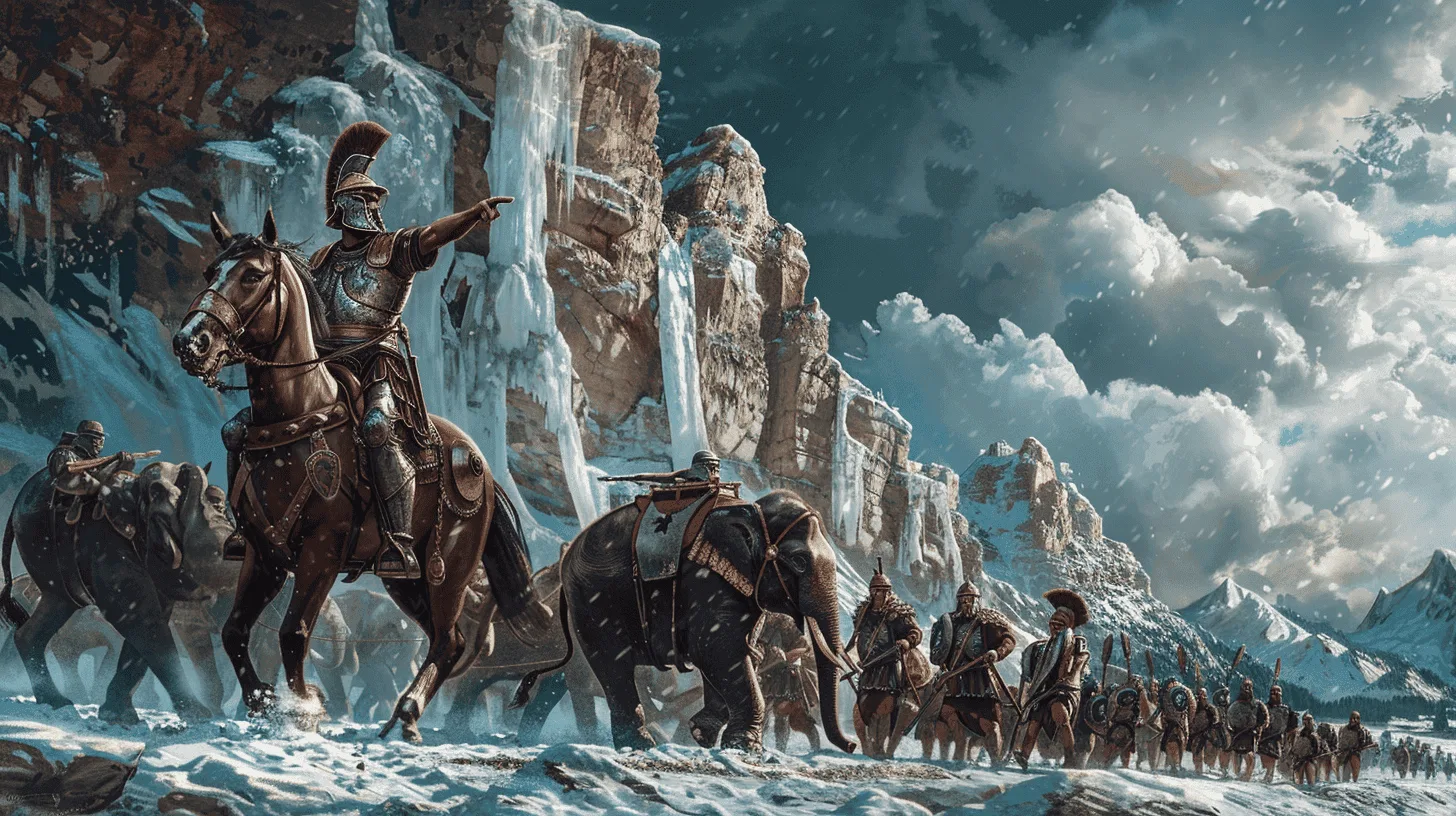
Narrow paths, steep grades, altitude sickness, and freezing weather took a heavy toll. The army climbed through forests and then above the treeline into alpine meadows and eventually snow and ice. The mountain tribes — most likely the Allobroges and other Gallic groups — attacked the column at its most vulnerable points, rolling boulders down from the heights and ambushing the baggage train.
In one famous ambush, tribesmen attacked the Carthaginians in a narrow gorge, rolling rocks and launching javelins from the heights. Hannibal, showing his tactical brilliance, occupied a defensive position for the night, waited for the tribesmen to disperse (assuming the Carthaginians were trapped), then seized the heights at night. He marched his troops stealthily along the ridges and attacked the tribal camps at dawn, clearing the pass and allowing his army to continue.
This engagement demonstrated Hannibal’s ability to turn a tactical crisis into an opportunity, a skill that would serve him well in Italy. It also solidified his reputation among his troops, who saw him leading from the front and personally engaging in the fighting.
Reaching the Summit and the Descent
At the summit, Hannibal famously pointed out the Italian plains to his troops, giving them a vision of their goal. According to Livy, he said: “You are climbing not merely the walls of Italy, but the walls of Rome itself.” He used the strategic vantage point to motivate his exhausted men, showing them the fertile Po Valley spread out below — the objective of their incredible journey.
After two days’ rest, fresh snow covered old ice, making the descent treacherous. The worst disaster occurred on an ice field: men and animals slid uncontrollably down slopes. Hannibal’s engineers had to cut a new path through the rock, reportedly by heating the stone with fire and then pouring vinegar to crack it — a method that has modern experimental support. Archaeologists have found evidence of fire-cracked rock at the Traversette pass consistent with this technique. The process was slow and dangerous, taking several days to create a passage wide enough for the elephants and baggage.
The descent was arguably more dangerous than the ascent. Exhausted, hungry, and suffering from exposure, soldiers and animals fell to their deaths on the icy slopes. The elephants, already stressed by altitude and cold, were particularly vulnerable. Many refused to move forward and had to be coaxed, pushed, and dragged down the mountain.
Losses: The Terrible Price
According to the Greek historian Polybius, Hannibal emerged from the Alps with only about 20,000 infantry and 6,000 cavalry — roughly a 40% loss. Many of the elephants died during or shortly after the crossing. Only one, Surus (meaning “the Syrian”), reportedly survived to fight in Italy. Surus became a legend in the Carthaginian army, said to be the bravest and most intelligent of the elephants. Hannibal used him as a personal mount in battle.
Causes of death included combat with mountain tribes, falls from cliffs, exposure to freezing temperatures, starvation, and the general trauma of the journey. Yet the army held together thanks to Hannibal’s leadership, the shared suffering, and the hope of plunder in Italy. The survivors emerged hardened and loyal, ready to face the Roman legions.
The losses were staggering, but Hannibal had achieved the impossible: he had brought a functioning army across the Alps into Italy, achieving complete strategic surprise. The Roman Republic, confident in its naval superiority and its alliance system, suddenly found a Carthaginian army on its home soil.
Arrival in Italy and the Campaign That Followed
In November 218 BCE, Hannibal’s battered army entered the Po Valley, where Gallic tribes — the Boii and Insubres — flocked to his banner. These tribes had been conquered by Rome within the previous two decades and were eager for revenge. Their support provided Hannibal with fresh troops, local knowledge, and supplies. Within weeks, he fought and won the Battle of Trebia using a hidden flank ambush against the Roman consul Tiberius Sempronius Longus, destroying a Roman consular army. The Romans lost perhaps 20,000 men, while Hannibal’s losses were relatively light.
The battle revealed Hannibal’s mastery of combined arms: his Numidian cavalry harassed the Roman camp, drawing them out into the cold December weather, while his brother Mago led a hidden force that struck the Roman flank at the decisive moment. The Romans, wet and hungry, were routed.
The Battle of Lake Trasimene (217 BCE)
Six months later, in the spring of 217 BCE, Hannibal ambushed a Roman army under Consul Gaius Flaminius near Lake Trasimene in central Italy. Mist and terrain trapped the Romans against the water in a defile between the lake and the hills. Hannibal posted his troops on the surrounding heights and attacked when the entire Roman column was inside the trap. Approximately 15,000 Romans were killed, Flaminius among them. The battle was one of the most successful ambushes in military history — a textbook example of using terrain to negate numerical superiority.
The disaster at Lake Trasimene threw Rome into a panic. The senate declared a state of emergency, appointed Quintus Fabius Maximus as dictator, and ordered the bridges over the Tiber to be cut. For the first time in centuries, Rome faced the real possibility of destruction.
The Masterpiece: Cannae (216 BCE)
At Cannae in southeastern Italy, Hannibal faced the largest Roman army ever assembled — some 80,000 men. The Romans, under the consuls Lucius Aemilius Paullus and Gaius Terentius Varro, decided to fight a decisive battle to destroy Hannibal once and for all. They massed their infantry in a deep formation, hoping to smash through the Carthaginian center.
Hannibal intentionally placed his weakest troops — his Gallic and Iberian infantry — in the center and pulled them back when the Romans attacked, creating a concave crescent. Then he used his strong African infantry on the flanks and his cavalry under Hasdrubal (not his brother, but a different commander) to envelope the Roman force. The result was a double envelopment that annihilated the Roman army. Estimates vary, but up to 70,000 Romans may have died. The Romans found themselves surrounded on all sides, unable to maneuver or fight effectively.
The Battle of Cannae remains a study in tactical perfection, studied at military academies to this day.
Cannae was Hannibal’s greatest victory and one of the most devastating defeats in Roman history. The city of Capua, the second largest in Italy, defected to Hannibal after the battle. Other cities followed. It seemed that Rome’s alliance system was crumbling.
Why Didn’t Hannibal Capture Rome?
Despite these victories, Hannibal never took Rome. He lacked siege equipment, the city was heavily fortified, and he lacked adequate reinforcements. After Cannae, his cavalry commander Maharbal reportedly told him: “You know how to win a victory, Hannibal, but you do not know how to use it.” Hannibal chose not to march on Rome immediately, believing that the city would fall once its allies had abandoned it. But Rome refused to negotiate and would not surrender.
More importantly, Carthage’s government was divided. The oligarchic faction in Carthage, led by Hanno the Great, opposed the war and refused to send adequate reinforcements to Hannibal. They viewed the Barcid family as a threat to their own power and were unwilling to support a campaign they had not authorized. Rome’s control of the sea prevented resupply from Africa or Spain. Hannibal’s brother Hasdrubal led a reinforcing army across the Alps in 207 BCE but was defeated and killed at the Metaurus River before he could join forces with Hannibal.
Moreover, Rome’s Italian allies did not defect en masse. Many remained loyal to Rome, bound by treaties, fear, and self-interest. Rome adopted the Fabian strategy — named after the dictator Fabius Maximus — of avoiding pitched battles and harassing Hannibal’s foragers, slowly grinding him down. This strategy was unpopular with the Roman public, but it was effective. Hannibal could not force Rome into a decisive battle on his terms, and his army was too small to besiege the city.
“You know how to win a victory, Hannibal, but you do not know how to use it.” — Attributed to Maharbal after Cannae
This famous quote captures the central tragedy of Hannibal’s campaign. He was a tactical genius but could not translate his battlefield successes into strategic victory. Rome’s institutional resilience, its willingness to accept staggering losses and refuse negotiation, proved more powerful than any single general.
Rome’s Resilience and Scipio’s Revenge
Rome showed remarkable institutional resilience. Refusing to negotiate or surrender, it raised new armies from its vast manpower pool. Boys as young as seventeen were conscripted, slaves were freed and armed, and even criminals were offered enlistment as an alternative to punishment. The Roman senate, led by Fabius Maximus, maintained a policy of steady resistance.
Rome sent Publius Cornelius Scipio to Spain, where he captured New Carthage and cut off Hannibal’s base of operations. Scipio, who had survived Cannae and learned from Hannibal’s tactics, proved to be the one commander who could match the Carthaginian general. By 204 BCE, Scipio invaded Africa, forcing Carthage to recall Hannibal from Italy after fifteen years of campaigning.
At the Battle of Zama (202 BCE), fought near Carthage, Scipio used Hannibal’s own tactics against him — creating gaps for the Carthaginian elephants to pass harmlessly through his lines, then using his cavalry to envelope the Carthaginian force. Hannibal was defeated for the first time. The battle ended the Second Punic War and established Rome as the dominant power in the Mediterranean. Ancient History Encyclopedia’s Hannibal article provides a good overview of the sources and the broader context.
Evidence and Modern Research
Our knowledge of Hannibal’s crossing comes primarily from two ancient authors: Polybius (a Greek historian who wrote in the second century BCE and personally visited the Alps) and Livy (a Roman historian writing two hundred years later). Both provide detailed narratives, but they disagree on some points—Polybius gives a more sober, logistical account, while Livy offers a dramatic, moralizing story. Both drew on earlier sources that have since been lost, including accounts by Greek writers who accompanied the Carthaginian army.
Archaeological evidence has been scarce, but the Col de la Traversette soil study offers the most compelling physical clue yet. However, some historians argue that the bacteria found could have come from later travelers, and the debate over the route continues. Other researchers have investigated potential routes using GIS mapping, weather data, and ancient climate reconstruction. The Alps in 218 BCE were likely colder than today, with more extensive glaciers and snow cover, making the crossing even more perilous.
Experimental archaeology has also provided insights. In 1959, a British team led by Sir Gavin de Beer recreated parts of the crossing using the Traversette route, demonstrating its feasibility. More recently, historians have studied the fire-and-vinegar method for breaking rock, finding that it can be effective with the right type of limestone. These experiments help us understand not just whether the crossing was possible, but how it was accomplished.
For a deep dive into the primary sources, the Perseus Digital Library edition of Polybius’s Histories provides a searchable Greek text and English translation of the relevant books, allowing readers to evaluate the evidence for themselves.
Why the Crossing Still Matters
Hannibal’s feat remains a landmark in military history. It demonstrates the power of audacity, the importance of logistics, and the limits of tactical brilliance against strategic depth. The crossing is also a timeless symbol of human endurance — a reminder that the supposedly impossible can be achieved with courage, planning, and leadership.
The campaign also reveals something about the nature of ancient warfare: it was not just about battles but about the ability to sustain an army in the field, to maintain alliances, and to outlast an enemy. Hannibal succeeded in the first but failed in the last. Rome’s strategic resilience — its refusal to accept defeat even after Cannae — proved to be the deciding factor in the war.
For modern students, leaders, and strategists, Hannibal’s Alpine crossing offers enduring lessons: sometimes the most dangerous path is the only one that leads to victory. The willingness to attempt the impossible, when combined with thorough preparation and adaptive leadership, can change the course of history. The crossing of the Alps was not the end of the story — it was the beginning of one of the most remarkable military campaigns ever recorded. The cost was terrible, the losses staggering, but the achievement has never been equaled.