Table of Contents
Viking Warfare: The Longship and Tactical Revolution
When Viking longships first appeared off the coast of England in 793 CE, they brought more than raiders—they brought a revolution in military mobility. The longship (langskip) was a masterwork of naval engineering: clinker-built hulls that flexed with waves, a shallow draft of under a meter that allowed navigation up rivers and onto beaches, and reversible symmetry for instant retreat. These ships could carry 70 to 100 warriors deep inland via waterways that coastal kingdoms had considered safe. The raid on Lindisfarne shocked Christian Europe not because of its violence but because of its speed and surprise—qualities that became Viking trademarks.
Viking tactical doctrine emphasized operational mobility and psychological warfare. Raiders gathered intelligence on targets, struck when defenses were weakest, and withdrew before organized resistance could form. They avoided pitched battles against superior forces, instead using rivers as highways to attack undefended interiors. The Siege of Paris in 845 CE, led by the semi-legendary Ragnar Lothbrok, demonstrated this approach: a fleet of 120 ships carried 5,000 warriors up the Seine, and rather than storming the city, they extracted 7,000 pounds of silver to leave—extortion by naval power.
European kingdoms responded with military innovations that reshaped medieval warfare. Alfred the Great of Wessex built a network of fortified towns (burhs) and created a navy specifically designed to counter Viking ships. Frankish rulers constructed fortified bridges across rivers to block inland penetration. The Danegeld system—paying tribute to buy off raiders—was a pragmatic alternative to costly campaigns. These adaptations forced the development of standing armies, professional military forces, and defensive infrastructure that Western kingdoms had previously lacked.
The Norman Synthesis: Warriors Become Conquerors
The most enduring Viking military legacy was not Scandinavian but Norman. In 911 CE, the Frankish king Charles the Simple granted lands along the Seine to the Viking chieftain Rollo. This territory became the Duchy of Normandy—literally “land of the Northmen.” Over three generations, the Norse settlers adopted Frankish language, Christianity, and mounted warfare while retaining Viking aggression and tactical flexibility. The result was a hybrid culture that produced some of medieval Europe’s most effective military forces.
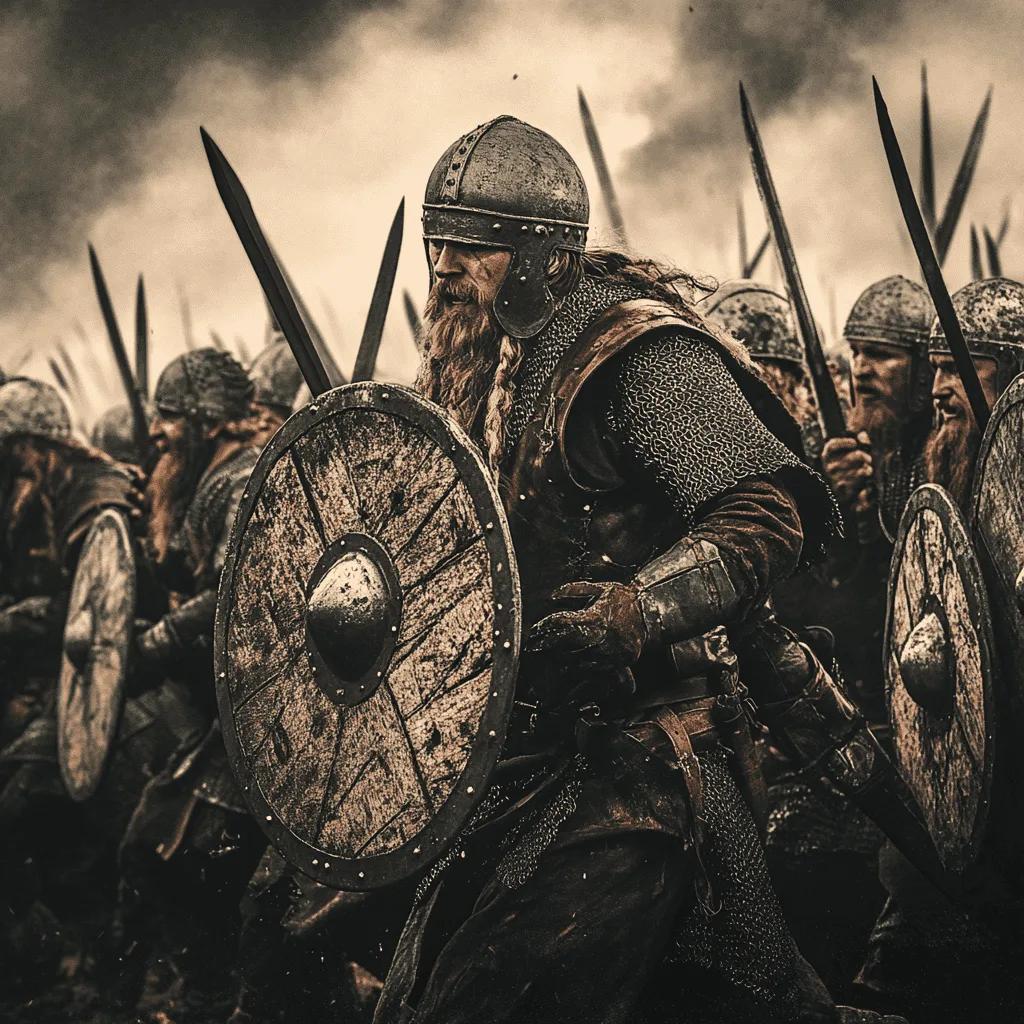
The Battle of Hastings in 1066 showed this synthesis at work. Duke William of Normandy invaded England with a fleet of 700 ships—the largest amphibious operation since Roman times. He transported horses across the Channel, used the classic Viking tactic of feigned retreat to break the Anglo-Saxon shield wall, and combined cavalry, infantry, and archers in coordinated attacks. The Anglo-Saxons, ironically, fought using the shield wall (skjaldborg) formation that Vikings had introduced to England decades earlier. The battle was a contest between two military traditions both shaped by Scandinavian warfare—and whichever side won, a man of Norse ancestry would rule England.
State Building: From Danelaw to Kievan Rus
Viking settlements created political entities that transformed Europe. In England, the Great Heathen Army of 865 CE conquered Northumbria, East Anglia, and Mercia, leaving only Wessex standing. This territory became the Danelaw, where Danish law and custom prevailed. The Danelaw’s significance went beyond conquest: it established a precedent for legal pluralism, stimulated urban development (York, Lincoln, Nottingham, Derby, Leicester—the “Five Boroughs”), and paradoxically spurred the unification of England. To resist the Vikings, the remaining Anglo-Saxon kingdoms under Alfred and his successors had to cooperate, creating a single English kingdom that might never have formed without the external threat.
Meanwhile, Swedish Vikings called Varangians were founding the state of Kievan Rus along the river routes connecting Scandinavia to Byzantium and the Islamic Caliphates. According to the Russian Primary Chronicle, Slavic tribes invited the Varangian leader Rurik to rule them around 862 CE. His successor Oleg captured Kiev in 882, creating a state that controlled trade flowing from the Baltic to the Black Sea. The Rus’ elite eventually adopted Slavic language and Orthodox Christianity—Prince Vladimir I converted in 988 CE—but their Viking origins remained part of dynastic identity. Modern Russia, Ukraine, and Belarus all trace their political heritage to this Norse-founded realm.
In Ireland, Vikings founded Dublin in 841 CE, turning it into a major slave market and trading hub. In France, the Duchy of Normandy became a springboard for further conquest: England in 1066, southern Italy and Sicily between 1061 and 1091, and participation in the First Crusade. The Normans proved that Viking-descended populations could integrate into European civilization while retaining their martial edge.
Trade Networks and Economic Transformation
Vikings were as much merchants as raiders. Their trade networks spanned three continents: eastward via the Rus’ territories to Constantinople and the Abbasid Caliphate, exchanging furs, amber, and slaves for silver, silk, and spices; westward to the British Isles, Frankish kingdoms, and Frisia; and northward into the Arctic for walrus ivory and furs. Silver from Islamic dirhams flooded into Scandinavia—thousands of coins have been found in buried hoards—providing capital that monetized northern economies.
Vikings also founded or developed numerous cities that became permanent commercial centers. Hedeby (in modern-day Germany) was Scandinavia’s largest trading town, with craftsmen producing goods for export and merchants from distant lands maintaining premises. Birka in Sweden connected Baltic and Russian trade. Jorvik (Viking York) grew into one of northern Europe’s largest cities, with a population of 10,000–15,000. These urban centers introduced or expanded commercial culture in regions that had relied on barter and local exchange, laying groundwork for the later Hanseatic League.
Legal and Political Contributions: The Thing
Vikings brought a tradition of democratic assembly that influenced European parliamentary development. The Thing (þing) was a gathering of free men that functioned as legislature, court, and political forum. Local Things resolved disputes and chose leaders; regional Things handled broader matters; and in Iceland, the Althing (established 930 CE) met annually at Þingvellir to legislate, adjudicate legal cases, and elect a Law Speaker who recited the law from memory.
The Althing is often called the world’s oldest parliament. While its functions differed from modern legislatures, it demonstrated that representative governance could operate without a king. The Thing tradition merged with Anglo-Saxon assemblies in the Danelaw, influencing England’s development of jury trial and common law. The modern Scandinavian parliaments—Folketing (Denmark), Storting (Norway), Riksdag (Sweden), and the Alþingi (Iceland)—all trace their lineage to these Viking assemblies.
Viking legal principles emphasized compensation over punishment. The wergild (man-price) system required offenders to pay victims or their families for injuries, restoring social harmony rather than simply exacting retribution. Procedural protections existed: defendants could present evidence, call witnesses, and challenge accusations. The most severe punishment was outlawry, declaring someone outside the law’s protection—a harsh penalty but more humane than the mutilation or execution common elsewhere in medieval Europe.
Cultural Legacy: Language, Literature, and Mythology
Viking settlement left lasting linguistic marks. Approximately 2,000 English words derive from Old Norse, including everyday terms like sky, egg, window, husband, law, wrong, anger, happy, get, take, want. Place names ending in -by (village), -thorpe (hamlet), and -thwaite (clearing) mark former Viking settlements, especially in northern England. The name “Russia” itself comes from “Rus’,” the term for the Swedish Vikings who founded Kievan Rus.
The Icelandic sagas represent one of medieval Europe’s greatest literary achievements. Composed in the 13th and 14th centuries but based on earlier oral traditions, these prose narratives include family sagas like Njál’s Saga and Egil’s Saga, kings’ sagas such as Snorri Sturluson’s Heimskringla, and legendary sagas about heroes like Sigurd the Dragon-Slayer. The sagas pioneered realistic prose narrative, complex characterization, and sophisticated storytelling techniques that influenced later European fiction.
Norse mythology, preserved in the Poetic Edda and Prose Edda, has profoundly shaped modern fantasy literature and popular culture. J.R.R. Tolkien, a professor of Old English and Norse studies, drew directly on Viking sources: the dwarves of The Hobbit are named from the Edda, Gandalf’s name comes from the same source, and the mythology of Ragnarök echoes in his cosmology. Marvel’s Thor, Neil Gaiman’s retellings, and video games like Assassin’s Creed Valhalla and God of War keep Viking mythology alive for contemporary audiences.
Conclusion: The Enduring Transformation
The Viking impact on Europe was not limited to three centuries of raids. It included:
- Military innovation: longships, tactical mobility, and the shield wall that influenced medieval infantry combat
- Political formation: the unification of England, the creation of Normandy, the foundation of Kievan Rus
- Economic integration: trade networks connecting North America to Central Asia, monetization of northern economies, urban development
- Legal contributions: the Thing system, jury trial, wergild, and procedural fairness
- Cultural synthesis: hybrid Norse-Gaelic, Anglo-Scandinavian, Rus’, and Norman cultures that were often more dynamic than their parent cultures
Vikings were not foreign to European development but integral to it. Their violence was real, but it was accompanied by trade, settlement, law-making, and cultural exchange that fundamentally shaped medieval Europe and left legacies still visible today. For further reading, see Britannica’s overview of the Viking Age, World History Encyclopedia’s analysis of Viking trade, and History Today’s examination of Viking politics.
