Table of Contents
Lu Bu's Betrayals and Battlefield Brilliance: Complete Study Guide
Lu Bu's name resonates through Chinese history as one of the most paradoxical figures of the Three Kingdoms era—simultaneously celebrated as the greatest warrior of his generation and reviled as history's ultimate traitor. His story embodies the chaos, ambition, and moral complexity that defined one of China's most turbulent periods. Born around 161 AD during the dying days of the Eastern Han dynasty, Lu Bu possessed exceptional martial prowess but was notorious for his unstable behavior, switching allegiances erratically and freely betraying his allies. His incredible fighting skills on the battlefield stood in stark contrast to his catastrophic failures in leadership and loyalty.
Understanding Lu Bu requires grappling with contradictions: How could someone so talented be so self-destructive? Why did the mightiest warrior of his era die captured and executed like a common criminal? What drove him to betray nearly everyone who trusted him? Lu Bu earned the nickname "Flying General" for his martial prowess and owned a powerful steed known as the Red Hare, giving rise to the famous saying: "Among men, Lu Bu; Among steeds, Red Hare." Yet this same man served and betrayed at least six different masters during his relatively short career.
This guide explores Lu Bu's rise, his infamous betrayals, his tactical brilliance, and his enduring legacy.
Key Takeaways
- Lu Bu is remembered as the most formidable warrior of the Three Kingdoms period, unmatched in personal combat.
- He betrayed and murdered both Ding Yuan and Dong Zhuo, two warlords who treated him as an adoptive son.
- His military genius was undermined by poor political judgment and an inability to inspire lasting loyalty.
- Despite multiple opportunities to establish himself as an independent power, his suspicious nature and erratic behavior led to his downfall.
- Lu Bu was captured and executed by Cao Cao in 199 AD after a siege at Xiapi.
- His legend has been amplified through Romance of the Three Kingdoms and countless adaptations in literature, games, and popular culture.
Historical Context of the Three Kingdoms Era
The Collapse of the Eastern Han Dynasty
The Eastern Han dynasty, which had ruled China for nearly 200 years, crumbled under corruption, factionalism, and incompetence by the late second century AD. Emperor Ling, ineffectual and weak, allowed palace eunuchs to dominate government. The Yellow Turban Rebellion (184 AD), a massive peasant uprising, fatally weakened central authority and empowered regional military commanders. When Emperor Ling died in 189 AD, General He Jin attempted to eliminate the eunuchs but was murdered, leading to chaos. Into this void stepped Dong Zhuo, a brutal warlord who marched his troops into Luoyang and seized control of the government, deposing the designated heir and installing a child puppet emperor.
This was the world Lu Bu entered—one where loyalty meant nothing and power meant everything.
The political vacuum also spawned numerous small warlords competing for territory. The Han court's authority evaporated, and the empire fragmented into shifting alliances and constant warfare. This environment rewarded military talent but also encouraged treachery. Ambitious commanders could gain rapid advancement by serving powerful patrons—and could fall just as quickly if their patrons lost confidence. For a warrior of Lu Bu's caliber, the chaos offered both opportunity and peril.
His decisions would shape the course of the civil war and ultimately seal his fate.
Lu Bu's Origins and Rise
Lu Bu was from Jiuyuan County in Wuyuan Commandery (near present-day Baotou, Inner Mongolia). This frontier region produced hardy warriors familiar with horse archery and nomadic warfare. When Ding Yuan, Inspector of Bing Province, recruited Lu Bu as a Registrar, he treated him kindly, promoting him rapidly. Ding Yuan recognized Lu Bu's exceptional talents, especially his skill in archery and horse-riding. Lu Bu possessed great physical strength, which he demonstrated repeatedly in combat.
The legendary Red Hare horse, described as capable of "galloping across cities and leaping over moats," became inseparable from his identity. His weapon of choice in popular tradition was the fangtian huaji—an ornate halberd combining a spear point with crescent-shaped blades. By 189 AD, Lu Bu was already recognized as one of the finest warriors in the empire, and his reputation spread beyond the northern frontier.
His early career under Ding Yuan gave him military experience and connections. However, his rise was also marked by increasing pride and ambition. Historical records suggest that Lu Bu chafed under Ding Yuan's authority, perhaps seeing himself as undervalued. This sense of entitlement would later make him receptive to Dong Zhuo's bribes and promises. The frontier origins shaped his worldview: direct, violent, and impatient with political subtleties.
He excelled in personal combat but lacked the strategic patience necessary for long-term control.
Cultural Significance and Literary Legacy
Lu Bu's historical importance is amplified by his prominent role in Romance of the Three Kingdoms (14th-century novel by Luo Guanzhong). The novel dramatizes his life, adding fictitious elements like the romance with Diaochan. It popularized the image of Lu Bu as the ultimate warrior, including the famous Battle of Hulao Pass where he single-handedly holds off a coalition of warlords. The story serves as a cautionary tale about talent without character. Lu Bu appears in Chinese opera, video games (especially Dynasty Warriors with the warning "Do not pursue Lu Bu!"), films, and manga such as Record of Ragnarok.
The literary version of Lu Bu has often overshadowed the historical figure. In the novel, his betrayals are motivated by passion and seduction; in history, they were driven by cold calculation. Yet both versions agree on his martial supremacy. The phrase "Among men, Lu Bu; among steeds, Red Hare" has entered common parlance in Chinese culture to denote unmatched excellence. Modern adaptations continue to reinterpret his character, sometimes as an antihero and sometimes as a tragic figure.
His enduring appeal lies in his raw power and fatal flaws—a combination that fascinates audiences worldwide.
The Betrayals That Defined Lu Bu's Legacy
Murder of Ding Yuan
Dong Zhuo, recognizing Ding Yuan's forces as an obstacle to his control of the capital, approached Lu Bu with an offer: kill Ding Yuan and receive command of cavalry forces, wealth, and position. Lu Bu followed through, bringing Ding Yuan's head to Dong Zhuo. This first betrayal established Lu Bu's reputation—someone willing to murder a benefactor for personal advancement. It revealed that no amount of past kindness mattered more than immediate material gain. The political impact was immediate: Dong Zhuo eliminated a rival and gained a fearsome general.
For Lu Bu, the reward was indeed substantial—he received a cavalry command and became Dong Zhuo's trusted enforcer.
Historians note that this murder marked a turning point in Lu Bu's career. He had shown himself capable of the ultimate disloyalty. Other warlords now knew that any alliance with Lu Bu carried immense risk. Yet his military value made him a tempting partner. The pattern was set: Lu Bu would be used, feared, and ultimately discarded.
The killing of Ding Yuan also revealed Lu Bu's short-term thinking. He gained immediate advantage but lost any claim to honor or trustworthiness. In the harsh world of the late Han, reputation mattered as much as force.
Assassination of Dong Zhuo
In 192 AD, Lu Bu turned against Dong Zhuo and killed him after being instigated by minister Wang Yun. Dong Zhuo had showered Lu Bu with honors and sworn to be as father and son. However, the relationship deteriorated due to Dong Zhuo's violent temper—once throwing a lance at Lu Bu. The assassination was dramatic: Lu Bu ambushed Dong Zhuo at the palace entrance, landing the killing blow. The aftermath proved disastrous.
Dong Zhuo's generals counterattacked, and Lu Bu lacked the political skills to consolidate power, fleeing the capital within weeks.
This second betrayal deepened the pattern. Lu Bu had now killed two men who had treated him as an adoptive son. The psychological dynamics are intriguing: Lu Bu seemed unable to sustain relationships with authority figures. He might have feared being dominated or suppressed, leading him to strike first. His alliance with Wang Yun was short-lived because he could not command the loyalty of Dong Zhuo's former officers.
When Li Jue and Guo Si, Dong Zhuo's former generals, marched on Chang'an, Lu Bu's forces melted away. He fled east, carrying only his family and a few loyal followers. The supreme assassin became a fugitive.
Wandering and Rejection: Yuan Shu, Yuan Shao, Zhang Yang
After fleeing Chang'an, Lu Bu sought shelter from various warlords. Yuan Shu refused, disgusted by his betrayals. Yuan Shao accepted him temporarily, and Lu Bu helped fight the Black Mountain Bandits, distinguishing himself greatly. But Yuan Shao grew uncomfortable with Lu Bu's discipline and methods, plotting to kill him. Lu Bu then sought refuge with Zhang Yang in Henei, but could not remain.
His military value could not overcome the liability of his character.
The wandering period (192-195 AD) was the lowest point of Lu Bu's career. He had no territory, no reliable allies, and a reputation that preceded him wherever he went. The historian Chen Shou notes that Lu Bu's martial talents made him a valuable asset, but his unpredictable nature made him a dangerous subordinate. Yuan Shao's attempted assassination forced Lu Bu to become even more cautious and suspicious. He developed a habit of sleeping with guards in rotation and constantly changing his location within a camp.
These survival instincts, however, also prevented him from forming the deep bonds necessary for building a stable power base.
Betrayal of Liu Bei
In 195 AD, Liu Bei, controlling Xu Province, offered refuge to Lu Bu despite his reputation. Lu Bu repaid this kindness by seizing the province while Liu Bei was away campaigning. Later, Lu Bu attacked even the reduced territory he permitted Liu Bei to hold. This betrayal was especially damaging because Liu Bei was known for his virtue. When Cao Cao later captured Lu Bu and considered employing him, Liu Bei reminded Cao Cao of Lu Bu's history of betraying his masters, sealing his fate.
The seizure of Xu Province demonstrated Lu Bu's ambition but also his tactical acumen. He executed a bold coup, taking advantage of Liu Bei's absence. However, he lacked the administrative skill to consolidate control. He soon faced rebellion from within his own ranks and pressure from external enemies. The alliance with Yuan Shu, who had declared himself emperor, further isolated Lu Bu from other warlords.
His decision to attack Liu Bei repeatedly alienated even those who might have sympathized with him. By 198 AD, Lu Bu had painted himself into a corner, with only the city of Xiapi under his control.
Pattern and Meaning
Lu Bu's betrayals followed a consistent pattern: initial trust, rising resentment, sudden violent betrayal, immediate tactical success but long-term strategic disaster, and further isolation. What distinguished Lu Bu was not changing sides—common in that era—but the personal, intimate nature of his treachery. He murdered adoptive fathers and attacked benefactors. His betrayals ensured his destruction; he died alone, captured by subordinates he had alienated.
Looking deeper, Lu Bu's behavior can be seen as a symptom of the era's moral collapse. The late Han dynasty had no stable authority; loyalty was conditional. Yet even by these low standards, Lu Bu stood out. His inability to form lasting alliances crippled him. Modern leadership theory emphasizes the importance of trust and reputation.
Lu Bu possessed neither. His story is a case study in how technical skill cannot compensate for character failure. He had all the tools for greatness except the one that mattered most: the ability to keep faith.
Battlefield Brilliance
The Battle of Hulao Pass
The Battle of Hulao Pass (190 AD) represents Lu Bu at his martial peak. Dong Zhuo abandoned Luoyang, and Lu Bu commanded the rearguard action at Hulao Pass. In the Romance version, Lu Bu challenges the coalition's heroes to single combat. Riding his Red Hare, he defeats multiple champions. Zhang Fei fights him for fifty bouts, then Guan Yu and Liu Bei join, but Lu Bu fights them to a standstill before withdrawing in good order.
This legendary encounter established Lu Bu as operating on a different level from ordinary warriors.
Historically, the engagement at Hulao was less dramatic but still significant. Lu Bu's archers inflicted heavy casualties on the coalition forces, and his cavalry charges kept them from pursuing Dong Zhuo's retreating main army. His personal bravery inspired his troops. The historical record notes that no coalition commander dared to face Lu Bu in single combat. The Records of the Three Kingdoms confirms that Lu Bu's martial reputation was already formidable by this point.
The fiction merely dramatizes what contemporaries already believed: Lu Bu was nearly invincible in personal combat.
Combat Skills and Tactics
Lu Bu specialized in archery and horse-riding, with great physical strength. His archery skills allowed him to kill enemies at range before closing for melee. The Red Hare gave him unmatched mobility. His weapon in tradition, the fangtian huaji, could hook shields and deliver devastating chops. Lu Bu's tactical approach emphasized personal prowess—leading charges personally and targeting enemy commanders.
This approach achieved decisive breakthroughs but did not scale to larger strategic campaigns. He was a warrior, not a general in the fullest sense.
His preferred tactics included rapid cavalry strikes, ambushes, and exploiting terrain. During his service with Yuan Shao against the Black Mountain Bandits, he led only a few hundred horsemen against tens of thousands, but his mobility and shock effect scattered the enemy. At the Battle of Yan Province (194), he used similar tactics to threaten Cao Cao's supply lines. However, he lacked patience for sieges and defensive warfare. When his opponents refused to give battle on his terms, he often became frustrated and made mistakes.
His greatest strength—aggressive personal leadership—was also his greatest weakness.
Famous Battles
Battle of Changshan (193 AD): While serving Yuan Shao, Lu Bu greatly distinguished himself against the Black Mountain Bandits. He led cavalry charges that scattered the bandit formations, killing several of their leaders. This victory made Yuan Shao wary of Lu Bu's power.
Seizure of Yan Province (194 AD): Lu Bu captured most of Cao Cao's province, holding it for nearly two years. His initial success came from surprise and speed. He allied with local rebels and took advantage of Cao Cao's absence on campaign. For a time, Lu Bu controlled a significant portion of the Central Plains.
Defense of Xiapi (198-199 AD): Despite leading over 1,000 cavalry in a sortie, he was defeated and forced to retreat, showing the limits of his personal courage against numerical disadvantage. The siege demonstrated Cao Cao's superior logistics and siegecraft. Lu Bu's horsemen could not break the encirclement, and his supplies dwindled.
Limitations: The Warrior Without Strategy
Lu Bu suffered from critical limitations: inability to build stable coalitions, suspicious nature that prevented delegation, short-term thinking that prioritized immediate advantage over long-term stability, and poor judgment of character. He repeatedly misjudged enemies and allies. The contrast with Cao Cao, who built systems that functioned without his personal presence, illustrates why Lu Bu failed despite his talents.
Cao Cao's success was built on administration: he appointed competent officials, rewarded loyalty, and created institutions. Lu Bu could do none of this. He relied solely on his reputation and personality, which eventually failed him. His subordinates, seeing no future in his service, betrayed him. The lesson is clear: leadership requires more than personal ability.
It requires creating a system that outlasts the leader. Lu Bu built nothing lasting because he trusted no one enough to share power.
Military Equipment and Tactical Innovations
The Red Hare and Cavalry Warfare
The Red Hare (Chu Tu Ma) was more than a mount; it was a weapon system. Contemporary descriptions credit the horse with extraordinary speed and stamina, allowing Lu Bu to outrun pursuers and overtake fleeing enemies. In a period when cavalry was becoming increasingly important, a superior horse gave a decisive advantage. Lu Bu's use of cavalry emphasized shock action—charging into enemy formations to break their morale. He often led from the front, using his personal aura to inspire his men.
His equestrian skills were legendary. He could shoot arrows accurately from horseback, a difficult feat requiring years of training. The combination of the Red Hare, his archery, and his fangtian huaji made him a one-man army on the battlefield. However, he never developed the massed cavalry tactics that later generals would employ. His style was that of a heroic warrior, not a commander of armies.
This limitation became critical when facing disciplined formations like those of Cao Cao and Liu Bei.
Weapons and Armor
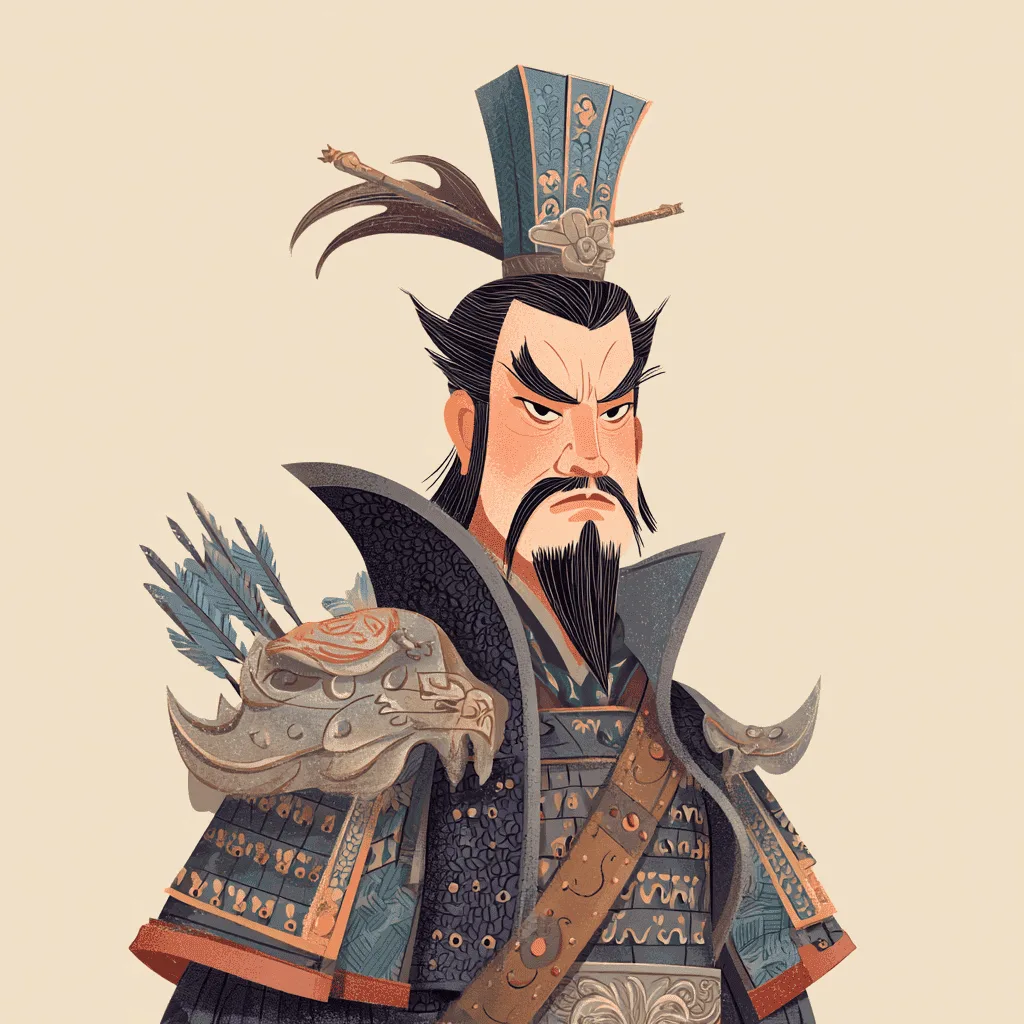
The traditional weapon of Lu Bu, the fangtian huaji (square-sky halberd), was a multi-purpose polearm. It could thrust like a spear, slash like an axe, and hook like a billhook. The crescent-shaped blades allowed a skilled user to disarm opponents or pull them from their horses. Historical records do not specify his exact weapon, but the halberd was common for elite cavalry. His armor would have been lamellar or scale armor, typical of Han dynasty heavy cavalry.
The entire ensemble—horse, armor, weapons—represented the pinnacle of military technology of his time.
His archery was especially feared. During the siege of Xiapi, he shot an arrow through the notch of a halberd to demonstrate his skill and negotiate with Yuan Shu's envoys. This feat, though possibly embellished, indicates his precision was exceptional. His physical strength also allowed him to draw heavier bows with greater range. In an era before firearms, archery skill could decide battles.
Lu Bu's combined arms capabilities—archery, cavalry, and melee—made him a versatile and deadly opponent on any field.
The Downfall: Siege of Xiapi and Execution
Cao Cao's Campaign
By 198 AD, Lu Bu controlled Xu Province from Xiapi. When he allied with Yuan Shu, who had declared himself emperor, Cao Cao allied with Liu Bei to attack. Cao Cao's campaign demonstrated systematic excellence—methodically capturing surrounding territories, cutting supply lines, and diverting rivers to flood the approaches, turning Xiapi into an island. The siege dragged through late 198 and early 199.
Cao Cao's strategy was textbook: isolate the enemy, deny them resources, and exploit internal discord. He did not need to defeat Lu Bu in the field; he only needed to wait. The floodwaters made cavalry sorties difficult and demoralized the defenders. Lu Bu's famed mobility was negated. Cao Cao also used psychological warfare, sending messages to Lu Bu's subordinates offering amnesty in exchange for betrayal.
The siege demonstrated that Lu Bu's tactical genius was useless against a patient, well-organized opponent.
Internal Collapse
Conditions in Xiapi deteriorated. Lu Bu prohibited alcohol to keep his men sober, but three commanders—Hou Cheng, Song Xian, and Wei Xu—resented this. Hou Cheng stole Lu Bu's Red Hare and escaped. The exhausted Lu Bu slept in a guardhouse, where Song Xian and Wei Xu tied him with chains and hoisted a white flag. The supreme warrior was captured while sleeping by his own subordinates.
The betrayal by his own men was fitting poetic justice. Lu Bu had built his career on betrayal; now he fell victim to it. The loss of the Red Hare was symbolic: his speed and power were gone. The commanders who captured him expected mercy from Cao Cao. History does not record their fates, but Cao Cao typically executed traitors.
Lu Bu's end was inglorious—bound and dragged before his enemy.
Cao Cao's Judgment
Brought before Cao Cao, Lu Bu thrashed in chains. He offered to serve Cao Cao, who considered the offer. But Liu Bei intervened, reminding Cao Cao: "Remember what happened to Ding Yuan and Dong Zhuo." That reminder was enough. Cao Cao ordered Lu Bu's execution by strangulation on February 7, 199 AD.
He was approximately 38 years old.
Cao Cao's decision was pragmatic. Despite Lu Bu's offers of service, the risk was too high. Lu Bu had killed two former masters; he could not be trusted. The execution was also a message to other warlords: Cao Cao would not tolerate betrayal. Lu Bu's death removed a major threat but also eliminated a potential asset.
Cao Cao's calculation was correct: Lu Bu could never be controlled. The execution was carried out quickly, without display. Lu Bu's body was buried near Xiapi. His legend, however, would only grow.
Historical Assessments
The historian Chen Shou wrote: "Lu Bu possessed the might of a tiger, but he lacked outstanding and extraordinary strategy; he was treacherous, fickle, and interested only in profit." Lu Bu represents the talented person destroyed by character flaws. His story serves as a cautionary tale about betrayal, a lesson in strategy versus tactics, a character study in self-destruction, and a warning about wasted potential. He had every advantage—exceptional strength, incredible skill, fine equipment, powerful patrons—yet threw it away through choices that any person of moderate wisdom would have avoided.
Modern scholars debate whether Lu Bu could have succeeded under different circumstances. Some argue that his personality was fundamentally incompatible with building trust. Others point to his poor upbringing or the cruelty of the era. Regardless, the consensus remains: Lu Bu was his own worst enemy. His military brilliance could not compensate for his personal failures.
His life is a lesson in the importance of character over talent.
Lu Bu's Enduring Cultural Legacy
Portrayal in Romance of the Three Kingdoms
The novel amplifies Lu Bu's characteristics to legendary proportions: superhuman physical prowess, dramatic betrayals driven partly by the fictional Diaochan romance, and enhanced villainy. The novel established the template for all subsequent depictions. Key elements include the three-on-one duel at Hulao Pass, the shooting of a halberd to demonstrate archery, and the tragic figure blessed with gifts but cursed with flaws.
The Diaochan subplot is entirely fictional but adds emotional depth. In the novel, Lu Bu falls in love with Diaochan, who is actually a pawn in Wang Yun's plan to drive a wedge between Lu Bu and Dong Zhuo. This romantic betrayal makes Lu Bu more sympathetic—he is not just a traitor but a man manipulated by love. The novel uses Lu Bu to explore themes of fate, passion, and the conflict between honor and desire. This fictional version has become the standard in popular culture.
Separating Myth from History
Modern historians distinguish the historical Lu Bu from the fictional counterpart. The Diaochan romance never happened; his motivation for killing Dong Zhuo was simpler. The elaborate duels are dramatized. His character was more complex than pure villainy. The historical context shows many commanders switching allegiances—Lu Bu was not uniquely treacherous but uniquely unsuccessful at betrayal.
Academic works like Records of the Three Kingdoms by Chen Shou remain the most reliable sources. Historians also study the Romance of the Three Kingdoms for its cultural impact rather than its historical accuracy. The gap between history and legend is instructive: it shows how societies reshape historical figures to tell moral stories. Lu Bu becomes an archetype of the flawed hero.
Modern Cultural Impact
Lu Bu's legend has exploded across modern media: Video games like Dynasty Warriors portray him as an overwhelmingly powerful enemy with the warning "Do not pursue Lu Bu!" Total War: Three Kingdoms explores his betrayals as game mechanics. Anime like Record of Ragnarok depicts him as the strongest human in history. Films, television, and academic scholarship continue to examine his life. The saying "Among men, Lu Bu; Among steeds, Red Hare" still resonates.
His image also appears in board games, card strategies, and historical reenactments. The phrase "Do not pursue Lu Bu" from Dynasty Warriors has become an internet meme. In China, he is a subject of both scholarly study and popular fascination. Museums display artifacts from the period, and tourist sites like Hulao Pass draw visitors interested in his story. Lu Bu has transcended history to become a symbol of both martial excellence and moral failure.
Lessons for Modern Audiences
Lu Bu's story remains compelling because it addresses timeless themes: talent versus character, the danger of distrust, the cost of betrayal, wasted potential, and self-destruction. He exemplifies how exceptional ability cannot compensate for moral failure. His suspicious nature created a self-fulfilling prophecy. In an age of shifting loyalties, his story asks when flexibility becomes treachery.
Business and leadership contexts often use Lu Bu as a cautionary example. His inability to build trust ruined his career regardless of his skills. Modern psychology might diagnose him with paranoid tendencies or narcissistic personality disorder. His life is a case study in the importance of emotional intelligence and collaborative skills. Even the most talented person can fail without character.
Lu Bu's tragedy is universal: he could have been great, but he chose to be treacherous.
Comparative Analysis: Lu Bu and Other Three Kingdoms Warriors
Lu Bu vs. Guan Yu
Guan Yu, the deified god of war, is often contrasted with Lu Bu. Both were exceptional warriors, but Guan Yu's loyalty to Liu Bei made him a symbol of righteousness. Where Lu Bu betrayed, Guan Yu remained steadfast. Their fates also differed: Guan Yu died honorably in battle, while Lu Bu was executed as a traitor. The cultural preference for Guan Yu over Lu Bu reflects traditional Chinese values: loyalty outweighs talent.
Guan Yu's shrine is still worshipped; Lu Bu's name is a curse.
Lu Bu vs. Zhang Fei
Zhang Fei was another warrior of immense strength, but his loyalty to Liu Bei never wavered. Like Lu Bu, Zhang Fei had a violent temper, but he channeled it in service of a cause. Lu Bu fought for himself alone. Zhang Fei's death came at the hands of his own soldiers, just like Lu Bu—but Zhang Fei's murder was personal, while Lu Bu's betrayal was institutional. The comparison highlights how even flawed warriors can be redeemed by loyalty to a larger purpose.
Lu Bu vs. Zhao Yun
Zhao Yun, the perfect warrior in Chinese lore, combined martial skill with absolute loyalty. He never betrayed a master and was trusted completely. Zhao Yun's legend is almost the opposite of Lu Bu's: where Lu Bu was feared, Zhao Yun was revered. Both were famous for their horsemanship and bravery, but Zhao Yun's moral clarity made him a hero. Lu Bu's story shows that skill alone does not create a hero—character determines how skill is used.
Conclusion: The Greatest Warrior and the Ultimate Failure
Lu Bu, courtesy name Fengxian, was a military general, politician, and warlord of the late Eastern Han. He betrayed and murdered Ding Yuan and Dong Zhuo, wandered seeking shelter, took control of territories, but was eventually defeated and executed by Cao Cao. His military legacy is undeniable—nicknamed "Flying General," his battlefield achievements set standards for generations. Yet he died captured and executed, betrayed by his own subordinates. The contrast between his battlefield brilliance and personal catastrophe creates a compelling tragedy.
For modern audiences, Lu Bu's story offers cautionary lessons about character, loyalty, and the long-term consequences of short-term thinking. Nearly 1,800 years after his death, he remains unforgettable—both the greatest warrior and the ultimate betrayer. His legacy teaches that true success requires more than strength, skill, or courage—it requires character, judgment, and the ability to build relationships that endure beyond immediate advantage.
Lu Bu's life is a mirror: in his brilliance, we see what humans can achieve; in his failures, we see what we must avoid. He was the flying general who fell to earth, the tiger who could not be tamed, the man who had everything except the one thing that mattered. His story will continue to be told for as long as people wrestle with the tension between talent and virtue.
Additional Resources
- Records of the Three Kingdoms (Sanguozhi) by Chen Shou provides the primary historical account of Lu Bu's life.
- Romance of the Three Kingdoms by Luo Guanzhong offers the classic literary treatment that shaped Lu Bu's cultural legacy.
- Lu Bu on Wikipedia for a comprehensive overview of historical and fictional accounts.
- Britannica entry on Lu Bu for a concise historical biography.
- World History Encyclopedia article on Lu Bu for additional context and analysis.