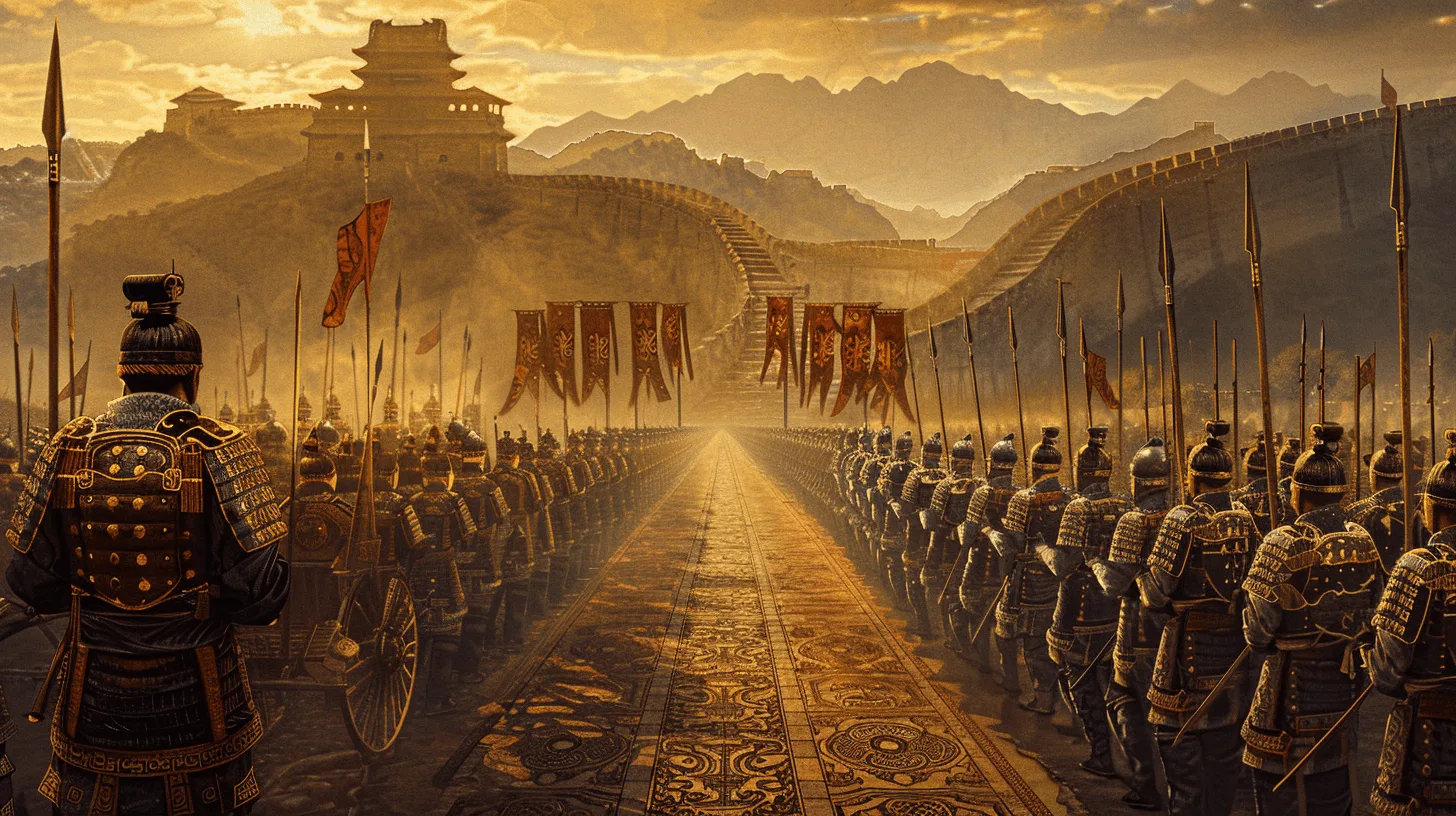
Military Strategy in the Qin Dynasty: How Ancient China's First Empire Conquered Through Discipline and Innovation
The Unification of China Through Military Genius
The Qin Dynasty did not simply field one of the strongest armies in ancient China—they reinvented warfare itself. Between 221 and 206 BCE, this short-lived dynasty accomplished what no other state had achieved: the complete unification of China under a single centralized government. Their success emerged from a careful orchestration of strict military organization, innovative tactics, and ruthless efficiency that permanently transformed Chinese warfare.
Understanding Qin military strategy reveals how disciplined systems, technological advantages, and bold leadership can overcome tremendous odds. The principles they established—centralized command, standardized training, and integration of new weapons technology—became foundational concepts that influenced Chinese military thinking for over two millennia.
This guide explores how the Qin Dynasty's military strategies transformed a regional power into China's first empire, examining battlefield tactics, organizational philosophy, and the systems that underpinned their approach to war.
The Crucible of Constant Warfare
The Warring States Period and Qin's Strategic Position
To understand why Qin developed such formidable military capabilities, one must grasp the chaos from which they emerged. The Warring States Period (475–221 BCE) was China's version of total war—seven major states battling for supremacy after the Zhou Dynasty collapsed.
The State of Qin occupied a strategic western position that initially appeared disadvantageous. Other states viewed them as semi-barbaric outsiders. But this peripheral position became an asset. Qin could expand eastward without worrying about attacks from behind, and their mountainous terrain provided natural defenses. They built strength while rivals exhausted themselves fighting on multiple fronts.
While other states relied on aristocratic warrior traditions, Qin embraced meritocracy and practical innovation. They were the first to fully transition from bronze to iron weapons, giving their soldiers superior cutting power and durability. Their adoption of new technologies—including the crossbow, which could be operated by less-trained soldiers—demonstrated a pragmatic approach that prioritized results over tradition. Qin's armies featured unprecedented scale, mobilizing massive infantry formations numbering in the hundreds of thousands. This shift from aristocratic warfare to mass mobilization fundamentally changed how wars were fought and won.
The Philosophical Foundation: Legalism Over Confucianism
Military strategy during the Qin Dynasty cannot be separated from the political philosophy that shaped it: Legalism. While other states clung to Confucian ideals emphasizing moral leadership and traditional hierarchies, Qin embraced Legalism's harsh pragmatism.
Shang Yang, the statesman who served as Qin's chief reformer in the 4th century BCE, implemented radical changes that militarized the entire society. His reforms replaced hereditary aristocratic privileges with a merit-based system tied to military achievement, divided the population into mutual-responsibility groups, implemented severe punishments for even minor offenses, and rewarded military success with land, titles, and social advancement.
This system rejected the traditional Mandate of Heaven. Instead, Legalism concentrated absolute power in the ruler's hands, backed by an unforgiving legal code. For soldiers, this meant clear incentives and consequences. Perform well in battle, and you could rise from peasant to nobleman. Fail or disobey, and brutal punishment awaited.
Centralized Government and Military Reforms
The transformation of Qin from regional power to empire required administrative innovation. When Ying Zheng (who would become Qin Shi Huang, the First Emperor) consolidated power, he implemented centralized reforms that gave the state unprecedented control over military resources. The central government directly managed recruitment, weapons production and standardization, supply chains, training regimens, and promotion systems based on documented achievements.
This centralization solved problems that plagued earlier Chinese states, where regional commanders might prioritize local interests or rebel. By maintaining tight control over appointments, supplies, and rewards, Qin ensured its armies remained instruments of state policy. The efficiency gains were remarkable. Qin could mobilize, equip, and deploy armies faster than any rival, striking with speed that seemed almost supernatural to their enemies.
The Architecture of Qin Military Power
Legendary Generals Who Shaped an Empire
Behind every successful military system stand exceptional leaders who translate strategy into victory. The Qin Dynasty produced several generals whose names resonate in Chinese military history.
Bai Qi stands out as perhaps the most formidable commander of the Warring States Period. Modern estimates credit him with killing over one million enemy soldiers during his career. His approach combined careful reconnaissance, psychological warfare, and ruthless efficiency. His most famous victory came at the Battle of Changping (260 BCE), where he used deception to lure Zhao forces into a vulnerable position, cut off their supply lines, and starved them into submission. After 46 days, Bai Qi reportedly ordered the execution of over 400,000 captured soldiers, breaking Zhao's military power permanently.
Wang Jian represented a different style of generalship—more cautious and diplomatic, known for negotiating favorable peace terms that converted enemies into allies. His campaigns against the southern state of Chu demonstrated how Qin combined military might with strategic patience.
Command Structure: Hierarchy and Communication
The Qin army's effectiveness depended on a clear chain of command that ensured orders could flow rapidly from generals to front-line soldiers. The army was divided into corps of approximately 12,500 men, divisions of about 2,500, battalions of 500, companies of 100, and squads of 5–10 soldiers who trained and fought together.
This structure solved the ancient problem of coordinating large numbers of soldiers without modern communications. By ensuring each small unit had clear leadership and each leader understood their role, Qin could execute complex maneuvers requiring thousands to act in concert. The system also incorporated standardized signals—drums, flags, and smoke signals—creating a communication network that functioned even when verbal orders were impossible.
The Challenge of Loyalty in a Meritocratic System
Ironically, Qin's greatest strength—promoting based on achievement—created a unique challenge: ensuring commander loyalty. Talented generals who won victories gained fame and armies personally loyal to them, making them potentially dangerous. Bai Qi was eventually ordered to commit suicide by the Qin king who feared his power.
Qin managed this through rotating assignments, political commissars accompanying armies, hostage systems holding generals' families in the capital, and strict legal accountability for unauthorized actions. This kept the army obedient but at a cost: talented commanders sometimes hesitated to seize opportunities for fear of exceeding authority. The tension between empowering leaders and maintaining central control is a challenge that military organizations throughout history have grappled with.
Tactical Innovation and Battlefield Excellence
Combined Arms Warfare
Qin's battlefield success stemmed partly from integrating different military units into cohesive fighting forces. Unlike earlier Chinese warfare dominated by chariot-mounted aristocrats, Qin developed a balanced approach using each unit type for its strengths.
Infantry formed the core—disciplined foot soldiers in large formations armed with spears, polearms, crossbows, short swords, and shields. The shift to infantry-dominant warfare reflected practical realities: infantry could be recruited from the general population and equipped more cheaply than chariots, allowing Qin to field much larger armies.
Cavalry played a supporting but crucial role in reconnaissance, screening friendly movements, harassing enemies, and pursuing routed forces. Chariots evolved into command and transport vehicles rather than primary combat platforms. This combined arms approach meant Qin armies could adapt to different enemies and terrain.
Tactical Doctrine: Speed, Surprise, and Shock
Qin battlefield tactics emphasized speed of execution—rapid decision-making and quick action to create and exploit opportunities before enemies could react. Surprise attacks included night marches, feigned retreats, attacking during seasons when warfare was traditionally suspended, and striking at multiple points simultaneously. Shock tactics aimed for quick, decisive engagements with elite units assaulting key points to create panic. Flanking maneuvers emphasized getting around or behind enemy formations, requiring coordination and good intelligence—both areas where Qin's organization paid off.
Case Study: The Battle of Changping (260 BCE)
The Battle of Changping represents Qin military strategy at its most effective and brutal. The campaign began with Zhao attempting to relieve a besieged city. Qin commander Bai Qi faced capable Zhao general Lian Po, who adopted defensive tactics and refused disadvantageous battles. The campaign stalemated for years.
Bai Qi turned to psychological warfare, spreading rumors in Zhao's capital that their king feared Lian Po was negotiating with Qin. They suggested that only the aggressive general Zhao Kuo could win quickly. The Zhao king, frustrated by the slow campaign, replaced Lian Po with Zhao Kuo—exactly what Bai Qi wanted.
Bai Qi drew Zhao forces into an extended position, then executed a massive flanking movement cutting off their supply lines and retreat. Zhao forces were surrounded for 46 days, slowly starving. Desperate breakout attempts failed. Eventually, Zhao Kuo launched a final assault and was killed. The remaining Zhao soldiers surrendered. Bai Qi reportedly ordered their execution—ancient sources claim 400,000 soldiers were buried alive.
Changping's impact was clear: Zhao never recovered its military power, and other states received an unmistakable message about resisting Qin. The battle demonstrated how Qin combined superior logistics, sophisticated psychological operations, tactical flexibility, and willingness to employ terror as a strategic tool.
Case Study: The Battle of Yique (293 BCE)
The Battle of Yique showcased different aspects of Qin capability. Here, Qin faced a coalition army combining forces from Wei and Han. Commanding Qin forces, General Bai Qi faced an enemy that outnumbered his troops. He used cavalry for aggressive reconnaissance, identifying weaknesses in the coalition's coordination, then conducted a rapid night march to position Qin forces between the two enemy armies. The battle featured shock tactics at their finest, concentrating overwhelming strength against one segment until it routed, then the second retreated. Ancient records claim 240,000 coalition soldiers died.
Yique demonstrated using mobility and night movements for surprise, exploiting coordination difficulties in enemy coalitions, concentrating superior force at decisive points, and making calculated risks based on good intelligence.
The Iron Fist: Discipline, Technology, and Training
Legalist Discipline and Military Law
The harsh discipline that defined Qin society reached its peak in military organization. The reward and punishment system was straightforward: rewards included promotion, land grants, social elevation, and shares of captured wealth; punishments included demotion, physical punishment, execution, collective punishment where entire units suffered for individual failures, and family members held accountable for desertion.
This system created powerful incentives. A peasant conscript could theoretically rise to noble status through military achievement. Collective responsibility proved particularly effective—soldiers in small squads monitored each other since desertion meant punishment for the entire squad. This created intense peer pressure that made running nearly impossible. It worked but at a human cost, creating an environment where every interaction could have legal consequences and reporting on comrades was expected.
Technological Advantages: Iron, Crossbows, and Standardization
Qin's military success relied heavily on technology. The transition from bronze to iron weapons gave greater hardness, more durable edges, and easier large-scale production. Iron could be forged into longer blades without excessive weight.
The crossbow exemplified Qin's pragmatic approach. Unlike traditional bows requiring years of training, crossbows could be operated by relatively inexperienced soldiers after minimal instruction. They offered greater range and penetration, could be loaded and held ready without fatigue, and had a psychological impact from silent, powerful projectiles. Archaeological evidence from the Terracotta Army reveals sophisticated trigger mechanisms with effective ranges exceeding 200 meters.
Standardization of equipment—weapons, armor, even cart axles—dramatically simplified logistics. A commander knew exactly what supplies were needed, and these could be sourced from any production center. This standardization allowed armies to move along roads without worrying about ruts worn by incompatible vehicles.
Comprehensive Training: From Conscripts to Elite Warriors
The Qin army's quality depended on systematic training programs. All able-bodied males faced military service obligations. Basic training included physical conditioning, basic weapon handling, formation drills, and camp discipline. Soldiers drilled regularly under experienced sergeants who had risen through the ranks.
Beyond basic training, soldiers learned hand-to-hand combat techniques—wrestling, knife fighting, and fighting in armor. Specialized units received additional training: cavalry in horsemanship and mounted archery, crossbowmen in maximizing rate of fire, siege engineers in constructing equipment, scouts in navigation and intelligence-gathering.
Qin maintained regular training schedules even during peacetime, keeping skills sharp and maintaining unit cohesion. Veterans mixed with new recruits, passing down practical knowledge. The system created soldiers who might not be individually superior but were collectively more effective due to training, equipment, and organization.
The Terracotta Army: A Window into Military Reality
The famous Terracotta Army, discovered in 1974 near Xi'an, provides extraordinary insights into Qin military organization. Over 8,000 life-sized clay warriors were buried with Qin Shi Huang, individually crafted with remarkable detail. The figures show individual variation within standardization—different facial features, heights, and body types—suggesting that while tactics and equipment were uniform, Qin valued soldiers as individuals. Different armor configurations reveal how equipment varied by role. Variations in clothing and headgear reveal the military hierarchy. The Terracotta Army represents a snapshot of the military system that conquered China. For those interested, the official Terracotta Army Museum site provides detailed information about ongoing excavations.
Strategic Vision: From Regional Power to Universal Empire
The Long Game: Multi-Generational Strategy
Qin's rise resulted from a carefully executed strategy spanning multiple generations. Shang Yang's reforms (356–338 BCE) laid the foundation by transforming Qin into a centralized state organized for war. Subsequent rulers built on this by expanding westward, building infrastructure, developing agriculture, and diplomatically isolating rivals to prevent coalitions. The strategy was essentially: grow stronger while keeping enemies divided.
The Conquest Phase: Eliminating the Six States
When Ying Zheng came to power in 246 BCE at age 13, Qin had already eliminated some rivals. His systematic elimination of the remaining six states showcased strategic warfare on a grand scale. The sequence was carefully planned: Han (230 BCE), Zhao (228 BCE), Wei (225 BCE), Chu (223 BCE), Yan (222 BCE), and Qi (221 BCE). Each victory made the next easier as Qin incorporated new territories and resources.
The Unification Vision
Qin Shi Huang's ultimate goal transcended conquering rivals; he aimed to transform China into a unified empire under centralized control. After conquering rival states, Qin systematically dismantled their aristocracies, destroyed fortifications, and relocated potential troublemakers. The Great Wall served multiple purposes: defense against northern nomads, demonstrating state power, employing massive labor forces, and psychologically defining China's boundaries. Standardization programs imposed uniform weights, measures, currency, and writing systems across conquered territories. The extensive road network designed for rapid military response made rebellion risky.
The Dark Side: Terror, Brutality, and Human Cost
Massacre as Policy
Any honest assessment of Qin military strategy must confront its brutal aspects. Mass executions of captured soldiers were deliberate policy, partly practical—feeding prisoners was expensive—and partly psychological: creating fear that would make future enemies surrender. Qin campaigns often targeted civilian populations, destroying agricultural resources and burning cities. Forced labor on massive projects like the Great Wall kept potentially rebellious populations controlled. The mutual responsibility system created societies based on fear and surveillance where trust between neighbors was systematically destroyed.
Why Qin Fell So Quickly
Despite overwhelming military success, the Qin Dynasty lasted only 15 years after unification. The system was unsustainable: over-mobilization kept armies active and populations on war-footing after unification; brutality bred widespread resentment; no loyalty existed beyond fear since the system relied on force; and elite alienation eliminated traditional power structures without creating new invested groups. The military system's very strengths became weaknesses. Discipline made soldiers obedient but populations resentful. Centralization enabled rapid mobilization but meant quick collapse when the center failed.
Lessons for Modern Understanding
The Qin military story offers cautionary lessons: short-term success does not equal long-term sustainability; fear is a brittle foundation; human costs matter; balance is essential. The Qin Dynasty proves that building the most efficient military machine in the world still fails if that is all you build.
Legacy: How Qin Military Thinking Shaped Chinese History
Han Dynasty and Institutional Continuity
When the Qin Dynasty fell in 206 BCE, many expected China to fragment again. Instead, after a brief civil war, Liu Bang established the Han Dynasty, which ruled for over four centuries. The Han preserved many Qin innovations while softening their harsh edges: centralized military command, standardized equipment, administrative division of territory, infrastructure networks, and merit-based promotion. They replaced Legalism with modified Confucianism, reduced punishment severity, limited conscription, and built loyalty through ideology and benefit.
Lasting Principles in Chinese Military Tradition
Qin established foundational principles: centralized command under imperial control, meritocracy in military advancement, emphasis on logistics and organization, integration of infantry and cavalry, and pragmatism over tradition. These principles persisted through subsequent dynasties and influenced Chinese military thinking for two millennia.
The Great Wall and Defensive Strategy
One of Qin's most visible legacies—the Great Wall—represented a strategic shift toward defending "China proper" rather than unlimited expansion. Later dynasties expanded and rebuilt it, but the concept originated with Qin's vision of creating defensible borders for internal consolidation.
Historical Memory and Modern Interpretation
Qin Shi Huang remains controversial. Traditional historians condemned him as a tyrant; modern assessments recognize his achievements while condemning his methods. Much of what we know comes from the Shiji by Sima Qian during the Han Dynasty, who had reasons to portray Qin negatively. Separating fact from propaganda requires careful analysis, but the impact is undeniable: Qin established the template for imperial China, including military systems that persisted for centuries.
Understanding Qin Military Strategy in Context
The Qin Dynasty's military achievements were extraordinary. In less than a decade, they conquered six rival states and unified China. They built one of history's most efficient military machines, introduced innovations that changed warfare, and established principles that influenced military thinking for millennia. But understanding Qin strategy requires seeing both its brilliance and its brutal limitations.
The key lessons from Qin military strategy include: organization matters—clear hierarchies, standardized training, and systematic logistics create overwhelming advantages; technology can be transformative—adopting new weapons and abandoning traditional methods shifts balances; psychology is warfare—terror generated by reputation was as important as tactical skill; sustainability requires more than force—building an army that conquers is different from building a system that governs peacefully; and context shapes strategy—Qin's approach worked because the Warring States Period rewarded ruthless efficiency.
For modern readers interested in military history, the Qin Dynasty offers a masterclass in success and failure. Their military achievements remind us that systematic organization, disciplined execution, and technological adaptation can overcome tremendous odds. Their rapid collapse reminds us that building something sustainable requires creating systems people want to preserve rather than destroy—not just an efficient war machine.
The terracotta warriors standing silent in their underground chambers serve as an appropriate monument to Qin military power: imposing, impressive, and ultimately frozen in time, unable to adapt. They represent an empire that conquered China but could not hold it, a military system that won every battle but lost the peace.
For further reading, the Cambridge History of Ancient China offers comprehensive scholarly analysis, and World History Encyclopedia's entry on the Qin Dynasty provides accessible context and references.