Table of Contents
The Warrior Diplomat Who Defied an Empire
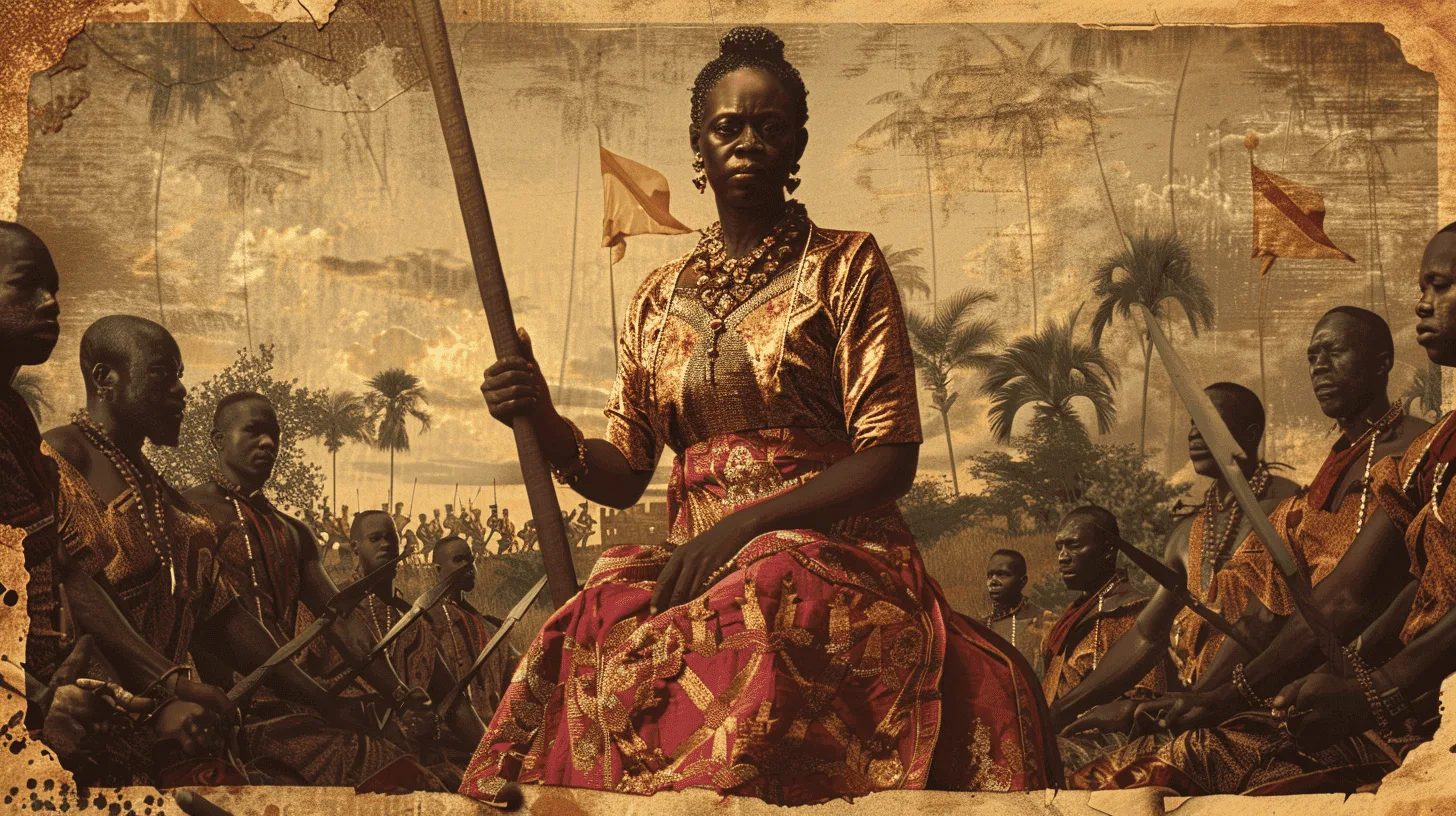
Queen Nzinga of Ndongo and Matamba stands among history's most formidable leaders—a brilliant diplomat, military strategist, and unyielding defender of her people's sovereignty during the 17th century. For nearly four decades, from 1624 until her death in 1663, she orchestrated resistance against Portuguese colonization in what is now Angola, employing sophisticated political maneuvering, innovative military tactics, and strategic alliances that frustrated European ambitions to control Central Africa.
Her story transcends simple narratives of resistance. Nzinga was a complex political actor who navigated the treacherous currents of the Atlantic slave trade, formed alliances with European powers to counter other European powers, adopted and adapted both African and European political symbols, and maintained her kingdoms' independence through an era when most African states were falling to colonial conquest.
Born into royalty around 1583, Nzinga grew up as Portuguese traders and soldiers expanded their presence along the African coast, seeking gold, slaves, and territorial control. She witnessed how Portuguese military pressure and participation in the slave trade devastated African societies, and she spent her life fighting to prevent her people from suffering the same fate. This comprehensive guide explores her extraordinary life—from her early years learning statecraft to her diplomatic missions, her ascension during crisis, her decades-long resistance, and her enduring legacy as a symbol of African defiance against colonialism.
Why Nzinga's Story Matters Today
Queen Nzinga's resistance offers crucial perspectives on African agency during the colonial era. Too often, narratives about European colonization portray Africans as helpless victims swept aside by superior technology and organization. Nzinga's story challenges this narrative, demonstrating that African leaders employed complex strategies—military, diplomatic, and economic—that sometimes succeeded in preserving independence for decades.
Her story also illuminates the Atlantic slave trade's complexity. Nzinga was not simply opposed to slavery—she herself owned slaves and participated in some slave trading. But she fought against Portuguese attempts to enslave her own people and recognized how the slave trade strengthened European power while weakening African societies. This moral complexity reflects historical reality rather than simplified narratives of good versus evil.
For contemporary African identity and independence movements, Nzinga remains a powerful symbol. When Angola finally achieved independence from Portugal in 1975 after a brutal liberation war, leaders invoked Nzinga's resistance as precedent and inspiration. Her image appears on Angolan currency, in monuments, and in cultural celebrations—a reminder that the struggle for independence had deep historical roots. The Encyclopaedia Britannica notes her as one of the most significant figures in African resistance history.
Central Africa in the Age of the Slave Trade
To understand Nzinga's challenge, one must grasp the political, economic, and social landscape of Central Africa during the Atlantic slave trade's expansion.
The Kingdom of Ndongo
The Kingdom of Ndongo (the origin of the name "Angola") occupied territory in what is now northern Angola, south of the Congo River. Founded in the 16th century, Ndongo was one of several kingdoms, including the more powerful Kingdom of Kongo to the north and Matamba to the east. These were sophisticated states with centralized governments, professional armies, complex legal systems, and extensive trade networks handling iron, salt, cloth, and enslaved people captured in warfare.
The region's political landscape was characterized by shifting alliances, tributary relationships, and competition for trade routes and resources. No single power dominated; various kingdoms competed for influence through warfare, marriage alliances, and diplomatic maneuvering. This political fragmentation proved both a weakness and an opportunity when the Portuguese arrived.
Portuguese Arrival and Early Contact
Portuguese explorers first reached Central Africa in the late 15th century, establishing contact with the Kingdom of Kongo in 1483. Initially, relations were relatively peaceful—Portuguese sought trade partners and Christian converts, while African rulers saw opportunities for acquiring European goods and military technology. The Portuguese established a presence in Luanda in 1575, founding what would become Angola's capital and a major slave trading port. Their initial strategy combined trade, missionary activity, and strategic alliances with African rulers willing to cooperate.
But Portuguese ambitions expanded beyond trade. They wanted territorial control, agricultural development, and above all, access to enslaved labor for their Brazilian colony's sugar plantations. The Atlantic slave trade was becoming enormously profitable, and Angola was positioned as a primary source of enslaved Africans shipped to the Americas.
The Slave Trade's Devastating Impact
By the early 17th century, the slave trade was transforming Central African societies in devastating ways. The Portuguese demand for enslaved people incentivized warfare, kidnapping, and social breakdown. African rulers faced difficult choices: participate and acquire guns and European goods, or refuse and risk being conquered and enslaved by neighbors who did participate. The trade disrupted traditional political systems, and the guns acquired through slave trading created military imbalances—those with European weapons could dominate those without, but acquiring weapons required selling people.
The demographic impacts were catastrophic: millions of Africans were forcibly removed, primarily young men in their productive years, weakening states and disrupting agriculture. The Trans-Atlantic Slave Trade Database documents that Angola was one of the most heavily impacted regions, with hundreds of thousands embarked from its ports over the centuries. Entire communities were destabilized, and traditional economic systems collapsed under the pressure of the trade.
Ndongo Under Portuguese Pressure
By the time Nzinga entered political life, Ndongo faced an existential crisis. Portuguese forces, armed with guns and cannons, pressured the kingdom militarily. Portuguese-allied African groups raided Ndongo territories for slaves. The kingdom's economy and social structure were breaking down under the combined pressures of warfare, slave raiding, and Portuguese economic disruption. Ndongo's rulers struggled to respond effectively—military resistance seemed futile, accommodation risked subordination.
The kingdom needed leaders who could navigate this impossible situation with both military skill and diplomatic sophistication.
Nzinga's Early Life and Path to Power
The woman who would become one of Africa's greatest leaders was born into royalty but had to fight for recognition and authority in a male-dominated political system.
Birth and Education
Nzinga Mbande was born around 1583 to Kiluanji kia Samba, the ngola (king) of Ndongo. She was one of several children and grew up in the royal court, receiving education in statecraft, diplomacy, military strategy, and the spiritual practices of her people. Contrary to European assumptions, royal women in Ndongo received serious political education and could wield significant influence as advisors, regents, and occasionally rulers. Nzinga demonstrated exceptional intelligence, ambition, and political acumen from a young age; some traditions suggest she even participated in military training alongside male nobles.
Her early exposure to the workings of power gave her a deep understanding of how politics operated at every level—from the court intrigues of Ndongo to the complex relationships between African kingdoms and European traders. This education would prove invaluable in the decades to come.
Brother's Reign and Crisis
When Kiluanji died around 1617, Nzinga's brother Ngola Mbandi succeeded. His reign was disastrous. Portuguese pressure intensified with military campaigns capturing territory and people. Mbandi proved unable to mount effective resistance—repeatedly defeated militarily and outmaneuvered diplomatically. The kingdom was fracturing, with Portuguese forces occupying strategic positions and tributary chiefs defecting.
Mbandi apparently viewed Nzinga as a threat—some sources suggest he had her son killed to prevent potential rival claims. Yet when he needed a skilled diplomat for crucial negotiations with the Portuguese in Luanda, he turned to his sister. This moment of need opened the door for Nzinga's emergence as a political force in her own right.
The 1622 Luanda Negotiations
In 1622, Mbandi sent Nzinga to Luanda to negotiate with Portuguese Governor João Correia de Sousa. The mission's objectives were survival—securing peace terms that might preserve some Ndongo autonomy and stopping Portuguese military advances. The negotiations showcased Nzinga's political brilliance and have become legendary in African history.
Portuguese sources describe a famous incident: when Nzinga arrived, the governor sat in a chair while offering her only a floor mat—a deliberate slight indicating inferior status. Without hesitation, Nzinga ordered one of her attendants to kneel on all fours, and she sat on the attendant's back, equalizing the seating arrangement and asserting her dignity. This act of quick-thinking defiance demonstrated that she understood European diplomatic protocol and refused to be diminished by it.
During negotiations, Nzinga demonstrated sophisticated understanding of European diplomacy and religion. She agreed to convert to Christianity (taking the name "Ana de Sousa" after the governor's wife who served as her godmother), understanding that this conversion would facilitate diplomatic relations and potentially secure Portuguese recognition of her legitimacy. The resulting treaty recognized Ndongo's independence in exchange for returning enslaved Portuguese deserters and allowing Portuguese missionaries—a reasonable compromise that bought time. The mission established Nzinga's reputation as a skilled diplomat who could negotiate with Europeans as an equal.
Ascension to Power
When Mbandi died in 1624 (possibly by suicide or poison—sources conflict), Nzinga moved quickly to seize power. Officially, she claimed to rule as regent for Mbandi's young son, but she effectively made herself queen, taking the title Ngola (from which "Angola" derives). Her ascension violated some traditional norms—while royal women could wield power, full sovereignty as ngola was typically male.
Nzinga addressed this through multiple strategies: military strength (she commanded loyal forces), diplomatic recognition (she leveraged her previous negotiations and Christian conversion), political reforms (removing rivals), strategic alliances (forming bonds with other kingdoms and Portuguese enemies), and gender performance (sometimes dressing in male clothing and adopting male titles when politically advantageous). Her consolidation was contested, but through political skill, military force, and diplomatic maneuvering, Nzinga established herself as Ndongo's undisputed ruler by the mid-1620s.
Military Resistance and Guerrilla Warfare
Once secure in power, Nzinga immediately confronted the Portuguese threat militarily, developing innovative tactics that frustrated European conquest for decades.
Understanding Portuguese Advantages
Portuguese forces in Angola possessed significant advantages: firearms and cannons gave them ranged firepower that African forces could not match; professional military organization created disciplined units; fortress networks provided defended bases; and African allies gave them local knowledge and additional troops. Traditional African tactics—massed infantry attacks, ambushes, raids—proved inadequate against entrenched positions defended by firearms. Nzinga proved remarkably innovative in developing new approaches.
Guerrilla Tactics and Mobile Warfare
Rather than fighting set-piece battles where Portuguese firepower would be decisive, Nzinga employed guerrilla warfare—hit-and-run tactics, ambushes, attacks on supply lines, and refusal to defend fixed positions where Portuguese artillery could be effective. Her forces operated from bases in difficult terrain—forests, mountains—where Portuguese columns could not easily pursue.
She understood that she did not need to decisively defeat Portuguese forces; she just needed to make conquest too costly and time-consuming to be worthwhile. By maintaining resistance indefinitely, she could preserve independence without winning major battles—a strategy requiring extraordinary endurance, organization, intelligence networks, and political support. Her forces became experts in using the dense Angolan forests for cover, striking quickly at Portuguese supply convoys and isolated outposts before melting back into the wilderness.
The Strategic Retreat to Matamba
By 1626, Portuguese military pressure on Ndongo became overwhelming. Rather than fighting a losing battle for traditional territories, Nzinga made a strategic decision: retreat eastward and conquer the Kingdom of Matamba, establishing a new power base beyond immediate Portuguese reach. This was not a retreat born of weakness but a calculated military maneuver that would extend her resistance for decades.
The conquest of Matamba required military force, diplomatic skill in integrating different peoples, and administrative ability to govern a newly created kingdom. From Matamba, Nzinga could continue resistance while controlling important trade routes, having productive agricultural land, and serving as a refuge for people fleeing Portuguese-controlled territories. Matamba became the center of sustained resistance for decades, and its geography provided natural defensive advantages that Portuguese forces struggled to overcome.
Alliance with the Dutch
In the 1640s, Nzinga formed an alliance with the Dutch West India Company, which had captured Luanda from the Portuguese in 1641. This demonstrated Nzinga's strategic sophistication—she understood European rivalries and leveraged them to her advantage. The Dutch wanted African allies against the Portuguese; Nzinga wanted Dutch military support, particularly firearms and ammunition.
The alliance allowed coordinated attacks on Portuguese positions, with Dutch providing naval and artillery support while Nzinga's forces attacked on land. For several years in the 1640s, it appeared Portuguese might be expelled from Angola entirely. However, the alliance also revealed contradictions: the Dutch were slave traders, and the alliance required Nzinga's cooperation in the slave trade—a morally complicated position reflecting the impossible choices African leaders faced. When the Portuguese recaptured Luanda in 1648, Nzinga lost her most powerful European ally, but her resistance continued.
Adapting to Military Technology
While Nzinga's forces never matched Portuguese firepower, she worked to acquire and effectively employ firearms obtained through trade, capture, and the Dutch alliance. She incorporated combined arms tactics, coordinating infantry, cavalry, and arquebusiers. She also adapted traditional strengths—mobility, knowledge of terrain, espionage networks—to counter Portuguese advantages. This sophistication challenges stereotypes about African military backwardness and demonstrates that Nzinga was a genuinely innovative military commander.
Diplomatic Maneuvering and Political Strategy
Nzinga's military resistance was complemented by sophisticated diplomatic efforts that kept her enemies off-balance and her allies engaged.
Manipulating European Rivalries
The 17th century saw European powers competing for colonial dominance—Portuguese versus Dutch, later involving Spanish, French, and British interests. Nzinga skillfully exploited these rivalries, forming alliances with Portugal's enemies. Her Dutch alliance was most significant, but she also maintained contacts with other European powers, playing them against each other. This required sophisticated understanding of European politics and motivations—knowledge she had been accumulating since her first diplomatic mission in 1622.
Negotiations and Treaties
Despite decades of warfare, Nzinga engaged in periodic negotiations with the Portuguese, signing treaties when circumstances warranted. A major peace treaty in 1656 ended decades of hostilities. Nzinga agreed to return Portuguese prisoners and deserters, allow Christian missionaries, and recognize Portuguese presence. In exchange, Portuguese recognized Nzinga's sovereignty over Matamba and ceased military operations. Some interpret this as surrender; others view it as Nzinga securing her goals—recognized independence and protection of her people from enslavement.
The treaty represented a pragmatic acknowledgment that neither side could achieve total victory.
Religious Conversion and Strategic Christianity
Nzinga's relationship with Christianity was complex and strategic. Her 1622 conversion facilitated negotiations, but her commitment wavered based on political needs. She sometimes emphasized Christianity when dealing with Europeans, sometimes returned to traditional African practices. This religious flexibility frustrated missionaries but demonstrated her sophisticated understanding of religion's political uses. Later in life, particularly after the 1656 treaty, she appeared to embrace Christianity more seriously—whether genuine conversion or political calculation remains debated by historians.
Managing Internal Opposition
Maintaining power through decades of warfare required managing internal opposition. Some nobles opposed her rule on gender grounds or political disagreements. She employed various strategies: placing loyal supporters in key positions, forming marriage alliances, demonstrating military success, and using strategic force when necessary. Her longevity in power—ruling from 1624 to 1663—testifies to her political skills and her ability to maintain the loyalty of her people despite enormous external pressures.
The Atlantic Slave Trade and Moral Complexity
Nzinga's relationship with the slave trade reveals the moral ambiguities inherent in her position and the impossible choices African leaders faced during this period.
Participating While Resisting
Nzinga both participated in the slave trade and fought against it—a contradiction requiring contextual understanding. She owned slaves, sold some to European traders, and used slave labor. Simultaneously, she fought to protect her people from Portuguese enslavement and recognized the trade's destructive impact. This reflects the constrained choices available: complete rejection meant forgoing firearms and diplomatic relationships; participation meant complicity in a devastating system.
She distinguished between enslaving outsiders (prisoners of war captured in legitimate conflicts) versus protecting her own subjects—a distinction with traditional precedent in African societies. However, the Atlantic trade's enormous scale meant that any participation strengthened the system that was destroying African communities. This moral tension cannot be easily resolved and speaks to the tragic nature of the choices forced upon African leaders during the slave trade era.
Economic Alternatives and Resistance
Nzinga attempted to develop economic alternatives to slave trading—promoting agriculture, controlling trade routes in non-human goods, and developing internal manufacturing. These efforts had limited success given the Atlantic trade's overwhelming profitability. Some historians argue that African leaders who understood the trade's destructive nature but could not completely escape it deserve sympathetic understanding. Others argue that participants share moral responsibility regardless of circumstances. This debate reflects broader questions about individual moral agency within unjust systems—questions that remain relevant today.
Queen Nzinga's Final Years and Death
After decades of warfare, Nzinga's final years brought a measure of peace and an opportunity to consolidate her life's work.
The 1656 Peace Treaty
The 1656 treaty effectively ended the long military struggle. Both sides were exhausted—Portuguese had failed to conquer Matamba despite decades of effort, while Nzinga's people suffered from constant warfare. The treaty preserved Matamba's independence while normalizing relations. Some historians view this as recognition that Nzinga had achieved her primary goal; others see it as compromise reflecting her inability to completely expel the Portuguese. Both interpretations contain truth.
What is indisputable is that Nzinga had accomplished what few African leaders managed: she had fought a European colonial power to a standstill and secured terms that recognized her sovereignty.
Religious Deepening and Legacy Planning
Nzinga's final years saw apparent deepening of Christian faith. She invited Capuchin missionaries, built churches, attended masses regularly, and enforced Christian practices in her court. Whether this was genuine spiritual transformation or deathbed insurance is unknowable. She also worked to secure succession, though accounts conflict about her designated heir. What is clear is that she remained politically active and engaged until the end of her life.
Death and Immediate Succession
Nzinga died on December 17, 1663, at approximately 80 years old. She had ruled for 39 years, fought the Portuguese for decades, and maintained her kingdom's independence. After her death, Matamba's stability declined; her successors lacked her political skills, and internal disputes weakened the kingdom. Portuguese gradually increased influence, though Matamba maintained formal independence for decades. Her death marked the end of the most effective African resistance to Portuguese colonization in Angola, but her legacy would only grow in the centuries that followed.
Legacy and Historical Memory
Nzinga's legacy evolved dramatically across centuries, reflecting changing political contexts and historiographical approaches.
Colonial Period Memory
During Portuguese colonial rule of Angola (1575-1975), colonial authorities downplayed or denigrated Nzinga's resistance. Portuguese histories portrayed her as a barbaric savage or curiosity—minimizing her achievements. Among Angolan peoples, oral traditions preserved Nzinga's memory as a hero who fought for independence, keeping her legacy alive despite colonial efforts to erase it.
Angolan Independence Movement
When Angolan nationalist movements emerged in the 20th century, they invoked Nzinga as a historical precedent for resistance. Independence leaders like Agostinho Neto explicitly connected their struggle to Nzinga's earlier resistance. When Angola achieved independence in 1975, the new government celebrated Nzinga as a founding figure of national identity. Her image appeared on currency, stamps, and monuments across the country.
Pan-African and Black Diasporic Memory
Beyond Angola, Nzinga became important to pan-African movements and African diaspora communities seeking historical examples of Black resistance. Her story offered evidence that Africans had fought colonialism from its beginning. The Schomburg Center for Research in Black Culture and other institutions have featured Nzinga prominently, recognizing her significance for understanding African history and continuing struggles against colonialism and racism. In Brazil and other parts of the African diaspora, her memory has been kept alive through cultural traditions and scholarly work.
Feminist Interpretations
Feminist historians have claimed Nzinga as an important example of women's leadership and resistance to patriarchal constraints. Her navigation of gender expectations while maintaining political power offers insights into how women leaders can operate effectively in male-dominated contexts. Debates continue about whether emphasis on her gender risks minimizing her broader achievements, but there is no doubt that her example has inspired generations of women seeking historical role models.
Academic Reassessment
Modern academic historians have worked to develop more nuanced understanding of Nzinga that moves beyond either colonial denigration or uncritical celebration. Recent scholarship emphasizes her strategic sophistication, her complex relationship with the slave trade, the importance of African agency, and the need to understand her within Central African political contexts. This reveals a more complex figure—a skilled leader making difficult decisions under extreme pressure, achieving remarkable successes while also making moral compromises. The Oxford Bibliographies entry on Nzinga provides an excellent overview of the scholarly literature.
What We Can Learn from Queen Nzinga's Story
Beyond historical fascination, Nzinga's story offers insights relevant to contemporary leadership, resistance movements, and understanding colonialism's complexity.
Leadership Under Impossible Constraints
Nzinga faced military disadvantages, gender discrimination, economic pressures from the slave trade, internal opposition, and an enemy with superior technology. Yet she maintained effective leadership for four decades by combining military resistance, diplomatic maneuvering, strategic alliances, religious adaptability, and political reforms. Leaders facing overwhelming challenges can learn that success often requires employing every available strategy rather than relying on a single approach.
The Complexity of Resistance
Nzinga's resistance was not pure or uncomplicated. She participated in the slave trade she fought against, made moral compromises, and sometimes cooperated with enemies. This complexity challenges simplistic narratives about resistance being always clear-cut or morally pure. Real resistance often involves compromise and impossible moral choices—acknowledging this makes historical understanding more honest and useful.
Gender and Power
As a woman leader in a patriarchal context, Nzinga developed sophisticated strategies for exercising authority despite gender constraints. Her example demonstrates that marginalized leaders can exercise power effectively by strategically navigating constraints rather than directly confronting all barriers simultaneously. She adapted her gender presentation, her use of titles, and her leadership style to suit different political contexts—a flexibility that modern leaders can still learn from.
The Long-Term Effects of the Slave Trade
Nzinga's story illuminates how the Atlantic slave trade devastated African societies. Even leaders who recognized its destructive nature could not escape participating because economic and political pressures were overwhelming. Understanding this helps explain why the trade persisted for centuries and why it had such catastrophic impacts on African political and social development. The scars of this history remain visible in contemporary Angola and across the African continent.
Historical Memory and National Identity
How Nzinga is remembered has changed based on political contexts—colonial authorities minimized her, independence movements celebrated her, contemporary scholarship complicates her. This evolution demonstrates how historical memory serves contemporary political and cultural needs rather than simply recording the objective past. Understanding this process helps us think critically about how history is constructed and whose stories are told.
Frequently Asked Questions About Queen Nzinga
Was Queen Nzinga really as militarily successful as legends suggest?
Nzinga achieved significant military successes—maintaining independence for decades, inflicting casualties on Portuguese forces, and preventing conquest of Matamba. However, she never decisively defeated Portuguese militarily and eventually negotiated peace from mutual exhaustion rather than clear victory. Her military achievements were real but should be understood as successful resistance and survival rather than total victory. Given the enormous power imbalance she faced, her accomplishments were remarkable by any standard.
Did she really sit on an attendant during negotiations?
This famous story appears in multiple Portuguese sources from the period, suggesting it likely occurred. However, exact details may have been embellished over time. What is clear is that Nzinga understood symbolic politics and used ceremony strategically to assert her status as equal to Portuguese authorities. The story has become emblematic of her refusal to accept subordination.
How should we understand her participation in the slave trade?
This remains one of the most morally complex aspects of her legacy. Nzinga participated in slavery while fighting to protect her people from enslavement. She faced impossible choices where complete rejection meant forgoing resources necessary for survival. Historical understanding requires acknowledging this complexity without making easy judgments from the comfort of the present.
Was she actually Christian or was her conversion purely strategic?
This is impossible to answer definitively. Her initial conversion was clearly strategic; her later life showed more consistent Christian practice, suggesting possible genuine faith. Most likely, her relationship with Christianity evolved over time, mixing strategic calculations with sincere spiritual engagement. The question itself may reflect assumptions about religious identity that do not fully apply to her context.
What happened to Matamba after her death?
Matamba maintained formal independence for several more decades but gradually weakened under less capable successors. Portuguese influence increased through economic penetration and indirect political control. By the 18th century, Matamba had lost effective sovereignty. Nzinga's achievements proved difficult to sustain without her particular combination of skills and determination.
How is she remembered in modern Angola?
Nzinga is a national hero in Angola, celebrated as a founder of Angolan resistance to colonialism. Her image appears on currency, in monuments, in school curricula, and in cultural celebrations. However, academic historians also recognize the complexity of her legacy, including her participation in the slave trade. She remains a figure of both pride and reflection.
A Leader Who Refused to Surrender
Queen Nzinga of Ndongo and Matamba stands as one of history's most remarkable leaders—a brilliant diplomat who negotiated with European powers as an equal, a skilled military commander who frustrated Portuguese conquest for decades, and a determined monarch who preserved her people's independence through an era when most African societies were falling to European domination. Her four-decade reign demonstrated that African leaders could match European opponents in political sophistication, military strategy, and diplomatic skill.
But Nzinga's legacy is complex and sometimes contradictory. She fought against Portuguese enslavement while participating in slavery. She employed Christianity strategically while maintaining traditional practices. She challenged gender norms while sometimes adopting male symbols. She achieved remarkable successes while making moral compromises that complicate simple heroic narratives.
This complexity makes her more interesting and instructive than simplified versions would suggest.
Nearly four centuries after her death, Queen Nzinga remains a powerful symbol—of resistance against oppression, of African political sophistication, of women's leadership, and of the difficult choices leaders face when confronting overwhelming power. In the end, her greatest achievement may have been simply this: she refused to surrender. For forty years, despite every pressure, every military defeat, every impossible circumstance, she maintained resistance and preserved her people's independence. That determination remains her most enduring legacy.