Table of Contents
Introduction
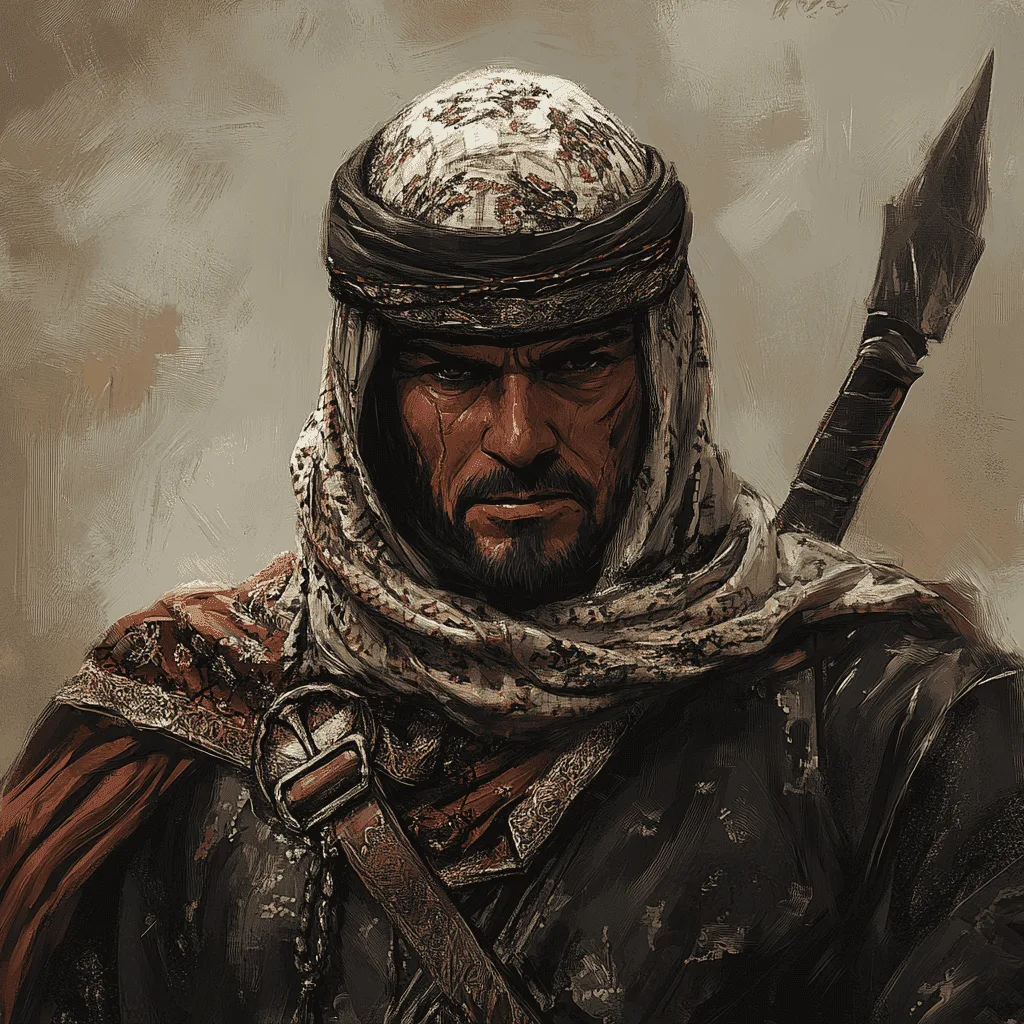
Saladin, born Ṣalāḥ ad-Dīn Yūsuf ibn Ayyūb in 1137 CE, remains one of the most revered figures in medieval history. As the founder of the Ayyubid Sultanate, this Kurdish warrior-statesman reshaped the political order of the Middle East during the Crusades. His recapture of Jerusalem in 1187 CE sent tremors through Christian Europe and established him as Islam’s most formidable defender against Western invasion.
What makes Saladin’s story so compelling is not merely his military genius—it is the rare fusion of battlefield prowess and moral leadership that earned him admiration from both allies and adversaries. Medieval European chroniclers, even while recording his victories over Christian armies, praised his chivalry and sense of justice. This warrior sultan, who defeated the Crusaders, paradoxically became a symbol of honor in Western literature, appearing in Dante’s Divine Comedy and later in Sir Walter Scott’s novel The Talisman.
Today, Saladin’s legacy resonates across cultures and centuries. His life offers enduring lessons in leadership, strategic thinking, religious tolerance, and the power of uniting divided people toward a common purpose. Understanding who Saladin was means exploring not just the battles he won, but the principles he embodied and the lasting impact he made on world history. In an age defined by political fragmentation and religious conflict, his example of combining military effectiveness with ethical governance remains strikingly relevant.
The Early Life of Saladin: From Scholar to Soldier
Birth and Family Background
Born in 1137 CE in Tikrit, Iraq, Saladin came from a noble Kurdish family enmeshed in the military and political networks of the medieval Islamic world. His father, Najm ad-Din Ayyub, served as governor of Tikrit under the powerful Zengid dynasty, which controlled vast portions of Syria and Mesopotamia. This privileged upbringing gave young Saladin access to both military training and scholarly education—a combination that would prove essential to his future success.
The family’s fortunes shifted when they relocated first to Mosul and then to Damascus, centers of Islamic culture and learning. Unlike many sons of military families who eagerly pursued warfare, the young Saladin displayed a contemplative nature. Historical sources describe him as deeply interested in Islamic theology, philosophy, and Persian poetry. He spent considerable time studying religious texts and engaging with scholars, building the intellectual foundation that would later inform his governance. His love for poetry and learning remained with him throughout his life; even during military campaigns, he was known to carry books and engage in scholarly discussions with his court.
Education and Early Influences
This scholarly inclination set Saladin apart from typical military commanders of his era. While he would become one of history’s greatest generals, his education in Islamic jurisprudence and ethics shaped his approach to leadership. The emphasis in Islamic teachings on justice, mercy, and proper conduct became core principles that guided his treatment of both subjects and enemies throughout his career. He studied under prominent scholars in Damascus, absorbing traditions from the Sunni legal schools, particularly the Shafi’i school, which stressed the importance of consultation and consensus.
The political environment of his youth also left a deep impression. Saladin grew up witnessing the fragmentation of the Muslim world after the First Crusade. The Crusader states carved out in the Levant survived largely because Muslim rulers fought among themselves. This lesson never left him: the key to defeating the Crusaders lay in unity. His later campaigns to bring Egypt and Syria under a single banner were driven by this strategic vision.
Mentorship Under Shirkuh
Saladin’s transformation from scholar to soldier came through his uncle, Asad ad-Din Shirkuh, a renowned general serving Nur ad-Din, the Sultan of Syria. Shirkuh recognized potential in his nephew and took him under his wing, teaching him the arts of warfare, strategic thinking, and military leadership. This mentorship proved invaluable—Shirkuh was one of the era’s most skilled tacticians, and his lessons formed the bedrock of Saladin’s military education. Saladin accompanied his uncle on campaigns in Syria and learned how to manage logistics, inspire troops, and negotiate with hostile tribes.
The political landscape of the 1160s created urgent opportunities for ambitious military leaders. Egypt, ruled by the declining Shi’a Fatimid Caliphate, had become a prize coveted by multiple powers: the Sunni Zengids of Syria, the Latin Crusader kingdoms, and various internal Egyptian factions. Recognizing Egypt’s strategic importance, Nur ad-Din dispatched Shirkuh to secure the region for the Zengid dynasty. In 1164 CE, Saladin accompanied his uncle on the first of three military expeditions to Egypt. These campaigns were brutal and complex, involving pitched battles against Crusader forces as well as cunning political maneuvers inside the Fatimid court.
The Rise to Power: Egypt and the Founding of the Ayyubid Dynasty
The Egyptian Campaigns and Becoming Vizier
These campaigns exposed the young soldier to the complexities of medieval warfare—not just battlefield tactics, but also the intricate political maneuvering required to navigate competing interests. Egypt’s political instability created a volatile environment where military skill alone was insufficient; success demanded diplomatic acumen, strategic patience, and the ability to build coalitions among fractious groups. Saladin observed how Shirkuh balanced the demands of the Fatimid caliph, the intrigues of the Egyptian court, and the pressure from Crusader raids.
The turning point came in 1169 CE following Shirkuh’s unexpected death shortly after being appointed vizier of Egypt. To everyone’s surprise, the 31-year-old Saladin was elevated to the position of vizier by the Fatimid Caliph Al-Adid. This appointment placed a Sunni outsider at the head of a predominantly Shi’a government—a precarious position that required extraordinary political skill to maintain. Saladin faced immediate challenges from the Fatimid court, Crusader forces, and his nominal overlord Nur ad-Din in Syria. Historians debate whether the Fatimid caliph genuinely believed Saladin was weak and easily manipulated, or whether he saw Saladin as a temporary solution to a crisis.
Regardless, Saladin quickly proved himself anything but weak.
Consolidating Control and Abolishing the Fatimid Caliphate
Over the next two years, Saladin executed a masterful consolidation of power. He systematically replaced Fatimid military commanders and administrators with his own loyal followers, primarily Kurds and Turks who owed allegiance to him personally. He strengthened Egypt’s defenses against Crusader attacks while carefully managing his relationship with Nur ad-Din. He also won over the Egyptian populace by reducing oppressive taxes and restoring order after years of instability. When the aging Caliph Al-Adid died in 1171 CE, Saladin made his decisive move.
Rather than appointing a new Fatimid Caliph, Saladin abolished the Fatimid Caliphate entirely, declaring Egypt’s allegiance to the Abbasid Caliphate in Baghdad. This bold action brought Egypt back into the Sunni fold, legitimized his rule under Abbasid authority, and effectively made him the independent ruler of Egypt. The Ayyubid Dynasty had begun. However, this independence created tension with his former lord Nur ad-Din, who now saw Saladin as a rival rather than a loyal vassal. Nur ad-Din prepared to march on Egypt, but his sudden death in 1174 CE removed the threat and opened a new phase in Saladin’s career.
Uniting the Muslim World: A Decade of Strategic Campaigns
The Challenge of Fragmentation
With Egypt secured as his power base, Saladin turned his attention to a more ambitious goal: unifying the fragmented Muslim territories to mount an effective resistance against the Crusader states. Since the First Crusade (1096-1099 CE), Christian forces had established four major states in the Levant: the Kingdom of Jerusalem, the Principality of Antioch, the County of Edessa, and the County of Tripoli. These Crusader states survived largely because Muslim rulers remained divided, often fighting each other rather than the common enemy.
Nur ad-Din’s death in 1174 CE created the opportunity Saladin had been waiting for. He marched north from Egypt and captured Damascus without bloodshed in November 1174, presenting himself as the rightful heir to Nur ad-Din’s anti-Crusader mission. The people of Damascus, recognizing his military strength and religious legitimacy, welcomed him. This was a crucial psychological victory: Damascus was the historic capital of the Muslim resistance to the Crusades, and controlling it gave Saladin immense prestige.
Key Campaigns Against Zengid Rivals
The following decade saw Saladin engaged in what historians call his “wars of unification”—campaigns against fellow Muslim rulers who resisted his authority. He portrayed himself not as a conqueror but as a unifier preparing the Muslim world to reclaim Jerusalem. His campaigns targeted Aleppo (1174-1183) in a prolonged struggle against Zengid rivals, and Mosul and northern Mesopotamia (1182-1186) to secure his eastern flank and gain control of vital resources.
These campaigns were not easy. The Zengid dynasty in Aleppo, led by Nur ad-Din’s son as-Salih, fiercely resisted unification. Saladin besieged Aleppo multiple times but lacked the heavy siege equipment to breach its formidable walls. He eventually resorted to blockade and diplomacy, gradually isolating the city. He also faced challenges from the Assassins (the Nizari Ismailis), who attempted to assassinate him on several occasions.
Saladin responded with a punitive campaign against their mountain fortresses, though ultimately he reached a modus vivendi with them.
Throughout these campaigns, Saladin demonstrated the strategic patience that characterized his leadership. Rather than destroying rival Muslim armies completely, he often incorporated defeated forces into his own military, turning former enemies into allies. He used marriage alliances to cement political relationships—he himself married the widows of defeated rulers to bind their families to his. He recognized the Abbasid Caliph’s authority to gain religious legitimacy, always framing his wars as holy jihad against the Crusaders, not mere territorial ambition. By 1186 CE, he controlled a unified realm stretching from Egypt through Arabia and Syria to Mesopotamia.
The Battle of Hattin: The Masterstroke That Changed the Holy Land
Strategic Context and Provocation
For nearly ninety years, Jerusalem had remained under Christian control following the brutal conquest of 1099 CE. As the third holiest site in Islam, Jerusalem held immense religious and symbolic significance. Saladin recognized that conventional siege warfare against the Crusaders’ castle network would drain his resources without achieving decisive results. He needed to force the Crusader army into open battle on terrain favoring his mobile cavalry forces. His strategy required patience, perfect timing, and the ability to lure the enemy into a trap.
The opportunity came when Raynald of Châtillon, a reckless Crusader lord, attacked a Muslim caravan in 1187, defying a truce that had been in place. Raynald had a long history of provocative attacks against Muslim traders and pilgrims. Saladin swore an oath to kill Raynald with his own hands. This violation gave Saladin the justification he needed to launch a full-scale invasion. He assembled a massive army from across his domains, numbering perhaps 30,000 men, including light cavalry, archers, and infantry.
The March into the Trap
Saladin’s strategy unfolded in carefully orchestrated phases. First, he attacked the castle of Tiberias, held by Raymond of Tripoli’s wife, provoking the honor-bound Crusader knights into action. King Guy of Lusignan, pressured by impetuous nobles—particularly Raynald and the Grand Master of the Templars—ordered the entire Crusader army to march from Sephoria toward Tiberias. The army numbered approximately 20,000 men including 1,200 heavily armored knights. Once they committed to the march, Saladin executed his masterstroke.
Muslim cavalry harassed the column continuously, preventing them from reaching water sources in the July heat. Archers shot into the packed ranks while light horsemen feigned attacks then retreated, drawing the Crusaders into disarray.
As the exhausted Crusaders approached the Horns of Hattin—twin hills overlooking the Sea of Galilee—they realized they had been outmaneuvered. Saladin’s forces controlled all nearby water sources. The Crusaders spent a torturous night on the arid plateau, desperately thirsty, demoralized, and increasingly aware they had marched into a trap. Saladin even ordered his men to set fire to the dry brush on the hillsides, creating smoke that further tormented the parched Christians. At dawn on July 4th, Saladin’s forces attacked from all directions.
Muslim archers rained arrows while cavalry charged repeatedly. The Crusader heavy cavalry proved nearly useless as horses were too weak from thirst to charge effectively. By afternoon, the Crusader field army had been destroyed. King Guy was captured, and Saladin personally executed Raynald of Châtillon with a sword blow, fulfilling his oath.
Aftermath and Significance
The Battle of Hattin was the single most devastating defeat ever inflicted on the Crusader states. The Kingdom of Jerusalem lost nearly its entire field army and most of its leadership. Furthermore, the True Cross relic, which the Crusaders had carried into battle as a talisman, was captured—a profound psychological blow to Christendom. Without a field army, the Crusader castles and cities fell one by one to Saladin’s forces over the following months. The crusading movement would never fully recover from the losses of manpower and territory.
The Fall of Jerusalem: A Triumph of Mercy
The Siege and Surrender Negotiations
With the Crusader army destroyed, Saladin’s forces swept through Palestine, capturing Acre, Nablus, Jaffa, Sidon, Beirut, and Ascalon within weeks. By September 1187, his army surrounded Jerusalem. The defense fell to Balian of Ibelin, who faced an impossible situation with few trained soldiers. After a siege lasting less than two weeks, Balian requested negotiations.
The surrender negotiations revealed the character that made Saladin legendary. He initially demanded unconditional surrender, intending to retaliate for the massacre of 1099, when Crusaders had slaughtered Muslim and Jewish inhabitants indiscriminately. Balian responded with a threat to destroy the Dome of the Rock and Al-Aqsa Mosque if denied honorable terms, including killing the Muslim prisoners in the city. Saladin reconsidered and agreed to terms that shocked the medieval world with their generosity.
Saladin’s Generous Terms
Saladin allowed Christians to purchase their freedom at fixed rates—10 dinars for men, 5 for women, 1 for children. When many poor Christians couldn’t pay, Saladin allowed approximately 15,000 to leave freely, sometimes paying ransoms from his own treasury. He provided safe escort to Christian-held territories, permitted no forced conversions, and protected religious sites. The great churches of the Holy Sepulchre and other Christian holy places were preserved, though their crosses were removed and they were converted to Muslim use. On October 2, 1187, Saladin entered Jerusalem peacefully.
The contrast with the Crusader conquest of 1099 could not have been starker: where the Crusaders had waded through blood, Saladin showed mercy and restraint. This act of magnanimity would become the defining image of his chivalrous reputation in both Muslim and Western sources.
The Third Crusade: Facing Richard the Lionheart
The Siege of Acre and the Massacre of Prisoners
The fall of Jerusalem ignited fury across Christian Europe. Three of Europe’s most powerful monarchs took up the cross: Richard I “the Lionheart” of England, Philip II Augustus of France, and Frederick Barbarossa of the Holy Roman Empire. When Frederick drowned in 1190, the Third Crusade became primarily a contest between Richard the Lionheart and Saladin. Both men were skilled commanders, and their conflict would become legendary.
The Siege of Acre (1189-1191) became the first major test, a brutal war of attrition. Crusader reinforcements arrived by sea, slowly building up forces to besiege the city, which Saladin had captured in 1187. Saladin himself encamped nearby, counter-sieging the Crusaders. For nearly two years, the two sides fought skirmishes, attempted blockades, and endured disease. Richard’s arrival in June 1191 with fresh troops and siege equipment transformed the siege.
Acre fell on July 12, 1191. When Saladin delayed ransom payments and prisoner exchanges, Richard ordered the execution of approximately 2,700 Muslim prisoners on August 20, 1191—one of the darkest episodes of the Crusades. This act horrified Saladin, who responded by killing his own Christian prisoners in retaliation. The massacre poisoned the relationship between the two leaders, though mutual respect later emerged.
The Battle of Arsuf
After securing Acre, Richard marched south along the Mediterranean coast toward Jaffa, intending to ultimately attack Jerusalem. Saladin adopted a harassment strategy, launching constant raids designed to exhaust the Crusaders and provoke them into breaking formation. Richard, however, proved an exceptionally disciplined commander. He kept his army in a tight column, with infantry protecting the knights from missile fire, and the baggage train by the sea. On September 7, 1191, near Arsuf, Saladin launched his main assault with heavy cavalry charges and archery volleys.
Richard allowed his knights to hold formation despite mounting casualties, waiting for the perfect moment. When the Hospitallers finally broke ranks and charged, Richard committed his entire force. The mass charge of heavily armored knights smashed into Saladin’s left flank, breaking the Muslim lines. But Saladin’s forces retreated in good order, having inflicted significant casualties. The battle was a tactical victory for Richard, but it did not destroy Saladin’s army.
The Treaty of Jaffa
By summer 1192, both leaders recognized that continuing the war served neither side’s interests. Richard had twice advanced within sight of Jerusalem but hesitated to besiege it, fearing supply lines would be cut. Saladin had successfully defended the city while wearing down Richard’s forces. The two leaders developed genuine mutual respect through correspondence and, according to some accounts, almost met in person. On September 2, 1192, they concluded the Treaty of Jaffa, establishing a three-year truce.
Crusaders retained a coastal strip from Tyre to Jaffa, Jerusalem remained under Muslim control, Christian pilgrims received safe passage, and trade was permitted freely. The treaty represented a diplomatic victory for both leaders: Richard secured access to the holy sites without capturing Jerusalem, and Saladin prevented a major crusader reconquest while maintaining control over the Holy City.
Governance and Legacy: The Architect of an Empire
Administrative and Economic Reforms
Saladin’s success ultimately rested on his abilities as an administrator. He implemented tax reform, reducing the burden on peasants and standardizing rates across his domains. He developed a professional standing army supported by the iqta system—land grants that provided income in exchange for military service—which created a loyal corps of officers. He centralized authority under the Ayyubid dynasty, appointing family members as governors in key provinces while keeping the central government strong. He strengthened the Islamic judge (qadi) system, ensuring that justice was accessible and consistent.
He invested in infrastructure, building roads, fortifications, and irrigation systems that boosted agricultural productivity. These reforms transformed his realm from conquered territories into a coherent empire capable of sustained military operations and economic growth.
Patron of Learning and Architecture
Saladin became a generous patron of learning, founding madrasas throughout his empire that taught religious studies, mathematics, astronomy, and medicine. He invested heavily in medical infrastructure, founding hospitals in Cairo and Jerusalem that provided free care regardless of religion. The Citadel of Cairo, begun in 1176, became a masterpiece of medieval Islamic architecture, serving as both a military fortress and a government seat. His court attracted leading intellectuals, including the great jurist al-Imad al-Isfahani and the historian Baha ad-Din ibn Shaddad, who later wrote his biography. He supported the copying and preservation of manuscripts, ensuring that the rich Islamic intellectual tradition continued to flourish despite the disruptions of war.
Religious Tolerance and Interfaith Relations
One of Saladin’s most remarkable qualities was his approach to religious diversity. After recapturing Jerusalem, he allowed freedom of worship for Christians, converted the Church of the Holy Sepulchre back to Christian use (though Muslims retained control of the site), and encouraged Jews to return after ninety years of exclusion from the city. He granted Christians and Jews protected dhimmi status under Islamic law, guaranteeing their safety and religious practice in exchange for a tax. He maintained diplomatic contact with Christian rulers, negotiating trade agreements and prisoner exchanges. Contemporary Christian chroniclers like William of Tyre and Geoffrey de Vinsauf praised his chivalry and fairness, creating his legendary reputation in European literature that would grow in the centuries after his death.
The Character of a Leader: Piety, Generosity, and Justice
What most distinguished Saladin was his personal character. His charitable giving became legendary—he gave away enormous sums to the poor, funded hospitals and schools from personal wealth, and paid ransom for prisoners who couldn’t afford freedom. Despite ruling an empire, he lived simply, dressed modestly, and ate plain food. He was deeply pious but applied religious principles with mercy and pragmatism, often tempering zeal with common sense. He made himself accessible to petitioners seeking justice, personally hearing grievances from common people in his court sessions.
He was known to weep during prayers and to recite the Quran often, yet he could be stern and decisive when necessary.
When Saladin died on March 4, 1193, in Damascus, his treasury held barely enough to pay for his funeral expenses. Despite controlling an empire’s wealth, he had given away virtually everything. His poverty at death became the ultimate testament to his character—a leader who served his people rather than exploited them. His tomb in Damascus remains a pilgrimage site for Muslims and a monument to his enduring legacy.
Conclusion: Why Saladin Still Matters
Saladin’s life presents a remarkable case study in leadership, strategy, and the relationship between moral principles and political necessity. He demonstrated that military success and moral authority need not be mutually exclusive. His treatment of conquered populations set standards that influenced warfare and diplomacy for centuries, prefiguring modern humanitarian laws of war.
In an era of religious conflict, Saladin showed that deep faith and interfaith respect could coexist. His administrative reforms, patronage of learning, and institutional innovations created foundations that outlived his conquests, contributing to the cultural and intellectual flourishing of the medieval Islamic world. His legacy transcends the Muslim-Christian divide, demonstrating that courage, justice, mercy, and honor resonate universally.
For readers seeking to explore this period further, the following resources provide deeper insight:
- Saladin on Britannica – A comprehensive overview of his life and legacy
- Saladin on World History Encyclopedia – Detailed examination of his military campaigns and governance
- The Third Crusade on History Today – Analysis of the conflict with Richard the Lionheart
Over eight centuries after his death, Saladin remains a compelling figure because his life poses enduring questions about the nature of leadership, the possibility of moral warfare, and the potential for finding common humanity amid bitter conflict. His example demonstrates that leaders can wage necessary wars without abandoning ethical principles, can serve their communities without exploiting them, and can achieve greatness while maintaining humility. In a world still grappling with religious and political divisions, Saladin’s story offers a timeless reminder that honor and compassion are not weaknesses but the truest marks of strength.