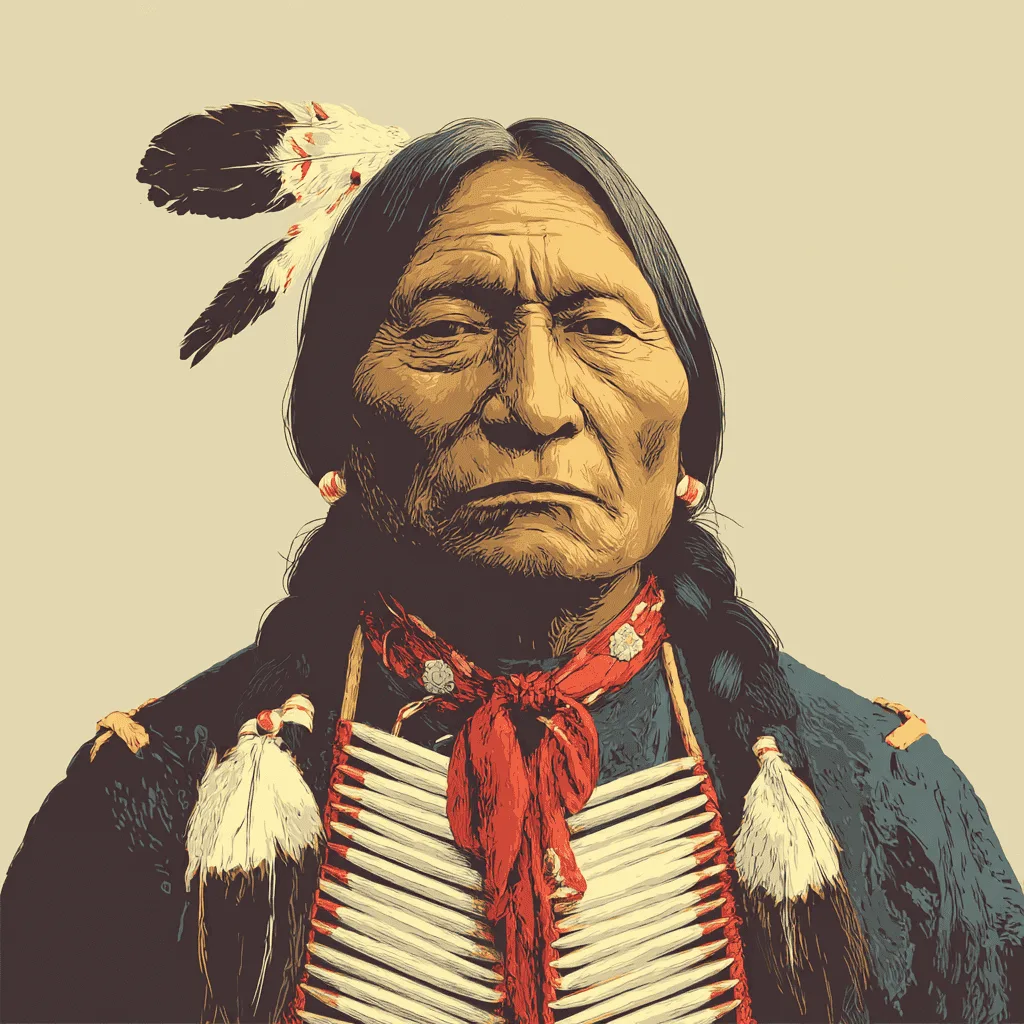
Sitting Bull and the Battle of Little Bighorn: Complete Guide to the Most Famous Native American Victory
The Historical Context: Broken Treaties and the Black Hills Gold Rush
The seeds of Little Bighorn were sown decades earlier through a pattern of U.S. treaty-making and treaty-breaking. The United States government recognized the sovereignty of Plains tribes through formal agreements, but as white settlers and gold seekers pushed westward, those promises were repeatedly violated.
The Fort Laramie Treaty of 1868
The Fort Laramie Treaty of 1868 was one of the most significant agreements in Native American–U.S. relations. It established the Great Sioux Reservation, encompassing all of present-day South Dakota west of the Missouri River, including the sacred Black Hills (Paha Sapa). The treaty guaranteed that the reservation would be Lakota land “for as long as rivers flow and grass grows,” forbade white entry without Lakota permission, promised government rations, and allowed Lakota to hunt in unceded territories without interference. Crucially, any future land cessions required approval from three-quarters of adult male Lakota—a safeguard against fraudulent sales. However, many Lakota bands, including Sitting Bull’s Hunkpapa, never signed the treaty. They rejected the premise that the United States had any authority to grant or restrict Lakota land rights.
The Black Hills Gold Rush
Everything changed in 1874 when Lieutenant Colonel George Armstrong Custer led a military expedition into the Black Hills—a direct violation of the treaty—ostensibly to explore but actually to confirm rumors of gold. When Custer’s expedition reported gold discoveries, thousands of prospectors flooded the region. The U.S. government made minimal efforts to enforce the treaty, and soon mining camps dotted the sacred Lakota lands. The Black Hills were not only rich in resources but were the spiritual heart of the Lakota world, home to important religious sites and creation stories. The government, unable to control the miners and unwilling to enforce treaty provisions, attempted to purchase the Black Hills in 1875. Lakota leaders refused to sell at any price—the Hills simply were not for sale.
Sitting Bull: Spiritual Leader and Resistance Icon
The man who became the most famous Native American resistance leader of his era earned his authority through courage, spiritual power, and unwavering commitment to his people.
Early Life and Warrior Training
Sitting Bull was born around 1831 near the Grand River in present-day South Dakota. His birth name was Jumping Badger, but at age 14 he earned the name Tȟatȟáŋka Íyotake (Sitting Bull) after demonstrating courage in battle against Crow warriors. Like all Lakota boys, he received rigorous training in hunting, horsemanship, and warfare. He killed his first buffalo at age 10 and joined his first war party at 14. He quickly distinguished himself, earning eagle feathers for his coups and battle achievements. By his mid-twenties, he was recognized as a war leader commanding respect from experienced warriors.
The Sun Dance Vision of 1876
In June 1876, weeks before the battle, Sitting Bull participated in a Sun Dance ceremony. He sacrificed pieces of his flesh and danced for hours, entering a trance. He saw soldiers falling upside-down from the sky into the Lakota camp like grasshoppers—a vision he interpreted as prophesying a great Native American victory. This vision spread rapidly through the growing camps along the Little Bighorn River, inspiring warriors and strengthening their determination. It was not a battle plan—Sitting Bull was not the tactical commander—but it provided spiritual confirmation that the spirits favored the Lakota cause.
Military Leadership and Unity
Sitting Bull’s combination of military achievement and spiritual authority gave him influence that transcended his own Hunkpapa band. He consistently refused to negotiate with Americans, insisting that the Lakota owned their lands and owed nothing to the U.S. government. By the early 1870s, as pressure mounted on Plains tribes to accept reservation life, Sitting Bull became the leading voice for absolute resistance. His refusal to compromise made him both a symbol of indigenous defiance and a target for U.S. military campaigns.
The Road to Little Bighorn
The immediate cause of the battle was the U.S. government’s ultimatum to all Lakota bands to report to reservation agencies or face military action.
The Ultimatum and Military Campaign
In December 1875, the Interior Department issued an ultimatum: all Lakota living in unceded territories must report to reservation agencies by January 31, 1876, or be considered “hostile.” This ultimatum violated the Fort Laramie Treaty, which guaranteed Lakota hunting rights in those territories. Many bands were scattered across winter camps hundreds of miles from agencies, making compliance impossible. When the deadline passed, the War Department began planning a coordinated military campaign. Three columns were to converge on the area where Lakota and Cheyenne were believed to be gathering. One of these columns was the 7th Cavalry under Custer.
The Gathering of Nations
As spring 1876 arrived, thousands of Lakota, Northern Cheyenne, and Arapaho gathered along the Little Bighorn and Bighorn Rivers. This massive camp—eventually numbering perhaps 7,000–10,000 people including 1,500–2,000 warriors—was the largest gathering of Plains Indians in history. They assembled for multiple reasons: to hunt buffalo on one of the last great buffalo ranges, to participate in religious ceremonies, to find strength in numbers, and to respond to Sitting Bull’s leadership. The Army called it “Sitting Bull’s camp,” though leadership was distributed among many chiefs. Sitting Bull’s spiritual and political authority made him the symbolic center.
The Battle of Little Bighorn (June 25–26, 1876)
The battle unfolded over two days, with the most famous engagement—Custer’s Last Stand—occurring on the afternoon of June 25.
Custer’s Tactical Errors
On June 25, Crow scouts reported the massive village to Custer and warned that it was larger than any they had ever seen. They advised waiting for General Terry’s infantry before attacking. Custer rejected this advice, fearing the village would scatter. He decided to attack immediately with his approximately 600-man regiment, confident that aggressive action would succeed as it had at the Battle of the Washita in 1868. Custer divided his force into four battalions: one under Captain Benteen to scout south, one under Major Reno to attack the village from the south, one under Captain McDougall guarding the pack train, and his own battalion of about 210 men to attack from the north. This division proved disastrous against the enormous Native American force.
Reno’s Attack and Retreat
Around 3:00 PM, Reno’s battalion attacked the village’s southern end. They initially drove into the camp but quickly met overwhelming resistance as hundreds of warriors counterattacked. Within 30 minutes, Reno’s advance turned into a desperate retreat across the Little Bighorn River to bluffs on the east bank. He lost about one-third of his command killed or wounded, and his unit was effectively out of the battle. Meanwhile, Custer’s battalion was miles north, unaware of Reno’s plight.
Custer’s Last Stand
Around 4:00 PM, Custer’s battalion approached the village from the north, but warriors who had repulsed Reno were now free to concentrate against him. Thousands of warriors, led by Crazy Horse, Gall, Two Moons, and Lame White Man, swarmed around Custer’s command. The battalion attempted to establish defensive positions on hills but was quickly surrounded and overwhelmed. The fighting was intense and brutal. Within approximately 45 minutes to an hour, every soldier in Custer’s battalion—about 210 men, including Custer, his brothers Tom and Boston, his nephew Autie Reed, and his brother-in-law James Calhoun—was killed. Archaeological evidence shows the battle was chaotic, with soldiers dying in scattered locations rather than in neat defensive formations. The overwhelming Native American numerical and tactical superiority made the outcome inevitable.
Native American Tactics and Weapons
Several factors contributed to the decisive Native American victory:
- Overwhelming numbers: The village contained perhaps 1,500–2,000 warriors, far more than Custer anticipated.
- Better weapons: Many warriors carried repeating rifles (Winchester, Henry, Spencer) acquired through trade or capture, while 7th Cavalry soldiers used single-shot Springfield carbines that required reloading after each shot.
- Superior knowledge of terrain: Warriors used the land effectively—taking high ground, using ravines for cover, and concentrating forces where they would be most effective.
- Tactical coordination: Despite coming from multiple tribes, warriors coordinated their attacks, responding to battlefield conditions and concentrating against divided Army units.
- High motivation: They fought to defend their families, lands, and way of life against strangers in unfamiliar country.
The battle demonstrated that Native American forces, when properly armed and led, could defeat regular Army units decisively through superior strategy and execution.
Key Personalities: The Leaders Who Shaped the Battle
Crazy Horse (Tȟašúŋke Witkó)
Crazy Horse, an Oglala Lakota war leader, was the tactical mastermind of the battle. Known for his brilliant battlefield instincts and personal fearlessness, he led the charge that broke Custer’s defensive lines. Crazy Horse had already earned a reputation as a formidable warrior in earlier conflicts such as the Fetterman Fight (1866) and the Battle of the Rosebud (June 17, 1876), where he held off General Crook’s forces just days before Little Bighorn. Unlike Sitting Bull, Crazy Horse was primarily a military leader, not a holy man. He refused to be photographed and lived by the traditional Lakota warrior code. After the battle, he continued resisting until his surrender in May 1877, and he was killed while allegedly resisting arrest at Fort Robinson later that year.
Gall (Phizí)
Gall, a Hunkpapa war chief, was among the most aggressive leaders during the battle. He initially confronted Reno’s attack from the south, then rapidly moved his warriors north to hit Custer. Gall was a fierce tactician who had lost two wives and several children to earlier Army attacks, fueling his determination. After the war, he became a pragmatic leader who eventually advocated for diplomacy and settled at the Standing Rock Reservation, where he farmed and served as a tribal judge—a stark contrast to his warrior youth.
Two Moons (Ishaynishus) and Lame White Man (Vóóhéhéve)
Two Moons led the Northern Cheyenne contingent, coordinating with Lakota fighters. He later became a key source of oral history, describing the battle in detail. Lame White Man, a Cheyenne chief, was killed in the fighting after leading a charge that overran a portion of Custer’s line. His bravery and death are remembered in Cheyenne oral traditions.
Aftermath and Consequences
The immediate aftermath brought shock, recriminations, and intensified military campaigns that crushed Plains Indian resistance within five years.
Shock and Recriminations
News of the defeat reached the American public on July 4, 1876—ironically, during centennial celebrations. Newspapers’ sensational coverage created the “Custer’s Last Stand” mythology almost immediately. Custer was portrayed as a martyred hero, Native Americans as bloodthirsty savages. This coverage ignored the context of broken treaties and Lakota self-defense. Public outrage demanded military response, giving generals political support for expanded operations.
The Intensified Military Response
Following Little Bighorn, the Army increased forces and pursued Native American bands relentlessly through fall and winter 1876–77. The massive camp scattered into smaller groups that were easier to track. Key engagements included the Battle of Slim Buttes (September 1876) and the Dull Knife Fight (November 1876). The U.S. Army destroyed food supplies, captured horses, and attacked villages, making continued resistance untenable. The National Park Service’s Little Bighorn Battlefield site notes that the relentless pressure combined with increasing buffalo scarcity forced band after band to surrender.
Sitting Bull’s Exile and Surrender
Sitting Bull refused to surrender and led his band north into Canada in May 1877. Approximately 5,000 Lakota fled across the border, hoping the “Great Mother” (Queen Victoria) would protect them. The Canadian government tolerated their presence but provided minimal support. For four years, his people struggled to find game, faced starvation, and watched as family members returned to U.S. reservations for rations. By 1881, with his people starving and his influence waning, Sitting Bull surrendered at Fort Buford, Dakota Territory. He was imprisoned for two years before being allowed to settle at Standing Rock Reservation.
The Later Years and Death of Sitting Bull
On the reservation, Sitting Bull remained a figure of quiet resistance. He participated in Buffalo Bill’s Wild West Show in 1885, earning money and seeing the white world, but he refused to abandon Lakota traditions. In 1890, the Ghost Dance movement—a spiritual revival promising the return of the buffalo and the disappearance of whites—swept through reservations. Fearing an uprising, Indian Agent James McLaughlin ordered Sitting Bull’s arrest. On December 15, 1890, Indian police attempted to take him; a scuffle broke out, and Sitting Bull was shot in the head and killed by Sergeant Red Tomahawk. His death triggered the tragic Wounded Knee Massacre two weeks later.
Legacy and Historical Memory
The battle and Sitting Bull’s role have been remembered, mythologized, and debated for nearly 150 years.
The Custer Myth
American media and popular culture quickly created a heroic narrative of Custer’s Last Stand. Artists painted dramatic scenes of Custer fighting bravely to the last. This mythology transformed military defeat into moral victory, justified continued Indian wars, and obscured the reality of broken treaties and Lakota defensive action. It ignored Custer’s tactical errors and the fact that Native Americans won a fair fight against a professional military unit.
Native American Perspectives
Native American accounts—largely ignored for decades—emphasized that they were defending their homes against invasion. Warriors described sophisticated tactical coordination and the overwhelming of Custer’s forces through superior numbers and strategy. Oral histories preserved within Lakota, Cheyenne, and Arapaho communities kept alternative memories alive, remembering Sitting Bull, Crazy Horse, and others as heroes defending their people.
Contemporary Reinterpretation
Since the 1960s, scholarship influenced by civil rights movements and Native American activism has reexamined the battle. The site is now Little Bighorn Battlefield National Monument, which incorporates both Army and Native American interpretations. As Smithsonian Magazine notes, the monument includes the Indian Memorial, honoring the warriors who died defending their way of life. The battle challenges comfortable national narratives about westward expansion, forcing recognition that treaties were systematically violated and that Native Americans actively resisted dispossession.
Key Lessons from the Battle
Beyond historical fascination, the story of Sitting Bull and Little Bighorn offers enduring insights:
- The tragedy of inevitable conflict: Broken promises and irreconcilable interests made conflict inevitable. The Fort Laramie Treaty theoretically protected Lakota lands, but American hunger for gold overrode legal obligations.
- Tactical victory versus strategic defeat: Little Bighorn illustrates the difference. Native Americans won decisively, but the victory accelerated their ultimate defeat by shocking the nation into intensified military campaigns.
- Leadership facing impossible choices: Sitting Bull tried resistance, exile, and accommodation—none fully preserved the Lakota world. His choices reflect the impossible constraints indigenous leaders faced.
- Memory as contested terrain: How the battle is remembered reveals how societies construct narratives that serve contemporary needs. Understanding this helps us seek more complete, honest history.
Today, the Battle of Little Bighorn remains one of the most studied and debated events in American history. It stands as a testament to the courage and military capability of Plains Indian nations, a reminder of the price of American expansion, and a lesson in how history is shaped by those who tell it. For further exploration, the PBS American Experience documentary on the battle provides excellent context, and the U.S. Department of State’s history of Indian treaties offers a primary source perspective on the legal frameworks that were broken. Sitting Bull’s legacy transcends his role at Little Bighorn—he represents indigenous resistance against overwhelming power, leadership facing impossible choices, and the refusal to accept injustice even when resistance seemed futile. His story, and the battle he helped inspire, continue to challenge Americans to reckon honestly with their national history.