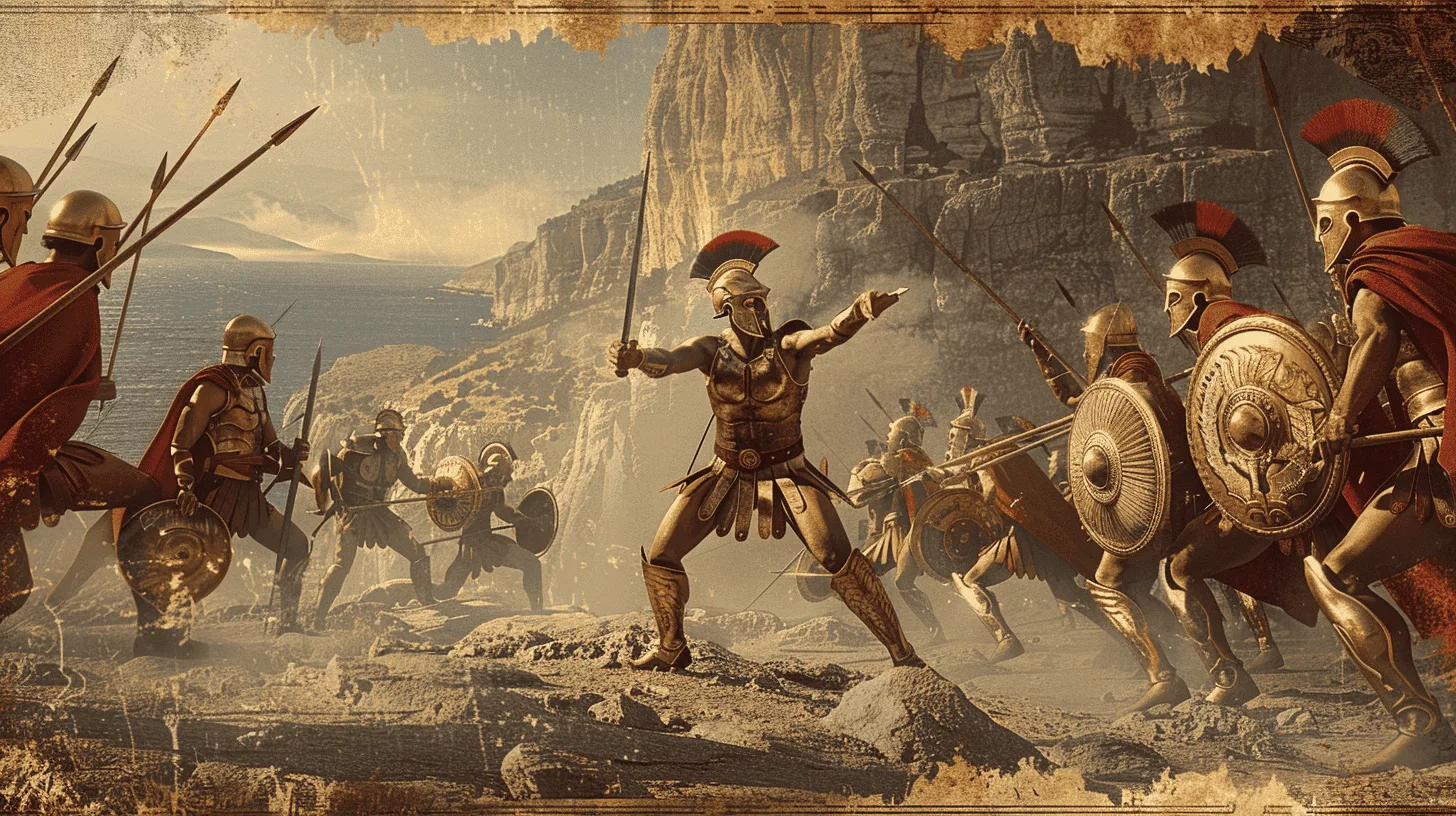
The Battle of Thermopylae and King Leonidas’ Stand: Study Guide for Understanding Ancient Greek Warfare and Heroism
The Battle of Thermopylae: King Leonidas and the Stand That Shaped History
The Battle of Thermopylae remains one of the most defining moments of the ancient world. In 480 BCE, a coalition of Greek city-states under King Leonidas of Sparta confronted the massive invading army of the Persian Empire at a narrow coastal pass. Their mission was to hold the line long enough for Greece to organize a defense. Though they ultimately fell, their stand became a cornerstone of Western history, demonstrating how strategic positioning, elite discipline, and unyielding resolve can challenge even the most overwhelming force. This conflict shaped military doctrine, political philosophy, and cultural identity for centuries to come.
This guide examines the battle in depth, exploring the key figures who influenced its outcome, the tactical decisions that defined it, and the lasting impact of this three-day struggle on Greece, the Persian Empire, and the world beyond.
Why Thermopylae Remains Relevant
Understanding Thermopylae offers insight into several critical aspects of human history and nature. First, it shows how geography and terrain can level the playing field in warfare, a lesson that remains applicable in modern military strategy. Second, it demonstrates the power of unity among fractious political entities when facing an existential threat. The Greek city-states, normally rivals, came together because the alternative was subjugation under Persian rule.
Beyond tactics, the battle raises profound questions about sacrifice, leadership, and what it means to stand for something greater than oneself. King Leonidas knew he was marching to his death, yet he went willingly. That choice, and the ripple effects it created, helped preserve Greek independence and, by extension, the democratic ideals and philosophical traditions that would influence Western thought for centuries.
Historical Background and Context
The clash at Thermopylae did not emerge from a vacuum. It was the culmination of decades of tension, imperial ambition, and cultural collision between the expanding Persian Empire and the fragmented but fiercely independent Greek city-states.
The Rise of the Persian Empire and Its Westward Expansion
The Persian Achaemenid Empire, under rulers such as Cyrus the Great and Darius I, had grown into a superpower controlling territories from modern Turkey to Egypt and deep into Central Asia. By the early 5th century BCE, Darius set his sights on Europe. He viewed the Greek city-states as disruptive elements on his empire's western frontier, independent, defiant, and dangerously democratic. Persia operated on a tribute system, but the Greeks' fierce independence threatened that model.
After Darius died, his son Xerxes I inherited both the throne and his father's ambition to bring Greece under Persian control. Xerxes was not interested in negotiation; he demanded submission. He assembled the largest invasion force the ancient world had ever seen: a massive army supported by a navy that controlled much of the Aegean Sea. For the Greeks, this was an existential crisis.
The Persian military machine was formidable: disciplined infantry, skilled cavalry, expert archers, and a navy that could outflank any defensive position. The outcome of the coming campaign would determine whether the eastern Mediterranean would remain under Persian hegemony or continue as a collection of independent city-states.
Ancient Greece: A Patchwork of Rival City-States
Ancient Greece was not a unified nation but a collection of independent poleis (city-states), each with its own government, army, culture, and ambitions. Major players included Sparta, Athens, Corinth, and Thebes, along with hundreds of smaller communities.
Sparta was a military society where boys entered rigorous training at age seven and remained soldiers for life. Spartan warriors, known as hoplites, were the ancient world's elite infantry, disciplined, fearless, and trained to fight as an unbreakable unit in the phalanx formation.
Athens, by contrast, invested heavily in naval power and cultivated a culture of philosophy, arts, and early democratic governance. While Athenian hoplites were formidable, the city's real strength lay in its triremes, fast, maneuverable warships that could ram enemy vessels.
These city-states frequently fought each other over territory, trade routes, and political influence. The idea of a unified "Greece" was more cultural than political. They shared language, religion, and events like the Olympic Games, but politically they operated as independent nations, often hostile ones. This fragmentation was both Greece's weakness and, paradoxically, its strength. While the Greeks struggled to coordinate, their fierce independence produced warriors and leaders who refused to submit to foreign rule.
The Ionian Revolt: Catalyst for Persian Invasion
The immediate trigger for the Persian invasion came from Greek cities in Asia Minor (modern Turkey). These communities, conquered by Persia decades earlier, grew resentful of Persian taxation and governance. Around 499 BCE, they launched the Ionian Revolt, seeking independence. Athens and Eretria sent ships and soldiers to support the rebellion. The revolt initially succeeded, with rebel forces even burning Sardis, a major Persian city. But Persia crushed the uprising by 494 BCE, and Darius did not forget which Greek cities had interfered.
In 490 BCE, Darius launched the first Persian invasion of Greece. His forces landed at Marathon, just 26 miles from Athens. Against expectations, the outnumbered Athenians achieved a stunning victory, killing thousands of Persians while suffering minimal casualties themselves. The Battle of Marathon became legendary, but it did not end Persian ambitions. Darius died before he could launch another invasion, leaving the task to Xerxes, who spent years assembling an enormous army and navy.
Thermopylae: Where Geography Becomes Strategy
The Greeks needed to buy time for their navy to assemble and for their cities to prepare defenses. The answer lay in a narrow coastal pass in central Greece called Thermopylae, or "Hot Gates," named for the hot springs in the area. This pass, situated between the mountains and the Malian Gulf, was only about 50 feet wide at its narrowest point. For an invading army traveling south, there was no easy way around it. The terrain meant that even a massive force could only engage a handful of defenders at once.
Greek military leaders, meeting at the Isthmus of Corinth, recognized Thermopylae's defensive potential. If a small force could hold the pass long enough, the Greek fleet could engage the Persian navy at Artemisium, and the southern city-states could fortify their positions. The pass had three distinct sections: the western gate, the middle gate (the narrowest point), and the eastern gate. Between these points ran an ancient wall, partially rebuilt by the Greeks before the battle. This wall, combined with the natural terrain, created a formidable defensive position.
Strategic Elements of Thermopylae:
- Narrow frontage: Limited the number of attackers who could engage simultaneously
- Coastal position: Protected the Greek left flank with cliffs dropping to the sea
- Mountain barrier: Protected the right flank with steep, supposedly impassable terrain
- Defensive wall: Provided cover and a fallback position for Greek forces
- Proximity to Artemisium: Allowed coordination between land and naval forces
Key Figures and Forces
The battle brought together some of ancient history's most significant leaders and warriors, each playing a crucial role in the conflict's outcome.
King Leonidas I: Sparta's Warrior King
Leonidas I was not Sparta's first choice for king. He was a younger son who inherited the throne unexpectedly when his older brother died without an heir. By 480 BCE, Leonidas was around 60 years old, ancient by warrior standards, but he commanded absolute respect. Spartan kings came from two royal families and served as both military commanders and religious figures. Leonidas embodied the Spartan ideal: disciplined, brave, and committed to the state above all else.
When the decision came to send forces to Thermopylae, Leonidas personally selected his force. He chose 300 Spartiates, full Spartan citizens who had completed their training and produced male heirs. This latter requirement was crucial: Leonidas expected this to be a one-way mission, and Sparta needed to preserve its bloodlines. The decision to send only 300 Spartans was not about numbers, Sparta could field several thousand warriors. Religious festivals, particularly the Carneia and the Olympic Games, prevented Sparta from mobilizing its full army at that moment. But Leonidas understood the urgency and marched with what he could gather, promising that more would follow after the festivals concluded.
The Spartan Military System: Why 300 Was Enough
To understand why 300 Spartans could terrify an empire, one must understand Spartan society. Sparta was essentially a military state where everything revolved around producing superior warriors. Boys entered the agoge at age seven, enduring two decades of physical training, combat instruction, and psychological conditioning. They learned to fight in the phalanx formation, a tight unit where warriors' shields overlapped, creating a nearly impenetrable wall of bronze and iron. Spartan hoplites wore distinctive red cloaks and carried lambda-marked shields, for Lacedaemon, Sparta's formal name. They fought with short swords and long spears, their equipment and tactics optimized for close-quarters combat.
But equipment alone did not make Spartans exceptional. Their training emphasized unit cohesion, discipline under pressure, and the absolute refusal to break ranks or retreat. Where other Greek hoplites might falter in desperate situations, Spartans held the line. The Spartans at Thermopylae were supported by perioikoi, free non-citizens, and helots, state-owned slaves who sometimes fought alongside their masters, providing logistics and light support.
Xerxes I: The God-King of Persia
Xerxes I inherited an empire that stretched across three continents and controlled approximately 44 percent of the world's population at the time. He ruled as an absolute monarch, considered semi-divine by his subjects, wielding power that Greek city-states could barely comprehend. The Persian king was not merely seeking conquest, he wanted to avenge his father's defeat at Marathon and demonstrate Persian supremacy.
According to Herodotus, Xerxes assembled an invasion force that numbered in the hundreds of thousands, possibly over a million including support personnel. Modern historians suggest more conservative figures, perhaps 100,000 to 200,000 combat troops, but even these lower estimates represented an overwhelming force. Xerxes commanded a diverse army: Persians in elaborate armor, Median cavalry, Bactrian archers, Egyptian marines, and troops from dozens of other subject peoples. This diversity was both a strength and a weakness, the army could deploy various tactical approaches, but coordination and unified command were challenging.
The elite core of Xerxes' army was the Immortals (Athanatoi), named because their unit was kept at exactly 10,000 men through immediate replacement of casualties. These were Persia's best infantry, equipped with spears, bows, and wicker shields, trained to fight in formation and respected throughout the ancient world.
The Allied Greek Forces: Unity Through Necessity
Leonidas did not stand alone at Thermopylae. Approximately 7,000 Greek soldiers from various city-states joined the defense, though exact numbers remain debated among historians. Significant contingents included:
- 700 Thespians: Who famously remained with the Spartans during the final stand
- 400 Thebans: Though their loyalty was questionable, Thebes had Persian sympathies
- 1,000 Phocians: Assigned to guard the mountain path
- Smaller units from Mycenae, Corinth, Arcadia, and other poleis
Each city-state had its own commanders, but Leonidas held overall command. This coalition represented something rare in Greek history: genuine cooperation against a common enemy. The allied Greeks knew that if Persia conquered one city-state, others would fall like dominoes. Athens, notably, had most of its forces engaged in naval operations at Artemisium under Themistocles, fighting a parallel battle to prevent Persian ships from bypassing Thermopylae.
Herodotus: Our Window to the Past
Nearly everything we know about Thermopylae comes from Herodotus of Halicarnassus, who wrote his Histories several decades after the battle. Called the "Father of History," Herodotus traveled extensively, collecting stories, interviewing veterans, and recording oral traditions. His account mixes detailed military description with dramatic storytelling. He records famous moments, like the Spartan Dienekes who, told that Persian arrows would blot out the sun, replied "Good, then we'll fight in the shade." Whether these moments happened exactly as described is uncertain, but they capture the spirit of the battle.
Herodotus had biases, he admired Greek culture and sometimes exaggerated Persian numbers to make Greek victories more impressive. He also included supernatural elements. Despite these limitations, his work remains invaluable. Archaeological evidence and later sources generally support his basic narrative, even when specific details seem embellished. For a deeper look at the historical reliability of Herodotus, see Livius.org's analysis of Herodotus.
The Course of the Battle of Thermopylae
The battle unfolded over three brutal days in August 480 BCE, each day bringing new challenges and demonstrating both the Greeks' defensive prowess and the Persians' determination.
Day One: Testing the Greek Defenses
When Xerxes' vast army arrived at Thermopylae, he reportedly waited four days, expecting the Greeks to flee at the sight of his forces. When they did not, he sent scouts to observe the Spartan camp. The scouts reported something puzzling: the Spartans were exercising, combing their long hair, and seemingly unconcerned about the approaching army. A Greek exile named Demaratus, a former Spartan king now serving Xerxes, explained that when Spartans dressed their hair, they were ready to die.
The Persian assault began with waves of Median and Cissian troops. These soldiers, competent by any normal standard, were sent forward to break the Greek line through sheer numbers. They found themselves funneled into the narrow pass where Greek hoplites waited in formation. The phalanx proved devastating. Greek warriors, protected by large bronze-faced shields (aspis) and fighting shoulder-to-shoulder, presented a wall of overlapping shields with spears extending beyond. Persian soldiers, with lighter armor and smaller wicker shields, could not penetrate this formation. Greek spears were longer than Persian weapons, allowing Greeks to strike enemies before those enemies got close. Waves of Persian troops attacked throughout the day, suffering heavy casualties while achieving nothing. Bodies piled up, making footing treacherous for subsequent waves.
Day Two: The Immortals Enter the Fight
Frustrated by the first day's failure, Xerxes deployed his elite Immortals on the second day. The result was the same. The Immortals fought bravely and skillfully, but the terrain and Greek tactics neutralized their advantages. Spartan discipline and superior armor made the difference. While Persian wicker shields might stop arrows, they could not stop bronze-tipped spears driven by warriors trained since childhood for exactly this kind of combat.
According to Herodotus, the Greeks employed a tactical innovation: they would pretend to retreat, baiting Persian troops to break formation and chase them. Once the Persians spread out, the Greeks would turn and fight, slaughtering the now-disordered enemy. This required extraordinary discipline. The Spartans rotated with other Greek contingents, allowing fresh troops to take the front line while exhausted warriors rested. By the end of the second day, Persian casualties were mounting while Greek losses remained relatively light. Xerxes had thrown everything at the pass, elite troops, massed infantry, even cavalry, which proved useless in the confined space, and the Greeks still held.
The Betrayal: Ephialtes Changes Everything
On the second night, a local Greek named Ephialtes approached Xerxes' camp. Motivated by promised rewards or resentment against his fellow Greeks, he revealed the existence of the Anopaea path, a mountain track that wound around the pass and could bring troops behind the Greek position. The path was not entirely secret. The Greeks knew about it and had stationed 1,000 Phocian hoplites to guard it. But Ephialtes knew the route intimately and could guide Persian troops through the darkness. Xerxes immediately ordered his Immortals, led by Hydarnes, to follow Ephialtes. Through the night, thousands of Persian soldiers climbed the mountain trail, moving to outflank the Greek position. The Phocians, hearing the Persian approach, armed themselves but were driven back by arrow volleys. Critically, they failed to send word to Leonidas quickly enough about the breakthrough.
Day Three: The Final Stand
Facing encirclement, Leonidas called a council of war. The tactical situation was clear: remaining at Thermopylae meant certain death. Leonidas made a command decision that has echoed through history. He ordered most of the Greek allied forces to withdraw southward, preserving their strength for future battles. He and his 300 Spartans would remain, along with volunteers who chose to stay.
Why did they stay? Strategically, they bought time for the retreating Greeks to escape and for the Greek fleet at Artemisium to disengage. Politically, a total retreat might have shattered the fragile Greek alliance. Personally, Spartan law and custom forbade retreat, Spartans returned with their shields or carried on them. The 700 Thespians chose to remain, led by their general Demophilus. These soldiers were not Spartans and could have left honorably; they stayed anyway, fighting to the death. The 400 Thebans may have been detained by Leonidas, suspected of Persian sympathies.
On the morning of the third day, Leonidas led his remaining forces out from behind the wall, taking the fight to the Persians in the wider part of the pass. This was not defense, it was a final offensive. The fighting was savage. Spears shattered, and warriors fought with swords and daggers. King Leonidas fell in the melee, and the fiercest fighting erupted over his body, with Spartans determined to recover their king. Four times they recovered Leonidas' body. When Persian forces from the Anopaea path began arriving behind them, the surviving Greeks withdrew to a small hill inside the pass, forming a defensive circle. Persian archers, at Xerxes' order, finally ended the battle with volleys of arrows.
According to tradition, two Spartans missed the battle due to illness and survived. One, Aristodemus, was so shamed that he sought and found death at the Battle of Plataea the following year, fighting with reckless courage to redeem his honor.
Aftermath and Persian Victory
The Persians had won, but at enormous cost. They lost thousands of soldiers, Herodotus claims 20,000, though this is likely exaggerated, and spent three days capturing a simple chokepoint. Xerxes, furious, ordered Leonidas' body beheaded and crucified, a desecration that violated Greek burial customs. This act, rather than intimidating the Greeks, hardened their resolve. The Persian army moved south, eventually capturing and burning Athens. But the delay at Thermopylae had given the Greeks time to evacuate Athens' population and position their fleet for the decisive naval battle at Salamis.
Legacy and Impact of Thermopylae
The battle's influence extended far beyond its immediate tactical outcome, shaping Greek identity, military thought, and Western cultural values for millennia.
Immediate Military Consequences
While Thermopylae was a defensive defeat, it achieved its strategic purpose. The three-day delay allowed the Greek fleet to engage the Persian navy at Artemisium, inflicting significant damage despite eventually withdrawing. More importantly, the time bought enabled Athens to evacuate its civilian population. When the Persians captured Athens weeks later, they found an empty city. The population survived to fight another day.
The Greek fleet, under Themistocles' command, lured the Persian navy into the narrow straits at Salamis in September 480 BCE. In these confined waters, Greek triremes destroyed much of the Persian fleet in a stunning victory. The following year, Greek forces achieved a decisive land victory at Plataea, effectively ending the Persian invasion. Thermopylae had not stopped the invasion, but it disrupted Persian momentum and gave Greece time to organize an effective resistance. For more on the naval campaign, see World History Encyclopedia's entry on the Battle of Salamis.
Creating the Spartan Legend
Before Thermopylae, Sparta was respected but not mythologized. Afterward, Spartans became legendary. The 300's stand created a cultural narrative that defined Spartan identity for generations. Sparta used this legend strategically, the battle became central to Spartan education and military culture, exemplifying obedience, courage, and contempt for death. The Spartan mirage, the idealized image of Spartan society as perfectly disciplined and militarily superior, was built partly on Thermopylae's legacy. However, the legend also trapped Sparta, creating pressure to maintain an increasingly unsustainable military system.
Thermopylae in Greek Art, Literature, and Memory
The battle quickly entered Greek cultural consciousness. The playwright Aeschylus, who fought at Marathon, referenced Persian Wars themes. Later authors like Plutarch retold Leonidas' story. At the battlefield, the Greeks erected monuments. The most famous epitaph, composed by the poet Simonides, read: "Go tell the Spartans, stranger passing by, that here obedient to their laws we lie." This captured the essence of how Greeks wanted to remember the battle: as an example of lawful obedience, civic duty, and sacrifice for the greater good. Religious festivals incorporated commemorations, and Leonidas was essentially heroized, with cult worship at Sparta.
Influence on Military Thought and Strategy
Military commanders throughout history have studied Thermopylae as an example of how terrain, discipline, and morale can offset numerical superiority. Key principles include:
- Force multiplication through terrain: The narrow pass made Greek numerical disadvantage irrelevant by limiting engagement frontage.
- Value of professional soldiers: Well-trained, heavily armed warriors consistently outperformed numerically superior but less-trained opponents.
- Defensive advantages: Prepared positions with good fields of engagement dramatically increase defensive effectiveness.
- Morale and cohesion: Units that trust their leaders and comrades fight far more effectively than unmotivated troops.
These lessons influenced everyone from Roman generals to modern military strategists. The concept of the "strategic chokepoint" became a standard tactical approach. For a modern analysis of Thermopylae's tactical lessons, see Ancient History Encyclopedia's detailed article.
Thermopylae and Western Cultural Identity
Beyond military history, Thermopylae became a foundational story for Western civilization's self-conception. The battle came to represent liberty versus tyranny, with Greeks cast as free citizens defending their autonomy against an authoritarian empire. Leonidas' decision represented civic virtue, placing community welfare above personal survival. The image of "the Few Against the Many" became a recurring theme in Western literature and film. The Battle of Thermopylae was invoked during the American Revolution, World War II, and countless other conflicts, becoming shorthand for principled resistance.
Modern Receptions and Interpretations
The 20th and 21st centuries saw renewed interest through Frank Miller's graphic novel "300" and its film adaptation. These modern retellings introduced the battle to new generations, albeit with creative license. Scholars debate whether such interpretations honor or distort the battle's significance. What remains consistent is the battle's emotional power: it asks fundamental questions about sacrifice, resistance, and how individual choices ripple through history.
Understanding the Spartans: Society and Warfare
To fully appreciate what happened at Thermopylae, we need to understand the society that produced warriors like Leonidas' 300.
The Agoge: Forging Warriors from Childhood
Spartan boys left home at age seven to enter the agoge, a state-run education and training system designed to produce perfect soldiers. Boys lived in barracks, deliberately underfed to teach them to steal food and endure hunger. Physical training was relentless: running, wrestling, weapons drills, and mock combat. The agoge also taught obedience, unit cohesion, and Spartan values. Boys learned to endure pain without complaint. At age 20, young men became eligible to join a syssitia, a mess unit where they would eat, train, and fight. This system created extraordinary soldiers but at enormous social cost, leaving little room for arts or commerce.
Women in Sparta: The Strength Behind the Shield
Spartan women enjoyed more freedom and authority than most ancient Greek women. They received physical education, could own property, and managed estates while men were at war. This was practical: Spartan society needed strong women to bear healthy children and manage affairs. Spartan mothers famously told their sons to return from battle "with your shield or on it," meaning victorious or dead. This was not cruelty but cultural expectation.
The Helot System: Sparta's Troubling Foundation
Sparta's military prowess rested on an uncomfortable foundation: helots, state-owned slaves who outnumbered Spartans significantly. Helots worked the land, producing food that freed Spartan citizens to train for war. This system required constant vigilance; helots periodically revolted. Young Spartans sometimes participated in the krypteia, a secret police force that terrorized helots to prevent uprising. This internal tension shaped Spartan foreign policy, they were often reluctant to commit forces far from home, worried about helot revolts. The decision to send only 300 to Thermopylae reflected these concerns as much as religious festivals.
What We Can Learn from Thermopylae Today
The Battle of Thermopylae offers lessons that transcend its ancient context, relevant to leadership, strategy, and human nature.
Leadership Under Pressure
Leonidas demonstrated several leadership qualities: leading from the front, making hard decisions, sending most forces away while staying behind, earning respect through example, and knowing when to stand firm. He adapted to changing circumstances while maintaining his core mission.
The Power of Strategic Delay
Thermopylae teaches that losing a battle can still achieve strategic success. The Greeks lost the pass but won the time they needed. This concept applies beyond warfare, in negotiations, legal battles, and business, sometimes the objective is to delay or deplete an opponent's resources rather than achieving immediate victory.
Unity in the Face of Existential Threats
The Greeks put aside their differences because Persian conquest threatened everyone. But this unity was fragile and temporary. After repelling Persia, Greek city-states quickly returned to fighting each other, leading to the destructive Peloponnesian War. The lesson is double-edged: people can unite against common threats, but maintaining that unity requires continuous effort.
The Limits and Dangers of Militarism
Sparta's warrior culture produced the 300 who stood at Thermopylae, but it also created a society with limited cultural development, economic inflexibility, and ultimate decline. Military excellence alone does not ensure civilizational success. Athens, with its balance of naval power, commerce, and culture, proved more adaptable in the long run.
Common Questions About Thermopylae
Did 300 Spartans really fight alone?
No. While 300 Spartans formed the core, approximately 7,000 Greek soldiers fought during the first two days. On the final day, about 1,400 warriors remained: the 300 Spartans, 700 Thespians, 400 Thebans, and possibly helots and perioikoi.
How many Persians actually fought?
Ancient sources claim millions; modern historians estimate 100,000 to 200,000 combat troops. Exact numbers remain debated, but the Persians had overwhelming numerical superiority.
Could the Greeks have held the pass without the betrayal?
Possibly for longer, but probably not indefinitely. The Persians were exploring alternate routes, and the Greek fleet's battle at Artemisium was going poorly. Persian naval superiority might have eventually allowed them to land troops behind the pass.
What happened to Ephialtes?
According to tradition, he fled after the battle, and a Spartan later killed him. His name became synonymous with "traitor" in Greek culture.
Did the Spartans really say "Come and take them" and "Then we shall fight in the shade"?
These quotes come from sources written decades or centuries after the battle. Whether they are actual quotations or dramatizations is impossible to verify, but they effectively capture Spartan culture and mindset.
Conclusion: The Eternal Resonance of Thermopylae
The Battle of Thermopylae endures not because the Greeks won, they did not, but because of what their stand represented. It demonstrated that courage, discipline, and strategic thinking can challenge even overwhelming force. It showed that a few determined people, fighting for their homes and freedom, could inspire entire civilizations. Leonidas and his warriors bought their civilization three days. In those three days, they bought time for Greek forces to regroup, for the navy to prepare at Salamis, and for Athens to evacuate its population. They transformed a potential rout into an organized strategic withdrawal.
But beyond tactics, Thermopylae became a story about values worth dying for. The Spartans could have retreated; instead, they stayed because their culture and identity demanded it. That choice, to stand when standing seemed pointless, created a legend that has outlasted empires, inspired countless leaders, and shaped how Western civilization understands courage, sacrifice, and duty. The Greeks at Thermopylae lost the battle but helped win the war. Their three-day stand at a mountain pass 2,500 years ago continues to challenge us with its fundamental question: What principles matter enough to make your stand, even against impossible odds? For further reading on the long-term influence of the Persian Wars, see The Metropolitan Museum of Art's overview of Greek warfare.