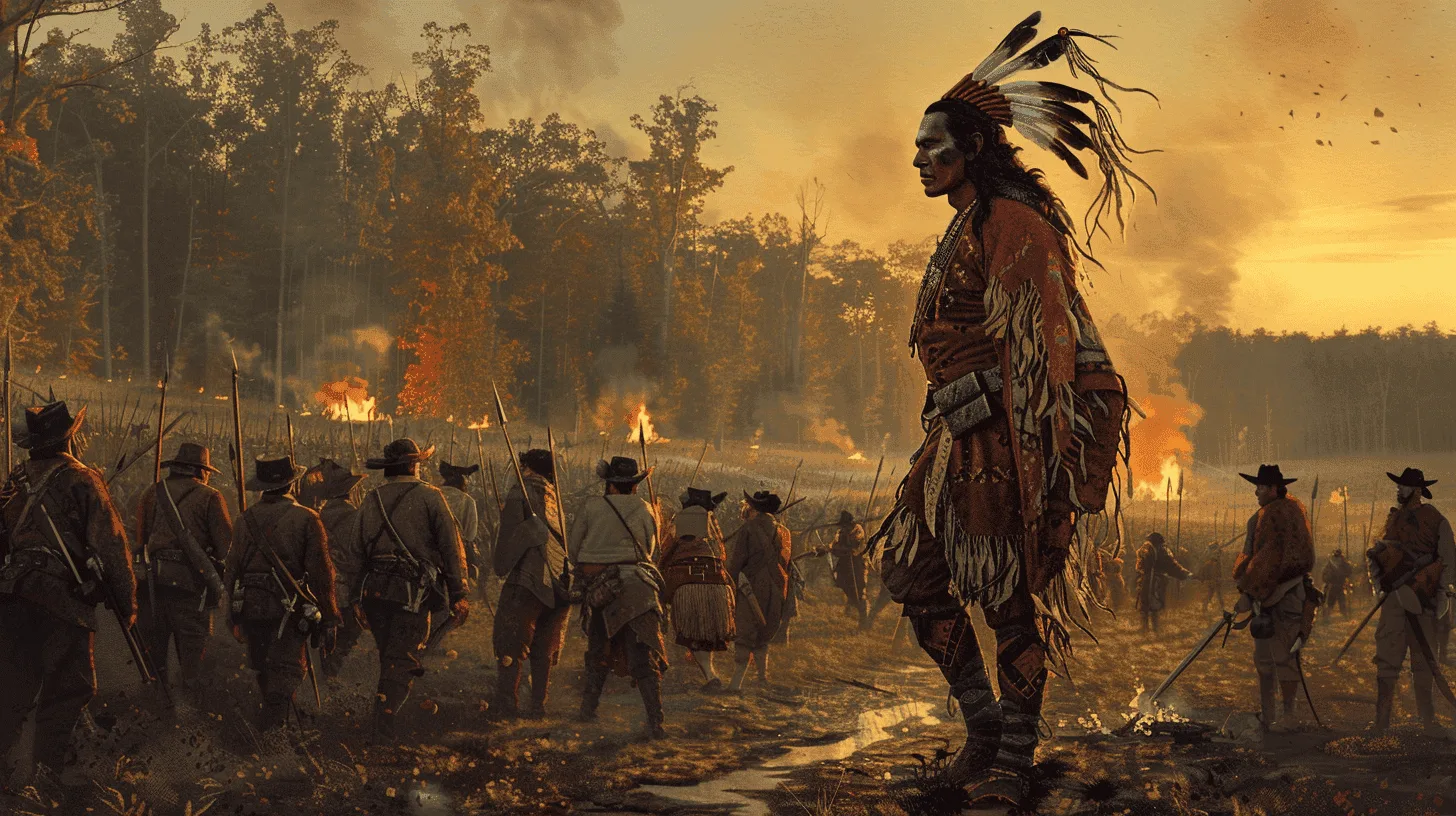
The Battle of Tippecanoe and Tecumseh’s Confederacy: Comprehensive Study Guide and Historical Analysis
Introduction: A Battle That Reshaped the Frontier
On a cold November morning in 1811, along the banks of Tippecanoe Creek in present-day Indiana, gunfire shattered the pre-dawn darkness as Native American warriors launched a surprise attack on an encampment of U.S. Army soldiers and militia. The brief but ferocious engagement that followed marked a decisive turning point—effectively ending the most ambitious attempt to create a unified Native American resistance since Pontiac’s Rebellion half a century earlier.
The Battle of Tippecanoe was far more than a single military clash. It represented the culmination of Tecumseh’s visionary but ultimately unsuccessful effort to unite dozens of diverse tribes into a confederacy powerful enough to halt American westward expansion. The battle’s outcome—a tactical draw but a strategic defeat for the Native alliance—destroyed the spiritual and political heart of the movement, scattered its warriors, and ensured that Native peoples would face American expansion as fragmented tribes rather than as a unified force.
Understanding Tippecanoe illuminates a moment when the future of the American frontier hung in the balance. Had Tecumseh succeeded in creating a lasting pan-Indian confederacy, the United States’ westward expansion might have been significantly delayed or diverted. The battle also reveals the complex dynamics of early American expansionism, the sophisticated political thinking of Native leaders, and the intersection of military conflict, diplomatic maneuvering, and religious revitalization movements in early 19th-century North America.
This article examines Tecumseh’s extraordinary effort to build a unified Native resistance, the religious and political foundations of his movement, the events leading to the battle, the engagement itself, and its profound consequences for both Native peoples and the expanding American republic.
Historical Context: The Northwest Territory and American Expansion
The Northwest Ordinance and Settler Pressure
To grasp why Tecumseh attempted to unite Native tribes and why conflict became inevitable, one must understand the relentless pressure Native peoples faced from American expansion after independence.
The Northwest Ordinance of 1787 established procedures for organizing and admitting new states from the territory north of the Ohio River and west to the Mississippi—lands that Native peoples had inhabited for millennia. While the ordinance included language about respecting Native property rights, reality rarely matched these promises.
The pattern of expansion proceeded systematically:
- Treaty-Making (Often Coercive): American officials negotiated treaties with individual tribes, using tactics ranging from diplomatic pressure to threats to bribery of cooperative chiefs. Treaties typically ceded vast territories for relatively small payments.
- Settler Flood: Following treaties, American settlers poured into newly “acquired” lands, establishing farms, towns, and territorial governments.
- Native Displacement: Treaties often ceded lands claimed by one tribe but used by others for hunting. Even tribes that had not signed treaties found their territories invaded by settlers.
Key treaties that drove this process included:
- Treaty of Fort McIntosh (1785): Forced cessions from several Ohio tribes following the American Revolutionary War.
- Treaty of Fort Harmar (1789): Obtained more land cessions through questionable negotiations.
- Treaty of Greenville (1795): Following the Northwest Indian War and Native defeat at the Battle of Fallen Timbers, this treaty ceded most of present-day Ohio and parts of Indiana, Illinois, and Michigan.
- Treaty of Fort Wayne (1809): Negotiated by William Henry Harrison, this controversial treaty ceded 3 million acres of prime hunting land, directly triggering Tecumseh’s most intense resistance efforts.
The Louisiana Purchase and Accelerated Expansion
In 1803, the Louisiana Purchase doubled U.S. territory. For Native peoples, it demonstrated that the United States possessed seemingly unlimited capacity for territorial expansion and that European powers would sell lands claimed without consulting indigenous inhabitants. For American expansionists, it validated Manifest Destiny thinking and created pressure to secure the eastern frontier before moving westward.
The purchase also shifted geopolitics: the French withdrawal removed a potential counterbalance to American power, and the influx of settlers into former French territories increased competition for resources. The impact on the Northwest Territory was immediate—land speculation boomed, and the pace of settlement accelerated, putting direct pressure on the homelands of the Shawnee, Miami, Delaware, and other tribes.
The Failure of Accommodation Strategies
By the early 19th century, different Native responses to American expansion had been tried and found wanting:
- Military Resistance (1790s): The Northwest Indian War (1785–1795) saw a confederacy of tribes inflict serious defeats, but eventual American victory at Fallen Timbers showed isolated resistance could not permanently stop expansion.
- Accommodation and “Civilization”: Some Native leaders advocated adopting American farming and education, only to face forced removal anyway in the 1830s.
- Individual Treaties: Tribes negotiating separately found themselves outmaneuvered as American negotiators exploited inter-tribal rivalries.
- Retreat Westward: Some groups migrated westward, but this created new conflicts and eventually they faced American expansion again.
None of these strategies succeeded in preserving Native autonomy. This failure created the conditions for Tecumseh’s alternative approach: pan-Indian unity that would make tribes collectively strong enough to negotiate from a position of power or resist militarily.
Tecumseh’s Grand Vision of Unity
Early Life and Formative Experiences
Tecumseh (meaning “Shooting Star” or “Panther Across the Sky”) was born around 1768 near present-day Springfield, Ohio, into the Shawnee nation. His early life was marked by violence and displacement: his father was killed at the Battle of Point Pleasant in 1774, and the Shawnee were repeatedly forced to relocate. He fought in the Northwest Indian War and witnessed both the power of Native unity and its limitations after the defeat at Fallen Timbers. By the early 1800s, Tecumseh had established himself as a respected warrior and political leader with a vision extending beyond his own tribe.
His experiences gave him a unique perspective. Unlike many Native leaders who focused on local or tribal concerns, Tecumseh observed the broader pattern of American expansion and recognized that the only way to resist effectively was through unity that transcended traditional tribal boundaries. He was also influenced by the earlier efforts of leaders like Little Turtle and Blue Jacket, who had attempted similar coalitions in the 1790s. Tecumseh’s genius was to take these earlier experiments and develop a more comprehensive political and ideological framework.
The Philosophy of Pan-Indian Unity
Tecumseh’s central insight was that disunity was the fundamental problem for Native peoples. His solution was revolutionary:
- Collective Land Ownership: Land belonged to all Native peoples collectively; no single tribe had authority to cede territory through treaties.
- Pan-Indian Identity: He advocated identifying primarily as “Indians” rather than as specific tribal members, emphasizing common interests and shared fate.
- Mutual Defense: An attack on any tribe should be considered an attack on all, requiring collective response.
- Rejection of Treaties: All treaties negotiated by individual tribes were illegitimate under the principle of collective ownership.
- Cultural Preservation: The confederacy aimed to preserve Native cultures and ways of life against American expansion.
This vision was remarkably ambitious—attempting to create a new political entity from dozens of independent tribes with different languages, cultures, territorial claims, and historical animosities. Tecumseh’s approach combined traditional Native diplomatic practices with a modern sense of national identity, making him one of the most innovative political thinkers of his era.
The Religious Dimension: Tenskwatawa the Prophet
Tecumseh’s movement gained crucial spiritual reinforcement from his younger brother Tenskwatawa. After a trance experience in 1805, Tenskwatawa emerged as a religious prophet preaching a message of cultural purification: rejection of alcohol, European trade goods, and cooperation with Americans; a return to traditional ways; and the promise of supernatural power. His accurate prediction of a solar eclipse in 1806 dramatically enhanced his credibility.
The religious movement provided spiritual justification for the confederacy, addressed social problems like alcoholism, created unity through shared beliefs, and energized followers. The combination of Tecumseh’s political leadership and Tenskwatawa’s spiritual authority created a powerful movement that attracted followers from tribes across the Northwest Territory and Great Lakes region. However, Tenskwatawa’s influence also introduced vulnerabilities—his prophecies about invulnerability in battle could be disproved, and his tendency to act without consulting Tecumseh occasionally led to risky decisions.
The Tenskwatawa Revival in Context
The Prophet’s teachings were part of a broader wave of Native religious revitalization movements that swept across eastern North America in the late 18th and early 19th centuries. Figures like Handsome Lake among the Seneca and the Delaware Prophet Neolin (whose ideas influenced Pontiac’s Rebellion) offered similar messages of rejecting European ways and returning to ancestral spiritual practices. Tenskwatawa’s movement was distinctive in its direct political connection to a confederacy-building effort, and in its timing—it emerged precisely when American expansion was accelerating and traditional support systems were collapsing.
Building the Confederacy (1805–1811)
Prophetstown: The Movement’s Center
In 1808, Tecumseh and Tenskwatawa established Prophetstown at the confluence of the Tippecanoe and Wabash Rivers in present-day Indiana. The location was centrally positioned in the Northwest Territory and symbolically demonstrated pan-Indian unity in practice. At its peak, Prophetstown housed 600–1,000 residents from multiple tribes—Shawnee, Delaware, Miami, Potawatomi, Kickapoo, Winnebago, and others. Its existence challenged American authority as a multi-tribal settlement not under U.S. control.
Prophetstown functioned as more than a village; it was a political and spiritual capital. Tenskwatawa presided over religious ceremonies that attracted visitors from far-flung communities, while Tecumseh used it as a base for his diplomatic missions. The settlement included meeting lodges for councils, storage facilities for food and ammunition, and training grounds for warriors. Its location on the Tippecanoe River allowed easy communication with both Great Lakes tribes and southern groups, making it an ideal hub for the confederacy.
Tecumseh’s Diplomatic Missions
While Tenskwatawa maintained Prophetstown, Tecumseh traveled extensively to recruit tribes. He visited northern tribes in the Great Lakes region, made an ambitious journey to southern tribes (Creek, Chickasaw, Choctaw, Cherokee) in 1811, and sought alliances with western tribes. His diplomatic approach combined shared grievances, apocalyptic vision, pragmatic politics, personal charisma, and strategic thinking. Success was mixed—many tribes pledged rhetorical support, but committing warriors to collective military action proved difficult due to old animosities and fear of American retaliation.
The 1811 southern mission was particularly significant. Tecumseh hoped to bring the powerful Creek Confederacy into his alliance, which would have created a united front stretching from the Great Lakes to the Gulf of Mexico. He spent months visiting Creek towns in present-day Alabama and Georgia, delivering powerful speeches that resonated with many younger warriors. The eventual result was the Creek War of 1813–1814, which pitted a faction of Red Stick Creeks inspired by Tecumseh’s message against the United States and allied Creeks. While this war was a separate conflict, it demonstrated the ripple effects of Tecumseh’s pan-Indian vision well beyond the Northwest Territory.
American Response: William Henry Harrison
The governor of Indiana Territory, William Henry Harrison, watched the growing confederacy with alarm. A former military officer and aggressive advocate for expansion, Harrison fundamentally believed Native peoples had no legitimate claim to resist. He attempted to undermine the confederacy by negotiating separate treaties, most notably the Treaty of Fort Wayne (1809). Direct confrontations between Tecumseh and Harrison at Vincennes in 1810 and 1811 revealed unbridgeable positions: Tecumseh demanded repudiation of the treaty; Harrison insisted settlement would proceed and threatened military action. By 1811, Harrison was convinced destruction of Prophetstown was necessary and began assembling forces. Political ambitions also drove him—a successful campaign would enhance his reputation, as “Tippecanoe” later became his presidential slogan.
Harrison was a skilled administrator and diplomat. He understood Native political dynamics well, often exploiting tribal rivalries and cultivating cooperative chiefs through gifts and promises. His approach was systematic: first weaken the confederacy by isolating it diplomatically, then strike militarily when the opportunity arose. Tecumseh’s absence in the South provided that opportunity, and Harrison moved quickly to exploit it.
The Road to Tippecanoe
The Campaign Begins
In September 1811, Harrison assembled a force of approximately 1,000 men: regular U.S. Army infantry (about 350 soldiers of the 4th Infantry Regiment), Indiana militia (approximately 600 men), Kentucky volunteers (about 100 mounted riflemen), and an artillery section. Harrison’s stated objectives were to march to Prophetstown, demand cessation of hostile activities, and if refused, destroy the settlement. The timing was deliberate—Tecumseh was away on his southern recruitment mission, leaving Tenskwatawa in charge.
The march was deliberately slow and methodical, with Harrison constructing a series of fortified supply depots along his route. This ensured his army could sustain itself in hostile territory and provided a line of retreat. The campaign was also a political demonstration: Harrison wanted to show both Native communities and American settlers that the federal government could project power into the heart of the confederacy.
Arrival at Prophetstown
On November 6, 1811, Harrison’s forces approached Prophetstown. Rather than immediately attacking, he sent messengers requesting a meeting. Tenskwatawa faced a difficult decision: Prophetstown had perhaps 600–700 warriors, but they lacked artillery, had less ammunition, and were assembled from multiple tribes without unified command. Tecumseh had explicitly instructed his brother to avoid battle until he returned. However, Tenskwatawa reportedly conducted religious rituals declaring that the Master of Life would ensure victory—American bullets would be harmless. He agreed to the meeting but apparently decided to attack the American encampment at dawn, hoping surprise would succeed where conventional battle might fail.
There has been considerable debate about Tenskwatawa’s decision. Some historians argue he was reluctantly forced into action by more aggressive warriors who feared that allowing Harrison to approach the town unchallenged would be seen as weakness. Others suggest Tenskwatawa genuinely believed in his prophecies and saw an opportunity to demonstrate his spiritual power by leading a preemptive strike. Whatever his reasoning, the decision violated Tecumseh’s explicit orders and proved catastrophic for the confederacy.
The Battle of Tippecanoe: November 7, 1811
American Defensive Position
Harrison, suspicious of Tenskwatawa’s intentions, positioned his forces defensively for the night. They camped on slightly elevated ground in a rough rectangular formation, with infantry companies around the perimeter, mounted riflemen and militia in the center as reserves, artillery covering approaches, and sentries posted. Fires were kept burning for warmth and visibility.
Harrison’s defensive arrangements were tactically sound. He ordered his men to sleep in their clothing with weapons ready, and instructed officers to maintain strict security. The perimeter was reinforced with improvised breastworks of logs and brush. Despite these precautions, the camp was not fully fortified—Harrison had expected to negotiate with the Prophet rather than fight, and he lacked the tools for extensive entrenchment.
The Attack
Around 4:30 AM, in darkness before dawn, Native warriors attacked, achieving tactical surprise. The heaviest assault hit the northern sector where Indiana militia held positions. These less experienced troops initially fell back, creating a dangerous gap. Harrison quickly moved regular troops and mounted riflemen to stabilize the line, riding along the front under fire to direct reinforcements. The battle devolved into close-range fighting in darkness, with both sides suffering casualties from friendly fire. Warriors used classic woodland tactics—taking cover and firing from concealment—but the darkness that aided their initial surprise also hindered coordination. As dawn broke, American artillery began firing canister shot, forcing warriors to maintain distance and reducing the intensity of their assault. The main fighting lasted approximately two hours.
The fighting was intensely personal. Many of the militia and regulars had never experienced combat, and the chaos of a night attack compounded their inexperience. Conversely, the Native warriors were veterans of frontier warfare, skilled in moving silently through darkness and using every scrap of cover. The outcome hinged on the ability of Harrison’s regulars to hold a thin line long enough for dawn to expose their attackers. Key figures like Major General John Gibson and Captain Zachary Taylor (future president) distinguished themselves by rallying troops under heavy fire.
Withdrawal and Aftermath
As daylight increased and American positions held, the Native attack lost momentum. Warriors withdrew in relatively organized retreat. American casualties were 62 killed and 126 wounded (nearly 20% of Harrison’s force). Native casualties were uncertain—American reports claimed 25–40 bodies found, but this likely undercounts because wounded warriors were typically carried away. Harrison’s forces held the battlefield but were in no condition to pursue. On November 8, they found Prophetstown abandoned and burned it, destroying buildings, stored food supplies, and the symbolic center of the confederacy. Harrison then marched back to Vincennes, having accomplished his objectives.
The destruction of Prophetstown was total. Hundreds of bushels of corn, stored for winter, were consumed by fire. The town’s layout—with its central council house and the Prophet’s lodge—was erased. For the Native peoples who had built their community there, it was not just a military defeat but a profound psychological blow. The center of their political and spiritual world was gone, and with it the hope that organized resistance could succeed.
Consequences and Historical Significance
Immediate Impact
The battle was tactically ambiguous but strategically decisive. The destruction of Prophetstown and dispersal of the confederacy meant a clear American strategic victory. The pan-Indian movement lost its physical center, its warriors scattered, and momentum toward unified resistance collapsed. Tenskwatawa’s claim that spiritual power would ensure easy victory was disproven, destroying his religious authority. When Tecumseh returned to find Prophetstown destroyed and the confederacy in disarray, he reportedly furiously confronted his brother.
The battle also had immediate political consequences in the United States. Newspapers across the country celebrated Harrison’s “victory,” and the phrase “Tippecanoe” became a watchword for American military prowess. The engagement provided a boost to the political fortunes of the War Hawks—members of Congress who argued that war with Britain was necessary to end British support for Native resistance.
The Path to the War of 1812
Tippecanoe helped precipitate the War of 1812 through several mechanisms: Americans widely believed British agents in Canada had encouraged and supplied the Native confederacy; congressional “War Hawks” used Tippecanoe as evidence that British-backed Native resistance threatened American security; and Tecumseh, having failed to unite tribes independently, allied with Britain when war broke out. During the War of 1812, Tecumseh’s warriors operated as effective British allies in the Great Lakes region.
The British connection was real but often exaggerated. British officials in Canada did supply guns and trade goods to Native communities as a buffer against American expansion, but there is no evidence they orchestrated Tecumseh’s confederacy. After Tippecanoe, the British saw Tecumseh as a valuable ally and provided more substantial support. The alliance reached its peak with the capture of Fort Detroit in August 1812, where Tecumseh’s tactics of psychological warfare (parading his warriors through a gap in the woods to create the illusion of overwhelming numbers) terrified the American commander into surrendering without a fight.
Tecumseh’s Death and the Final Defeat
At the Battle of the Thames (October 5, 1813), American forces under Harrison pursued retreating British and Native forces. British troops quickly surrendered or retreated, but Tecumseh and his warriors continued fighting. Tecumseh was killed in the battle, and his death effectively ended organized Native resistance in the Northwest. No other leader emerged with the vision or capability to recreate such a movement. The location of his grave remains unknown, deliberately obscured to prevent desecration by enemies.
Tecumseh’s death marked a turning point not just in the region but in the broader story of Native American resistance. With his passing, the dream of a unified pan-Indian state died. The War of 1812 concluded with the Treaty of Ghent in 1814, which required Britain to cease supporting Native allies. The British abandonment of their Native allies in the treaty was a devastating betrayal, confirming Tecumseh’s earlier skepticism about relying on European powers.
Long-Term Consequences for Native Peoples
The failure of Tecumseh’s confederacy had profound consequences. Without unity, tribes faced American expansion individually and eventually lost all territorial independence. The Indian Removal Act of 1830 and forced migrations like the Cherokee Trail of Tears showed that even accommodation would not save Native lands. Displacement, poverty, disease, and cultural suppression devastated Native societies throughout the 19th century. Survivors were confined to reservations—a fate Tecumseh had fought to prevent.
The psychological impact was equally devastating. The loss of the confederacy shattered hopes that Native peoples could preserve autonomous political structures and maintain control over their ancestral homelands. For generations afterward, Native communities in the Ohio Valley and Great Lakes region struggled with the trauma of dispossession and the collapse of their political order. The memory of Tecumseh’s vision, however, remained alive in oral traditions and eventually became a powerful symbol of Native unity and resistance.
Impact on American Expansion
For the United States, Tippecanoe and the subsequent War of 1812 removed primary obstacles to expansion in the Northwest Territory. The Treaty of Ghent (1814) required Britain to withdraw support for Native allies. With organized resistance eliminated, American settlement accelerated dramatically in the 1820s–1840s, and territories became states. The pattern established—treaty-making, military defeat of resistance, removal of Native populations, establishment of states—would be replicated across the continent.
The economic transformation was equally dramatic. Within a decade of Tippecanoe, the Ohio Valley became a major agricultural region, supplying grain, livestock, and eventually industrial products to the rest of the nation. The Erie Canal, completed in 1825, connected the Great Lakes to the Atlantic, accelerating the integration of former Native lands into the national economy. By the 1840s, the region that Tecumseh had tried to preserve for Native peoples was thoroughly transformed into the heartland of American commercial agriculture.
Legacy and Historical Perspectives
Tecumseh’s Legacy
Tecumseh remains one of the most respected Native American leaders in historical memory, recognized for visionary leadership, moral character, strategic thinking, and oratorical skill. Modern Native peoples often view him as a hero who fought for indigenous rights and sovereignty. American historical memory presents Tecumseh more ambivalently—respected as a “worthy adversary” but ultimately an obstacle to expansion. Britannica’s biography of Tecumseh provides authoritative context.
In Canada, Tecumseh is celebrated as a hero who fought alongside British forces to defend Canadian soil from American invasion. Several Canadian towns and streets are named after him, and his image appears on the priciest Canadian stamp ever issued. This contrast in national memory—American ambivalence versus Canadian celebration—reflects the complex politics of the War of 1812 and the differing national narratives constructed around it. The Canadian Encyclopedia entry on Tecumseh offers a detailed account of his role in Canadian history.
Historical Sites and Commemoration
Several sites commemorate the battle and Tecumseh’s confederacy. Tippecanoe Battlefield in Indiana is preserved with monuments to both American forces and Native warriors. Prophetstown State Park near the original site offers historical interpretation. These commemorations reflect evolving understanding—from earlier celebrations of American “triumph” to more balanced perspectives acknowledging legitimate resistance.
The battlefield itself became a powerful symbol in American politics. William Henry Harrison’s campaign slogan “Tippecanoe and Tyler Too” in the 1840 presidential election turned the obscure general into a national figure. His victory was portrayed as a triumph of American civilization over Native “savagery,” a narrative that shaped popular perceptions for over a century. Modern interpretation at the site has moved toward a more nuanced view, emphasizing the sophistication of Tecumseh’s political vision and the tragic consequences of the battle for Native peoples.
Scholarly Debates
Historians continue debating whether Tecumseh’s confederacy ever had realistic chances of success given demographic disparities and the difficulty of maintaining inter-tribal unity. Some argue more complete unity or British support might have created a lasting Native state; others view defeat as inevitable. The role of Tenskwatawa’s religious movement is also debated—did it attract followers or create vulnerabilities like the failed prophecy at Tippecanoe? Scholarly articles on JSTOR offer in-depth analysis of these questions.
Recent scholarship has also focused on the confederacy’s use of written communication, the role of women in the movement, and the ways in which Tecumseh’s ideas influenced later Native political movements, including the modern sovereignty movement. The Smithsonian Magazine article on Tecumseh provides an accessible overview of contemporary thinking about his legacy.
Conclusion: A Turning Point in North American History
The Battle of Tippecanoe, despite being a relatively small engagement militarily, marked a crucial turning point—the moment when the last realistic possibility of unified Native American resistance to U.S. expansion in the Northwest Territory ended. Tecumseh’s vision of pan-Indian identity and collective action was remarkable, but proved impossible to fully realize given the practical challenges of uniting diverse peoples. The battle itself was almost an accident—Tenskwatawa acting without authority, Harrison seeking military glory, and circumstances spiraling into violence.
The consequences echo through history: unified resistance failed, so Native peoples faced American expansion as fragmented tribes that could be defeated, removed, or confined individually from coast to coast. For Native peoples, Tippecanoe represents a tragic missed opportunity. For the United States, it removed a major obstacle and validated confidence in Manifest Destiny. Modern understanding must grapple with uncomfortable realities: American expansion meant conquest, dispossession, and cultural devastation. Tecumseh and his confederacy were not obstacles to progress but people defending their homes and ways of life against invasion.
Two hundred years later, the Battle of Tippecanoe reminds us how contingent historical outcomes can be, how visionary leaders can fail due to circumstances beyond their control, and how relatively minor military conflicts can have consequences far beyond the battlefield. Tecumseh’s dream died along Tippecanoe Creek, and with it died the possibility of a North American future where Native peoples might have preserved autonomous territories rather than facing conquest and removal.
Additional Resources
For readers interested in deeper engagement with Tecumseh’s confederacy and the Battle of Tippecanoe:
- R. David Edmunds’ Tecumseh and the Quest for Indian Leadership (Pearson, 2006) provides a scholarly biography that examines Tecumseh within the broader context of Native American resistance and pan-Indian political movements.
- The Tippecanoe Battlefield Museum in Battle Ground, Indiana offers artifacts, interpretive materials, and annual commemorations that help visitors understand the battle’s context and significance from multiple perspectives.
- John Sugden’s Tecumseh: A Life (Henry Holt, 1997) is widely considered the definitive biography, offering exhaustive research and balanced analysis of both Tecumseh’s strengths and limitations as a leader.
- Visit the Tippecanoe Battlefield National Historic Landmark for more information.
- The Library of Congress War of 1812 collection includes primary source documents, maps, and images related to the battle and its context.