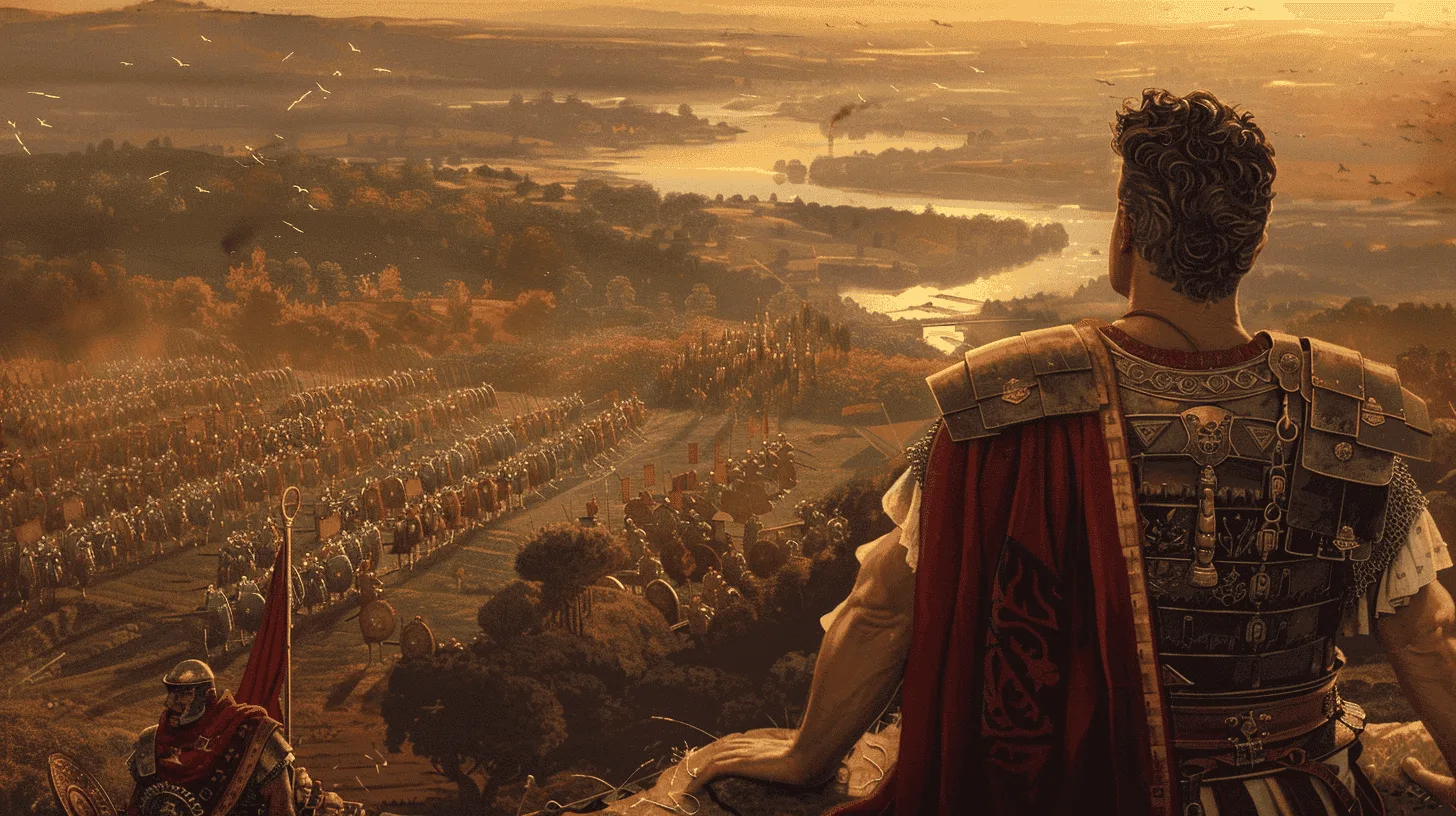
The Gallic Wars and Caesar’s Military Strategy: Study Guide for Understanding Key Campaigns and Tactics
Historical Context: The Republic on the Brink of Collapse
The Political Crisis of Late Republican Rome
By the mid-first century BCE, the Roman Republic was tearing itself apart from within. Rome's sweeping Mediterranean conquests had generated enormous wealth, but that wealth flowed overwhelmingly to a narrow senatorial elite, widening the gap between rich and poor to a breaking point. The traditional cursus honorum—the ladder of political advancement that had produced generations of statesmen—had become prohibitively expensive, requiring massive expenditure on public games, banquets, and outright bribes simply to win elections. Meanwhile, the military reforms of Gaius Marius a generation earlier had created a professional army drawn from the landless poor, known as the capite censi or "head count." These soldiers now looked to their commanders rather than the state for land grants, bonuses, and retirement benefits, making individual generals personally powerful in ways the Republic's founders had never anticipated. Violence in the streets, electoral corruption, and political murder became routine. Into this turmoil stepped three men who would dominate politics through an informal but devastatingly effective alliance: the First Triumvirate.
The First Triumvirate
Formed around 60 BCE, this alliance united Pompey the Great, Rome's most celebrated general; Marcus Licinius Crassus, the wealthiest man in Rome; and Julius Caesar, an ambitious aristocrat from the ancient Julian clan. Pompey needed land for his veterans and ratification of his eastern settlements—things the jealous and obstructionist Senate had persistently denied him. Crassus craved military glory to match Pompey's, and he was also deeply involved in financial schemes that required political protection. Caesar, meanwhile, needed a military command to escape crushing debt and build his own reputation. The alliance worked with brutal efficiency: as consul in 59 BCE, Caesar forced through legislation benefiting Pompey and Crassus, ignoring vetoes and religious omens. In return, Pompey and Crassus secured him an unprecedented five-year command over Cisalpine Gaul, Illyricum, and Transalpine Gaul—a base from which he could launch the conquests that would change everything.
Gaul Before Caesar
"Gaul" encompassed a vast region of Celtic tribes stretching from the Rhine to the Atlantic, from the Alps to the English Channel. These tribes varied enormously in their sophistication and organization: some, like the Aedui and Arverni, had complex political structures, minted coins, maintained fortified towns called oppida, and even engaged in diplomacy with Rome. Others were smaller, more fluid, and governed by warrior chieftains who relied on personal prestige and war booty to maintain power. Constant inter-tribal warfare was the norm, driven by disputes over land, resources, and honor. Economically, Gaul was rich in agriculture, livestock, and metalworking, with well-established trade networks reaching all the way to the Mediterranean world. Rome already held a province in southern Gaul (Gallia Narbonensis), but most of the region remained independent and often hostile. The strategic situation was volatile: Germanic tribes from across the Rhine occasionally invaded, pressing against Gallic territory and sometimes settling permanently, while Rome held formal alliances with some tribes, such as the Aedui, whom Caesar could claim to protect. This patchwork of fear, rivalry, and opportunity was the perfect theater for Caesar's ambition.
The Campaigns: Eight Years of Relentless Conquest
Year 1 (58 BCE): The Helvetii and Ariovistus
Caesar's first campaign began with the Helvetii, a powerful tribe from the area of modern Switzerland that was planning a mass migration westward through Roman territory. Some 368,000 Helvetii, including combatants and civilians, were on the move. Caesar claimed this movement threatened Roman security and the allied Aedui. He intercepted the Helvetii and won the Battle of Bibracte, a hard-fought engagement that forced them to surrender and return to their homeland. He then turned on the Germanic king Ariovistus, who had crossed the Rhine with substantial forces and was settling in eastern Gaul despite a treaty with Rome. At the Battle of Vosges, Caesar crushed Ariovistus and drove him back across the Rhine, reportedly killing some 80,000 Germans. These two quick victories established the Rhine as Rome's future defensive frontier and showed Gauls and Germans alike that a new, aggressive power had arrived on the scene.
Year 2 (57 BCE): The Belgic Campaign
The Belgae—fierce tribes of northern Gaul who claimed Germanic ancestry—formed a grand coalition to resist Roman expansion. Caesar marched north with eight legions, defeating the coalition at the Battle of the Axona through careful use of defensive fortifications. He then systematically reduced individual tribes, accepting surrenders from the Suessiones, Bellovaci, and Ambiani. But his most dangerous moment came against the Nervii, a particularly warlike tribe, at the Battle of the Sabis. A surprise attack caught Caesar's legions while they were building their marching camp, and the battle nearly turned into a rout. Caesar personally seized a shield, rallied his troops, and—with the help of arriving reserves—turned the tide. The Nervii were virtually annihilated. By year's end, Roman control extended all the way to the English Channel, and the Senate in Rome voted an unprecedented fifteen days of thanksgiving for Caesar's victories.
Year 3 (56 BCE): Naval Warfare on the Atlantic
The Veneti, a maritime tribe living on the Atlantic coast of what is now Brittany, resisted Roman rule by mobilizing their powerful fleet. Their ships were built of oak, with high sterns and prows, designed to survive Atlantic storms—far different from the sleek Mediterranean galleys Caesar knew. The Romans had no comparable navy, so Caesar ordered warships built from scratch, a remarkable logistical feat for a land army. In a naval battle at Quiberon Bay, Roman ships defeated the Veneti by using hooked poles to tear down their leather sails, rendering the enemy vessels immobile and then boarding them. After the victory, Caesar executed the Veneti leaders and enslaved the entire population, sending a brutal warning to all coastal tribes. This campaign also saw his lieutenant Crassus (the son of the triumvir) pacify the Aquitani in southwestern Gaul.
Years 4–5 (55–54 BCE): The British Expeditions
In 55 BCE, Caesar launched the first Roman expedition to Britain—a bold, risky move with limited military value but immense propaganda impact. He crossed the English Channel with only two legions, fought a contested landing against British warriors on the beach, gathered intelligence about the island and its tribes, and withdrew before autumn storms could trap him. The following year he returned with five legions and two thousand cavalry, pushed inland, crossed the Thames River, and defeated the British king Cassivellaunus. Again, news of serious trouble in Gaul forced withdrawal after receiving nominal submissions and taking hostages. The expeditions captured the Roman imagination: Caesar became the first general to lead armies across the "Ocean" into the unknown island, and his reports of Britain's size, resources, and warlike inhabitants fascinated his readers back home.
Year 6 (53 BCE): Crisis and Ruthless Pacification
While Caesar campaigned in Britain, resentment in Gaul was simmering just below the surface. In the winter of 54–53 BCE, the Eburones under their wily chief Ambiorix ambushed and destroyed an entire Roman legion—the Fourteenth Legion—along with five cohorts from another, totaling some 6,000 men dead. This was the worst Roman disaster of the Gallic Wars. The defeat inspired a wider revolt among the Nervii, Treveri, and others. Caesar responded with chilling efficiency. He first campaigned against the Menapii and Morini, then built a temporary bridge across the Rhine in just ten days—an engineering marvel that allowed him to intimidate the Germanic tribes who had been supporting the rebellion. He then systematically devastated the territory of the Eburones, offering rich plunder to allied tribes who helped hunt them down. Ambiorix escaped into the forests and was never captured, but his tribe was effectively erased as a political entity, its people scattered or killed. Caesar's message was unmistakable: rebellion brought annihilation.
Year 7 (52 BCE): Vercingetorix and the Great Revolt
The year 52 BCE brought Caesar's greatest challenge. Vercingetorix, a young and charismatic noble of the Arverni tribe, managed to unite most of Gaul's tribes under a single leader for the first time in history. He adopted a brilliant scorched-earth strategy, avoiding pitched battles with the superior legions and systematically burning Gallic towns and farms to deny the Romans supplies. He also focused on cutting Caesar's supply lines and defeating his cavalry. Caesar nearly lost momentum: his assault on the hill fort of Gergovia failed with heavy losses, and key allies like the Aedui defected back to the Gallic cause. But Caesar, ever resourceful, pursued Vercingetorix to the hill fort of Alesia in eastern Gaul, and there he constructed his masterpiece of military engineering—a double ring of fortifications. The inner wall, 18 kilometers long, blockaded the fort; the outer wall, 21 kilometers long, protected against a massive Gallic relief army that arrived to break the siege. The walls were lined with trenches, palisades, watchtowers, and hidden pits called lilia (lilies) filled with sharpened stakes. When the relief army arrived, Caesar's legions fought on two fronts for several days of brutal combat. In the climactic moment, Caesar personally led a cavalry charge from behind the Roman lines that struck the relief army in the rear, shattering it. The next day, Vercingetorix surrendered in a scene of historic drama, reportedly riding out on a horse, wearing his finest armor, and laying it at Caesar's feet. He was sent to Rome in chains, paraded in Caesar's triumph five years later, and executed by strangulation in the Tullianum prison.
Year 8 (51 BCE): Mopping Up and Final Terror
Scattered uprisings continued, but without Vercingetorix they were easily suppressed. The last significant stand came at Uxellodunum, a hill fort in southwestern Gaul. Caesar cut off the water supply by diverting underground springs, forcing the defenders to surrender. To make an example that would deter any future rebellion, he cut off the hands of all the fighting-age men and sent them throughout Gaul as living warnings. By the end of 51 BCE, the entire region—from the Rhine to the Atlantic, from the Alps to the Pyrenees—was under secure Roman control. The scale of destruction is difficult to comprehend: an estimated one million Gauls had died in battle or in the massacres that followed sieges, and another million had been enslaved. The Celtic population of Gaul was permanently and devastatingly reduced.
Caesar's Military Strategy
Strategic Vision and Operational Excellence
Caesar's success rested on several core principles that combined into a coherent and devastating approach to warfare. Speed and initiative were paramount: he consistently moved faster than his enemies expected, disrupting their plans and preventing coordination. His legions routinely marched 30–40 kilometers per day, but could push further when necessary, carrying their own equipment and supplies. This speed gave Caesar the strategic initiative—he chose where and when to fight. Intelligence was another key: he maintained extensive networks of informants among allied tribes, interrogated prisoners systematically, and personally scouted terrain. He entered battles with superior knowledge of the ground, enemy morale, and enemy dispositions. Flexibility allowed him to adapt tactics to each enemy—building a fleet against the Veneti, constructing defensive fortifications against the Nervii, and using diplomacy and division to break up Gallic coalitions. Logistics and engineering were perhaps his greatest operational strengths: every night his men built a fortified marching camp with ramparts and ditches; every siege involved elaborate trenches, towers, and artillery. The ten-day bridge over the Rhine and the double circumvallation at Alesia remain stunning achievements that still impress military engineers today. Finally, Caesar practiced calculated aggression: he took risks, but only when intelligence suggested victory was likely, and once committed he fought with relentless intensity aimed at the complete destruction of the enemy's ability to resist.
Tactical Innovations
Caesar led from the front, and his personal presence was a decisive tactical factor. At the Sabis, at Alesia, and in numerous smaller engagements, his personal intervention, often with a shield in hand and his red general's cloak flying, rallied wavering troops and turned the tide. He consistently held back reserves to respond to crises or exploit opportunities—a practice that saved him repeatedly and was by no means universal among ancient commanders. He used fortifications not only for defense but to create favorable tactical situations, channeling enemy attacks into killing zones and protecting his own forces from surprise. He understood psychological warfare deeply: the massacres at Avaricum and Uxellodunum, the public executions of leaders, and the enslavement of entire populations all terrorized tribes into submission without further fighting. And he was a master of combined arms, coordinating heavy infantry, light infantry, cavalry, archers, and siege engines into a cohesive fighting force. The use of German allied cavalry to screen his operations and later to defeat Vercingetorix's horsemen before Alesia was a classic example of this tactical sophistication.
The Roman Legion as an Instrument of War
The instrument of Caesar's victories was the Roman legion, the most effective military formation of the ancient world. Each legion consisted of about 5,000 professional soldiers organized into ten cohorts of roughly 480 men each, with each cohort divided into three maniples and each maniple into two centuries of 80 men. Constant training, brutal discipline, and standardized equipment—the gladius (short sword designed for stabbing), the pilum (heavy javelin that bent on impact to prevent reuse), and the scutum (large curved shield that provided excellent protection)—made the legion a flexible, resilient fighting machine. Every legionary was also a trained engineer who could dig ditches, build palisades, and construct siege works. A full marching camp for a legion, with defensive fortifications, could be built in a few hours. The testudo formation, with shields locked on all sides and overhead, protected against missiles during assaults on fortifications. This combination of organization, training, standardized equipment, and engineering capability gave Caesar's legions a decisive edge over the more individualistic Gallic warriors, who fought with longer swords, less armor, and little tactical discipline.
Use of Allied and Auxiliary Forces
Caesar skillfully integrated non-Roman troops into his forces, recognizing that the legions alone were not sufficient for all tasks. Gallic cavalry provided mobility and scouting capabilities, though their reliability was sometimes questionable—they could be swayed by tribal loyalties. He eventually recruited and relied heavily on German cavalry from across the Rhine, who proved more dependable and less susceptible to Gallic politics. These German horsemen, riding tough ponies and fighting with long lances, helped win key battles, including the climactic cavalry engagement before Alesia. Allied tribes supplied auxiliary infantry, archers, slingers, and light skirmishers. By incorporating these forces, Caesar not only augmented his numbers but also demonstrated to other Gauls that collaboration with Rome had tangible benefits—and that resistance was futile. The auxiliaries also freed his legionaries for the decisive tactical roles while performing the less glamorous work of screening, skirmishing, and pursuit.
The Political Dimension
Military Success as Political Currency
The Gallic Wars were always about Roman politics as much as they were about territorial conquest. Caesar used the immense plunder—massive amounts of gold, silver, slaves, and luxury goods—to enrich himself and his soldiers beyond anything previously seen. A single legionary could expect a bonus of perhaps 500 denarii after a successful campaign—equivalent to more than a year's pay. This wealth funded a sophisticated political campaign back in Rome: bribes for key senators and tribunes, spectacular public games and banquets, building projects that transformed the Roman Forum, and a network of clients loyal to Caesar personally. His Commentarii de Bello Gallico were masterful propaganda, written in a deceptively simple and elegant Latin that presented every Roman action as justified, every victory as a defense of Roman honor, and every enemy as a threat to civilization. The Commentaries were distributed to Roman audiences to shape the public narrative, and they remain one of history's great works of political self-promotion. By the time the wars ended, Caesar commanded a veteran army of ten legions utterly loyal to him personally—a private force that would march on Rome itself when the Senate eventually turned against him.
Growing Tension with the Senate
Caesar's spectacular success alarmed conservative senators, especially Cato the Younger, who saw the accumulation of personal military power as an existential threat to the Republic and its constitutional order. As Caesar's command neared its end, his political enemies plotted to prosecute him for illegal actions taken during his consulship and for various alleged crimes during his campaigns—prosecutions that would mean exile and ruin once he lost the legal immunity that his command provided. Caesar, for his part, wanted to transition directly from his proconsular command to a second consulship, preserving his legal protection and allowing him to continue his political and economic domination of Rome. The deadlock over this issue, with the Senate refusing Caesar's requests and Caesar refusing to disarm, became the immediate cause of the civil war that would destroy the Republic.
Crossing the Rubicon
In January of 49 BCE, the Senate, under the influence of Cato and Pompey (who had now turned against his former ally), ordered Caesar to disband his army or be declared an enemy of the state. Caesar refused. He led his veteran Thirteenth Legion across the Rubicon River, the small stream that marked the boundary of his province and the sacred limit beyond which a general could not bring his army. By crossing the Rubicon, Caesar committed an act of treason. He is famously reported to have said "Alea iacta est"—the die is cast—as he crossed, although whether he actually spoke these words is uncertain. This single act plunged the Roman world into a devastating civil war that pitted Caesar's veteran legions against Pompey's forces, which included many soldiers who had fought under Pompey in the East. The war ended with Caesar's victory and his appointment as dictator for life, a position that effectively ended the Roman Republic and replaced it with personal rule.
Aftermath: From Republic to Empire
Assassination and the Second Triumvirate
Caesar's dictatorship and his increasingly monarchical behavior provoked a conspiracy among traditionalists and former supporters who still believed in the old Republic. On the Ides of March (March 15, 44 BCE), a group of senators, including Caesar's protégé Marcus Junius Brutus, surrounded him in the Senate chamber and stabbed him to death. He fell at the foot of a statue of Pompey—a bitter irony given that Pompey had been his greatest enemy. But the assassination did not restore the Republic as the conspirators had hoped; it triggered another cycle of civil wars that proved even more destructive. Caesar's adopted heir Octavian (the future Augustus) allied with Mark Antony and Marcus Lepidus in the Second Triumvirate, a formal legal arrangement that proscribed and executed hundreds of senators and equestrians who had opposed them. They tracked down and defeated the Liberatores—Brutus and Cassius—at the twin battles of Philippi in 42 BCE. Eventually Octavian turned on Antony, defeating him decisively at the naval Battle of Actium in 31 BCE. Octavian became Augustus, Rome's first emperor, and the Republic was gone—destroyed by the very ambition Caesar had unleashed and the political dynamics he had exploited.
Transformation of Gaul
Under Roman rule, Gaul underwent a profound transformation that would shape the future of Western Europe. New cities built on Roman models—with forums, amphitheaters, baths, and aqueducts—rose across the landscape. The Gallic aristocracy received Roman citizenship, adopted Roman dress, sent their sons to Roman schools, and participated in imperial administration. Latin replaced the Celtic languages of Gaul over several centuries, evolving eventually into the French and other Romance languages spoken today. Gaul became one of the most important parts of the Roman Empire—economically productive in agriculture, wine, and pottery; militarily important as a source of recruits for the legions; and culturally integrated into the Greco-Roman world. The independent Celtic world that Caesar had conquered and largely destroyed vanished, replaced by a Romanized Gallic civilization that formed the foundation of medieval France, Belgium, and the Rhineland. For further exploration of this transformation, the British Museum's collection of Roman artifacts from Gaul provides excellent visual and contextual material.
Conclusion: Enduring Legacy of the Gallic Wars
The Gallic Wars gave Julius Caesar everything he wanted: wealth beyond measure, glory that would be celebrated for millennia, and the military power to seize control of the Roman state. The wars also set in motion the forces that would destroy the Roman Republic and create the Roman Empire—a transition that was far from inevitable but was in many ways made unavoidable by the scale of Caesar's ambition and success. For Gaul, the conquest meant the end of Celtic independence but integration into Mediterranean civilization, a trade-off that brought peace, prosperity, and cultural sophistication at the cost of freedom and cultural identity. Caesar's military methods—speed, flexibility, engineering, psychological warfare, and personal leadership—are still studied today by soldiers and strategists as timeless examples of how to fight and win wars. His name became synonymous with supreme power: "Caesar" itself became a title used by Roman emperors for centuries, and later by German emperors (Kaiser) and Russian emperors (Tsar). His life remains a cautionary tale about how military success can be used to overturn a constitutional order and how ambition, unchecked by institutional constraints, can destroy the very system that produced it. The wars he fought between the Rhine and the Atlantic more than two thousand years ago shaped the map and culture of western Europe in ways that are still visible today, and their lessons continue to resonate for anyone who studies the art of war, the dynamics of leadership, and the fragility of republican government. For those interested in the archaeological evidence supporting Caesar's accounts, the Wikipedia article on the Siege of Alesia offers a detailed breakdown of the battle complete with information about the modern site at Alise-Sainte-Reine, where extensive remains of Caesar's fortifications have been excavated.