Table of Contents
Historical Context: The Evolution of Japanese Swords
The katana did not appear in its perfected form overnight. It represents the culmination of centuries of adaptation, driven by changes in warfare, materials, and cultural values. Understanding this evolution is key to appreciating the sword's design and significance.
Ancient Origins: The Straight Sword Era (Before 900 CE)
Early Japanese swords bore little resemblance to the iconic curved blade. The chokutō (straight swords) were Japan's earliest bladed weapons, heavily influenced by Chinese and Korean designs. These were straight, double-edged blades, typically used for both stabbing and slashing in the context of infantry-based warfare. The forging techniques were relatively simple, relying on imported iron and steel. However, these early swords had significant vulnerabilities: they would bend, break, or lose their edge when striking armor or other hard materials.
Japanese smiths recognized the need for stronger, more resilient blades, setting the stage for innovation.
The Development of Curved Blades (900–1200 CE)
The shift to cavalry warfare during the Heian period (794–1185 CE) was the primary driver of sword evolution. The tachi (太刀), the direct predecessor to the katana, emerged as a longer, more dramatically curved sword worn edge-down, suspended from the belt. This design was superior for mounted combat: the curve improved cutting geometry for downward slashing motions from horseback, the overall structure was stronger and less prone to breaking, and the cutting mechanics were optimized for use against armor. Metallurgical advances during this period were revolutionary. Japanese smiths developed differential hardening, a process of applying clay to create zones of different hardness, along with folding techniques that refined steel through repeated forging and welding.
They learned to combine harder steel for edges with softer steel for cores, creating a composite blade that was both sharp and durable. This era also saw the emergence of famous smithing traditions, including the Bizen, Yamashiro, Yamato, Sōshū, and Mino schools, each developing distinct styles that would define Japanese swordmaking for centuries.
Birth of the Katana (1200–1600 CE)
The katana as we know it emerged during the Kamakura period (1185–1333 CE) and reached its refined form in the Muromachi period (1336–1573 CE). As warfare shifted from mounted archery toward close-quarters infantry combat, the need for shorter, more quickly drawn blades became paramount. The katana's defining characteristics include a blade length (nagasa) typically 60–73 cm (24–29 inches), a moderate curve (sori) of 1.5–2 cm, and a mounting style worn edge-up thrust through the belt (obi), enabling rapid drawing and cutting in one motion (iaijutsu). Its balance, positioned near the guard (tsuba), provided excellent control and reduced wrist strain. Every aspect of the katana's design—the curve, length, balance, and mounting—served specific functional purposes while achieving aesthetic perfection.
The Golden Age and Decline (1600–1876)
The Edo Period (1600–1868) brought Japan a long peace under Tokugawa rule. Paradoxically, this era saw the height of aesthetic refinement. With less actual warfare, swordsmithing became increasingly artistic, focusing on elaborate hamon (temper lines), beautiful jihada (surface patterns), and masterful polishing. However, as swords became primary status symbols rather than battlefield weapons, some argued that the art was becoming more decorative than functional. The end of the samurai era came with the Meiji Restoration (1868–1876).
The 1876 Haitorei Edict prohibited wearing swords in public (except for military and police), effectively ending the samurai class and traditional sword culture. Recognition of swords as cultural treasures led to efforts to preserve traditional smithing techniques even as their military purpose vanished.
The Science and Art of Forging: Creating the Katana
Understanding what makes the katana special requires examining the extraordinary processes that created it. This was not mere metalworking; it was a fusion of metallurgical science, artistic vision, and spiritual discipline.
Raw Materials: The Foundation of Excellence
Traditional Japanese steel (tamahagane, 玉鋼) came from a unique challenge: Japan has limited high-quality iron ore. Early Japanese smiths had to work with relatively poor raw materials—iron sand (satetsu) rather than high-grade ore. The solution was the tatara smelting process, a uniquely Japanese method that transformed iron sand into usable steel. The tatara furnace was a clay structure approximately 4 meters long, 1 meter wide, and 1 meter tall, operated continuously for over 72 hours at temperatures reaching 1,400°C (2,550°F). Iron sand and charcoal were added in precise ratios over days, producing a bloom (kera) of steel mixed with slag. The result, tamahagane, is actually a mixture of different carbon contents: high-carbon steel (1.0–1.5% carbon) for blade edges, low-carbon steel (0.1–0.3% carbon) for blade cores, and medium-carbon steels for various intermediate components.
Scientific analysis reveals that tamahagane typically contains very low impurity levels (especially sulfur and phosphorus) compared to other premodern steels, contributing to its excellent properties.
The Forging Process: Transforming Steel into Art
Creating a katana required months of labor and mastery of complex metallurgical processes. Each step demanded precision, patience, and deep understanding of the materials.
Step 1: Selecting and sorting steel. Master swordsmiths could identify different steel qualities by sight, sound (when struck), and how pieces broke. They separated tamahagane into categories based on carbon content, choosing which steels to use for different blade components.
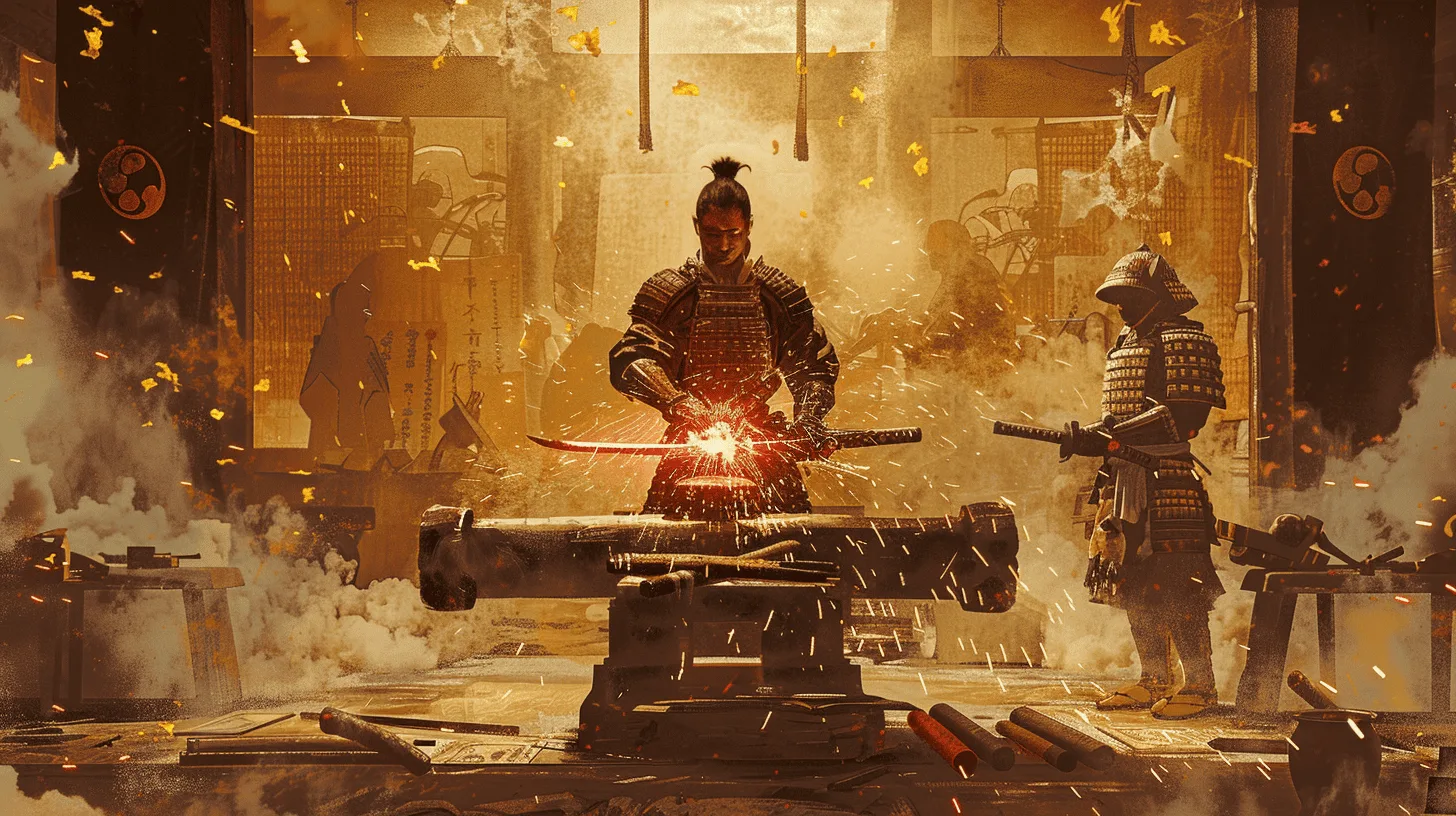
Step 2: Breaking and stacking. Large chunks of tamahagane were broken into smaller pieces, heated in the forge, coated with clay and straw ash (acting as flux to prevent oxidation), and pounded together to create the initial billet.
Step 3: Folding and forge welding. This is perhaps the most famous aspect of katana making, often misunderstood in popular culture. The process involves heating the steel billet to welding temperature (around 1,200–1,300°C), hammering it flat, folding it, then reheating and hammering to weld the layers together—repeated 10–15 times. Folding homogenizes carbon distribution, purifies the steel by squeezing out impurities, refines the grain structure, and creates the visible grain pattern (jihada). However, contrary to myth, folding does not significantly strengthen the blade beyond removing impurities; excessive folding can actually introduce weaknesses.
Step 4: Combining different steels. The katana's legendary properties come from using different steel compositions in different parts of the blade. Common construction methods include kobuse (hard steel wrapped around a soft steel core), honsanmai (hard steel edge, soft steel core, medium-hard steel sides), shihozume (hard steel edge and spine, soft steel core), and Soshu kitae (complex seven-piece construction). The engineering principle is that the katana functions like a composite material, combining properties that single-composition steel cannot achieve: the edge can be extremely hard (around 60–62 HRC) while the core remains relatively soft (around 30–40 HRC), creating a blade that is both sharp and durable.
Step 5: Shaping the blade. Using various hammers and anvils, the smith shapes the blade's length, curve, width, and thickness taper. The classic katana cross-section (shinogi-zukuri) features a distinct ridge line (shinogi) separating the blade face from the back. Edge thickness is extremely thin (0.5–1 mm) for cutting efficiency, and blades taper in both thickness and width from base to tip.
Step 6: Clay coating and differential hardening. This process creates the katana's most visually distinctive feature—the hamon (temper line)—while providing its unique combination of hard edge and flexible spine. The smith applies a thin coat of clay (1–2 mm) to the edge area and a thick coat (3–5 mm or more) to the spine, creating different hamon patterns (straight, wavy, irregular) by varying the application. When the blade is heated and quenched, thin-clay areas cool rapidly, forming hard martensite crystal structure, while thick-clay areas cool slowly, forming softer pearlite/ferrite structure. The transition zone creates the visible hamon line.
Quenching is the most critical and dangerous moment: the blade is heated to approximately 750–800°C, then plunged into water or oil, edge first. Uneven contraction causes the characteristic curve to increase and immense stress throughout the blade; many blades crack or break at this stage.
Step 7: Initial tempering and straightening. Gentle reheating (around 150–200°C) reduces brittleness while maintaining hardness. The smith corrects any warping and adjusts the curve to desired specifications. Finally, the smith signs (mei) the tang (nakago).
Polishing: Revealing the Soul
After forging, the blade goes to a specialist polisher (togishi)—a separate profession requiring years of training. Polishing is not just sharpening; it reveals the blade's internal structure, creates its mirror-like surface, and exposes the hamon and jihada patterns. The process takes weeks to months, using numerous natural Japanese water stones of specific types and grits applied in specific sequences. A master polisher can make or ruin a blade's appearance and value.
Mounting: Completing the Weapon
The blade receives mounts (koshirae) created by specialized craftsmen: the habaki (collar securing the blade in the scabbard), tsuba (guard, often elaborately decorated), tsuka (handle wrapped with ray or shark skin and silk or leather cord), menuki (ornaments under the wrapping), and saya (scabbard, traditionally wood coated with lacquer). Entire teams of specialized artisans—metalworkers, lacquerers, weavers—contributed to creating fully mounted swords, making each piece a collaborative artwork.
Spiritual and Cultural Significance
The Sword as Soul
"The sword is the soul of the samurai" (武士の魂は刀, bushi no tamashii wa katana) was not merely poetic metaphor. A samurai's sword was inseparable from their identity and honor. Carrying a katana brought enormous responsibility—drawing it inappropriately could mean death. Many believed swords possessed spirits, especially famous blades with names and histories. Swords were treated with reverence, properly displayed, and handled with ritual respect.
Famous swords received names, treating them as entities rather than objects.
The Daishō: The Paired Swords
Samurai typically carried two swords: the katana (longer, blade length 60+ cm) and the wakizashi (shorter companion, blade length 30–60 cm). Together, the daishō (大小, meaning "big-little") symbolized the samurai's status and readiness. The katana was the primary battlefield and self-defense weapon; the wakizashi served as a backup, was used indoors, and was employed for seppuku (ritual suicide). Only samurai could legally carry the daishō, visibly marking social status in Edo-period Japan.
Bushidō: The Way of the Warrior
The katana embodied the principles of Bushidō (武士道): righteousness (gi), courage (yū), benevolence (jin), respect (rei), honesty (makoto), honor (meiyo), and loyalty (chūgi). Sword training (kenjutsu) was not merely combat technique—it was character development. The discipline, focus, and self-control required to master the sword were meant to shape moral character.
Religious and Ritual Dimensions
Swords feature prominently in Shinto mythology. The imperial regalia includes a sacred sword (Kusanagi-no-Tsurugi). Shrines often housed famous blades as sacred objects. Zen Buddhism influenced samurai culture and swordsmanship, emphasizing mushin (無心, "no-mind"), present awareness, and acceptance of death. Swordsmiths often performed religious purification before and during forging, treating the creation of swords as sacred acts.
The Katana in Combat: Practical Realities
Actual Combat Use
Contrary to popular belief, the katana was not the samurai's primary battlefield weapon during most of Japanese history. The yumi (bow) was the primary samurai skill for centuries, and in infantry combat, the yari (spear) offered superior reach. The naginata (polearm) provided reach advantage over swords. Swords became primary weapons in close-quarters combat when other weapons were impractical, indoor fighting, surprise encounters, and after primary weapons were broken or lost. During the peaceful Edo period, archery and spear skills declined while swordsmanship flourished.
Combat Techniques
Iaijutsu/Iaido (居合道) is the art of drawing and cutting in one motion, enabling instantaneous response to sudden threats. From a kneeling or standing position, the warrior draws and cuts in a single fluid motion, often targeting the opponent's wrist, neck, or torso. The philosophy is that the fight ends with the draw.
Kenjutsu (剣術) involves swordfighting with a drawn blade. Formal stances (kamae) balance readiness, defense, and attack potential. Cuts emphasize precision to specific targets: do-giri (horizontal cuts to torso), kesa-giri (diagonal cuts from shoulder to opposite hip), and tsuki (thrusts to throat, abdomen, or heart). Defensive techniques create openings for counterattacks. Distance management (ma-ai) is crucial.
Despite one-handed capability, katanas were typically used with two hands for greater power and control.
Limitations and Vulnerabilities
The katana was an excellent cutting weapon but had limitations. Against heavy armor—European plate or Japanese o-yoroi—katana cuts were largely ineffective. Thrusting to armor gaps, specialized armor-piercing weapons, and grappling and dagger work (yoroi kumiuchi) developed for armored combat. Katanas could chip, bend, or break if they struck hard objects at poor angles or were used by unskilled fighters. They required regular cleaning, oiling, and polishing.
Effective katana use required years of training. The myth of cutting through everything—other swords, armor, stone—is unrealistic. Blade-on-blade contact was avoided when possible, and the sharpness and cutting ability, while impressive, were not magical.
Famous Swordsmiths and Legendary Blades
The Five Great Traditions (Gokaden)
Japanese swordsmithing schools centered in five regions, each with distinctive styles: Yamashiro (Kyoto, elegant, straight grain), Yamato (Nara, practical military blades), Bizen (Okayama, beautiful grain patterns like mokume and itame), Sōshū (Kamakura, spectacular hamon with bright nie crystals), and Mino (central Japan, practical blades later famous for mass production).
Legendary Swordsmiths
Masamune (late 13th century) is perhaps the most famous Japanese swordsmith. His blades perfected nie-filled hamon, created spectacular tempering effects, and pioneered aspects of the Sōshū tradition. Only about 70 blades attributed to Masamune survive, each designated a National Treasure. Muramasa (16th century), a Mino school smith, created excellent blades that acquired a dark reputation due to Tokugawa propaganda—the "curse" was probably chance combined with politics. The legend made Muramasa blades symbols of rebellion in popular culture.
Masamune's students, including Sadamune, Yoshimitsu, and Hiromasa, carried forward the Sōshū tradition.
Famous Named Swords
Honjo Masamune, considered the greatest of Masamune's surviving works, disappeared after World War II—its current location unknown. Dōjigiri Yasutsuna ("The Cutter of Children," actually referring to demon-slaying), is one of the Five Swords Under Heaven (Tenka Goken) and a National Treasure. Mikazuki Munechika ("Crescent Moon") is famous for its crescent-moon-shaped nie in the hamon, also among the Five Swords. Kusanagi-no-Tsurugi, the legendary sword from Japanese mythology, is said to be kept at Atsuta Shrine, though no one has seen it in centuries. For further reading on iconic Japanese swords, see the list of National Treasure swords.
Modern Legacy and Cultural Impact
Preservation of Traditional Techniques
The Japanese government designates master swordsmiths as Living National Treasures (Ningen Kokuho), supporting traditional techniques. Swordsmiths must use traditional methods, materials, and tools—no modern machinery for primary forging. New smiths apprentice under masters, but limited demand and grueling work mean few enter the profession. Strict laws regulate sword production and ownership. The Tokyo National Museum often exhibits these masterpieces.
Martial Arts and Modern Practice
Kendo (剣道, "Way of the Sword") uses bamboo swords (shinai) emphasizing character development. Iaido (居合道) focuses on form, precision, and mental discipline with real or replica swords. Kenjutsu schools (koryu) preserve historical fighting techniques. Tameshigiri (試し斬り) involves test-cutting sharp swords on targets (traditionally condemned criminals, now rolled bamboo mats or straw) to demonstrate cutting technique and blade quality.
Cultural Symbolism
The katana appears throughout modern Japanese culture—in anime, manga, films, and video games, spreading globally. High-quality antique katanas command extraordinary prices (millions of dollars for masterworks), while modern reproductions range from cheap decorative pieces to expensive traditionally-made swords.
Separating Myth from Reality
Myth 1: "The Katana Can Cut Through Anything"
Reality: While excellent cutting weapons, katanas cannot cut through armor, stone, other swords, or bone as effortlessly as movies suggest. They are extremely sharp and well-designed for cutting flesh and bamboo armor, but they have physical limitations.
Myth 2: "The Katana Is the Best Sword Ever Made"
Reality: "Best" depends on context. European longswords were better suited to European armored combat; Chinese jian had different advantages. No sword is universally superior—each design optimizes for specific contexts.
Myth 3: "Folding the Steel 1,000 Times Makes It Super-Strong"
Reality: Folding purifies and homogenizes carbon, but after about 10–15 folds, additional folding provides diminishing returns and can introduce weaknesses. The katana's excellence comes from differential hardening and composite construction, not purely from folding.
Myth 4: "Samurai Never Used Guns"
Reality: Samurai readily adopted firearms when they arrived in the mid-1500s. Guns were used extensively, though swords maintained cultural and symbolic importance.
Myth 5: "The Katana Was Primarily a Two-Handed Weapon"
Reality: While typically used with two hands for power, katanas were designed to be usable one-handed when necessary, allowing simultaneous use of both katana and wakizashi or combining the sword with other weapons.
Conclusion: The Enduring Allure of the Katana
Stand again before that museum display, looking at the katana with deeper understanding. You now know that blade was not created by a single person but by multiple master craftsmen—the smelter, the smith, the polisher, and the artisans. Its creation required months of labor, mastery of complex metallurgical processes, and artistic vision combined with technical precision. The patterns you see reveal the blade's internal structure and the processes that created it.
For the samurai who carried it, this was not just a weapon but a physical manifestation of their identity, honor, and commitment to a demanding moral code. The pursuit of the perfect blade reflected broader Japanese cultural values—the belief that anything worth doing deserves complete dedication, that form and function should harmonize, and that true mastery requires a lifetime of focused practice.
The katana endures not because it was the deadliest weapon ever created (it was not) or because it possesses magical properties (it does not), but because it represents the human capacity for excellence. It shows what becomes possible when craftsmen dedicate lifetimes to perfecting their skills, when function and beauty harmonize, when technical knowledge combines with artistic vision, and when physical creation intertwines with spiritual discipline.
The katana teaches that perfection is a direction, not a destination—a constant pursuit that refines both the object being created and the person creating it. In an age of mass production and disposable goods, the katana reminds us that some things gain value through the human dedication invested in their creation. Whether you see it as a weapon, a work of art, a cultural artifact, or a philosophical statement, the samurai katana rewards study and contemplation. It is, ultimately, exactly what its creators intended: a pursuit of perfection, forged in fire, tempered by discipline, and refined through dedication.
For more on the history and philosophy of samurai culture, explore resources at Curious Fox Learning and Hall of Ancient Warriors. For a deeper dive into the metallurgy and craftsmanship, the Metropolitan Museum of Art's Heilbrunn Timeline of Art History offers an excellent scholarly overview of Japanese swords.