Table of Contents
Introduction: Where History Meets Legend
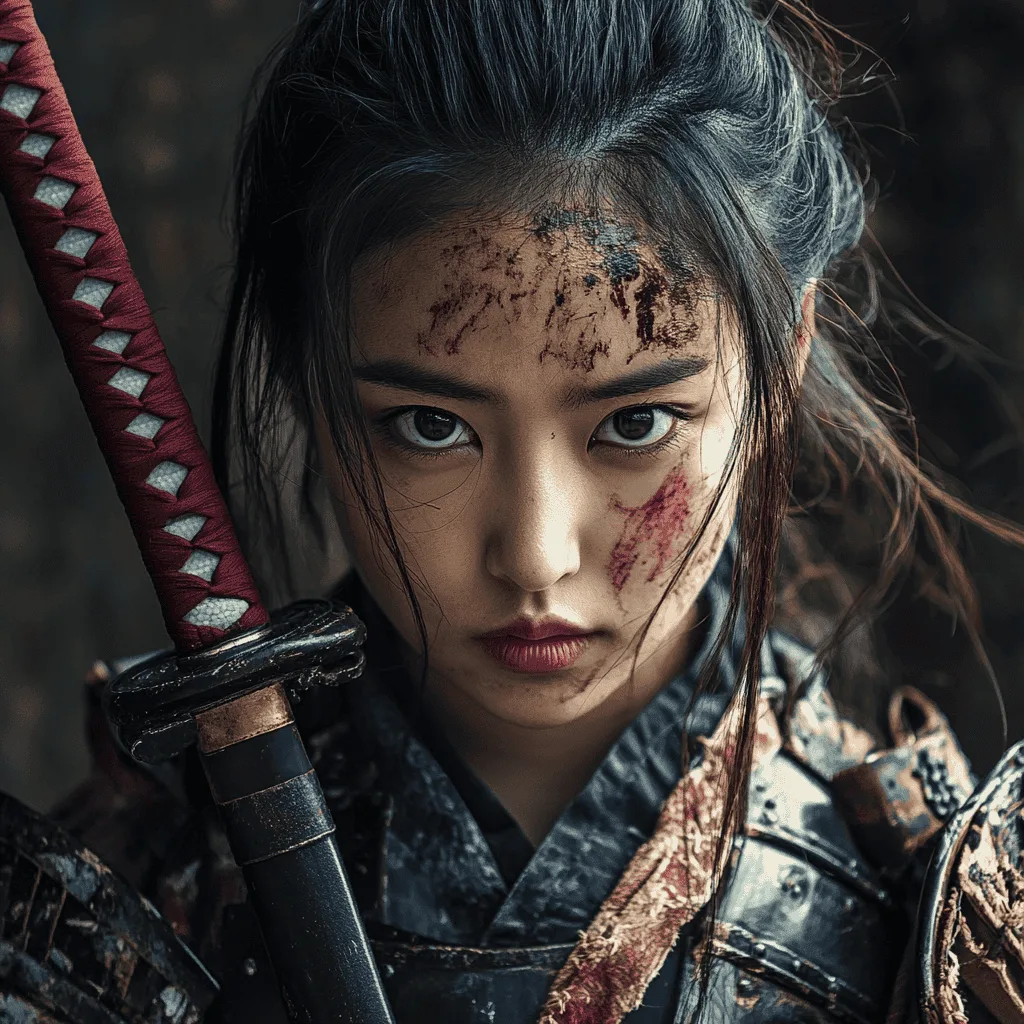
Tomoe Gozen stands as the most renowned female warrior in Japanese cultural memory — a figure who, whether rooted in fact or myth, has shaped ideas about women, warfare, and samurai values for over eight hundred years. The Heike Monogatari (The Tale of the Heike), a thirteenth-century war epic, paints her as a breathtakingly beautiful and lethal commander who fought alongside Minamoto no Yoshinaka during the Genpei War (1180–1185). In the epic, she charges into battle as Yoshinaka’s first captain, wielding a bow and sword with superhuman skill, only to vanish from history after her master’s death.
The historical reality is less certain but no less fascinating. No contemporary documents from the 1180s mention Tomoe. Every detail of her life comes from texts composed decades or centuries later, often mixing fact with literary invention. Yet most historians accept that a woman named Tomoe probably existed and likely held some martial role in Yoshinaka’s household. The weight of tradition, local lore in the Kiso region, and the consistency of her depiction across multiple medieval sources suggest a real person behind the legend — even if her specific exploits were exaggerated or invented.
This tension between fact and story is precisely what makes Tomoe Gozen a powerful cultural symbol. Her tale reveals how medieval Japan imagined the limits and possibilities of female agency, how warrior values were applied across genders, and how stories can outlive their subjects to shape national identity. In modern times, she has been reclaimed as a feminist icon, a video game character, and a symbol of women’s martial capability — each generation finding new meaning in her enigmatic story.
The World of the Genpei War
Civil War That Forged the Samurai Age
The Genpei War was the crucible in which samurai identity was forged. For five years, the Taira (Heike) and Minamoto (Genji) clans fought for control of Japan. The Taira had dominated the imperial court through military service and political marriages, but resentment simmered among provincial warriors and aristocrats who felt their power was eclipsed. When Prince Mochihito issued a call for the Minamoto to rise in 1180, the conflict exploded into a nationwide war.
Battles raged from the capital in Kyoto to the northern provinces. Both sides employed mounted archers, infantry, and warrior monks from powerful Buddhist temples. The war reached its climax at the naval battle of Dan-no-ura in 1185, where the Minamoto crushed the Taira fleet. Minamoto no Yoritomo emerged victorious, establishing the Kamakura Shogunate — Japan’s first military government — and cementing the samurai class as the ruling elite for centuries to come.
It was in this chaotic, violent landscape that Tomoe Gozen reportedly made her mark. The war produced many heroes and villains, but few figures have captured the imagination as persistently as this female warrior.
Minamoto no Yoshinaka: The Master She Served
Minamoto no Yoshinaka — also known as Kiso Yoshinaka — was a cousin of the eventual victor Yoritomo. He was raised in the Kiso mountains after his father’s murder and built a reputation as a fierce, unconventional warrior. In 1183, he led his forces to a stunning victory against the Taira at the Battle of Kurikara, driving the enemy from the north and entering Kyoto as a liberator.
But Yoshinaka’s rough, rustic soldiers alienated the imperial court, and his rivalry with Yoritomo deepened. In early 1184, Yoritomo’s forces turned against him. Yoshinaka’s army disintegrated, and he was killed at the Battle of Awazu with only a handful of retainers. It is during this final stand that Tomoe appears most vividly in the Heike Monogatari — and where her story reaches its dramatic climax.
The Evidence: What Documents Tell Us
The Tale of the Heike: Our Primary Source
The Heike Monogatari is not a dry historical chronicle but a literary epic performed by blind monks who chanted it to the accompaniment of a lute. It blends genuine historical events with Buddhist morality tales, romance, and dramatic embellishment. The description of Tomoe occupies only a few paragraphs, but those lines have resonated across centuries:
“Tomoe was especially beautiful, with white skin, long hair, and charming features. She was also a remarkably strong archer, and as a swordswoman she was a warrior worth a thousand, ready to confront a demon or a god, mounted or on foot. She handled unbroken horses with superb skill; she rode unscathed down perilous descents. Whenever a battle was imminent, Yoshinaka sent her out as his first captain, equipped with strong armor, an oversized sword, and a mighty bow; and she performed more deeds of valor than any of his other warriors.”
The text then recounts that at Awazu, with only a handful of men remaining, Yoshinaka ordered Tomoe to flee, saying it would be shameful to die with a woman. She initially refused but then made one last charge: she grabbed a renowned enemy warrior, pulled him from his horse, pinned him against her saddle, and cut off his head. She then rode away and disappeared from history.
Other References and the Scholarly Debate
Besides the Heike, Tomoe appears in the Genpei Jōsuiki (a later expanded version of the tale) and in local genealogies from the Kiso region. Some traditions claim she later became a nun, married a warrior named Wada Yoshimori, or lived to old age. None of these accounts are corroborated by contemporary records.
Scholars are divided into three broad positions:
- Skeptics view Tomoe as a purely literary invention — a narrative device created to highlight Yoshinaka’s humanity or to embody the tragic elegance of the fallen Heike.
- Moderates (likely the majority) accept that a woman named Tomoe existed and had some martial role, but argue that her battlefield exploits were greatly exaggerated by later storytellers.
- Believers take the Heike account at face value, arguing that medieval chronicles, while literary, were rooted in oral tradition and historical memory.
The truth is probably somewhere in the middle. The lack of contemporary documentation is not surprising — women were rarely recorded in official military records. But the precise, heroic detail of her story suggests literary crafting. What matters most is that Tomoe has become real through cultural memory, regardless of what actually happened in 1184.
Women Warriors in Medieval Japan: The Onna-Musha
A Broader Tradition Than Often Assumed
Tomoe was not a complete anomaly. Medieval Japan recognized a category of female warriors called onna-musha or onna-bugeisha — women who were trained in martial arts and occasionally fought. Samurai families often taught both sons and daughters how to handle weapons, especially the naginata (a polearm with a curved blade), which gave women reach and leverage against armored men.
Women’s martial training served practical purposes: defense of the household when men were away at war, the ability to perform ritual suicide (jigai) with dignity if captured, and the preservation of family honor. But some women went beyond defense and took the field themselves.
Other Historical Female Warriors
Tomoe is the most famous, but she had company:
- Empress Jingū (legendary, c. 3rd century) was said to have led a military campaign to Korea while pregnant.
- Hangaku Gozen (early 13th century) defended a castle against the Hōjō, shooting arrows that killed dozens before she was captured.
- Hōjō Masako (1157–1225) was the wife of Minamoto no Yoritomo and later wielded enormous political power as the “nun shogun,” commanding military forces herself.
- Nakano Takeko (1847–1868) led the Jōshitai, a unit of female warriors, during the Boshin War. She died in combat at age 21, and her unit’s story is still celebrated.
These examples show that women warriors, while exceptional, were not unthinkable in Japanese culture. The samurai code of bushidō — with its emphasis on loyalty, courage, and skill — did not explicitly exclude women, even if society largely did.
Development of the Legend
Medieval and Edo Periods
After the Heike Monogatari cemented her image, Tomoe became a staple of Noh and kabuki theater. In Noh, she often appears as a ghost reliving her final battle, a melancholic figure haunted by her violent past. Kabuki adaptations emphasized the romance between Tomoe and Yoshinaka, turning her story into a tragic love tale.
During the Edo period (1603–1868), woodblock print artists like Utagawa Kuniyoshi produced dramatic images of Tomoe. These prints portrayed her as both beautiful and ferocious, often shown on horseback in full armor, cutting down male enemies. These visual depictions helped fix her in the popular imagination as the archetypal warrior woman.
Modern Reinterpretation
The Meiji period (1868–1912) saw Tomoe co-opted by nationalist ideologues who held her up as an example of traditional Japanese spirit. At the same time, women’s education reformers used her story to argue for physical training for girls. Novelists of the twentieth century fleshed out her biography, inventing childhoods and later lives to satisfy reader curiosity.
In the late twentieth and early twenty-first centuries, Tomoe underwent a feminist reclamation. Historians highlighted her to challenge narratives of total female subjugation in pre-modern Japan. Gender equality activists pointed to her as evidence that women could fight in combat roles. She appeared in textbooks alongside famous male samurai.
Cultural Significance: Gender, Power, and Memory
An Ambivalent Symbol
Tomoe’s legend is deeply ambivalent. On one hand, she proves that a woman could be a warrior, a captain, a killer of men. She is described as fighting better than any of Yoshinaka’s other warriors. On the other hand, she is ordered to leave the battlefield because she is a woman. Her final act of loyalty is to obey her master and disappear.
The legend thus both challenges and upholds gender hierarchies.
This tension has made her a malleable symbol. For conservatives, she represents the ideal female subject: beautiful, skilled, yet ultimately submissive to male authority. For feminists, she represents the subversive potential of women who exceed their prescribed roles. Both readings are possible because the text itself is ambiguous.
Embodiment of Bushidō
Regardless of gender, Tomoe embodies core samurai values: loyalty to one’s lord (chū), courage in the face of death (yū), honor (meiyō), and duty (gimu). Her story is often used to teach these values. In this sense, she is not a “female samurai” but simply a samurai who happens to be a woman.
Tomoe in Contemporary Culture
Video Games, Anime, and Manga
Tomoe appears as a playable character in the Samurai Warriors and Warriors Orochi series, where she is depicted as a graceful yet deadly warrior with a naginata. In Fate/Grand Order, she is a servant class archer with tragic backstory elements from the Heike. The game Nioh 2 features her as a boss and later ally. These portrayals emphasize her supernatural combat skills and tragic romance, introducing her to new generations of fans worldwide.
Feminist Icon and Scholarly Subject
Academic interest in Tomoe has grown. Historians debate her historicity in journals and conferences. Gender studies scholars analyze how her legend reflects and shapes attitudes toward women in combat. Comparative studies place her alongside Joan of Arc, Mulan, and Boudica, exploring how different cultures remember women warriors.
Tourism and Heritage
In the Kiso region, local governments promote Tomoe tourism. Signage marks sites associated with her and Yoshinaka. A statue stands in Kiso-Fukushima, and annual festivals reenact scenes from the Heike. Museums display armor and weapons said to be of the period. This heritage industry keeps her memory alive and economically valuable.
Broader Historical Questions
Why Some Women Warriors Are Remembered
Tomoe’s enduring fame is exceptional. Most women who fought in history were forgotten because they did not fit the narrative templates that cultures use to preserve memory. Tomoe survived because she was tied to a famous male leader, because her story was recorded in a canonical literary work, because her ending was dramatic and mysterious, and because she could be romanticized as both beautiful and deadly. Women warriors who lived ordinary lives after war, or who fought independently without male association, rarely entered the historical record.
The “Exceptional Woman” Trap
Celebrating Tomoe as exceptional can inadvertently reinforce the idea that women cannot normally be warriors. If she is the one woman who could do these things, then other women’s failures or exclusions seem natural. Modern historians try to navigate this by emphasizing that Tomoe was not entirely unique — other onna-musha existed — while acknowledging that war was overwhelmingly male. The goal is to use her story to broaden, not narrow, our understanding of women’s historical agency.
Conclusion: A Legend for All Eras
Tomoe Gozen exists in that fertile boundary between history and myth. We may never know for sure whether she cut off a man’s head at Awazu or whether she was entirely a storyteller’s invention. But that uncertainty is precisely what makes her powerful. A purely historical figure would be bound by facts; a legendary one can be endlessly reshaped.
Over eight centuries, her story has been told and retold: in medieval battle tales, in Noh plays, in kabuki dramas, in woodblock prints, in nationalist propaganda, in feminist manifestos, in anime and video games. Each version has found in Tomoe what it needed — a model of loyalty, a symbol of resistance, a tragic lover, a martial heroine. The core of the legend remains remarkably stable: a beautiful woman of extraordinary skill who fought for her lord until the end and then vanished.
Her greatest legacy may be not on any battlefield but in the cultural imagination. She proves that even in a deeply patriarchal society, women could be imagined as warriors, leaders, and heroes. She offers a counter-narrative to the idea that women have always been passive in history. And she shows how stories about the past can inspire the present, whether as a role model for girls, a character to play in a game, or a case study in the power of myth.
Tomoe Gozen remains, after eight centuries, a compelling figure — not because we know her, but because we can imagine her, and in imagining her, we explore our own ideas about courage, gender, honor, and the meaning of a life.
Further Resources
- For a scholarly overview of female warriors in Japan, see “The Female Warrior in Medieval Japan” by R. W. McCullough
- Historical context on the Genpei War is available at the Samurai Archives
- Modern interpretations of Tomoe in popular culture are surveyed in this ANIME NEWS NETWORK article on warrior women in anime