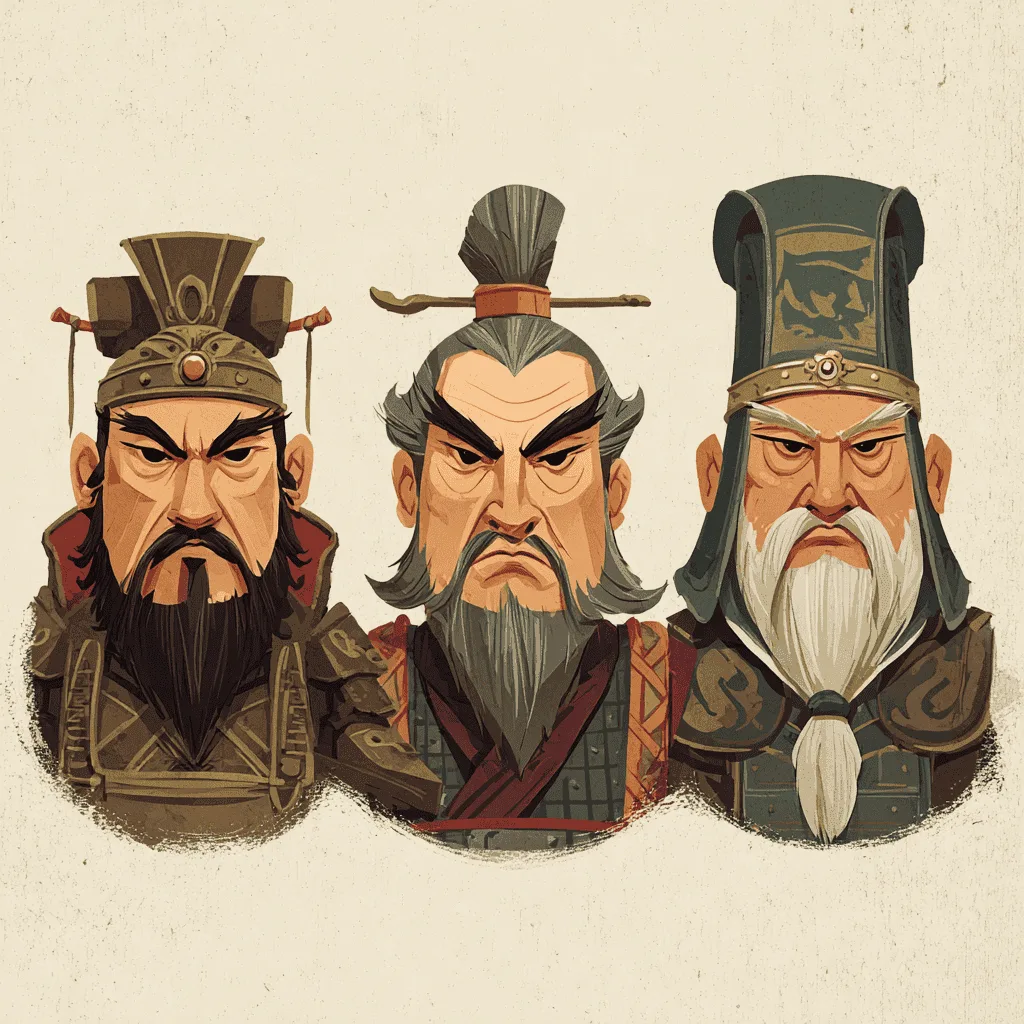
The Generals Who Unified China Under Qin Shi Huang: Complete Military History
The Generals Who Built China's First Empire
The unification of China in 221 BCE under Qin Shi Huang stands as one of the most consequential military and political achievements in world history. For over two centuries, seven warring kingdoms had fought in brutal conflict. They were forged into a single centralized empire that defined Chinese civilization for two thousand years. This transformation was not the work of one ruler alone. It required the exceptional skill, strategic vision, and relentless dedication of legendary generals who commanded Qin's armies through decades of conquest.
These commanders—principally Wang Jian, his son Wang Ben, Meng Tian, and Li Xin—systematically dismantled the rival states of Han, Zhao, Wei, Yan, Chu, and Qi. Their victories were not simple battlefield triumphs. They were carefully orchestrated campaigns combining intelligence operations, psychological warfare, sophisticated siegecraft, and innovative tactics that overwhelmed larger enemy forces through patience, guile, and overwhelming force.
Understanding these generals is essential to grasping how Ying Zheng—a 13-year-old king of a relatively small northwestern state dismissed as crude by its neighbors—became China's First Emperor. Their military genius provided the force for political unity, while the emperor's administrative reforms and Legalist philosophy supplied the structure to maintain it.
Key Takeaways
- Qin Shi Huang unified China in 221 BCE after a decade of campaigns that conquered six rival states
- Wang Jian and his son Wang Ben were the primary architects of military victory, personally conquering five of the six states
- The generals employed innovative strategies including deception, patience, overwhelming force, and psychological warfare
- Meng Tian defended the northern frontier against the Xiongnu and supervised construction of early sections of the Great Wall with 300,000 troops
- Military success was built on Qin's Legalist philosophy emphasizing strict laws, meritocracy, and centralized command
- The unification ended 254 years of the Warring States Period and established patterns for Chinese governance lasting two millennia
- Despite their achievements, several generals including Meng Tian were executed during palace intrigues following Qin Shi Huang's death
Background: The Warring States Period and Qin's Rise
To understand Qin's military unification, one must grasp the chaotic world these generals operated in—a China fragmented into competing kingdoms locked in perpetual warfare.
Two and a Half Centuries of Conflict
The Warring States Period (475–221 BCE) emerged from the collapse of Zhou dynasty authority. The Zhou had ruled China since approximately 1046 BCE through a feudal system where the king granted territories to noble vassals in exchange for military service and loyalty. Over centuries, these vassals became increasingly independent, treating Zhou kings as ceremonial figureheads while competing among themselves for power.
By 475 BCE, seven major states dominated: Qin in the northwest, Han in the central region, Zhao in the north, Wei in the center, Yan in the northeast, Chu in the south, and Qi in the east. Dozens of smaller states were gradually absorbed by these seven, creating an ever-more concentrated struggle for supremacy.
This era witnessed constant warfare, shifting alliances, and remarkable military innovation. States competed to field larger armies, develop better weapons and tactics, and attract talented generals and advisors. Warfare evolved from aristocratic chariot battles to mass infantry formations employing crossbows, cavalry, and sophisticated siege equipment. Professional armies replaced feudal levies, and military strategy became increasingly sophisticated.
The human cost was staggering. Battles involving hundreds of thousands of soldiers became common, with casualty rates that would horrify even by modern standards. The infamous Battle of Changping (260 BCE) saw Qin general Bai Qi defeat Zhao, then reportedly bury alive 400,000 captured Zhao soldiers—numbers that may be exaggerated but indicate the scale and brutality of conflicts.
Constant warfare drove state consolidation and centralization. Successful states developed efficient bureaucracies to extract resources, maintain large standing armies, and coordinate complex campaigns. Those that failed to adapt were conquered and absorbed. The Warring States Period served as a brutal selection process where only the most effectively organized and militarily powerful states survived.
By the mid-3rd century BCE, the contest had narrowed primarily to Qin versus the other states, which increasingly formed coalitions to resist Qin expansion. Yet these alliances proved fragile, undermined by mutual distrust and Qin's skillful diplomacy that exploited rivalries and bribed key officials.
Qin's Legalist Foundation: Creating a War Machine
What made Qin different from its rivals? Why did this northwestern frontier state, considered culturally backward by the sophisticated eastern kingdoms, ultimately triumph?
The answer lies primarily in Qin's wholesale adoption of Legalism—a political philosophy emphasizing strict laws, harsh punishments, centralized authority, and subordination of all social interests to state power. In the mid-4th century BCE, the statesman Shang Yang implemented radical Legalist reforms in Qin that transformed a relatively weak state into a military powerhouse.
His reforms included abolishing the old aristocratic system, where noble families lost hereditary privileges and rank came exclusively through military merit. Even peasants could gain noble status by bringing enemy heads to the state. He implemented collective responsibility by organizing the population into groups who bore collective responsibility for each other's behavior, creating a surveillance state where citizens monitored each other. He standardized laws and punishments with clear, published laws applied uniformly, where punishments were severe enough to keep the population compliant. He encouraged agriculture while restricting commerce, maximizing food production and trained fighters. He created an efficient bureaucracy appointed based on ability rather than birth, enabling Qin to mobilize resources more effectively than rivals still operating under feudal systems.
When Ying Zheng ascended the throne of the Qin state in 246 BCE, the country had long established a ruthless, autocratic system that prioritized military expansion and state power above all else. These reforms made Qin society more militarized, mobilized, and brutal than its neighbors—characteristics that translated directly into battlefield advantages.
Ying Zheng's Path to Power
Ying Zheng was born in 259 BCE under controversial circumstances. His father, Zichu, was a prince of Qin held hostage in the state of Zhao. Through the machinations of the wealthy merchant Lü Buwei, Zichu became king of Qin, and Ying Zheng may have been Lü Buwei's biological son, though this remains historically uncertain.
When Zichu died in 247 BCE, 13-year-old Ying Zheng became King of Qin. Lü Buwei served as regent during his minority. A critical moment came when a figure named Lao Ai, emboldened by his relationship with the queen dowager, attempted a coup in 238 BCE when Ying Zheng reached maturity. The young king crushed the rebellion, executed the conspirators, exiled his mother, and forced Lü Buwei into retirement, where he eventually committed suicide.
These experiences shaped Ying Zheng profoundly. He learned to trust no one completely, to act decisively against threats, and to maintain absolute control. By 230 BCE, Ying Zheng had consolidated power and launched the wars of unification. His ambition was not simply to dominate other states but to conquer and absorb them completely, replacing the entire feudal system with centralized imperial rule under his personal authority.
This vision required military commanders of exceptional ability who could win battles against numerically superior enemies, conquer vast territories, and maintain discipline over enormous armies operating far from Qin's core territories. In Wang Jian and his colleagues, Ying Zheng found exactly such commanders.
The Supreme Commander: Wang Jian
Wang Jian stands as the greatest general of the unification wars, personally leading campaigns that conquered three of the six rival states and planning the conquest of a fourth. His military genius, political astuteness, and remarkable longevity made him indispensable to Qin's victory.
Background and Early Career
Wang Jian was born in Dongxiang, Pinyang, in the Guanzhong region around the early 3rd century BCE. Unlike many generals who came from established military families, Wang Jian rose through the ranks based purely on ability—a possibility under Qin's meritocratic system that would have been impossible in states still dominated by hereditary aristocracies.
During his youth, teenage king Ying Zheng met young officer Wang Jian, and a relationship of deep trust developed. This proved crucial—Wang Jian gained the king's complete trust, rare for the suspicious Ying Zheng, while the king gained a military commander of unparalleled skill. In 236 BC, Wang Jian commanded the Qin army which attacked Zhao and captured nine cities, marking the start of Ying Zheng's wars of unification.
Conquest of Zhao: Spies, Siege, and Systematic Destruction
The conquest of Zhao proved particularly challenging. Zhao possessed capable generals, especially Li Mu, one of the era's finest military commanders. Li Mu understood Qin tactics and knew how to counter them, building defensive positions and avoiding direct confrontation where Qin's superior training and discipline would prevail.
In 229 BC, Qin took advantage of natural disasters in Zhao to launch a two-pincer attack on Handan, the capital. Three Qin armies embarked from Shangdi, Jingxing, and Henei, respectively led by Wang Jian, Jiang Lei, and Yang Duanhe. Li Mu's defensive strategy stymied the Qin advance. His troops built fortifications and refused battle, creating a stalemate that could have dragged on indefinitely.
Wang Jian responded with political warfare. The Qin state bribed Guo Kai, a minister in Zhao, to sow discord between King Qian of Zhao and Li Mu. Through lies and fabrications, Guo Kai convinced the king that Li Mu was secretly negotiating with Qin and planning rebellion. King Qian removed Li Mu from command and eventually executed him—eliminating Qin's most dangerous opponent through corruption rather than combat. With Li Mu gone, Wang Jian attacked and captured Handan in 228 BCE, and the Kingdom of Zhao ceased to exist.
Conquest of Yan: Assassination Attempts and Strategic Patience
After Zhao's fall, the state of Yan realized it would be next. Crown Prince Dan of Yan sent Jing Ke to assassinate Ying Zheng, but the attempt failed spectacularly. In 226 BC, using the assassination attempt as an excuse, Ying Zheng ordered Wang Jian to lead an army to attack Yan. The Qin defeated the Yan army on the eastern bank of the Yi River, after which they captured the Yan capital, Ji (present-day Beijing). The king of Yan and Crown Prince Dan fled with their remaining forces to the Liaodong Peninsula.
General Li Xin, with several thousand men, pursued the retreating Yan forces, destroyed the bulk of Yan's army, and captured Crown Prince Dan. The desperate Yan king ordered his son's execution and sent his head to Qin as an apology. Qin accepted the offer and temporarily ceased attacking Yan, allowing the remnant state to survive until 222 BCE when it was finally absorbed.
The Great Campaign Against Chu: Patience as Strategy
Wang Jian's conquest of Chu represents the pinnacle of his military career. Chu was enormous—larger than all other states combined, with vast resources, a warrior tradition, and capable generals. Conquering Chu required not just defeating armies but occupying and controlling territory stretching from the Yangtze River valley to the southern coast.
In 225 BC, only two kingdoms remained independent: Chu and Qin. Ying Zheng called a council to discuss the Chu invasion. He asked Wang Jian how many troops would be needed. Wang Jian said the invasion force needed to be at least 600,000 strong, while Li Xin thought that less than 200,000 men would be sufficient. Ying Zheng, influenced by Li Xin's confidence and perhaps hoping to conserve resources, chose the smaller force. Wang Jian, seeing his advice rejected, claimed illness and retired to recuperate at home.
The initial Qin invasion under Li Xin and Meng Tian appeared successful, capturing several cities. But the Chu general Xiang Yan (grandfather of the famous Xiang Yu who would later nearly destroy the Qin dynasty) was waiting. He attacked Li Xin's army with 500,000 troops and completely annihilated Li's force in unfamiliar territory—one of Qin's worst defeats during the unification wars.
Upon learning of Li Xin's defeat, Ying Zheng visited Wang Jian, apologized for not heeding his advice, and invited him back to serve. He put Wang Jian in command of the 600,000 troops he had requested earlier, with Meng Wu serving as his deputy.
Wang Jian knew Ying Zheng did not fully trust him. Commanding 600,000 soldiers meant controlling enough force to threaten Qin itself if Wang Jian chose rebellion. To reduce the king's suspicions, he maintained close contact by frequently sending messengers to report his progress and request rewards for his family. This behavior suggested he was focused on enriching his family rather than plotting rebellion.
Wang Jian's campaign strategy confounded everyone. After invading Chu territory, he constructed strong fortifications and simply stayed there for over a year, refusing battle despite Chu armies challenging him repeatedly. He focused on training his troops, studying Chu geography, ensuring supply lines, and waiting. He knew that maintaining 600,000 soldiers in the field strained Chu's resources and that eventually, economic pressure would force Chu to either attack on unfavorable terms or disperse their army.
After a year, Chu decided to disband most of their army due to the apparent lack of action. Wang Jian then invaded and overran Huaiyang and the remaining Chu forces. The sudden offensive caught Chu completely unprepared. In 224 BC, after the Qin army under Wang Jian made camp at Pingyu, the Chu army led by Xiang Yan assaulted the Qin camp but failed to push back the invaders. Wang Jian held his position, refusing to attack as Xiang Yan had wanted, and the Chu force withdrew. As the Chu army was doing so, Wang Jian launched a surprise attack.
Xiang Yan was defeated at the battle of Shouchun and withdrew to Qinan, where he was killed in battle or committed suicide. In 223 BC, Wang Jian conquered the Chu capital Shouchun and captured King Fuchu of Chu. The following year, Wang Jian and Meng Wu led Qin forces to attack the Wuyue region, capturing descendants of the ancient royal family of Yue. These conquered territories became part of the expanding Qin Empire.
Retirement and Legacy: The General Who Lived in Peace
Unlike many successful generals throughout history who were executed by suspicious rulers, Wang Jian survived. After the establishment of the Qin Dynasty in 221 BCE, Wang Jian and Wang Ben immediately resigned from their political and military positions. Wang Jian and his family left the powerful Emperor Qin Shi Huang, gave up their power, and lived in seclusion. Wang Jian also forbade his descendants from joining the military anymore, believing that he and his son had already taken away many people's lives on the battlefields.
This voluntary retirement demonstrated remarkable wisdom. Wang Jian understood that in autocratic systems, successful generals posed inherent threats to rulers. By voluntarily surrendering power and withdrawing from politics, he removed himself as a potential threat and ensured his family's survival. His descendants prospered, with the Taiyuan Wang clan and Langya Wang clan claiming descent from him. During the Tang dynasty, eleven prime ministers came from these Wang clans.
Wang Ben: Completing the Conquest
Wang Ben, son of Wang Jian, proved himself a worthy successor to his father's military genius. While Wang Jian conquered Zhao, Yan, and Chu, Wang Ben defeated Wei and Qi—the final two states standing between Qin and complete unification.
Conquest of Wei: Hydraulic Warfare
In 225 BCE, after Chu's fall, only three independent states remained: Wei, Qi, and the remnant of Yan. Wei occupied strategic territory in the central plains but was surrounded by Qin-controlled lands on three sides. Wang Ben led the Qin army against Wei's heavily fortified capital at Daliang. Rather than attempting costly direct assault on the walls, Wang Ben employed an innovative strategy: he diverted the Yellow River and Bian River to flood the city.
By breaking river dikes and directing water toward Daliang, Wang Ben created an artificial flood that undermined the city's walls and made life unbearable for defenders and civilians alike. After three months, the walls collapsed and Wei surrendered. This conquest showcased how Qin generals combined traditional military tactics with engineering expertise—using terrain, water, and infrastructure as weapons.
Conquest of Yan and Qi
In 222 BCE, Wang Ben led forces that finally eliminated the last Yan territory in the Liaodong Peninsula. By 221 BCE, only Qi remained independent. For years, Qin had bribed Qi's chancellor Hou Sheng to advise King Tian Jian of Qi not to assist other states when they were attacked by Qin. This cunning diplomacy kept Qi neutral while Qin conquered everyone else.
When Qin finally moved against Qi, Hou Sheng convinced the king that resistance was futile. Wang Ben's force avoided direct confrontation with the Qi armies and advanced into the heartland via a southern detour from Yan. When the Qin army arrived at Linzi, the capital of Qi, the king was caught by surprise and surrendered without putting up a fight. This bloodless conquest demonstrated that Qin's unification resulted from a sophisticated combination of military pressure, diplomatic manipulation, bribery, and psychological warfare.
Meng Tian: Guardian of the Northern Frontier
While Wang Jian and Wang Ben conquered rival Chinese states, Meng Tian distinguished himself defending Qin's northern border and extending control into territories inhabited by nomadic peoples.
Military Background
Meng Tian (c. 250 BC – 210 BC) descended from a great line of military generals. His grandfather, Meng Ao, was a general from the era of King Zhao, and his father, Meng Wu, served as deputy to Wang Jian during the conquest of Chu. This pedigree gave Meng Tian exceptional training from childhood. In 224 BC, he served as vice-general under Li Xin during the disastrous first invasion of Chu, sharing responsibility for the defeat but apparently learning from it.
The Xiongnu Campaign and the Great Wall
After China's unification in 221 BCE, Qin Shi Huang's expansionist ambitions did not end. In 215 BCE, he ordered Meng Tian to lead over 300,000 troops to drive away the Xiongnu, nomadic peoples who dominated the Eurasian steppes and had been encroaching on northern territories. Meng Tian's campaign pushed the Xiongnu out of the Ordos Plateau region, giving Qin control over strategically important grazing lands.
Qin Shi Huang then ordered the building of what became the Great Wall of China to protect the empire from northern nomads. Meng Tian supervised this massive construction project, linking and extending older walls made by earlier states. The project required coordinating hundreds of thousands of laborers over thousands of miles of difficult terrain. The wall worked as both a barrier and a signal system using watchtowers, allowing rapid communication about Xiongnu movements and concentrating defensive forces where needed.
For detailed background on the Xiongnu and their conflicts with Qin, see Encyclopedia Britannica's overview of the Xiongnu.
Tragic End: Victim of Palace Intrigue
Despite his loyal service, Meng Tian died tragically during the political chaos following Qin Shi Huang's death in 210 BCE. The emperor died while on a tour of eastern provinces, and his death was initially concealed by the chief eunuch Zhao Gao and Prime Minister Li Si, who conspired to manipulate the succession. They forged a letter from Qin Shi Huang commanding the emperor's eldest son Fusu and General Meng Tian to commit suicide. Meng Tian was forced to commit suicide in prison, and his family was killed. This execution eliminated one of Qin's most capable military commanders and contributed to the dynasty's rapid collapse.
Li Xin: Talented Commander with Mixed Fortune
Li Xin played significant roles in multiple campaigns but is best remembered for his catastrophic defeat in the first Chu invasion. He participated successfully in the conquest of Zhao and pursued the retreating Yan forces, destroying much of their army and capturing Crown Prince Dan. However, his overconfidence during the first Chu invasion in 224 BCE led to disaster. When he claimed 200,000 troops would suffice versus Wang Jian's requested 600,000, Ying Zheng gave him command, and Xiang Yan's counterattack annihilated his force.
Despite this humiliation, Li Xin continued serving Qin. He participated in the final conquest of Qi alongside Wang Ben and contributed to other campaigns. After Qin's unification, Li Xin retired to the area of modern Gansu, where he was bestowed the title of 'Marquis of Longxi' by Qin Shi Huang. Li Xin's descendants achieved greatness: he was the great-great-grandfather of Li Guang, a famous Han dynasty general. You can explore more about the later Han dynasty context in Britannica's profile of Qin Shi Huang.
Military Strategies That Enabled Unification
Qin's unification resulted from systematic application of strategic principles, innovative tactics, and ruthless efficiency that overwhelmed rivals.
Sequential Conquest and Intelligence Operations
Rather than fighting all enemies simultaneously, Qin attacked states individually while using diplomacy to keep others neutral. The sequence mattered: Han fell first as the weakest, Zhao second despite being strong militarily, Yan third, Wei fourth, Chu fifth, and Qi last after complete isolation. Qin invested heavily in espionage, bribery, and political warfare. The bribery of Guo Kai in Zhao led to Li Mu's execution, removing Qin's most dangerous opponent without fighting. The bribery of Hou Sheng in Qi kept that state neutral until surrounded and helpless.
Overwhelming Force and Engineering
Wang Jian's Chu campaign demonstrated Qin's willingness to commit overwhelming resources and wait for optimal conditions. The 600,000-man army and year-long wait showed strategic patience rare in military history. Wang Ben's flooding of Daliang demonstrated sophisticated siege techniques. Qin generals understood how to use terrain, water, and infrastructure as force multipliers.
Psychological Warfare and Standardization
Qin deliberately cultivated a reputation for invincibility and ruthlessness. The massacre of Zhao prisoners at Changping sent a message: resistance meant total destruction. This reputation sometimes caused enemy states to surrender without fighting, as Qi ultimately did. Qin also standardized weapons, training, and tactics across all forces, enabling units from different regions to coordinate effectively and allowing interchangeable parts for weapons and equipment.
For a deep dive into Qin's military organization and weaponry, Wikipedia's article on Qin's Wars of Unification offers extensive detail.
Legacy and Impact on Chinese History
The military achievements of Wang Jian, Wang Ben, Meng Tian, and their colleagues shaped Chinese civilization in ways extending far beyond their lifetimes.
The Terracotta Army and Imperial Legacy
Near Xi'an, Qin Shi Huang created the Terracotta Army to guard his tomb. This army includes thousands of life-sized terracotta soldiers, horses, and chariots arranged in battle formation, reflecting the emperor's actual military forces. It remains one of the greatest archaeological finds related to ancient Chinese military history.
Influence on Subsequent Dynasties
The Han dynasty (206 BCE - 220 CE) initially rejected much of Qin's harsh Legalism but retained and perfected Qin's centralized administrative system. Military organization and strategy developed under Qin influenced all subsequent Chinese dynasties. The concept of professional armies under centralized command, merit-based promotion, and systematic conquest strategies became models for later military thinkers. The Great Wall established by Meng Tian became China's most iconic symbol, representing both defensive strength and the human cost of imperial ambition.
Lessons in Leadership and Loyalty
Wang Jian's survival through voluntary retirement taught important lessons about managing relationships with autocratic rulers. His decision to surrender power ensured his family's prosperity. Conversely, Meng Tian's execution despite loyal service demonstrated the dangers of palace politics. His fate illustrated how political skill mattered as much as military ability.
Conclusion
The unification of China under Qin Shi Huang represents one of history's most significant military and political achievements. Wang Jian, Wang Ben, Meng Tian, and Li Xin provided the military force necessary to conquer rival states, but their success resulted from more than battlefield victories. These generals operated within a systematic framework that combined military innovation, political warfare, economic capacity, and ruthless efficiency. They faced larger enemies, hostile terrain, and desperate resistance, yet consistently achieved victory through superior strategy, patience, and an understanding that warfare extends beyond direct combat to encompass psychology, economics, and politics.
Wang Jian's campaigns particularly demonstrated strategic brilliance rare in military history. His conquest of Chu using patience, overwhelming force, and psychological insight stands as a masterpiece of strategic thinking. His political wisdom in managing his relationship with Qin Shi Huang and voluntarily surrendering power showed that military genius alone was not enough—survival required political understanding.
The rapid collapse of the Qin dynasty just three years after Qin Shi Huang's death, with generals like Meng Tian executed during court intrigue, demonstrated the system's fragility. Yet despite Qin's brief existence, the patterns established during these wars of unification shaped Chinese civilization permanently. The concept of a unified China under centralized imperial control became the expected and natural condition. The bureaucratic structures created to govern the conquered territories became the template for Chinese government for two millennia.
The generals who achieved this transformation deserve recognition not just as military commanders but as figures whose actions fundamentally shaped world history. Their strategies and achievements remain studied by military historians, their stories inspire literature and popular culture, and their legacy endures in the continued existence of China as a unified civilization.
For additional reading on Wang Jian's life and cultural significance, ChinaFetching's biography of Wang Jian provides valuable perspective.