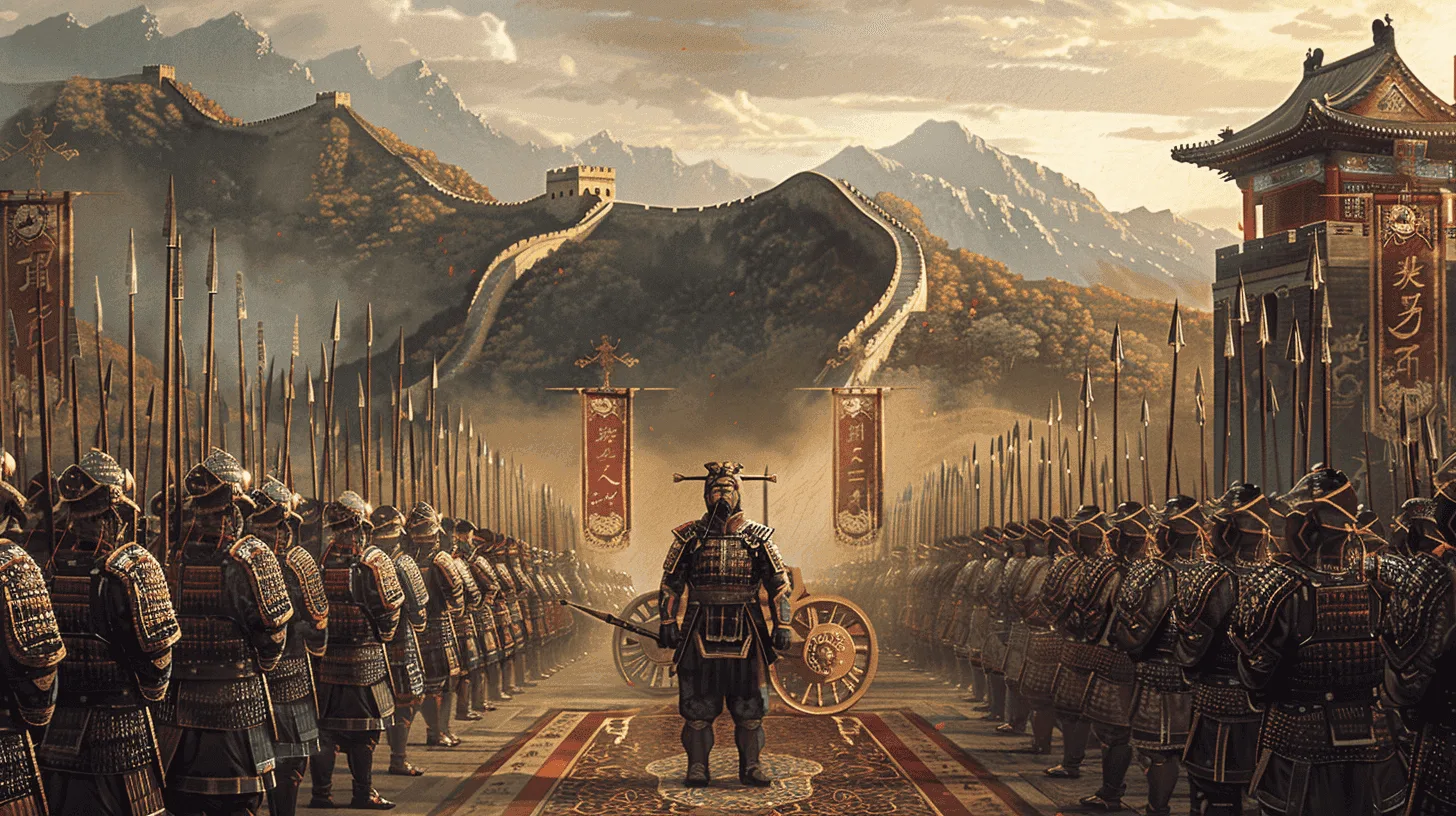
Wang Jian and Meng Tian: Qin Dynasty Generals Who Unified China
Forging an Empire: The Military Genius of Wang Jian and Meng Tian
Before China emerged as a unified empire, the land was a fractured patchwork of warring kingdoms locked in centuries of relentless conflict. Seven major states—Qin, Chu, Zhao, Wei, Han, Yan, and Qi—fought incessantly, each with its own army, laws, currency, and culture. Transforming this chaos into a single imperial order demanded more than political vision; it required military leadership capable of executing one of history’s most ambitious conquests.
Two generals stand at the center of this transformation: Wang Jian and Meng Tian. While Qin Shi Huang, the First Emperor, often dominates the historical spotlight, these commanders were the ones who made unification a reality on the ground. Wang Jian led the massive armies that systematically crushed rival states, employing overwhelming force combined with strategic patience. Meng Tian secured the newly unified empire’s vulnerable northern frontier, oversaw construction of the early Great Wall, and ensured conquered territories remained under Qin control.
Understanding these two generals matters because they represent complementary aspects of empire-building: conquest and consolidation, expansion and defense, military victory and lasting security. Their contributions shaped not just the Qin Dynasty but established precedents that influenced Chinese military organization and imperial administration for over two millennia.
The Warring States: A Crucible of Conflict
The Pre-Unification Chaos
To appreciate what Wang Jian and Meng Tian accomplished, you must understand the world they operated in. The Warring States Period (475–221 BCE) was one of the most violent and transformative eras in Chinese history. After the Zhou Dynasty’s central authority collapsed, China fragmented into independent states that functioned as separate nations.
The scale of warfare was unprecedented. Earlier Chinese conflicts involved small forces of chariot-mounted aristocrats fighting ritualized battles. By the Warring States Period, armies numbered in the hundreds of thousands, drawn from general populations, and fought total wars where entire populations could be enslaved or massacred.
Constant warfare drove rapid military innovation:
- States transitioned from bronze to iron weapons
- Cavalry tactics adapted from nomadic peoples became standard
- Crossbows allowed less-trained soldiers to fight effectively
- Siege warfare techniques grew increasingly sophisticated
- Standing professional armies replaced seasonal warrior levies
This environment created intense pressure on commanders. Success brought wealth, power, and noble titles. Failure often meant execution—not just for the general but potentially for their entire family under collective punishment systems. The best commanders had to be both brilliant strategists and political survivors.
Why Qin Rose Above Its Rivals
Among the warring states, Qin started from a disadvantaged position. Located in the western mountains, other states viewed Qin as semi-barbaric and culturally inferior. But several factors transformed this liability into strength.
Geographic advantages played a crucial role. Qin’s mountainous terrain provided natural defenses, allowing them to focus military resources on offense while relying on geography for protection. Their position also meant they could expand eastward without worrying about threats from behind—other states had to defend multiple borders simultaneously.
Political reforms under the statesman Shang Yang in the 4th century BCE revolutionized Qin society. He implemented Legalism—a political philosophy emphasizing strict laws, centralized authority, and merit-based advancement—that turned Qin into a state organized primarily for war:
- Aristocratic privileges were abolished; advancement came through military achievement
- Agricultural production was maximized to support larger armies
- Strict legal codes ensured discipline and obedience
- Resources were centralized under state control
Military professionalization meant Qin maintained standing armies with regular training, standardized equipment, and clear command structures. While other states still relied partly on traditional aristocratic warriors and seasonal conscripts, Qin had created a military machine that operated year-round with industrial efficiency.
By the time Wang Jian and Meng Tian rose to prominence, Qin had spent generations building advantages that made unification possible. But advantages alone do not win wars—they need commanders capable of exploiting them.
The Military and Political Landscape
The world Wang Jian and Meng Tian navigated was extraordinarily complex. Military strategy could not be separated from diplomacy, politics, and psychological warfare.
Alliances shifted constantly. States would ally against a common threat, then betray each other when convenient. Qin excelled at manipulating these alliances, often joining with one or more states to attack a third, then later turning on former allies once they were weakened.
Intelligence and espionage were crucial. States planted agents in rival courts, bribed officials, and spread disinformation. Wang Jian in particular became known for his careful intelligence gathering before campaigns.
Psychological warfare often determined outcomes before battles began. Qin cultivated a reputation for ruthlessness—massacring captured armies, destroying cities, and showing no mercy—that made enemies more likely to surrender rather than face certain death in defeat.
This was the world where Wang Jian and Meng Tian had to operate: a landscape where military skill alone was not enough, where political acumen and strategic patience mattered as much as tactical brilliance, and where the stakes were literally life and death.
Wang Jian: The Architect of Conquest
Early Life and Path to Command
Unlike many ancient figures, Wang Jian came from relatively humble origins. He was not born into the aristocratic warrior class that traditionally monopolized military leadership. Instead, he rose through Qin’s merit-based system—a sign of the revolutionary nature of Qin’s political reforms.
The details of his early life remain sparse. Ancient Chinese historians focused on achievements rather than personal backgrounds, especially for non-aristocratic figures. What we know comes mostly from his actions and the positions he attained.
Wang Jian entered military service during the later years of the Warring States Period, probably in the mid-3rd century BCE. His early career involved smaller commands where he demonstrated the qualities that would later make him indispensable: careful planning, discipline, and an ability to manage large forces effectively.
His rise accelerated under King Zheng—the ruler who would become Qin Shi Huang. As Zheng consolidated power within Qin and prepared for the final push to unify China, he needed commanders he could trust completely. Wang Jian proved himself not just militarily capable but also politically reliable—a crucial combination in a system where successful generals could become threats to central authority.
By the 230s BCE, when Qin launched its systematic conquest of the remaining states, Wang Jian had become one of Qin’s most trusted generals, regularly receiving command of the largest and most important campaigns.
Military Philosophy and Command Style
What distinguished Wang Jian from other capable generals was his particular approach to warfare. Unlike commanders who relied on brilliant tactical maneuvers or personal charisma, Wang Jian emphasized systematic preparation, overwhelming force, and patient execution.
Thorough Preparation: Wang Jian insisted on extensive intelligence gathering before campaigns. He wanted to know enemy troop dispositions, supply situations, political conditions, and terrain features. This preparation meant his campaigns often moved slowly by ancient standards, but when he engaged, he did so with clear informational advantages.
Overwhelming Force: Wang Jian preferred to campaign with armies that significantly outnumbered his opponents. This was not just about having more soldiers—it was about creating psychological pressure that made enemies question whether resistance was worth the cost. His most famous campaign, against the state of Chu, involved an army of 600,000 soldiers—possibly the largest army assembled in the ancient world up to that point.
Defensive Posture: Counterintuitively for such a successful offensive commander, Wang Jian often adopted defensive tactics after initial positioning. He would establish strong defensive positions and wait for enemies to attack him, exhausting themselves against prepared fortifications. Only after enemies were weakened would he launch decisive counteroffensives.
Logistics and Sustainability: Wang Jian understood that ancient warfare was often won or lost through supply rather than battlefield tactics. He paid careful attention to supply lines, foraging, and maintaining his army’s ability to operate over extended periods. This allowed him to outlast enemies who might be his equal tactically but could not sustain long campaigns.
Political Savvy: Perhaps Wang Jian’s most underappreciated skill was his ability to navigate Qin’s dangerous political environment. He understood that successful generals could threaten emperors, so he was careful to defer to authority, share credit, and avoid actions that might appear threatening to central power.
The Conquest of Chu: Wang Jian’s Masterpiece
Wang Jian’s greatest achievement—and one of the most significant campaigns in Chinese military history—was the conquest of Chu in 223 BCE. This campaign showcases his approach to warfare and why he succeeded where others had failed.
Chu was a formidable target. The largest of the remaining independent states, Chu controlled vast territories in southern China, had a population comparable to Qin’s, and maintained a strong military tradition. Previous Qin attempts to conquer Chu had failed.
The campaign began with a political crisis. Qin Shi Huang initially assigned the campaign to a younger general, Li Xin, who confidently claimed he could conquer Chu with 200,000 soldiers. When the emperor asked Wang Jian’s opinion, the older general stated he would need at least 600,000 troops. The emperor, perhaps concerned about the cost or suspicious about giving one general so much power, chose Li Xin’s optimistic assessment.
Li Xin’s campaign ended in disaster. Chu forces defeated his army, forcing a humiliating retreat. This failure created an opening for Wang Jian to demonstrate his superior approach.
The emperor recalled Wang Jian from retirement. The elderly general agreed to take command but insisted on his original requirement: 600,000 troops. He also demanded the best lands and properties for his family, essentially requesting that the emperor make him wealthy beyond imagining.
These demands were not about greed—they were Wang Jian’s way of ensuring his safety. By openly requesting rewards while the campaign was still unresolved, he positioned himself as someone focused on personal gain rather than political power. This reassured the emperor that Wang Jian would not use his massive army to stage a coup. It was a brilliant piece of political theater.
With his massive army assembled, Wang Jian invaded Chu—but not in the way Chu expected. Rather than immediately seeking battle, he established fortified positions and ordered his troops to rest and train. For over a year, the armies faced each other without major engagements.
Chu commanders were initially cautious, then frustrated, then desperate. Their army represented a massive economic drain—feeding and maintaining hundreds of thousands of soldiers consumed resources at an unsustainable rate. They needed to force a decision.
Wang Jian understood this perfectly. His army, supplied by Qin’s efficient logistics network, could afford to wait. He had his soldiers practice sports, games, and training exercises, maintaining morale while appearing unthreatening. Meanwhile, Chu’s army grew increasingly restless and their supplies dwindled.
When Chu finally attacked in desperation, Wang Jian was ready. The Chu forces, exhausted by months of frustration and weakened by supply issues, crashed against prepared Qin defensive positions. At the critical moment, Wang Jian launched counterattacks that shattered the Chu formations.
The victory was decisive and complete. Chu’s military power was broken, its king captured, and its territories absorbed into the growing Qin Empire. Wang Jian had achieved what previous generals could not, not through tactical brilliance in the moment but through strategic patience and superior preparation.
Other Major Campaigns and Contributions
While the Chu campaign stands as Wang Jian’s masterpiece, he led numerous other successful operations that contributed to Qin’s unification:
The Zhao Campaign: Wang Jian participated in operations against Zhao, a northern state that had been weakened by earlier defeats but remained dangerous. His methodical approach helped secure Qin’s northern flank before the final push to unification.
Coordinated Operations: Wang Jian coordinated with other Qin generals, including Wang Ben (his son) and Meng Tian, to execute synchronized campaigns that prevented enemies from supporting each other. This strategic-level coordination was relatively sophisticated for the era.
Training and Organization: Beyond specific battles, Wang Jian contributed to Qin’s military effectiveness by refining training methods and organizational structures. The armies he commanded were models of discipline and efficiency.
Mentorship: Wang Jian trained and influenced younger commanders, including his own son Wang Ben, who would go on to conquer the state of Qi in 221 BCE, completing the unification his father had made possible.
Wang Jian’s Strategic Partnerships
Wang Jian’s success was not solely individual—he worked closely with other commanders to coordinate Qin’s conquest strategy. His relationships with figures like Meng Wu (Meng Tian’s father) and later Meng Tian himself created a network of capable commanders who could execute complex, multi-front campaigns.
This collaboration reflected Qin’s systematic approach to warfare. Rather than relying on individual heroic generals, Qin built a command structure where multiple competent leaders could coordinate effectively. Wang Jian’s willingness to work within this system contributed to his success and survival.
The partnership between Wang Jian and the Meng family would prove particularly important, as Meng Tian would take on the challenge of securing what Wang Jian had conquered.
Meng Tian: The Guardian of Empire
Family Legacy and Early Career
Unlike Wang Jian, who rose from relative obscurity, Meng Tian came from an established military family. His grandfather, Meng Ao, had been a successful general for Qin. His father, Meng Wu, served alongside Wang Jian in the conquest campaigns, particularly distinguishing himself in the operations against Chu.
This family military tradition gave Meng Tian significant advantages: early exposure to military strategy, connections within Qin’s military hierarchy, training from experienced commanders, and a reputation based on family achievements.
But family connections alone did not determine success in Qin’s merit-based system. Meng Tian still had to prove himself through actual achievements. The pressure on sons of successful generals was intense—they inherited expectations but also scrutiny, with failures potentially being judged more harshly.
Meng Tian entered military service during the final phases of Qin’s unification campaigns in the late 220s BCE. He participated in operations against Qi, the last independent state to fall in 221 BCE, gaining experience in large-scale warfare and demonstrating the competence that would lead to greater responsibilities.
When Qin Shi Huang completed the unification in 221 BCE, the nature of military challenges facing the new empire changed dramatically. The emperor no longer needed generals to conquer rival Chinese states—that phase was complete. Instead, he needed commanders who could secure borders, suppress rebellions, and defend against external threats, particularly from nomadic peoples to the north.
This was where Meng Tian found his calling.
The Northern Frontier: Defending Against the Xiongnu
The unified Qin Empire faced a significant problem: its northern border remained vulnerable to raids from nomadic peoples, particularly the Xiongnu confederation. These nomadic groups posed a different kind of military challenge than the settled Chinese states Qin had just conquered.
The Xiongnu were formidable adversaries for several reasons:
- Superior cavalry: Xiongnu were essentially a nation on horseback, with mobility that Chinese armies struggled to match
- Guerrilla tactics: Rather than defending fixed positions, Xiongnu could raid, retreat, and disperse before Chinese forces could respond effectively
- No central authority to defeat: Unlike conquering Chinese states where capturing the capital meant victory, Xiongnu had no fixed centers of power
- Harsh terrain: The northern steppes and deserts favored mounted warfare and created serious supply challenges for Chinese armies
In 215 BCE, Qin Shi Huang appointed Meng Tian to command a massive expedition—reportedly 300,000 soldiers—to push back the Xiongnu threat and secure the northern frontier. This assignment represented enormous trust, as Meng Tian would command a force equal to half of what Wang Jian had needed to conquer Chu and would operate far from the capital with significant autonomy.
Meng Tian’s northern campaigns achieved remarkable success. He drove Xiongnu forces back beyond the Yellow River bend, reclaiming territories that nomads had occupied for generations. Rather than attempting to conquer or destroy the Xiongnu—probably impossible given their mobility and lifestyle—Meng Tian focused on establishing a defensible frontier that could resist raids while allowing Qin to maintain control over valuable agricultural lands.
His approach combined military operations with infrastructure development:
- Establishing military garrisons at strategic points along the frontier
- Building fortifications to defend key river crossings and mountain passes
- Creating supply depots to support troops stationed in remote border regions
- Settling military colonies where soldier-farmers could both defend the border and support themselves through agriculture
- Constructing roads to enable rapid movement of reinforcements
This represented a sophisticated understanding of frontier defense. Meng Tian recognized that simply defeating enemies in battle would not provide lasting security—the border needed infrastructure that could sustain a defensive presence indefinitely.
The Great Wall: From Military Strategy to World Wonder
Meng Tian’s most famous achievement was overseeing construction of the early unified Great Wall—connecting and extending various defensive walls built by earlier states into a continuous fortification system. This project was monumental in every sense: an engineering marvel, a massive military undertaking, and a defining symbol of Chinese civilization that endures today.
The Great Wall was not Meng Tian’s idea—it was Qin Shi Huang’s strategic vision. But Meng Tian was responsible for actually making it happen, which required solving enormous practical challenges.
Why build such a massive fortification? The wall served multiple strategic purposes. It reduced the effectiveness of quick cavalry raids—Xiongnu raiders who had to dismount, breach walls, and then escape while Chinese defenders responded found raiding much less profitable. Watchtowers along the wall created a communication network that could alert defenders to threats within hours rather than days. The wall channeled movement through controlled gates and passes, making it harder for large forces to infiltrate Chinese territory undetected. And it physically manifested Chinese civilization’s distinction from the nomadic peoples beyond.
The construction challenges were staggering. The wall stretched across thousands of miles of diverse and often hostile terrain: mountains, deserts, river valleys, and plains. Meng Tian had to mobilize massive labor forces—hundreds of thousands of workers including soldiers, conscripted laborers, and convicts—and organize complex supply chains to move food, water, building materials, and tools to remote construction sites.
The sections Meng Tian oversaw connected earlier walls built by Qin’s predecessor states, particularly in the eastern regions near modern Beijing, and extended new construction westward through more remote territories. Construction techniques varied based on available materials—rammed earth in areas with limited stone, stone construction where quarries were accessible.
The human cost was enormous. Ancient sources and archaeological evidence suggest hundreds of thousands of workers died during construction from accidents, disease, and harsh conditions. The Great Wall became associated in Chinese folk memory with suffering and sacrifice, immortalized in legends like that of Meng Jiangnu, who supposedly wept so bitterly over her husband’s death during construction that part of the wall collapsed.
For Meng Tian, overseeing this massive project meant balancing military necessity with practical constraints. He had to push workers hard enough to complete construction while maintaining sufficient morale and health to prevent total collapse of the labor force. He had to defend construction sites while simultaneously prosecuting military operations against the Xiongnu. It was a test of organizational and logistical skill as much as military command.
Military Innovations and Organizational Reforms
Beyond specific campaigns and construction projects, Meng Tian contributed to Qin military effectiveness through innovations in organization and tactics, particularly regarding frontier defense.
He improved coordination between units by refining signal systems and developing procedures for rapid response to threats detected at any point along the border. Rather than treating walls and garrisons as passive defenses, Meng Tian created a system where fortifications served as bases for mobile forces that could sortie against raiders, making the defense dynamic rather than static.
Recognizing that Chinese infantry could not match Xiongnu mobility, Meng Tian worked to improve Qin’s own cavalry capabilities. He adapted nomadic tactics and equipment, learning from the enemy to become more effective against them. He also developed systems for maintaining forces in remote regions over extended periods, including military agricultural colonies that could partly support themselves.
These innovations might seem less dramatic than Wang Jian’s battlefield victories, but they were essential for transforming conquest into lasting control.
The Tragic End: Political Intrigue and Execution
Despite his enormous contributions to the empire, Meng Tian met a tragic end that illustrated the dangerous political environment surrounding powerful military commanders in imperial China.
When Qin Shi Huang died in 210 BCE, he was on an inspection tour far from the capital, accompanied by key officials including the eunuch Zhao Gao and the chancellor Li Si. The emperor had designated his eldest son, Fusu, as heir. Fusu was serving under Meng Tian’s command on the northern frontier—both as a form of training and possibly to keep him away from court politics.
Zhao Gao, fearing Fusu’s accession would threaten his own power, conspired with Li Si to forge documents claiming the emperor had ordered both Fusu and Meng Tian to commit suicide. Instead of the competent Fusu, they elevated Qin Shi Huang’s younger son Huhai (later known as Qin Er Shi, the Second Emperor) to the throne.
Fusu, trusting in imperial authority, immediately committed suicide upon receiving the forged order. Meng Tian was more suspicious and initially refused, requesting clarification. This hesitation probably reflects his political savvy—he recognized something was wrong.
Meng Tian was imprisoned while the conspirators consolidated power. Eventually, despite his loyal service and his family’s generations of contribution to Qin, Meng Tian was forced to commit suicide in 210 BCE. His final words lamented his fate, recognizing the injustice but accepting it as his duty to obey imperial commands.
His execution eliminated one of the empire’s most capable commanders precisely when the Qin Dynasty most needed skilled leadership. The regime’s instability, exacerbated by the loss of figures like Meng Tian, contributed to the dynasty’s rapid collapse following Qin Shi Huang’s death.
Comparative Analysis: Different Strengths, Shared Success
Contrasting Command Styles and Personalities
Wang Jian and Meng Tian, while both essential to Qin’s success, represented quite different approaches to military leadership.
Wang Jian embodied patient, methodical warfare. He preferred overwhelming force and careful preparation, avoided unnecessary risks, emphasized logistics and sustainability, focused on completely destroying enemy capability to resist, and was politically cautious and deferential to authority.
Meng Tian demonstrated adaptive, dynamic leadership. He operated with more autonomy in remote regions, combined military operations with infrastructure development, adapted tactics and strategy to different types of enemies, balanced multiple simultaneous challenges, and showed more willingness to innovate.
These differences reflected their different challenges. Wang Jian faced enemies similar to Qin—settled agricultural states with similar military traditions. Victory came through superior execution of similar approaches. Meng Tian faced fundamentally different challenges—nomadic enemies with asymmetric capabilities and the need to defend rather than conquer.
Complementary Roles in Empire Building
The relationship between Wang Jian and Meng Tian’s contributions illustrates an important principle: building an empire requires different skills than defending it.
Wang Jian excelled at conquest—breaking enemy armies, capturing territory, eliminating rival states. His campaigns were finite: defeat Chu, absorb their territory, move to the next target. His forces could operate with clear objectives and definable endpoints.
Meng Tian excelled at consolidation—transforming conquered territory into defensible imperial domain, establishing infrastructure that would last, creating systems for ongoing defense that did not rely on constant military campaigns. His challenges were ongoing: the Xiongnu did not surrender once defeated, the frontier required permanent vigilance, infrastructure needed continuous maintenance.
Together, they represented the two phases of empire building: breaking down what exists and building up what you want to create. Qin Shi Huang’s success depended on having both capabilities available at the right times.
Shared Characteristics: What Made Them Effective
Despite their differences, Wang Jian and Meng Tian shared several crucial qualities that enabled their success:
- Loyalty to Central Authority: Both commanders remained firmly committed to serving the emperor rather than pursuing personal power
- Organizational Excellence: Both excelled at managing large, complex operations, coordinating thousands of subordinates
- Logistical Sophistication: Both understood that military success depended on supply, maintenance, and sustainability
- Strategic Patience: Neither commander was impulsive or reckless; they knew when to wait and prepare thoroughly
- Political Awareness: Both navigated Qin’s dangerous political environment successfully (until Meng Tian’s tragic end)
- Mentorship and Development: Both contributed to developing younger commanders and improving Qin’s overall military capability
These shared qualities suggest that Qin’s success was not just about finding two talented individuals but about creating a system that identified, rewarded, and empowered commanders with the right combination of military skill and political reliability.
Lasting Impact: How Two Generals Shaped Two Millennia
Military Organization Models
The command structures and organizational principles Wang Jian and Meng Tian employed influenced Chinese military thinking for centuries afterward. The clear hierarchical chain of command—from emperor to commanding general to individual soldier—became the standard model. The integration of infantry, cavalry, and specialized units that characterized Qin warfare became standard practice in later Chinese armies.
The emphasis on logistics as a core competency established supply and sustainability as central concerns in Chinese military planning. Meng Tian’s frontier defense system, which combined military garrisons with agricultural colonies, became a model for how later dynasties managed borders. And the Great Wall established fortification as a central element of Chinese strategic thinking.
Influence on Successive Dynasties
The impact of Wang Jian and Meng Tian’s military systems extended well beyond the brief Qin Dynasty. The Han Dynasty (206 BCE–220 CE), which succeeded Qin after a brief civil war, incorporated many Qin military and administrative innovations while maintaining centralized military command under imperial authority and continuing the merit-based promotion system.
The Tang Dynasty (618–907), often considered the height of Chinese imperial power, drew explicitly on Han precedents—which themselves derived from Qin foundations. Tang military organization, particularly in frontier defense, showed clear lineage from systems Meng Tian had pioneered.
Even the Ming and Qing Dynasties, ruling over a millennium after Qin’s fall, demonstrated continuity in military administration and strategic thinking that traced back to the foundations Wang Jian and Meng Tian helped create.
The Great Wall as Symbol and Reality
Perhaps no legacy of Wang Jian and Meng Tian’s era is more visible than the Great Wall. While the wall we see today largely dates from the Ming Dynasty, it follows routes and principles established during the Qin period under Meng Tian’s supervision.
As a physical structure, the Great Wall has protected and defined the northern boundary of Chinese civilization for over two millennia. As a symbol, it has come to represent Chinese civilization itself—its ambition, its achievements, and its emphasis on defense. This symbolic power emerged directly from the strategic vision that led Qin Shi Huang to order its construction and from Meng Tian’s success in actually building it.
Historical Assessment: Separating Fact from Legend
The Challenge of Ancient Sources
Evaluating Wang Jian and Meng Tian’s actual achievements requires careful consideration of how we know what we know. The main source for Qin military history is the Shiji (Records of the Grand Historian), compiled by Sima Qian during the Han Dynasty around 109–91 BCE, roughly a century after the events described. Sima Qian had access to earlier records that no longer exist, making his work invaluable but impossible to fully verify.
Han legitimacy partly depended on portraying Qin as tyrannical, creating incentive to exaggerate Qin’s brutality while acknowledging its military successes. Ancient sources also often inflate numbers, particularly regarding army sizes and casualties. Claims about Wang Jian commanding 600,000 soldiers may be exaggerated, though Qin certainly fielded the largest armies seen in Chinese history to that point.
What We Can Confidently Assert
Despite source limitations, certain facts are solidly established. Both were real historical figures who commanded major military operations for Qin. They played crucial roles in Qin’s unification—Wang Jian’s conquest of Chu and Meng Tian’s northern campaigns were decisive events. They established lasting precedents, and archaeological evidence confirms extensive fortification building during the Qin period in the northern frontier regions where Meng Tian operated.
The accounts of their careers—Wang Jian’s careful political maneuvering and Meng Tian’s execution—fit broader patterns of civil-military relations in imperial China, lending them credibility. For more detailed scholarly analysis, The Cambridge History of Ancient China provides comprehensive coverage of the Warring States Period and Qin unification. The UNESCO World Heritage documentation for the Great Wall offers archaeological and historical information about the wall’s construction. Additionally, the Encyclopedia Britannica entry on Wang Jian provides a concise overview of his life and campaigns.
Conclusion: Two Generals, One Empire, Enduring Legacy
Wang Jian and Meng Tian transformed Chinese history. Their military achievements enabled the creation of unified imperial China, their organizational innovations influenced military administration for millennia, and their service exemplified both the possibilities and dangers of military leadership in imperial systems.
Wang Jian’s patient, methodical approach to conquest demonstrated that overwhelming force, carefully applied, could achieve what brilliant tactics alone might not. His conquest of Chu eliminated Qin’s most powerful remaining rival and made unification inevitable. His political savvy in navigating Qin’s dangerous court environment allowed him to succeed where more brilliant but less cautious commanders failed.
Meng Tian’s dynamic defense of the northern frontier and his successful management of the Great Wall construction showed that empire-building required more than conquest—it demanded consolidation, infrastructure, and sustained commitment. His ability to combine military operations with engineering projects exemplified the multifaceted capabilities imperial commanders needed.
Together, they represent the two essential phases of creating a lasting empire: breaking down resistance to establish control, and building up structures to maintain it. The Qin Dynasty fell quickly after Qin Shi Huang’s death, partly because the systems Wang Jian and Meng Tian created were dismantled through political intrigue and incompetent succession. Yet the precedents they established—unified military command, merit-based advancement, logistical sophistication, and strategic fortification—persisted through subsequent dynasties.
For anyone interested in military history, strategic thinking, or Chinese civilization, Wang Jian and Meng Tian offer compelling case studies in leadership, strategy, and the complex relationship between military power and political authority. They helped create an empire that lasted, in various forms, for over two thousand years—an achievement that speaks to the profound impact skilled leadership can have on the course of human history.