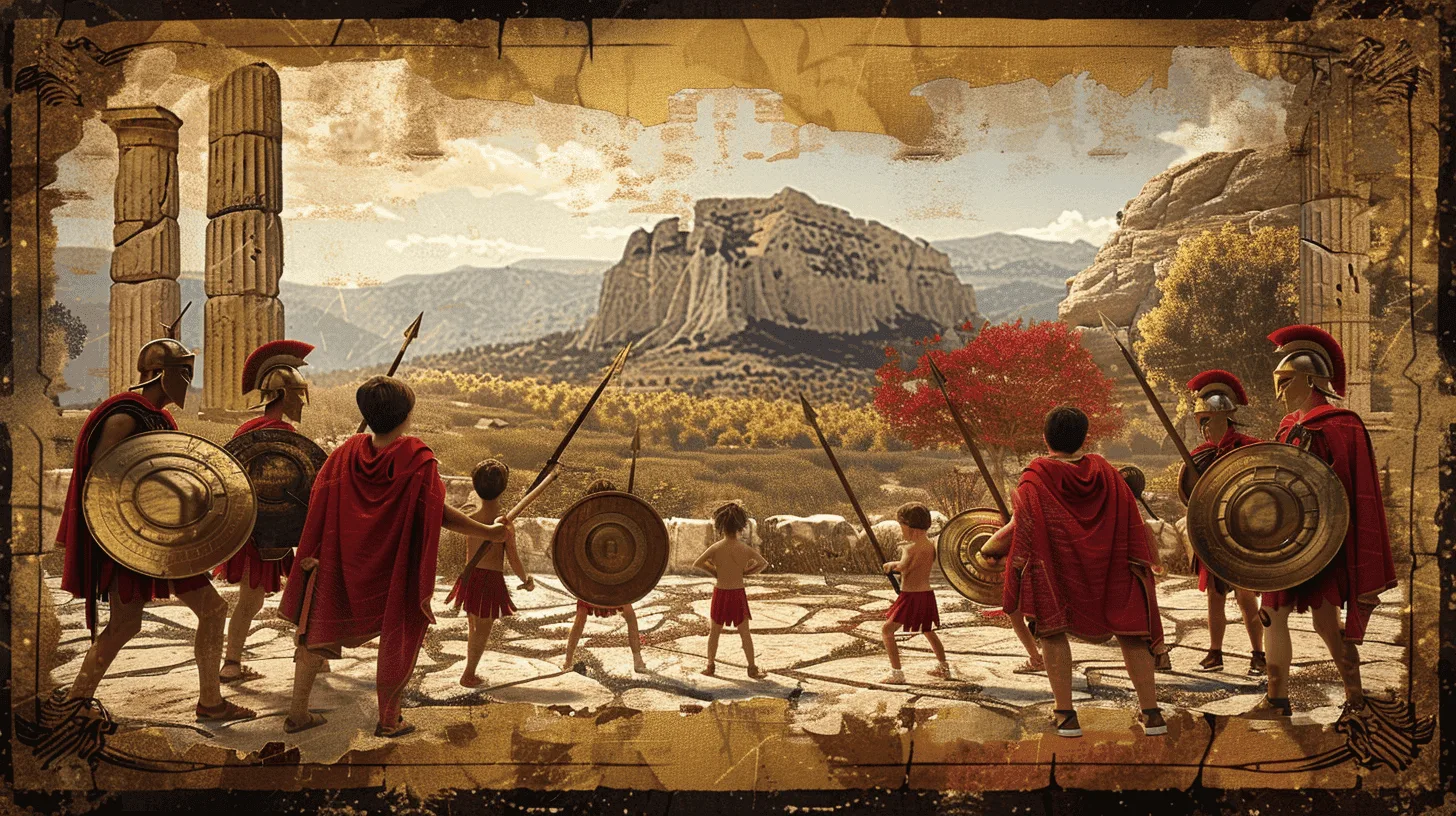
Who Are the Agoge? How Sparta Trained Its Children for War
Introduction: The Forging of a Warrior
At age seven, a Spartan boy was taken from his mother and never returned home. His childhood ended overnight. He would sleep on reeds he gathered with bare hands, wear a single thin cloak through both blazing summer and bitter winter, and subsist on deliberately insufficient rations. He would be beaten for the smallest mistake, forced to steal to survive, and punished not for the theft but for being caught. This was not cruelty for its own sake—it was the Agoge (ἀγωγή), the state-sponsored education system that turned boys into the most feared soldiers of the ancient world.
For nearly two centuries, the Agoge produced warriors who stood firm at Thermopylae, who never retreated, who sang as they marched into battle. But the Agoge was far more than military training. It was a total system of social engineering designed to erase individuality, suppress emotion, and create absolute loyalty to the state. It shaped not just soldiers but an entire civilization built on discipline, conformity, and martial excellence.
Why did Sparta create such an extreme system? How did it actually work? What happened to the boys who endured it? And what can this ancient institution teach us about education, military training, and the price of forging a warrior society? This article explores every aspect of the Agoge—from its historical origins to its daily brutalities, from the psychological mechanisms that made it effective to its ultimate legacy.
Historical Context: Why Sparta Needed the Agoge
To understand the Agoge, you must first understand the unique—and precarious—situation that shaped Spartan society. Sparta was not a normal Greek city-state. It was a military camp built on a foundation of fear.
The Helot Problem: A Foundation of Terror
Sparta's entire social structure rested on the helots (εἵλωτες). These were not typical ancient slaves purchased in markets. The helots were a conquered Greek population, primarily descendants of the Messenians whom Sparta subjugated in brutal wars during the late eighth and seventh centuries BCE. They lived on their ancestral lands but were reduced to permanent servitude, forced to work Spartan fields and hand over a fixed portion of their harvest.
The mathematics of this arrangement were nightmarish for the Spartans. Helots vastly outnumbered Spartiates (full citizens)—ancient sources suggest ratios of 7:1 or even 10:1. At Sparta's height, there may have been only 8,000–10,000 Spartiates controlling perhaps 70,000–100,000 helots. Every Spartan knew that a single uprising could mean annihilation. To keep the helots in line, the state employed systematic terror: annual declarations of war against the helots that made killing them legal; state-sanctioned night raids by young men (the krypteia) to intimidate and eliminate potential leaders; public humiliations such as forced drunkenness and beatings to psychologically crush resistance; and brutal reprisals after any hint of rebellion.
Historical sources record major helot revolts, particularly after earthquakes or military defeats when Spartan control weakened. The most serious revolt, around 464 BCE, required years to suppress and nearly destroyed Sparta. This demographic reality explains the Agoge's brutality. Sparta did not just need soldiers—it needed a warrior class capable of suppressing a vast, hostile population through absolute military superiority and the willingness to use systematic violence. Every Spartan had to be a soldier because internal security depended on it.
The Spartan Social Pyramid
Understanding the Agoge requires grasping Sparta's unique social hierarchy:
- Spartiates (full citizens): Male Spartan citizens who completed the Agoge. They formed a warrior elite, prohibited from labor or trade, required to participate in communal mess halls (syssitia), and the only class with full political rights.
- Perioikoi ("dwellers around"): Free non-citizens who lived in surrounding communities. They could own land and engage in commerce, served in the military, but lacked political rights.
- Helots: The conquered population in permanent servitude. They were tied to land plots, working them for Spartan masters, with no legal rights and subject to arbitrary violence.
This rigid hierarchy meant Spartiates were a tiny, isolated elite whose survival depended on absolute military superiority and internal cohesion—exactly what the Agoge was designed to create.
The Evolution of the Agoge
The Agoge did not emerge fully formed. It evolved over centuries as Sparta responded to historical challenges:
- Pre-Agoge period (before c. 650 BCE): Early Sparta was relatively normal by Greek standards. Archaeological evidence shows a flourishing arts culture, poetry (Sparta produced famous poets like Tyrtaeus), and social patterns similar to other Greek city-states.
- Crisis period (c. 650–600 BCE): The Second Messenian War, a desperate helot revolt that nearly succeeded, traumatized Spartan society. Combined with military defeats and internal social tensions, it triggered a comprehensive social reorganization.
- The Lycurgan reforms (attributed to the legendary lawgiver Lycurgus, possibly mythical): Around 600 BCE, Sparta underwent a radical transformation: land redistribution to create equality among Spartiates, prohibition of gold and silver currency (iron bars only), mandatory communal dining, and the formal creation of the Agoge as state-controlled education.
- Classical period (c. 550–371 BCE): The mature Agoge operated during Sparta's height, creating warriors who became legendary throughout Greece.
- Decline and modification (371 BCE onwards): After the devastating defeat at Leuctra, citizen numbers collapsed, and the Agoge evolved with non-Spartiates increasingly integrated. It continued in modified form even under Roman rule.
The Agoge System: Age-by-Age Breakdown
The Agoge controlled Spartan males from birth through age 30. Let's examine each phase in detail.
Birth to Age 7: Selection and Early Conditioning
Contrary to popular myth, Spartans probably did not throw "defective" infants off cliffs. However, inspection of newborns did occur. Male infants were brought before elders for examination; sickly or deformed infants might be denied citizenship rights or left exposed (exposure was common throughout Greece, not unique to Sparta). Only healthy infants were accepted for eventual Agoge entry.
Boys lived with their families until age seven, but Spartan parenting emphasized toughness from the start: minimal coddling, physical hardening exercises, suppression of crying, and early indoctrination in Spartan values. Spartan mothers were famously stern. The much-repeated saying "Come back with your shield or on it"—meaning victory or death—may be a literary invention, but it captures the spirit of maternal expectations. Other sayings attributed to Spartan women include "Only Spartan women give birth to men."
Ages 7–12: The Mikichizomenos (Little Boys)
At age seven, boys were taken from their families to live in communal barracks. They saw their parents only occasionally from then on. They were organized into agelai (ἀγέλαι, "packs" or "herds") of age-cohort groups. The strongest, most promising boy in each group was designated bouagos, serving as leader and learning early leadership and responsibility. A state official, the paidonomos (παιδονόμος), oversaw the entire Agoge, wielding absolute authority and carrying a whip. Older youths, the eirenes (εἴρενες, ages 18–20), directly supervised younger boys and administered discipline.
Living conditions were deliberately harsh. Boys slept on rushes or reeds they had to gather themselves from riverbanks—forbidden to use knives, so they tore them by hand. They wore a single cloak (τρίβων, tribōn) year-round, went barefoot, bathed infrequently, and were kept perpetually hungry on deliberately insufficient rations. Their hair was kept short initially, in contrast to the long hair they would wear as adults.
Education included physical training (wrestling, running, gymnastics, swimming, javelin throwing), basic literacy (Spartans were not illiterate, despite some myths), group singing and war dances (pyrrhic dances) to develop rhythm and coordination, and training in laconic speech—speaking briefly and sharply, from which we get the word "laconic."
One of the Agoge's most notorious features was institutionalized theft. Boys were given insufficient food and forced to steal to supplement their rations. The lesson was not about acquiring food but about cunning, stealth, risk assessment, self-reliance, and courage under pressure. If caught, they were beaten—not for stealing, but for being caught. The ancient historian Plutarch tells of a boy who stole a fox, hid it under his cloak, and let it gnaw his stomach to death rather than reveal the theft. Whether true or apocryphal, the story illustrates the values being taught.
Ages 12–18: The Adolescent Phase
Training intensified as boys became teenagers. Physical conditioning escalated to prepare for wearing 60+ pound hoplite armor. Combat training introduced actual weapons—spear, sword, and the hoplon (the heavy round shield). Formation drill taught movement in the phalanx. Endurance tests included long-distance marching, carrying heavy loads, and operating on minimal sleep.
The diamastigosis (ritual whipping at the altar of Artemis Orthia) was perhaps the most notorious practice. Boys were whipped before an altar in an endurance contest to see who could endure longest without crying out. Spectators, including tourists in the Roman period, watched. Deaths occasionally occurred. The practice proved courage, pain tolerance, and devotion to honor.
Combat tournaments between boys were common, often brutal, developing fighting skills and competitive spirit. Boys formed close bonds with specific partners—training pairs practiced together, and older youths mentored younger ones. Some of these relationships became sexual, following Greek pederastic traditions. These bonds reinforced unit cohesion and mutual obligation.
Educational elements included attendance at syssitia (communal mess halls) to learn adult behaviors, political observation by listening to adult discussions, and continued cultural education in music and poetry, especially martial poetry celebrating Spartan victories.
Ages 18–20: The Eirenes (Youth)
This transitional period marked the shift from student to junior instructor. Eirenes supervised younger boys, administering discipline and teaching skills they had recently mastered.
The krypteia (κρυπτεία, "secret service") was the most controversial Agoge institution. Select eirenes were sent into the countryside armed only with daggers, surviving by stealth, living rough, and—according to ancient sources—assassinating helots. Historians debate its purposes: military training in survival and stealth, terror tactics to intimidate the helot population, intelligence gathering to scout for potential revolt leaders, or a final test of loyalty by performing morally challenging acts. Thucydides and Plutarch describe the krypteia, though details are murky. Some modern scholars argue that the krypteia may have been exaggerated by later sources, but its place in Spartan lore remains powerful.
Advanced military training continued: tactical education in warfare strategies, leadership development, and final preparation for service as hoplites.
Ages 20–30: Full Warriors, Conditional Citizens
At age 20, men became full hoplite soldiers, fighting in Sparta's wars. They were required to join a syssitia and contribute from their land allotments—failure to contribute meant loss of citizenship. They could marry but could not live with their wives; they continued living in barracks, visiting wives secretly at night. Only at age 30 could men live with their families, though military obligations continued until age 60. Even after "graduating," men remained under military discipline, attending training and maintaining constant readiness.
Daily Life in the Agoge: The Experience of Systematic Brutality
What was daily existence actually like? A typical day might begin before sunrise with cold water washing and a brief, insufficient breakfast of black broth or barley porridge. Morning assembly and inspection were followed by physical training—running, wrestling, gymnastics—and combat drill supervised by eirenes who corrected errors with whips or fists. Midday brought a minimal rest period and another insufficient ration, prompting theft attempts. Afternoon continued with physical training or educational instruction, music, dance, or combat competitions. Evening meal was again insufficient, followed for older boys by attendance at syssitia to observe adult discussions. Night meant sleep on reed beds with a single cloak for warmth, while eirenes patrolled and administered discipline.
Psychological Mechanisms
The Agoge's effectiveness depended on sophisticated psychological techniques:
- Deliberate hardship: Constant discomfort created mental toughness and normalized battlefield conditions. Hunger, cold, inadequate rest, and pain became routine.
- Fear and violence: Arbitrary punishment built chronic anxiety and absolute obedience. Public humiliation created intense shame and incentive to avoid failure. Regular beatings normalized violence and built pain endurance.
- Competition and hierarchy: Constant ranking against peers created intense competition. Groups held collectively responsible for individual failures generated powerful social pressure. Leadership rotation taught both command and obedience.
- Identity erasure: Separation from parents weakened family loyalty and redirected allegiance to state and unit. Identical clothing, training, and treatment created collective rather than individual identity. Emotional suppression was actively punished, creating stoic personalities.
Modern psychology recognizes that victims of systematic abuse sometimes identify with their abusers. The Agoge may have produced similar effects: boys internalized the values of their tormentors, and graduates defended and perpetuated the system, taking pride in their suffering.
The Female Experience: Education for Girls
Sparta's education system for girls was unique in the ancient Greek world. Unlike other Greek states where girls were largely confined, Spartan girls received formal education that included physical training: running, wrestling, gymnastics, javelin and discus throwing, swimming, and dancing. They exercised publicly, sometimes minimally clothed or nude, which scandalized other Greeks. The purposes were practical: to bear healthy children, to maintain households during male military deployment, and to embody Spartan ideals of strength and discipline.
Girls learned reading, writing, arithmetic, music, poetry, and civic values. They were trained for their role as Spartan wives and mothers, including managing estates since husbands were often absent at war or in barracks. Spartan women could own land and property—extraordinary in ancient Greece—and with men constantly away, they managed significant aspects of society.
The Products of the Agoge: What It Created
What kind of man emerged from this brutal system? Physically, the ideal Spartan warrior possessed exceptional strength and endurance, high pain tolerance, proficiency in weapons and formation fighting, and the ability to operate on minimal resources. Psychologically, he showed absolute courage, unquestioning obedience, emotional suppression, and fierce loyalty to unit and state. Socially, he spoke laconically, disdained luxury, and identified with the collective over the individual.
Military Effectiveness
Sparta's warriors fought in the classic Greek phalanx—a dense formation of heavily armored hoplites with overlapping shields and projecting spears. Years of shared hardship in the Agoge created unbreakable unit cohesion, discipline to maintain formation under extreme pressure, courage that made them less likely to break and run than other Greek citizen-soldiers, and professional training that set them apart from part-time warriors.
Their battlefield reputation was fearsome. Other Greeks dreaded facing Spartans. They rarely retreated or broke formation, famously sang paeans (battle hymns) as they advanced, and wore red cloaks so blood would not show, maintaining a fearsome appearance when wounded. Key examples include the stand at Thermopylae (480 BCE) where 300 Spartans and allies held off the Persian army for three days, and the critical Spartan role at Plataea (479 BCE). During the Peloponnesian War (431–404 BCE), Spartan military superiority eventually defeated Athens despite Athenian naval and economic advantages.
The Costs and Limitations
The Agoge's brutality had severe consequences. Many boys did not survive or succeed. High mortality during training, strict citizenship requirements, and low birth rates among Spartiates led to a demographic catastrophe: the population declined from roughly 10,000 Spartiates to about 1,500 over two centuries. Intellectual stagnation resulted from the focus on military training—minimal philosophy, science, or arts compared to Athens. The system created excellent hoplites but struggled with new tactics like light infantry, cavalry, and siege warfare. Losses could not be replaced quickly; each soldier took 23 years to produce. When warfare evolved, Sparta could not adapt.
Though ancient sources do not discuss psychological damage, modern understanding suggests the Agoge produced trauma, emotional stunting, possible sadistic tendencies, and rigid thinking. The system that created Sparta's strength also contained the seeds of its destruction.
The Decline and End of the Agoge
The oliganthropia ("shortage of men") became critical. By the fourth century BCE, Spartan citizen numbers had collapsed. Strict citizenship requirements meant economic failure equalled loss of status. Land consolidation concentrated wealth among a few families. War casualties could not be replaced quickly. By 250 BCE, perhaps only 700 Spartiates remained.
The Battle of Leuctra (371 BCE) shattered Spartan invincibility. Theban general Epaminondas used revolutionary tactics to defeat the Spartan phalanx. Of the 700 Spartiates present, 400 were killed—a catastrophic loss. Spartan military supremacy ended permanently. The Messenian helots were liberated, destroying Sparta's economic base.
In the Hellenistic period, Sparta became a minor power. Kings Agis IV and Cleomenes III attempted to revive the Agoge and redistribute land, but these efforts failed. Under Roman rule, the Agoge became a tourist attraction, with ritual whipping contests performed for Roman spectators. The system finally disappeared sometime in the third or fourth century CE.
Legacy and Modern Relevance
The Agoge remains culturally significant. Modern military academies draw selectively from Spartan principles: shared hardship in boot camps builds cohesion and resilience; stress inoculation prepares soldiers for combat; and unit cohesion is emphasized. But modern training avoids child soldiers, deliberate cruelty, suppression of independent thought, and lifetime commitment from childhood.
Popular culture has embraced the Agoge through films like 300, literature such as Steven Pressfield's Gates of Fire, and video games. "Spartan" races and training programs exploit the brand, emphasizing toughness and endurance. The term "Spartan" evokes discipline and sacrifice in political rhetoric.
But the Agoge offers cautionary lessons. By contemporary standards, it constituted systematic child abuse. Sparta's single-minded focus on military power led to cultural stagnation and collapse. The system was unsustainable—military effectiveness came at enormous human cost. The Agoge stands as both achievement and tragedy: a society that pushed human training to extremes and, for a time, succeeded, but at a price no modern society should be willing to pay.
Conclusion: The Paradox of Spartan Excellence
The Agoge created the ancient world's most formidable warriors through methods we now recognize as institutionalized child abuse. This paradox lies at the heart of Sparta's legacy: extraordinary effectiveness achieved through morally reprehensible means. The system worked for a time—Spartan warriors were genuinely superior, more disciplined, more cohesive, more willing to stand their ground. But the costs were staggering: while producing military excellence, Sparta sacrificed everything else—arts, philosophy, economic development, and ultimately its own sustainability.
The Agoge teaches us the power of institutions to shape people profoundly. It demonstrates how shared adversity creates powerful social bonds—a principle used in modern military training without the cruelty. It shows that discipline and toughness have value, but cannot compensate for declining numbers, strategic inflexibility, and failure to adapt. And it reveals that systems pushing humans to extremes may achieve short-term results but prove unsustainable. Sparta's collapse illustrates this principle starkly.
When we look at the Agoge today, we see both achievement and tragedy. The Spartan warriors were real, their courage genuine, their discipline remarkable. But they were created through a process we study and understand while recognizing that some historical achievements came at prices no society should ever be willing to pay again.
For further reading, see Britannica's entry on the Agoge and World History Encyclopedia's overview. Also explore the Curious Fox Learning collection of ancient history resources. For a deeper dive into Spartan military tactics, the Perseus Digital Library offers primary sources on Spartan warfare.