Table of Contents
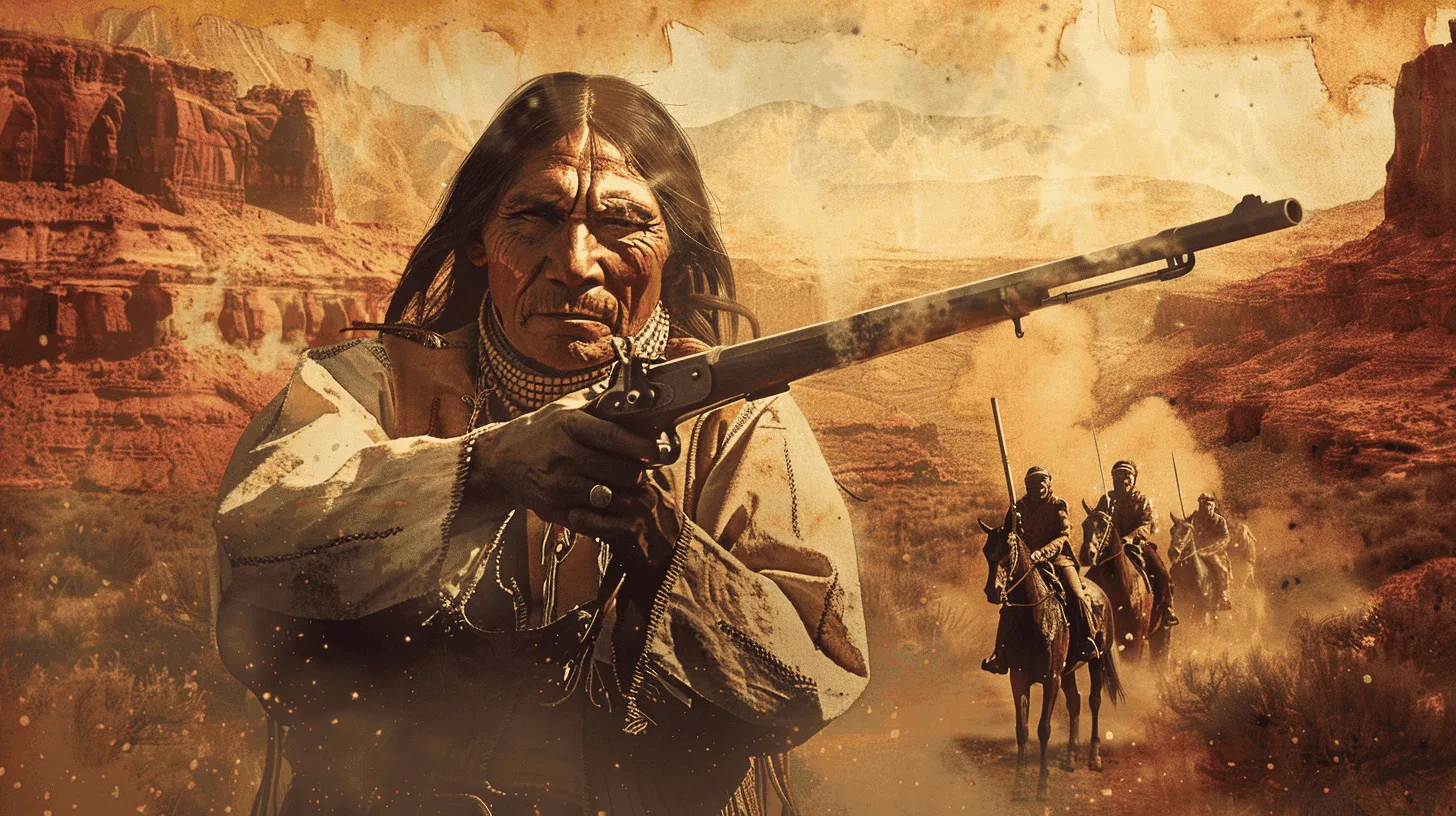
Geronimo (1829–1909) remains one of the most iconic and frequently misunderstood figures in Native American history. A Chiricahua Apache warrior and medicine man, his name has become synonymous with fierce resistance, tactical brilliance, and the final, tragic chapter of Apache independence. For nearly three decades, from the 1850s through his surrender in 1886, Geronimo led a small band of fighters in a desperate, high-stakes struggle to preserve their homeland and way of life against overwhelming Mexican and American military power.
His story is remarkable not because he commanded vast armies or led a unified nation—he never did. Instead, his significance lies in his absolute refusal to accept defeat, his uncanny ability to evade massive military forces with only a few dozen followers, and his transformation from a hunted fugitive into a complex cultural icon. With rarely more than 30 to 40 warriors, Geronimo repeatedly escaped confinement, eluded thousands of soldiers from two nations, and survived in some of the harshest deserts and mountains in North America for months at a time. His saga is a testament to the limits of conventional military power when faced with a determined guerrilla fighter who knew the land intimately.
Geronimo was never a hereditary chief. He rose to prominence as a war leader and medicine man. His authority came not from birthright but from demonstrated courage, spiritual power, and proven success in battle. This distinction is critical to understanding why his resistance endured long after other Apache leaders had negotiated peace or accepted reservation life.
His life spanned the entire arc of Apache independence—from a childhood spent in traditional territory, through decades of brutal warfare with Mexico and the United States, to eventual surrender and 23 years as a prisoner of war. His story illuminates the violent collision between Apache culture and American westward expansion, the impossible choices faced by Native peoples, and how one man's unwavering determination to remain free made him both a feared enemy and a celebrated symbol of indigenous resistance.
Why Geronimo’s Story Matters Today
Geronimo’s resistance illuminates several crucial aspects of the Apache Wars that are often simplified or distorted in popular narratives. Understanding these deeper themes gives his story weight beyond mere adventure.
First, it reveals the diversity of Native American responses to American expansion. While many Apache leaders accepted reservation life as the only viable option, Geronimo and his followers fought on despite impossible odds. This was not simply stubbornness; it was a choice rooted in specific circumstances, personal history, and deeply held cultural values. Examining why some fought and others accommodated provides a more nuanced understanding of the period.
Second, his repeated evasions demonstrate the limitations of American military power in the 19th century. The U.S. Army deployed thousands of soldiers, enlisted Apache scouts, used telegraphs for rapid communication, and implemented scorched-earth tactics like controlling water sources—yet Geronimo still escaped time and again. Guerrilla warfare in difficult terrain, waged by people who knew every canyon and spring, proved extraordinarily difficult to defeat, even for a modernizing military.
Third, his story shows how personal tragedy and cultural context can shape a lifetime of resistance. Geronimo’s warfare was deeply personal, rooted in the murder of his family and the Apache cultural obligations of revenge and honor. That personal dimension explains both his relentless determination and why he could not simply accept accommodation after suffering such loss.
Finally, his later life as a prisoner and public celebrity reveals a paradox of American culture: the simultaneous demonization and romanticization of Native resistance. Geronimo became a famous attraction, selling autographs and posing for photographs at world's fairs, yet he remained a prisoner until his death, never allowed to return to the mountains he called home. That contradiction continues to shape how we remember the frontier era.
The Chiricahua Apache and Their Homeland
Apache Peoples and Divisions
The term "Apache" actually covers multiple Athapaskan-speaking groups who occupied the American Southwest: Western Apache, Chiricahua, Mescalero, Jicarilla, Lipan, and Plains Apache. The Chiricahua Apache—Geronimo’s people—lived primarily in the mountainous regions of what is now southeastern Arizona, southwestern New Mexico, and the northern Mexican states of Sonora and Chihuahua. They were further divided into four bands: the Chihenne (Warm Springs), the Chokonen (Cochise’s people), the Bedonkohe (Geronimo’s own band), and the Nednhi. Each band had its own leaders, hunting territories, and sacred places. This internal fragmentation later complicated efforts to mount unified resistance against outside forces.
Traditional Apache Culture and Way of Life
Chiricahua life centered on extended family groups that hunted, gathered, and raided together. Leadership was earned through demonstrated ability rather than inherited. The Apache were semi-nomadic, moving seasonally between different ecological zones to exploit available resources. Raiding was a deeply ingrained part of their culture—not senseless violence, but a practical means of acquiring resources, demonstrating courage, and settling scores. Apache society drew a clear distinction between raiding (taking property while avoiding killing) and warfare (killing enemies).
Spiritually, they believed in a supernatural power known as diyin, which could be acquired through visions and rituals. Geronimo became widely known as a medicine man whose spiritual abilities complemented his martial skills, giving him an aura of invincibility among his followers.
The Sacred Homeland
The Chiricahua homeland included some of the most rugged terrain in North America: the Chiricahua Mountains, Dragoon Mountains, Mogollon Rim, and the Sierra Madre of Mexico. These mountains were not just a place to live; they were imbued with spiritual significance and ancestral memory. Every canyon, spring, and peak held meaning. That intimate connection to the land explains why Geronimo and others fought so desperately to remain free and why forced removal to unfamiliar reservations was not just inconvenient but spiritually catastrophic.
Geronimo’s Early Life: From Goyahkla to Warrior
Birth and Family Origins
Born around June 1829 near the headwaters of the Gila River in what is now southwestern New Mexico (then part of Mexico), his birth name was Goyahkla, meaning "One Who Yawns." He was Bedonkohe through his father and Nednhi through his mother, giving him connections to multiple Apache groups. This dual heritage would later prove advantageous, allowing him to move between bands and enlist support. He received traditional training in hunting, tracking, horsemanship, and wilderness survival—skills that would later make him almost impossible to corner.
Training as Warrior and Medicine Man
Goyahkla participated in his first raid at around age 17. Even as a young man, he showed signs of spiritual power—prophetic dreams, visions, and a seeming ability to survive where others died. He became both warrior and medicine man, a dual role that gave him authority beyond what any purely military leader could command. His followers believed that his diyin protected him in battle and could reveal the movements of enemies.
The Kas-ki-yeh Massacre
In 1851 or 1852, while his band was trading peacefully at the Mexican settlement of Kas-ki-yeh (present-day Janos, Chihuahua), Mexican soldiers and scalp hunters attacked the Apache camp without warning. Goyahkla returned from trading to find his wife, his three young children, and his mother brutally murdered. This single event transformed him. The grief and rage he felt fueled a lifelong hatred of Mexicans and turned him from an ordinary young man into a dedicated warrior seeking vengeance. The massacre is often cited as the defining trauma that shaped the rest of his life.
Becoming "Geronimo"
The name "Geronimo" reportedly came from Mexican soldiers who cried out "Jerónimo!" during battles—perhaps invoking Saint Jerome for divine protection, or simply shouting a battle cry. The name stuck, becoming a symbol of terror to Mexicans and of defiant resistance to Apaches. The adoption of this new name marked his transformation into a dedicated war leader, one who would fight for decades to avenge his family and preserve his people's way of life.
Decades of Warfare: Fighting Two Nations
Raids into Mexico
Through the 1850s and 1860s, Geronimo participated in increasingly bold raids deep into the Mexican states of Sonora and Chihuahua. These raids combined personal revenge with traditional Apache raiding culture. His ferocity against Mexicans earned him a fearsome reputation, and stories of his prowess spread rapidly. His spiritual power, which he claimed protected him in battle, attracted followers who believed in his abilities. Many Apache men were willing to fight alongside a proven war leader, especially one who seemed to have supernatural advantages.
The Bascom Affair and Cochise’s War
In 1861, the infamous Bascom Affair triggered the outbreak of Cochise’s War (1861–1872). A young U.S. Army officer, Lieutenant George Bascom, attempted to capture Cochise under a flag of truce, leading to a bloody escalation. Geronimo fought alongside Cochise during this period, learning from the older leader's tactical brilliance and honing his own skills. The war validated the idea that armed resistance could at least delay, if not prevent, American encroachment. Geronimo emerged from this conflict as a seasoned and respected war leader in his own right.
Reservation Confinement and Escapes
During the 1870s, the U.S. government implemented a policy of concentrating Apache groups onto reservations, most notoriously San Carlos in Arizona. San Carlos was a desolate, disease-ridden location with poor water, limited game, and oppressive administration. Conditions were so harsh that many Apache saw no future there. Between 1876 and 1886, Geronimo escaped multiple times, each time leading a band of followers into the mountains of Mexico. Each escape triggered massive military pursuit, yet he evaded capture for months or even years, slipping back and forth across the border with impunity.
His ability to vanish into the Sierra Madre became legendary.
The 1885–1886 Campaign: The Final Chase
Geronimo’s final breakout occurred in May 1885. With about 140 followers—men, women, and children—he fled the San Carlos reservation and headed for Mexico’s Sierra Madre mountains. General George Crook, commanding the U.S. Army’s Department of Arizona, deployed thousands of troops, Apache scouts, and experimental heliograph communication stations that used mirrors to flash messages across mountain peaks. Despite this advanced military effort, the Army struggled even to locate Geronimo’s band. The chase became a national obsession, with newspapers reporting every rumor of his whereabouts.
The Final Surrender: September 1886
Negotiations with General Miles
By the summer of 1886, Geronimo’s band had dwindled to fewer than 40 people. They were being pursued by an estimated 5,000 U.S. troops and 3,000 Mexican soldiers, a staggering numerical advantage. General Nelson Miles, who had replaced Crook, decided to send Lieutenant Charles Gatewood, a man Geronimo trusted, to negotiate. Gatewood, with the help of Apache scouts, found Geronimo’s camp and presented terms: surrender, imprisonment in Florida, eventual reunion with their families, and a possible return to Arizona after a period of exile. Geronimo was skeptical but exhausted.
Surrender at Skeleton Canyon
On September 4, 1886, Geronimo formally surrendered to General Miles at Skeleton Canyon in southeastern Arizona. His entire band numbered just 38 people: 14 men, the rest women and children. This surrender marked the last significant armed resistance by Native Americans in the continental United States. Geronimo surrendered not because he had been decisively defeated in battle but because continued resistance had become logistically impossible—his people were starving, out of ammunition, and surrounded.
Betrayal and Exile to Florida
Immediately after the surrender, the promises made to Geronimo began to unravel. He and his warriors were separated from their families and sent to different prisons in Florida. Worse, the U.S. government also imprisoned Apache scouts who had helped the Army track down Geronimo, as well as many innocent Apache men, women, and children who had never fought at all. Hundreds of these prisoners died in Florida from tropical diseases to which they had no immunity. Geronimo himself would never see Arizona again, despite repeated pleas to be allowed to return.
Life as a Prisoner of War: The Final Decades
From Florida to Fort Sill
After confinement in Florida and later Alabama, the surviving Apache prisoners were moved to Fort Sill in Oklahoma in 1894. At Fort Sill, Geronimo was given a plot of land and attempted to farm, though he continued to practice traditional polygamy. He lived under military guard for the remaining 23 years of his life. He was still a prisoner of war, not a free man.
Attempts to Return Home
Geronimo repeatedly petitioned U.S. presidents and government officials for permission to return to Arizona. Each request was denied, largely due to opposition from Arizona settlers who still feared and hated him. The federal government’s official policy was that the Chiricahua Apaches would never be allowed to return to their homeland. Even those who had never participated in hostilities were kept in exile.
Conversion to Christianity and Celebrity Status
In his final years, Geronimo nominally converted to Christianity, though he retained many of his traditional Apache beliefs. He also became a public curiosity, a living symbol of the "wild west." He appeared at the 1904 World’s Fair in St. Louis and at President Theodore Roosevelt’s 1905 inauguration parade. He sold autographed photographs and bows and arrows to tourists. Yet for all his celebrity, he remained a prisoner, never free to leave the grounds of Fort Sill.
This bizarre duality—famous yet captive—perfectly encapsulates the contradictions of American attitudes toward Native Americans.
Death at Fort Sill
Geronimo died of pneumonia on February 17, 1909, at an estimated age of 79. He was buried in the Apache cemetery at Fort Sill, far from the mountains of his youth. In 2009, descendants requested that his remains be reinterred in Arizona, but the request remained unresolved due to legal and bureaucratic complications. His grave at Fort Sill remains a site of pilgrimage for many.
Geronimo’s Autobiography and Self-Presentation
In 1905–1906, Geronimo dictated his life story to S.M. Barrett, a local educator, resulting in the book "Geronimo’s Story of His Life". This autobiography preserves his own perspective: why he fought, his deep love for his homeland, his criticism of broken treaties and promises, and his pride in Apache culture. While the narrative was edited and filtered through translation, it offers a rare indigenous voice in the historical record. Geronimo took the opportunity to portray himself as a defender of his people, not a savage murderer, and to explain the motivations behind his actions. The book remains an essential primary source for understanding the Apache Wars from the Apache side.
Legacy and Cultural Impact
The Name as Battle Cry
During World War II, U.S. paratroopers began shouting "Geronimo!" as they jumped from aircraft. The origin of this practice is debated, but one story involves soldiers watching a film about Geronimo and being impressed by his fearless spirit. The irony of using the name of a man who fought the U.S. Army as a battle cry for American soldiers is profound and often commented on. More recently, the use of "Operation Geronimo" as a code name for the 2011 raid that killed Osama bin Laden sparked controversy; the Apache tribe and many others objected to the association of their warrior with an enemy of the United States.
Symbol of Resistance
For contemporary indigenous rights movements, Geronimo represents defiant resistance against colonialism and cultural erasure. His image appears on flags, posters, and protest signs. His story is taught as an example of determination against overwhelming odds and as a reminder of the cost of American expansion. He has become a symbol of Native American pride and perseverance.
Popular Culture
Geronimo has appeared in countless films, television shows, books, and even video games, almost always heavily fictionalized. These portrayals often tell us more about American cultural anxieties and fantasies than about the historical figure. He is sometimes depicted as a bloodthirsty savage and other times as a noble warrior. Few depictions capture the complexity of a man who was both a fierce fighter and a spiritual leader, a grieving father and a cunning strategist.
What We Can Learn from Geronimo’s Story
Geronimo’s life and career offer several enduring lessons. First, his resistance demonstrates the limits of even the most determined military struggle: when demographic and economic disparities are too vast, guerrilla warfare cannot achieve political victory. Second, his story illustrates how personal trauma can drive political violence across a lifetime. The Kas-ki-yeh massacre shaped everything that followed. Finally, it reminds us that the world Geronimo fought to preserve was already changing beyond recognition, making any hope of victory tragically unrealistic.
His life is a stark lesson in the costs of conquest and the resilience of the human spirit.
Frequently Asked Questions
Was Geronimo an Apache chief? No. He was a war leader and medicine man, not a hereditary civil chief. His authority came from his reputation and spiritual power.
How many people did he kill? Exact numbers are unknown. Contemporary accounts vary wildly, and many are greatly exaggerated. He likely killed dozens of people in raids and battles, but the number of hundreds sometimes attributed to him is almost certainly inflated.
Why did he fight so long? A combination of personal grief for his murdered family, Apache cultural values of honor and revenge, his spiritual beliefs, and a persistent hope that the Americans might eventually give up and leave.
Could he have won? Almost certainly not. The demographic, industrial, and military advantages held by the United States were overwhelming. His resistance could delay but not prevent eventual defeat.
Why is his grave at Fort Sill? He died there as a prisoner of war. His descendants have sought to have his remains repatriated to Arizona but have not succeeded as of this writing.
Conclusion
Geronimo endures as a symbol of unwavering resistance in the face of impossible odds. With a small band of followers, he evaded thousands of soldiers for years, outrunning and outsmarting one of the most powerful military forces of the 19th century. Yet his story is also one of profound tragedy: the world he fought so desperately to preserve was already disappearing, swept away by forces he could not control. His final 23 years as a prisoner, his transformation into a celebrity spectacle, and his unfulfilled longing for the Arizona mountains he would never see again encapsulate the painful legacy of American westward expansion. Nearly 115 years after his death, Geronimo’s story challenges us to confront the true cost of how the Southwest was won—through military force, broken promises, and the systematic destruction of a way of life.
For further reading, consult the National Park Service biography of Geronimo, the Encyclopedia Britannica entry, and the National Archives resource on Geronimo’s surrender. Another excellent source is the Oklahoma Historical Society’s entry on Geronimo.