Who Was Hannibal Barca? Understanding the Legendary Carthaginian General
Who Was Hannibal Barca? The Carthaginian General Who Nearly Destroyed Rome
Hannibal Barca (247–183 BCE) stands as one of history's most formidable military commanders—a Carthaginian general whose audacious invasion of Italy during the Second Punic War (218–201 BCE) pushed the Roman Republic to the edge of annihilation. His strategic genius, innovative tactics, and legendary crossing of the Alps with war elephants have fascinated military historians, strategists, and general audiences for more than two millennia.
Born into the powerful Barcid family of Carthage in the aftermath of the First Punic War (264–241 BCE), Hannibal was raised in an atmosphere of military tradition and fierce anti-Roman sentiment. According to ancient sources, his father Hamilcar Barca made the nine-year-old Hannibal swear an oath of eternal enmity toward Rome—a vow that would define his entire life and career.
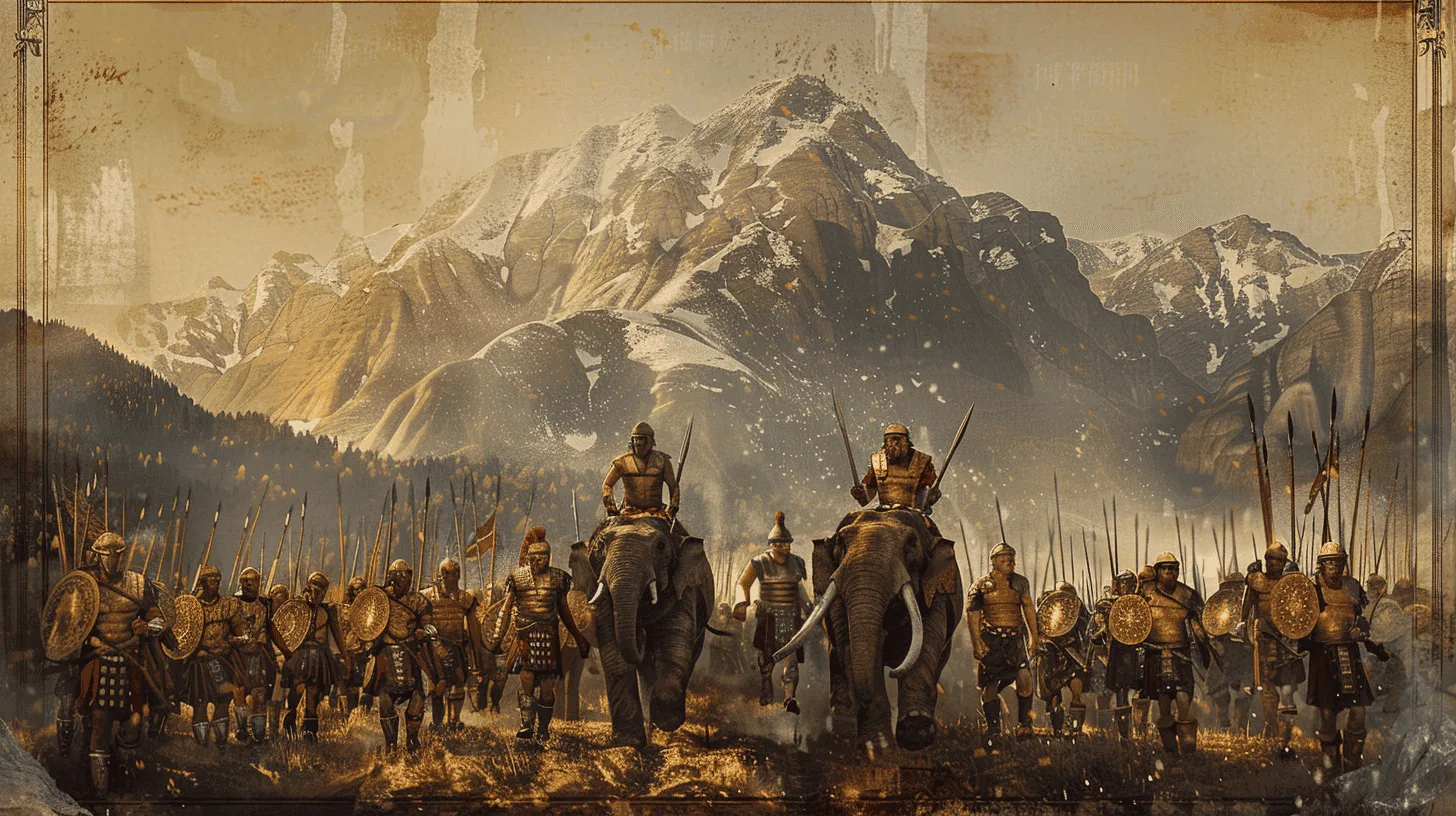
Hannibal's invasion of Italy represents one of the most remarkable military campaigns in history. Leading a diverse army of Carthaginians, Iberians, Numidians, and other allied forces, he crossed the Pyrenees, marched through hostile Gaul, and accomplished what Romans considered impossible: crossing the Alps in autumn with an army including war elephants. This audacious maneuver brought Carthaginian forces directly into Italy, bypassing Rome's naval superiority and Roman expectations of where and how the war would be fought.
For fifteen years (218–203 BCE), Hannibal campaigned in Italy, winning stunning tactical victories against numerically superior Roman forces. At Cannae in 216 BCE, he executed what military historians consider one of the most perfect tactical battles in history, encircling and destroying a Roman army of perhaps 50,000–70,000 men. His victories at Trebia, Lake Trasimene, and numerous smaller engagements demonstrated tactical brilliance that Roman commanders struggled to counter.
Yet despite these victories, Hannibal ultimately failed to achieve his strategic objectives. He could not force Rome to sue for peace, could not break Rome's Italian alliance system, and could not secure adequate reinforcements from Carthage. The war's tide turned when Roman strategy shifted from confronting Hannibal directly to attacking Carthaginian territories in Spain and Africa. In 202 BCE, Scipio Africanus defeated Hannibal at the Battle of Zama in North Africa, ending the Second Punic War and Carthage's status as a Mediterranean great power.
This comprehensive guide explores Hannibal's life from his youth in a military family through his spectacular campaigns and ultimate defeat, examines his revolutionary military tactics and their lasting influence, analyzes why he failed despite his tactical genius, traces his post-war career and eventual suicide in exile, and assesses his profound impact on military history and popular imagination. Whether studying ancient warfare, exploring themes of strategy and leadership, or examining how military genius alone cannot overcome systemic disadvantages, Hannibal's story offers profound insights into the complexities of war, the limits of individual brilliance, and the enduring power of historical memory.
Historical Context: Carthage, Rome, and the Punic Wars
Carthage: The Phoenician Trading Empire
Carthage (from the Phoenician Qart-Hadasht, meaning "New City") was founded around 814 BCE by Phoenician colonists from Tyre (in modern Lebanon) on the North African coast near modern Tunis, Tunisia. By Hannibal's time, Carthage had evolved from a Phoenician colony into an independent commercial empire controlling territories across the western Mediterranean.
Political structure: Carthage was an oligarchic republic governed by wealthy merchant families. Power centered in the Senate ('adirim), two annually elected suffetes (chief magistrates), the Council of 104 (a judicial body), and the Popular Assembly (with limited power).
Economic foundation: Unlike Rome's agricultural base, Carthaginian wealth derived primarily from maritime trade, silver mining (especially in Iberia), agricultural estates in North Africa, and tribute from subject territories.
Military system: Carthage relied heavily on mercenary armies, naval supremacy, elite Numidian light cavalry, and war elephants used as shock weapons. This commercial, cosmopolitan empire stood in sharp contrast to Rome's militaristic, citizen-soldier culture—a fundamental difference that would shape the Punic Wars' character and outcome.
Rome: The Rising Italian Power
By the mid-3rd century BCE, Rome had transformed from a small Italian city-state into the dominant power in the Italian peninsula. Key distinguishing characteristics included:
- Military culture: Citizen legions, allied troops from the socii system, the capacity to raise multiple armies, and a cultural resilience that absorbed losses and continued fighting.
- Political structure: A republican system with a Senate dominated by aristocratic families, two annually elected consuls as supreme commanders, powerful popular assemblies, and various magistrates.
- Strategic position: Control over central Italy, a network of allied Italian cities, and access to both the Adriatic and Tyrrhenian seas.
- Expansionist drive: Roman culture emphasized military glory, territorial expansion, and the obligation of aristocratic families to win victories for the state.
The First Punic War (264–241 BCE)
The First Punic War erupted over control of Sicily when Rome intervened in conflicts involving Carthaginian-controlled Sicilian cities. This 23-year war established patterns that would shape the Second Punic War:
- Naval warfare: Despite Carthage's naval superiority, Rome built a fleet and eventually won crucial naval battles, including the decisive Battle of the Aegates Islands (241 BCE).
- Carthaginian defeat: Carthage abandoned Sicily (which became Rome's first province), paid a massive indemnity, and suffered economic exhaustion.
- Hamilcar Barca's campaigns: Hannibal's father fought effectively in Sicily but was undermined by Carthage's political divisions and inadequate support. The war's end left him bitter toward both Rome and Carthage's ruling oligarchy.
- The "Truceless War": After the First Punic War, unpaid mercenaries rebelled (241–237 BCE), nearly destroying Carthage. Hamilcar suppressed this revolt, demonstrating the military competence he would pass to his son.
- Roman opportunism: While Carthage struggled with the mercenary revolt, Rome seized Sardinia and Corsica (238 BCE) and demanded additional indemnities—acts of bad faith that Carthaginians viewed as unjust aggression.
Carthaginian Expansion in Iberia
To compensate for losses in Sicily and Sardinia, Hamilcar Barca led Carthaginian expansion in Iberia (modern Spain and Portugal) beginning around 237 BCE. Strategic objectives included exploiting Iberian silver mines to pay war indemnities and rebuild Carthaginian power, creating a territorial base independent of Carthage's oligarchic politics, recruiting Iberian warriors, and establishing a launching point for potential future conflict with Rome. The Ebro Treaty (226 BCE) set the Ebro River as the northern limit of Carthaginian expansion, implicitly recognizing Carthaginian control south of the Ebro. The city of Saguntum, located south of the Ebro but allied with Rome, would become the immediate cause of the Second Punic War.
Hannibal's Early Life and Rise to Command
Birth and Family Background (247 BCE)
Hannibal was born in 247 BCE, during the final years of the First Punic War, into the Barcid family—one of Carthage's most prominent military families. His father Hamilcar Barca was one of Carthage's most successful generals during the First Punic War and never accepted Carthaginian defeat as legitimate. The most famous story from Hannibal's childhood comes from the Roman historian Livy, who describes Hamilcar taking the nine-year-old Hannibal to a sacrifice before departing for Iberia, making him swear to prove himself an enemy of the Roman people. Whether literal or allegorical, the story captures an essential truth: Hannibal was raised with an intense hostility toward Rome and a mission to avenge Carthaginian defeats.
Youth in Iberia (237–221 BCE)
Around 237 BCE, Hamilcar took Hannibal to Iberia, where the family built their powerbase. Hannibal grew up in military camps, receiving practical education in warfare, strategy, logistics, and command. He learned to work with diverse peoples (Iberians, Celts, Carthaginians, Greeks) and reportedly spoke Punic, Greek, some Latin, and various Iberian languages. Ancient sources describe young Hannibal as demonstrating exceptional physical courage, indifference to physical comfort, the ability to inspire loyalty, and remarkable tactical intuition. In 228 BCE, Hamilcar died, and Hannibal's brother-in-law Hasdrubal the Fair succeeded him. Hannibal served as a cavalry commander and military apprentice under Hasdrubal until Hasdrubal's assassination in 221 BCE, when the army immediately acclaimed the 26-year-old Hannibal as commander. Carthage's Senate later ratified the choice, though some oligarchic families distrusted the Barcids' independent power.
The Road to War: Saguntum and the Outbreak of Conflict
The Siege of Saguntum (219 BCE)
The city of Saguntum (modern Sagunto, Spain), south of the Ebro River but allied with Rome, created a Roman-allied enclave within Carthaginian-controlled territory. In 219 BCE, Hannibal besieged Saguntum, probably to eliminate a potential Roman base and test Rome's willingness to defend distant allies. After an eight-month siege—during which Hannibal was seriously wounded fighting from the front—the city fell. Rome demanded Hannibal's surrender, but the Carthaginian Senate, led by the Barcid faction, chose to support him, making war inevitable.
The Strategic Situation (218 BCE)
Rome's advantages included superior manpower reserves, the ability to field multiple armies, naval supremacy, a central Mediterranean position, and recent successes. Carthage's advantages included Hannibal's military genius and veteran army, Iberian silver wealth, excellent cavalry (especially Numidian light cavalry), war elephants, and potential allies among Rome's enemies. Romans expected to invade North Africa and attack Carthage directly, but Hannibal's actual plan—invading Italy by land—was completely unconventional and brilliant.
The Alpine Crossing: Strategy and Execution
Hannibal's Strategic Vision
Hannibal's decision to invade Italy overland represented revolutionary strategic thinking: bypass Roman naval power, achieve strategic surprise, attack Rome's alliance system, force decisive battles on his terms, and maintain the initiative. This plan required accomplishing what Romans considered impossible: crossing the Alps with an army in campaigning condition.
The Army and Its Composition
Hannibal departed New Carthage (modern Cartagena) in spring 218 BCE with approximately 50,000 infantry (Libyan, Iberian, and Gallic), 9,000 cavalry (Numidian light and Iberian heavy), and 37 African forest elephants. This was a multi-ethnic, polyglot army requiring exceptional leadership to maintain cohesion.
The March Through Gaul
The route took him through the Pyrenees (May–June 218 BCE), encountering resistance from mountain tribes; southern Gaul (July–August), where some Gauls allied with him and others opposed; and the Rhône crossing (August), a major engineering feat against the Volcae tribe. Meanwhile, the Roman consul Publius Cornelius Scipio (father of Scipio Africanus) tried to intercept Hannibal but arrived too late, realizing Hannibal's intentions and returning to Italy.
The Alpine Crossing (September–October 218 BCE)
The exact route remains debated—scholars propose passes such as the Col de Clapier, Col du Mont Cenis, or Col de la Traversette. The crossing faced daunting challenges: autumn timing (approaching winter), hostile Alpine tribes rolling boulders onto troops, treacherous terrain (narrow paths, cliffs, rockslides), early snow and freezing temperatures, and severe logistical difficulties. Moving 37 war elephants through the Alps was extremely difficult; most died from cold and disease during the first winter. Casualties were heavy: Hannibal lost roughly half his force—20,000–30,000 soldiers—and most of his elephants. The actual crossing through the Alps took about 15 days. He descended into the Po Valley in late October 218 BCE with perhaps 20,000 infantry and 6,000 cavalry—a battered but intact army that had achieved the impossible. The psychological shock to Rome was enormous.
The Italian Campaigns: Fifteen Years of War (218–203 BCE)
Early Victories: Trebia and Trasimene
Battle of Trebia (December 218 BCE): The Roman consul Sempronius Longus engaged Hannibal near the Trebia River. Hannibal deployed an ambush under his brother Mago, lured the Romans across the icy river, and then attacked the cold, wet, and tired legions from front and rear. Result: crushing Carthaginian victory; most Roman infantry were destroyed.
Battle of Lake Trasimene (June 217 BCE): The consul Gaius Flaminius pursued Hannibal into central Italy. Hannibal chose ground for an ambush along Lake Trasimene, hiding troops in hills above a narrow defile. On a foggy morning, the Roman army marched into the killing zone and was attacked from above, trapped against the lake. Perhaps 15,000 Romans were killed, including Flaminius, with minimal Carthaginian losses. This remains one of military history's most complete ambushes.
Cannae: The Perfect Battle (August 216 BCE)
After Trasimene, Rome appointed Fabius Maximus dictator, who adopted a strategy of avoiding pitched battle and shadowing Hannibal (the "Fabian strategy"). But in 216 BCE, Rome abandoned caution and raised a massive army to crush Hannibal. Commanded by consuls Lucius Aemilius Paullus and Gaius Terentius Varro, the Roman force numbered approximately 80,000 infantry and 6,000 cavalry, substantially outnumbering Hannibal's 40,000 infantry and 10,000 cavalry (with superior cavalry).
Hannibal deployed his weakest troops (Gallic and Iberian infantry) in the center in a convex formation, with his best African infantry on the wings and cavalry on both flanks. As the Romans pushed forward, the Carthaginian center gave ground as planned, drawing the Romans in. Then the African wings wheeled inward, attacking the Roman flanks while returning Carthaginian cavalry attacked the rear. The Roman army was completely surrounded. Packed too tightly to fight effectively, the legions were methodically destroyed: 50,000–70,000 Romans killed, including Paullus, 29 military tribunes, 80 senators, and countless experienced soldiers. Carthaginian casualties were perhaps 6,000–8,000.
The double envelopment at Cannae became a tactical model studied for over 2,000 years. Yet Hannibal did not march on Rome afterward—a decision debated ever since. Possible reasons: Rome's formidable walls, his army's need for rest, lack of siege equipment, and his strategy of breaking alliances rather than capturing Rome itself.
The War Drags On: Stalemate in Italy (215–203 BCE)
Following Cannae, several major Italian cities (Capua, Syracuse, and others) defected to Hannibal, but most Italian allies—particularly in Latium and central Italy—remained loyal to Rome. Rome adapted its strategy: avoid pitched battles, open multiple fronts (Iberia, Sicily, Africa), systematically recapture defected cities (Capua fell in 211 BCE), and outlast Hannibal. Hannibal faced insurmountable problems: no reinforcements from Carthage (political opposition and Roman naval control prevented this), supply difficulties, siege limitations, diplomatic failure to break Rome's confederacy, and attrition of his forces. In 207 BCE, his brother Hasdrubal was defeated and killed at the Battle of the Metaurus before joining him. By 203 BCE, Roman forces under Scipio had conquered Carthaginian Iberia and invaded North Africa, forcing Hannibal's recall. After fifteen years in Italy, Hannibal sailed back to Africa, never defeated in battle but strategically checkmated.
The Battle of Zama and Defeat (202 BCE)
Scipio's African Campaign
Publius Cornelius Scipio (later Scipio Africanus) had studied Hannibal's tactics, adapted Roman formations, secured an alliance with Numidian prince Masinissa (providing excellent cavalry), and demonstrated strategic vision. In 204 BCE, he invaded North Africa, threatening Carthage itself and forcing the recall of Hannibal.
The Final Confrontation at Zama
At Zama (October 19, 202 BCE), Hannibal commanded 40,000–50,000 infantry and 4,000 cavalry (including war elephants), but many troops were inexperienced, and he lacked superior cavalry. Scipio commanded approximately 40,000 infantry and 6,000 cavalry, including veteran legions and Masinissa's Numidian cavalry. Scipio prepared for the elephant charge by creating lanes through his formations, causing the stampede to fail. Roman and Numidian cavalry defeated Carthaginian horsemen, then returned to attack Hannibal's infantry from behind—using Hannibal's own Cannae tactics. The result: Carthaginian casualties of perhaps 20,000 killed and 15,000 captured, ending Carthage's military power.
The Peace Terms
Carthage surrendered and accepted harsh terms: lose all territories outside Africa, pay 10,000 talents over 50 years, surrender all but 10 warships, and be prohibited from making war without Roman permission. Rome also recognized Masinissa's Numidian kingdom as a neighboring ally. Carthage was reduced from a Mediterranean great power to a subordinate state.
Why Hannibal Failed: Strategic Analysis
Tactical Genius, Strategic Limitations
Hannibal's tactical brilliance is undeniable, but tactical victories do not automatically translate to strategic success. Rome's advantages were systemic: enormous manpower reserves from the Italian confederation, a loyal alliance system (most allies stayed faithful), the ability to open multiple fronts while Hannibal was in Italy, naval supremacy that prevented reinforcement, and remarkable political unity despite disasters.
Carthaginian Weaknesses
Carthage provided minimal support due to political opposition to the Barcids, resource allocation to other theaters, weaker naval capability after the First Punic War, and strategic myopia. Carthage also lacked the agricultural surplus, manufacturing capacity, and population base of Rome to sustain a protracted war.
Hannibal's Strategic Mistakes
Questionable decisions include not marching on Rome after Cannae, failing to capture major ports (needed for reinforcement and supply), lacking siege capability, and insufficient diplomatic success in securing effective allies (Philip V of Macedon provided little help). After seizing the initiative, he gradually lost strategic momentum as Rome opened new fronts.
The Fundamental Problem: Hannibal Couldn't Win Without Carthage
Hannibal fought a systemic conflict with tactical means. Defeating Rome required breaking the Italian alliance, directly threatening Rome severely, or organizing a multi-front coalition. Carthage failed to provide the necessary reinforcements, coordinated efforts, naval support, or diplomatic coalitions. No amount of tactical genius could overcome these structural disadvantages. Hannibal's defeat at Zama was not primarily because Scipio was a better commander but because Rome had systematically dismantled Carthage's strategic position.
Post-War Life: Politics, Exile, and Death
Political Career in Carthage (200–195 BCE)
After Zama, Hannibal returned to Carthage and was elected suffete (chief magistrate) in 195 BCE. He implemented financial and political reforms, targeting corruption and reforming tax collection, which made enemies among the oligarchy. His political opponents sent envoys to Rome claiming he was secretly negotiating with Antiochus III of the Seleucid Empire. Rome demanded his surrender, and Hannibal fled Carthage in 195 BCE.
Exile and Wanderings (195–183 BCE)
Hannibal found refuge with Antiochus III, serving as a military advisor during the Roman-Seleucid War (192–188 BCE). His influence was limited; Antiochus's own generals did not fully utilize his expertise. After Rome's victory, Hannibal fled to Prusias I of Bithynia, where he again served as a military advisor and reportedly helped Bithynian sailors by using clay pots filled with venomous snakes—a creative but dubious tactic. Rome pressured Prusias to surrender Hannibal, and in 183 BCE (or 182/181 BCE), facing capture, Hannibal poisoned himself. According to tradition, he said, "Let us relieve the Romans from the anxiety they have so long experienced, since they think it tries their patience too much to wait for an old man's death." He died in obscure exile in Bithynia at about age 64.
Historical Sources and Modern Understanding
Our understanding of Hannibal comes from ancient historians, all writing after his death and mostly from a Roman perspective. Key sources include Polybius (Greek historian, generally reliable and based on eyewitness accounts), Livy (Roman historian with dramatic literary style but patriotic bias), Appian and Cassius Dio (later Roman writers), and Plutarch (Greek biographer focusing on character). No Carthaginian primary sources survived. All accounts come from his enemies, which introduces potential bias—Romans had incentives to exaggerate Hannibal's threat to make their victory more impressive.
Modern historians debate questions such as whether Hannibal should have marched on Rome after Cannae, whether more Carthaginian support could have turned the tide, the exact route of the Alpine crossing, and the reliability of casualty figures. Archaeological evidence from battle sites and possible pass routes remains fragmentary but continues to inform scholarship. For further reading, consult Livius.org's article on Hannibal or the Encyclopaedia Britannica entry.
Hannibal's Legacy and Historical Impact
Military Influence
Hannibal's battles, especially Cannae, have been studied for over 2,000 years. The double envelopment became a tactical model for commanders from the Schlieffen Plan (World War I) to modern military theory. His use of terrain, cavalry integration, and psychological warfare influenced combined arms and operational art. Military academies worldwide continue to analyze his campaigns.
Strategic Lessons
Hannibal's story teaches that tactical victory does not equal strategic success; logistics and grand strategy matter; offensive operations deep in enemy territory are hard to sustain; and coalition warfare and alliance management are critical. Rome's superior grand strategy ultimately defeated cunning tactics.
Cultural Impact
Hannibal became the archetype of the brilliant commander, cited alongside Alexander, Caesar, and Napoleon. Romans grudgingly admired him even while fearing and defeating him. He appears frequently in historical fiction, strategy games, and educational media. The image of elephants crossing the Alps has become iconic in art and popular culture.
Political and Historical Significance
The Second Punic War brought Rome closer to destruction than any other conflict in its early history. Victory over Hannibal confirmed Rome's status as the Mediterranean superpower and set the stage for further expansion. The war's aftermath directly led to Carthage's eventual destruction in the Third Punic War (149–146 BCE). The conflict demonstrated the importance of resilience, political unity, and strategic adaptability—qualities that would underpin the Roman Empire for centuries.
Conclusion: The General Who Almost Changed History
Twenty-two centuries after his death, Hannibal Barca remains one of history's most studied and admired military commanders—not because he won his war (he did not) or because he achieved his strategic objectives (he failed) but because his tactical genius, audacious strategy, and relentless determination brought the ancient world's greatest power to the brink of destruction.
Hannibal's life embodies both the power and limitations of individual genius. His tactical brilliance at Cannae and other battles demonstrated what extraordinary leadership and innovative thinking could accomplish. His strategic vision in invading Italy overland showed creative problem-solving that defied conventional thinking. His fifteen-year campaign in enemy territory, never defeated in pitched battle, revealed exceptional operational skill.
Yet individual genius proved insufficient to overcome systemic disadvantages. Rome's superior resources, resilient political culture, loyal alliance system, and strategic adaptability ultimately defeated Hannibal despite his tactical superiority. His story demonstrates that wars are won not just on battlefields but through economic capacity, political cohesion, diplomatic skill, and sustained strategic vision—areas where Carthage failed to match Rome.
The tragedy of Hannibal's life lies in recognizing how close he came. After Cannae, with tens of thousands of Roman dead, multiple Italian cities defecting, and Rome's military power temporarily shattered, the war might have been won if Carthage had provided adequate support. But that support never came. Hannibal fought brilliantly with inadequate resources, achieving tactical miracles that ultimately could not translate to strategic victory.
His post-war life—exile, wandering, and suicide to avoid capture—adds poignant dimension to his story. The general who had terrorized Rome for nearly two decades died a hunted fugitive in obscure Bithynia, choosing poison over surrender. There is both nobility and tragedy in his final words, refusing to grant Rome the satisfaction of capturing him.
Understanding Hannibal requires appreciating both his genuine brilliance and his ultimate failure. He was one of history's greatest military commanders who nearly accomplished the impossible. That he failed does not diminish his achievements but rather illuminates the complex interaction of individual ability, institutional capacity, cultural factors, and resource constraints that determine historical outcomes. Hannibal's name remains legendary not just for what he accomplished but for what he nearly achieved—the destruction of Rome and the rewriting of Western civilization's trajectory.
For further exploration of ancient warfare and the Punic Wars, see World History Encyclopedia's profile of Hannibal and The Collector's article on Hannibal's campaigns.