Table of Contents
Introduction: The Arrow That Ended an Era
On September 25, 1066, a single arrow changed the course of history. Harald Hardrada—“Hard Ruler”—fell at the Battle of Stamford Bridge, his throat pierced by an English projectile, ending not just a life but the entire Viking Age. This Norwegian king’s death marked the symbolic conclusion of three centuries when Norse warriors terrorized European coasts, established kingdoms from Russia to Sicily, and reshaped medieval civilization.
Harald Sigurdsson was born in 1015 CE into Norway’s royal dynasty during the twilight of the Viking world. His life reads like myth turned history: a young prince forced into exile after his brother’s death, a mercenary fighting across three continents, a Byzantine general commanding elite troops in the Mediterranean, and finally a king determined to forge a Scandinavian empire. What makes his story compelling is what it reveals about the transformation of the Viking world itself. Harald lived during the critical transition from pagan raiders to Christian kingdoms, from Viking warriors to medieval knights, from plunder to state-building. He embodied this transition—a warrior trained in ancient traditions who deployed Byzantine sophistication, a pagan descendant who ruled as a Christian monarch, a sea king who understood coinage and centralized administration.
His final campaign—the 1066 invasion of England—represented the last gasp of Viking expansion. That it failed, that Harald died just weeks before William the Conqueror’s victory at Hastings, that his death effectively ended Viking military dominance—all this gives his story a poignant quality of historical turning points. Today, over 950 years later, Harald remains one of history’s most fascinating warriors. Understanding him means understanding the Viking Age’s final chapter.
Early Life and Exile
A Prince in a Divided Kingdom
Harald was born in 1015 CE in Ringerike, north of modern Oslo. His father, Sigurd Syr, was a regional king; his mother, Åsta Gudbrandsdatter, connected him to Norway’s most powerful families through her previous marriage to King Harald Grenske. Most significantly, Harald’s half-brother was Olaf Haraldsson—later Saint Olaf, Norway’s patron saint. This placed young Harald at the center of turbulent politics. Norway was a collection of competing petty kingdoms and powerful families, further complicated by Cnut the Great, the Danish king who had conquered England and now targeted Norway.
Growing up in this environment, Harald absorbed lessons about power, loyalty, and survival.
The Battle of Stiklestad: Baptism in Blood
The defining moment of Harald’s youth came on July 29, 1030, at the Battle of Stiklestad. Harald, just 15 years old, fought alongside Olaf against an army of Norwegian nobles backed by Cnut. Olaf had been driven into exile but returned with loyalists including his teenage half-brother. The battle proved catastrophic: Olaf fell, later canonized as a martyr. Harald was severely wounded and carried from the field.
Remaining in Norway meant certain death—he was the half-brother of the defeated king, a potential rallying point for resistance.
Flight into Exile
Harald’s escape reads like an adventure saga. Wounded and pursued, he was hidden by farmers loyal to Olaf’s memory. Once recovered, he and a small band began the dangerous journey eastward to Kievan Rus’. The Norse called it Garðaríki. Prince Yaroslav the Wise, who had supported Olaf, welcomed them.
This experience—fleeing as a hunted fugitive—taught Harald about survival, loyalty, and the precariousness of power. He left Norway a wounded boy of 15; he would not return for fifteen years, and when he did, he would return as a hardened warrior determined never to be powerless again.
In the Service of Byzantium
Kievan Rus’ and the Path to Constantinople
Around 1031 CE, Harald arrived at Yaroslav’s court in Kyiv. The Kievan Rus’ had been founded by Scandinavian Varangians and remained closely tied to Norse culture. Yaroslav needed capable commanders to defend against the Pechenegs, Turkic steppe nomads. Harald proved his value quickly, learning cavalry tactics and the logistical challenges of campaigning across vast distances. By the mid-1030s, he commanded significant forces, but his ambitions extended further.
Tales reached him of Constantinople—Miklagard, the “Great City”—where Scandinavian warriors earned vast fortunes in the Varangian Guard. Around 1034 CE, Harald journeyed south.
The Varangian Guard: Elite Warriors in the East
The Varangian Guard (from Old Norse væringi, “sworn companions”) was established in 988 CE when Emperor Basil II recruited Scandinavian warriors as personal bodyguards. By Harald’s time, it was legendary. Varangians received exceptional pay, shares of plunder, proximity to power, and special legal privileges—including the right to plunder the imperial palace for one hour after an emperor’s death. For nearly a decade, Harald fought across the Byzantine world, serving under several emperors and gaining unparalleled military experience.
Campaigns Across the Mediterranean
Harald participated in major Byzantine operations:
- Sicily (1038-1040 CE): Under General George Maniakes, the Byzantines attempted to reconquer Sicily from Arab control. Harald’s Varangians served as shock troops, storming fortifications. The campaign ultimately failed due to court politics, teaching Harald about the empire’s complex intrigues.
- Bulgaria and the Balkans: Operations against rebels involved mountain warfare, sieges, and counterinsurgency.
- North Africa and the Levant: Saga accounts describe campaigns in these regions, though details are uncertain. Harald may even have reached Jerusalem.
These campaigns exposed Harald to advanced siege warfare (including Greek fire), naval operations, and multi-ethnic armies. He returned to Yaroslav’s court around 1043-1044 CE with enormous wealth and a fearsome reputation. He had also been imprisoned briefly by Byzantine authorities—perhaps for political reasons or financial disputes—but escaped dramatically, reportedly jumping his ship over Constantinople’s harbor chain. The story is legendary but captures Harald’s audacity.
Return to Kievan Rus’
Back at Yaroslav’s court, Harald married Elisiv, Yaroslav’s daughter, securing a powerful dynastic alliance. His fortune in gold and silver, sent from Byzantium over the years, made him one of the wealthiest men in Scandinavia. The time had come to reclaim his birthright.
Return and Rise to Power
The Political Landscape
Harald’s nephew Magnus the Good, son of Saint Olaf, had ruled Norway since 1035. Magnus had driven out Danish influence and even held the Danish throne briefly. But his position had vulnerabilities: ongoing conflicts with Denmark, no direct heir, and discontent among nobles. When Harald returned to Scandinavia in 1045 CE with a substantial force, the situation became critical.
The Uneasy Co-Kingship
Rather than civil war, Harald and Magnus negotiated a compromise: joint rule of Norway, formalized in 1046 CE. Both held the title of king, sharing authority and coordinating military operations. The arrangement was unstable—medieval kingship was inherently singular—but it prevented immediate conflict. Harald contributed his Byzantine wealth to fund the state and military.
The co-kingship ended abruptly in October 1047 when Magnus died suddenly, possibly from illness. Harald became sole King of Norway at about 32. His claim to the Danish throne—inherited from Magnus—led to nearly two decades of war with Denmark.
The King of Norway
State-Building and Administration
Harald was more than a warrior. Drawing on Byzantine experience, he implemented reforms that transformed Norway into a more centralized medieval kingdom:
- Monetary System: He introduced Norway’s first systematic coinage, bearing his royal image. This facilitated trade, tax collection, and enhanced royal authority across the kingdom.
- Fortifications: He invested in defensive infrastructure at strategic locations, using advanced techniques learned in Byzantium.
- Naval Power: He maintained a powerful fleet that allowed rapid response to challenges and enabled offensive campaigns.
- Legal Centralization: He worked to strengthen royal courts at the expense of regional assemblies (things), facing resistance but gradually reinforcing monarchical institutions.
The Iron Fist: Suppressing Autonomy
Harald’s epithet “Hardrada” reflected his ruthless approach. Regional nobles who resisted faced military expeditions, confiscation of lands, exile, or execution. He used strategic marriages to bind families to the court, controlled minting and trade to reduce economic independence, and relied on his fearsome reputation to discourage rebellion. While centralization was never completed, Harald’s reign marked a significant step toward a unified Norwegian state.
The War with Denmark
From 1048 to 1064, Harald repeatedly invaded Denmark, adopting a strategy of systematic devastation: burning towns, destroying crops, and disrupting commerce. He aimed to break Danish resistance economically, but Sweyn Estridsson avoided decisive battle, retreating and returning. The war included the Battle of Niså (1062), a naval engagement that Harald won but failed to end the conflict. By 1064, both sides recognized stalemate and signed a peace treaty formally recognizing Sweyn as King of Denmark. For Harald, this was a significant diplomatic defeat after twenty years of effort.
The Invasion of England
The Succession Crisis of 1066
On January 5, 1066, King Edward the Confessor died without a clear heir. Three claimants emerged:
- Harold Godwinson, the powerful Earl of Wessex, crowned immediately.
- William, Duke of Normandy, claiming Edward had promised him the throne.
- Harald Hardrada, basing his claim on an old agreement between Magnus and Harthacnut.
Harald’s claim was arguably weakest, but he had a formidable military reputation and resources. He allied with Tostig Godwinson, Harold’s exiled brother, who provided local knowledge and potential English support.
The Invasion Fleet
In early September 1066, Harald assembled perhaps 200-300 ships carrying an estimated 9,000-11,000 warriors—the last great Viking invasion force. They landed in the Humber estuary, strategically chosen for Tostig’s connections and distance from Harold Godwinson’s southern forces.
The Battle of Fulford: Last Viking Victory
On September 20, 1066, Harald’s army met the northern English earls Edwin and Morcar at Gate Fulford, just south of York. The battle was fierce, but Harald’s veterans broke through the English left flank, routing the defenders with heavy casualties. York surrendered, and Harald established control of northern England within weeks. It was his last triumph.
Harold Godwinson’s Forced March
Learning of the invasion, King Harold Godwinson made a bold decision: he would march his army north to confront Harald personally, rather than waiting for the expected Norman invasion. His army covered approximately 190-200 miles from London to York in about four days—an extraordinary feat that achieved complete surprise.
Stamford Bridge: The Last Battle
On September 25, 1066, Harald’s forces were scattered; many warriors had left their armor at the ships. At Stamford Bridge, about seven miles east of York, only half his army was present. Harold Godwinson’s fresh troops attacked without warning.
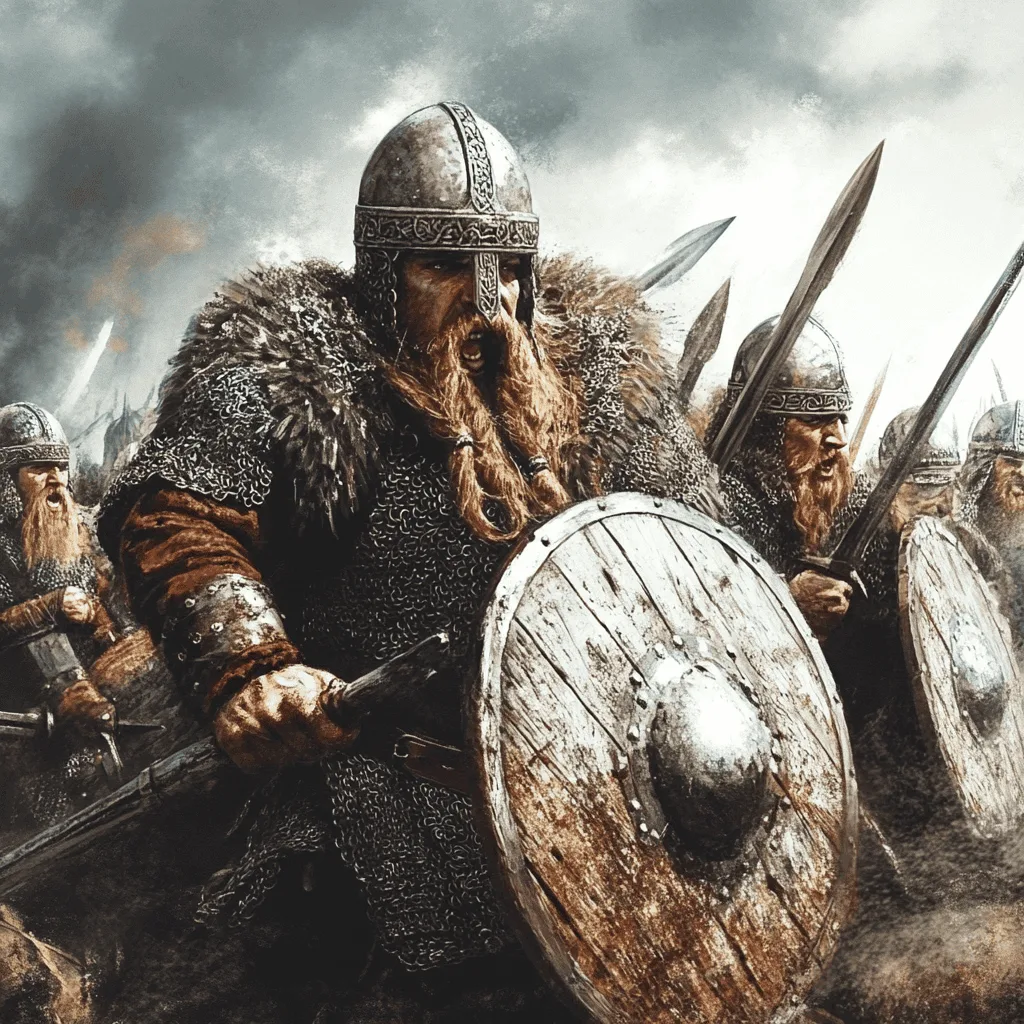
The battle became desperate. One Norwegian warrior famously held the narrow bridge, killing dozens before being stabbed from below through the planking. Once the English crossed, Harald organized a shield wall and fought ferociously. But an arrow struck him in the throat, mortally wounding him. Tostig continued fighting but was also killed.
The Norwegian army was annihilated—of 300 ships, only 24 carried survivors home.
The End of an Era
Why Stamford Bridge Marks the Viking Age’s End
Harald’s death traditionally dates the Viking Age’s conclusion for several reasons:
- Last Major Invasion: No subsequent Viking attempt to conquer an established kingdom succeeded.
- Military Evolution: Medieval armies had developed tactics and organization to defeat Viking forces consistently.
- Christianization and State Formation: Scandinavia was transforming into Christian monarchies, reducing the social basis for large-scale raiding.
- National Identities: Norwegians, Danes, and Swedes were becoming distinct peoples with territorial kingdoms.
Legacy of Harald Hardrada
Harald became the archetypal Viking: warrior excellence from Stiklestad to Stamford Bridge, travel across continents, wealth through war, poetic skill, and death in battle. His state-building efforts left Norway more centralized. His failure in Denmark and England defined the limits of Viking power. Culturally, he appears in sagas such as Heimskringla, in modern media, and as a symbol of the transition from pagan raider to medieval king.
Ironically, his invasion indirectly enabled the Norman Conquest. Harold Godwinson’s army was exhausted and reduced after Stamford Bridge, and just weeks later William the Conqueror defeated him at Hastings. Harald’s last campaign thus helped change English history forever.
For further reading, explore Harald Hardrada’s biography on Britannica and the account of Stamford Bridge in History Today. Those interested in the Varangian Guard can find more here.