Table of Contents
The Man Behind the Legend: Leonidas I of Sparta
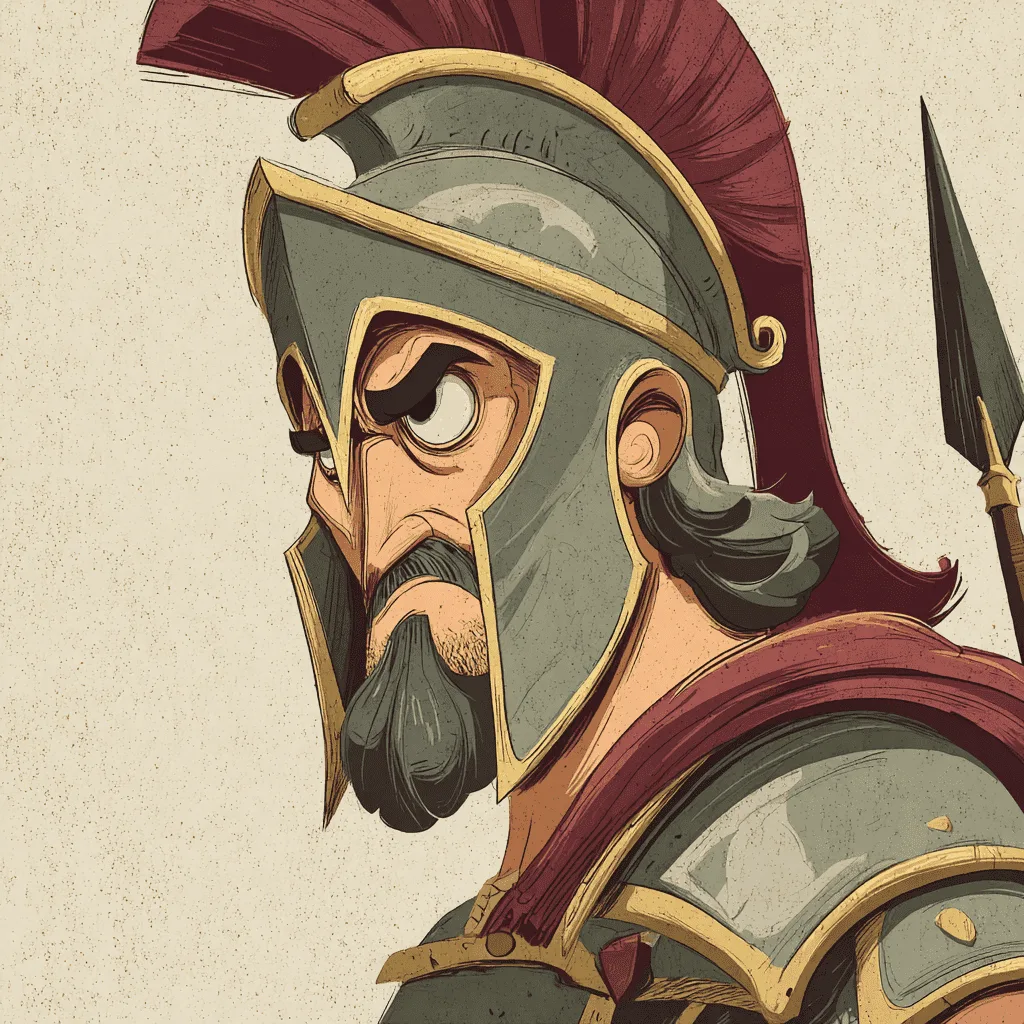
Leonidas I was not merely a king of Sparta—he was a living symbol of the city‑state’s iron‑willed military culture. For more than two millennia, his name has been synonymous with courage, sacrifice, and the defiant refusal to submit against impossible odds. He is best remembered for commanding the Greek rearguard at the Battle of Thermopylae in 480 BC, where he and his personal guard of 300 Spartans, along with allied soldiers, made a last stand against the invading Persian army of King Xerxes I. That single act of defiance turned a tactical defeat into one of history’s most enduring legends.
To understand Leonidas is to understand the world that shaped him—a world where a man’s worth was measured not by his wealth or intellect, but by his willingness to die for his city. Sparta was a society built on discipline, endurance, and a relentless focus on military excellence. Leonidas embodied these ideals from his earliest years. His reign coincided with the greatest external threat Greece had ever faced, and his response to that threat defined not only his own legacy but also the course of Western civilization. The story of Leonidas is the story of how a single decision, made in a narrow mountain pass, echoed across centuries.
Early Life and Royal Lineage
The Agiad Dynasty and Spartan Dual Kingship
Leonidas was born around 540 BC into the Agiad dynasty, one of two royal houses that ruled Sparta simultaneously. This dual‑kingship system, almost unknown elsewhere in Greece, had existed for centuries and was believed to trace its origins to the Heracleidae—descendants of the hero Heracles. Leonidas’s father was King Anaxandridas II. His mother was, according to ancient sources, Anaxandridas’s second wife, which made Leonidas a younger half‑brother to Cleomenes and a full brother to Cleombrotus.
Sparta was a highly stratified society. Full citizens, the Spartiates, formed a warrior elite who devoted their lives to military training and public service. They were outnumbered by a vast population of enslaved Helots, who worked the land and supported the Spartan economy. Between these two groups stood the Perioeci, free non‑citizens who managed trade, crafts, and limited military duties. This structure meant that Sparta was perpetually on a war footing—both to maintain dominance over its own Helots and to defend against external threats.
The dual kingship was designed to prevent any single ruler from becoming too powerful, but it also created a system of checks and balances that could be both a strength and a weakness in times of crisis.
Leonidas’s royal lineage was steeped in myth. The Agiad dynasty claimed descent from Heracles, linking Sparta’s kings to the heroes of the Trojan War and the age of the Iliad. This ancestry was not merely symbolic; it conferred a sacred authority that legitimized their rule and gave their commands a quasi‑religious weight. In a society that valued tradition and obedience above all, such lineage was a source of immense power—and immense responsibility.
The Agoge: Training for War
Every male Spartan citizen, regardless of royal blood, underwent the agoge, the city‑state’s famed state‑sponsored education and training program. At the age of seven, Leonidas would have been taken from his family and placed in a communal barracks with other boys. The agoge was designed to produce warriors who were physically hardened, mentally disciplined, and absolutely loyal to Sparta. It was a brutal system by any standard.
The training emphasized endurance through deprivation. Boys were given minimal clothing, adequate food but not enough to avoid hunger, and were encouraged to steal to supplement their rations—though they were severely punished if caught. They slept on reeds, endured public floggings to test their pain tolerance, and participated in mock battles that often left real bruises and broken bones. The goal was not just to create strong fighters but to forge men who would never betray fear or hesitation in battle. The Spartan poet Tyrtaeus wrote: “It is a beautiful thing for a brave man to die at the front of the battle, fighting for his homeland.”
This was the ethos drilled into every Spartan boy from his earliest days.
Academically, Spartans learned to read and write, but only enough to function in society. Far more important was the study of martial poetry, the memorization of laws, and the practice of military dances that taught rhythm and coordination. Young Spartans also learned the art of heavy infantry combat—the hoplite phalanx. Leonidas trained with the aspis (the large round shield), the dory (the long thrusting spear), and the xiphos (the short sword). He learned to fight as part of a tight formation, where each man’s survival depended on the man beside him.
The agoge not only taught technique; it instilled a profound sense of collective duty. A Spartan who lost his shield in battle was dishonored, for the shield was not just a weapon but a symbol of the warrior’s bond to his comrades.
Leonidas would have completed the agoge around the age of 20, after which he would become a full citizen. But even then, he continued to live in barracks with his fellow soldiers, eating in common messes and maintaining constant readiness. This communal lifestyle, known as the syssitia, reinforced the bonds of loyalty and equality that made the Spartan army so formidable. For Leonidas, there was no privileged path. He earned his place in the ranks just as every other Spartan did—through suffering, discipline, and the will to endure.
Rise to the Throne
Leonidas did not expect to become king. His half‑brother Cleomenes I ruled Sparta for nearly thirty years, and it was only after Cleomenes’s death around 490 BC that Leonidas ascended the throne. Cleomenes had been a dynamic and controversial ruler. He expanded Spartan influence, destroyed the rival city of Argos in a devastating battle, and intervened in Athenian politics. But he also made enemies among the Spartan elite and was said to have become mentally unstable in his later years.
He died under suspicious circumstances—possibly by his own hand, possibly murdered.
The succession was not automatic. Cleomenes left no sons, only a daughter named Gorgo. Spartan law forbade a queen regnant, so the throne passed to the next male in the Agiad line. Leonidas was chosen over his younger brother Cleombrotus, suggesting that he had already earned a reputation for capability and leadership. His rising came at a crucial moment.
The First Persian Invasion had been repelled at Marathon in 490 BC, but everyone in Greece knew that the Persians would return. The new Persian king, Xerxes I, was determined to avenge his father’s defeat and complete the conquest of Greece.
As king, Leonidas wielded both military and religious authority. He was the commander-in-chief of the Spartan army, but he also shared power with the two boards of ephors (elected officials who could veto the kings) and the Gerousia (the council of elders). This complex political system meant that Leonidas could not simply dictate policy; he had to negotiate, persuade, and sometimes defer to others. When news arrived of Xerxes’s massive invasion force, Leonidas found himself at the center of a political and military crisis that would test his leadership to its absolute limit.
The Battle of Thermopylae
Causes and Prelude
The Greco‑Persian Wars had their origins in the early 5th century BC. The Greek city‑states of Ionia (on the coast of modern Turkey) had revolted against Persian rule around 499 BC. Athens and Eretria sent ships and soldiers to support the rebels, which infuriated the Persian king, Darius I. After suppressing the revolt, Darius decided to punish Athens and Eretria and to bring the Greek mainland under Persian control. His first invasion was stopped at Marathon in 490 BC.
Darius died before he could launch a second invasion. His son Xerxes spent years preparing a colossal army and navy. The Greek city‑states, alarmed by the threat, formed a defensive alliance under the leadership of Sparta and Athens. A congress was held at Corinth, where it was decided to attempt a stand at the narrow pass of Thermopylae—the “Hot Gates”—while the Greek navy engaged the Persian fleet off the coast of Artemisium. Thermopylae was chosen because its narrow width, only about 15 meters at the narrowest point, would prevent the Persians from bringing their numerical superiority to bear.
The pass was also protected by the sea on one side and the steep mountains of Mount Oeta on the other.
Leonidas was chosen to lead the advance force. He selected 300 Spartiates, all of whom had living sons (so their family lines would continue), along with allied contingents from other cities, totaling around 7,000 men. The decision to send such a small force was partly political—the main Spartan army was delayed by the religious festival of the Carneia, and the Spartans were reluctant to commit all their forces until the festival ended. But it also reflected a strategic judgment: even a small force could hold the pass for a time, and delay was the Greeks’ most valuable asset.
Forces and Leadership
The Greek force at Thermopylae consisted of approximately 7,000 hoplites and light troops. The core was the 300 Spartiates, but there were also contingents from the Peloponnese, Boeotia, Locris, Phocis, and other regions. The exact composition varied according to Herodotus, but the largest allied group was from Thespiae, whose soldiers chose to remain with Leonidas to the end.
Leonidas positioned his forces at the narrowest part of the pass. The Greek phalanx, with its overlapping shields and long spears, was ideally suited for fighting in such confined space. The Persian army, by contrast, was composed primarily of archers and light infantry with shorter swords and wicker shields. The Persian cavalry, which would have been devastating on open ground, could not operate in the narrow pass. Leonidas’s tactical plan was simple: hold the line, kill as many Persians as possible, and buy time for the Greek fleet to achieve a favorable outcome at Artemisium.
The leadership of Leonidas was decisive. He personally commanded from the front, as Spartan kings were expected to do. His presence bolstered the morale of his troops and demonstrated that he was willing to share their fate. The Persians, meanwhile, were commanded by Xerxes himself, who watched the battle from a golden throne on a nearby hill. The encounter was as much a clash of cultures as of armies—the freedom‑loving Greeks against the imperial might of the Persian king.
The Three-Day Battle
Day One: Xerxes waited four days, expecting the Greeks to flee. When they did not, he ordered an assault. The Persian troops—first the Medes and Cissians, later the elite Immortals—attacked in waves. But the narrow front made numbers meaningless. The Greek hoplites stood firm, their spears cutting down attackers, their shields forming a wall of bronze.
The Persians fought bravely but could not break the formation. The Greeks even employed a tactic of feigned retreat, drawing the Persians into a trap before turning and slaughtering them. By the end of the first day, the pass was choked with Persian dead.
Day Two: Xerxes sent in his best troops, the Immortals. These were the elite of the Persian army, but they, too, failed to break through. The Greek phalanx held, and the Persian casualties mounted. At one point, the Greeks fought in relay, rotating fresh troops to the front while the exhausted ones fell back. The Spartans, in particular, displayed almost superhuman endurance.
Ancient sources say that the Greeks fought with their spears until those shattered, then with their swords, then with their daggers, and finally with their hands and teeth.
Day Three: The Betrayal—A local Greek named Ephialtes revealed a mountain path that bypassed the pass. This was the Anopaea path, a goat track that wound through the mountains and came out behind the Greek position. Xerxes immediately dispatched the Immortals on a night march. The Phocians guarding the path did not detect the Persian advance until it was too late; they withdrew to a safer position, allowing the Persians to encircle the Greek army.
When Leonidas learned of the encirclement at dawn, he held a council. Most of the allied troops were dismissed to escape and fight another day. Leonidas decided to stay with the Spartans, along with the Thespians (who refused to leave) and a contingent of Thebans (who were forced to remain). The decision to stay was shaped by multiple factors: the oracle at Delphi had foretold that either Sparta would be destroyed or a Spartan king would die; Spartan law forbade retreat; and Leonidas felt a personal responsibility to hold the line as long as possible. He sent most of the allies away, but the 300 Spartans, the 700 Thespians, and about 400 Thebans remained.
The Final Stand
The final battle was a massacre. The Greeks advanced from the narrow pass into a slightly wider area, determined to kill as many Persians as possible before they fell. They fought with their spears until those broke; then with their swords; then with their daggers; and finally, according to Herodotus, with their bare hands and teeth. Leonidas fell early in the fighting, but the Greeks held his body and fought over it, preventing the Persians from taking it. The struggle for his corpse went back and forth until the Greeks finally secured it.
Eventually, the surviving Greeks retreated to a small hill behind the pass, where they were surrounded. The Persians, having learned not to engage them in close combat, overwhelmed them with arrows and javelins from all sides. Every single Spartan and Thespian died. Some of the Thebans surrendered and were later branded with the king’s mark as prisoners. The pass was open, but the cost to the Persians was staggering.
Aftermath and Strategic Significance
The tactical result of Thermopylae was a Persian victory. But strategically, it was a Greek triumph. The three‑day delay allowed the Greek fleet to fight a series of battles at Artemisium that, while inconclusive, cost the Persians many ships and gave the Greeks confidence. A violent storm also struck the Persian fleet, wrecking hundreds of vessels. This reduced Persian naval superiority, which proved crucial in the later Battle of Salamis.
More importantly, the stand at Thermopylae became a rallying cry for all Greece. The defiance of Leonidas and his men showed that the Persians were not invincible. It inspired the Greek city‑states to continue the fight rather than surrender. Within a year, the Greek navy crushed the Persians at Salamis, and a year after that, the Greek army defeated Xerxes’s remaining forces at Plataea. The Persian threat was ended, and Greece preserved its independence.
The immediate aftermath was grim for the fallen. Xerxes, enraged by the resistance, ordered Leonidas’s body beheaded and crucified—a dishonorable act that was not typical of Persian treatment of enemy dead. But the memory of Thermopylae was preserved in epic poetry. Simonides composed the famous epitaph: “Go tell the Spartans, stranger passing by, that here obedient to their laws we lie.” Later, a stone lion was erected at the site in Leonidas’s honor.
Cultural and Historical Legacy
Leonidas in Ancient Literature
Our most detailed account of Leonidas and Thermopylae comes from Herodotus, the Greek historian who wrote the Histories around 440 BC. Herodotus’s narrative blends historical fact with legend, moral lessons, and dramatic storytelling. He portrays Leonidas as a king who fully understood the prophecy of his own death and acted accordingly. The famous exchange—“Molon labe” (Come and take them)—may have been invented, but it perfectly captures the Spartan spirit. The anecdote of “fight in the shade” reflects the contempt Spartans had for the enemy’s numerical advantage.
Later Greek and Roman historians, such as Plutarch and Diodorus, elaborated on the story, adding details about Leonidas’s character and the battle. The legend grew over time. In the Roman period, Thermopylae was seen as a model of virtus and patriotism. The story was taught in schools and used as an example of how to face death with dignity. The New Testament even uses the imagery of the “300” as a symbol of faithful sacrifice, though indirectly.
Archaeological Evidence
Modern archaeology has confirmed several details of the Thermopylae narrative. The pass has been identified, and remains of an ancient wall (the lower section) have been excavated. The Anopaea path has been traced through the mountains. In 1939, the Greek archaeologist Spyridon Marinatos discovered a mass burial of hundreds of skeletons near the pass, consistent with a mass grave of defenders. A modern lion monument now stands at the site, a replica of the original.
While the exact numbers and some details remain debated, the core of the story—a heroic last stand—is firmly supported by archaeological evidence.
Encyclopedia Britannica provides an excellent overview, and History.com offers a detailed analysis of the battle and its context.
Symbolism and Modern Reception
Leonidas’s story has been reinterpreted countless times. In the 18th and 19th centuries, it was used by nationalists and revolutionaries to inspire resistance against larger empires. The Battle of Thermopylae was seen as the archetypal struggle of freedom against tyranny. In the 20th century, it was controversially co‑opted by Nazi ideology, which distorted Spartan values to support racial and militaristic agendas.
In modern popular culture, the 2006 film 300 and its sequel brought a highly stylized version of the story to a global audience. While historically inaccurate, the film sparked renewed interest in Leonidas and Spartan culture. It also sparked debate about the use of classical history for modern political messaging. Despite these distortions, the central themes—courage, duty, sacrifice—remain powerful.
Wider Significance: The Greco‑Persian Wars and Their Legacy
Key Figures Beyond Leonidas
Leonidas is the most famous figure of the Persian Wars, but others were equally crucial. Themistocles of Athens was the architect of the Greek naval victory at Salamis. He foresaw that sea power would decide the conflict and convinced Athens to build a fleet. Xerxes himself is portrayed by Herodotus as a capricious tyrant, but he was a competent administrator who inherited a massive empire. Mardonius, the Persian commander who survived Thermopylae, led the army at Plataea and was killed in battle.
Artemisia of Halicarnassus was a female commander who advised Xerxes wisely at Salamis, though her advice was ignored. The war was not a simple clash of civilizations but a complex interplay of personalities, politics, and cultures.
Geopolitical Consequences
The Greek victory in the Persian Wars preserved the independence of the Greek city‑states. This had profound consequences for Western civilization. Had Persia conquered Greece, the unique Greek developments in democracy, philosophy, science, and art might have been suppressed or never fully developed. The wars also set the stage for the rise of Athens and the subsequent Peloponnesian War with Sparta, which ultimately weakened both and led to the rise of Macedon. But the cultural legacy of Greece—its literature, its political thought, its artistic achievements—was passed on to the Romans and then to the modern world.
For more on the broader conflict, see World History Encyclopedia’s entry.
What Modern Readers Can Learn from Leonidas
Leadership Through Example
Leonidas did not send his men forward from safety; he led from the front. This principle of leadership by example is as relevant today as it was in ancient Sparta. Modern military leaders, business executives, and team managers can draw inspiration from the idea that the best leaders share the risks and hardships of their followers. Trust is earned when leaders demonstrate that they are willing to do what they ask of others.
Strategic Creativity Under Constraints
Leonidas faced a situation of limited resources against a vastly superior enemy. Instead of despairing, he used the terrain to neutralize the enemy’s advantages. This is a timeless lesson in strategic thinking: identify the constraints, then use creativity to turn them into strengths. Whether in competition, conflict, or personal challenges, the ability to reframe a problem can yield solutions that raw power cannot achieve.
The Power of Shared Culture
The Spartans’ effectiveness came from their shared culture, instilled by the agoge. This culture created unbreakable bonds and ensured that every warrior would stand and die rather than break ranks. In modern organizations, building a strong culture of shared values and mutual commitment can produce extraordinary results. While no one would want to replicate the harshness of Sparta, the principle that culture is a force multiplier is widely applicable.
Ethical Clarity in Crisis
Leonidas’s decision to stay and die raises deep ethical questions about duty and sacrifice. In a world that often prioritizes individual rights and self‑preservation, his choice challenges us to consider what obligations we have to our communities and our principles. The story does not provide easy answers, but it forces us to reflect on the nature of heroism and the price of freedom.
The Limits of Force
The Persian Wars demonstrate that overwhelming force does not guarantee victory if it cannot be effectively applied. The Persians had numbers and resources but could not convert them into success at Thermopylae because of the terrain and the Greek tactics. This lesson has been repeated throughout history—from the Roman defeat in the Teutoburg Forest to modern counter‑insurgency campaigns. Military power is only one element of strategic success; understanding the human and environmental factors is equally important.
The Enduring Power of Story
Finally, the story of Leonidas shows how a single narrative can inspire generations. The tale of Thermopylae has been retold for 2,500 years because it embodies universal human values. Stories matter. They shape identity, motivate action, and transmit culture. For any organization or movement, the stories they tell about themselves are a powerful tool for building cohesion and purpose.
Conclusion: The Eternal Resonance of Leonidas’s Stand
More than 25 centuries after his death, Leonidas I remains one of the most recognizable figures in history. His stand at Thermopylae is a touchstone of courage and sacrifice. But the historical Leonidas was not a cartoon hero; he was a product of a harsh, militaristic society that valued obedience above all. His greatness lay in his ability to embody the ideals of his culture and to make a choice that, while leading to his own death, ensured the survival of his people.
The Battle of Thermopylae was a tactical defeat, but a strategic and moral victory. It bought precious time, it inspired the Greek resistance, and it provided a narrative that has resonated across civilizations. The story asks us to consider what we are willing to fight for, what we are willing to die for, and what we are willing to sacrifice for the common good. In an age of individualism and uncertainty, Leonidas’s example remains a powerful—and troubling—reminder of what human beings are capable of when they are united by purpose and driven by conviction.
The lion of Thermopylae stands as a monument not to the glory of war, but to the power of the human spirit. Leonidas I, the Spartan king who defied an empire, deserves his place in history—not as a flawless hero, but as a man who, when faced with impossible odds, chose the path of courage.