Table of Contents
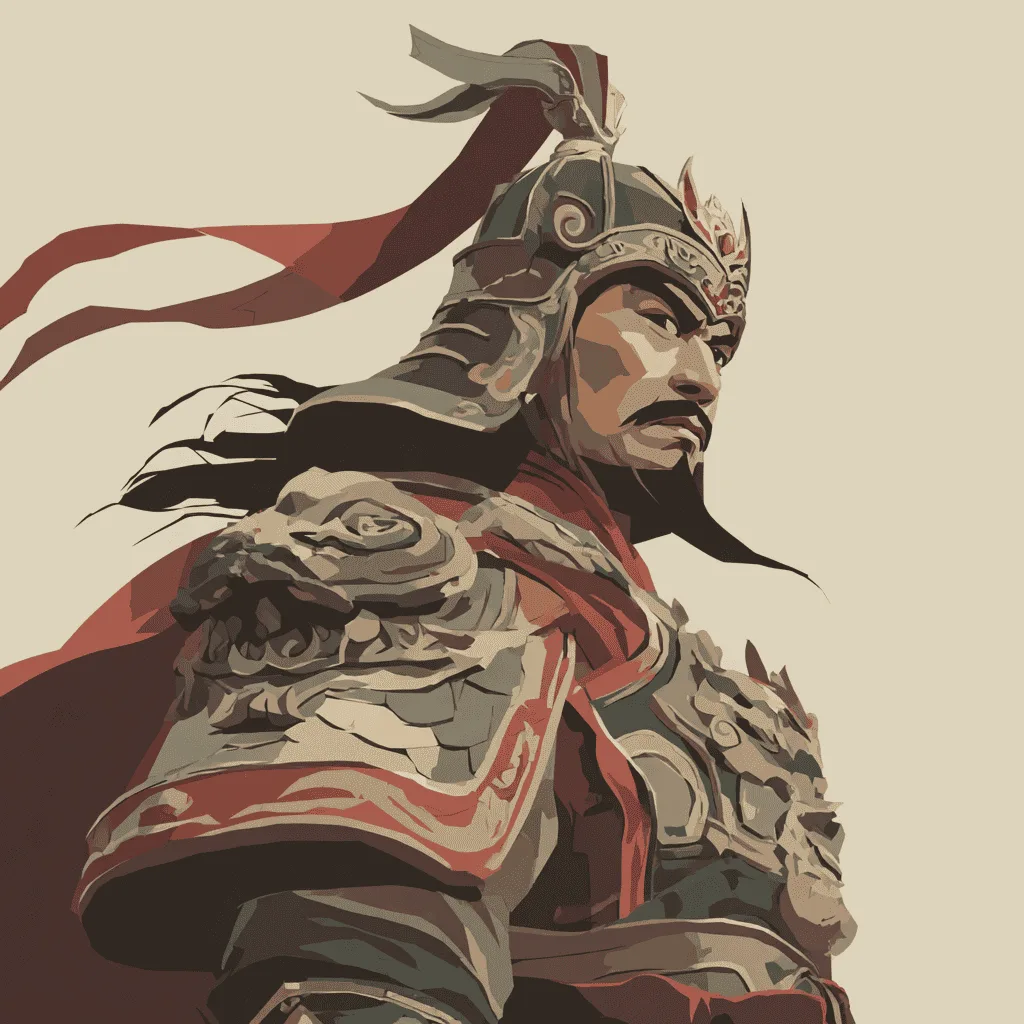
Lu Bu remains one of the most recognizable figures from ancient Chinese history—a warrior whose name still echoes through centuries as the epitome of martial prowess and, simultaneously, the embodiment of treacherous ambition. His story unfolds during the final chaotic decades of the Eastern Han dynasty, a period when the old imperial order was crumbling and mighty warlords fought for control of a fractured empire. Lu Bu rose from modest frontier origins to become the most feared combatant of his age, yet his inability to forge lasting alliances and his repeated betrayals of those who trusted him ultimately sealed his fate. Understanding Lu Bu means exploring both his extraordinary talents and the fatal character flaws that turned his remarkable life into a cautionary legend.
The Rise of a Legend: Lu Bu’s Early Life and the Chaos of the Late Han
The Collapse of Han Authority
To appreciate Lu Bu’s meteoric rise, one must first understand the world he entered. By the late 2nd century AD, the Han dynasty was collapsing under the weight of internal corruption, eunuch intrigues at court, and massive peasant rebellions like the Yellow Turban Uprising. Provincial governors and military commanders accumulated power, ignoring the figurehead emperors who sat powerless on the throne. This environment of violent flux created unprecedented opportunities for ambitious men willing to seize them by force. The Three Kingdoms period, which would follow the Han’s final collapse, became one of the most celebrated and romanticized eras in Chinese history—and Lu Bu was one of its most dramatic figures.
From Border Warrior to Trusted Officer
Born around 160 AD in Jiuyuan County in modern-day Inner Mongolia, Lu Bu grew up in a frontier region known for producing skilled horsemen and archers. Historical records describe him as possessing extraordinary physical strength and exceptional talent in mounted combat. His early career began under Ding Yuan, a Han general who served in the capital region. Ding Yuan recognized Lu Bu’s martial gifts and promoted him rapidly, treating the younger man almost as an adopted son. This bond was built on trust and mentorship—values that would soon prove meaningless to Lu Bu when a better offer appeared.
The First Great Betrayal
When the powerful warlord Dong Zhuo seized control of the imperial court and began consolidating power, he saw Lu Bu as a valuable asset. Dong Zhuo tempted Lu Bu with promises of greater status, wealth, and military command. In a shocking act, Lu Bu murdered his benefactor Ding Yuan and defected to Dong Zhuo’s camp, bringing his elite cavalry with him. This betrayal not only launched Lu Bu into the highest echelons of power but also established a pattern that would define his entire life: he would consistently sacrifice loyalty for immediate personal gain.
The Betrayer Betrayed: Lu Bu Under Dong Zhuo
An Adopted Son’s Treachery
Dong Zhuo formally adopted Lu Bu as his son, a gesture that in Confucian culture carried immense ethical weight. Lu Bu became Dong Zhuo’s top general, enforcing his rule across the realm. Yet the relationship was fraught with tension. Dong Zhuo was notoriously cruel and paranoid, and Lu Bu’s pride chafed under his patron’s dominance. More importantly, Lu Bu had already demonstrated that his loyalty was for sale.
The court official Wang Yun saw an opportunity to eliminate Dong Zhuo and quietly cultivated Lu Bu’s growing resentment.
The Role of Wang Yun and Diao Chan
According to the Romance of the Three Kingdoms, Wang Yun orchestrated an elaborate scheme involving his beautiful adopted daughter Diao Chan. He secretly promised her to both Lu Bu and Dong Zhuo, then arranged for the two men to encounter her separately. Jealousy and desire inflamed the already strained relationship between the adopted father and son. In 192 AD, Lu Bu assassinated Dong Zhuo during a court ceremony, an act that shocked contemporaries because it violated the most sacred bonds of filial piety. Lu Bu had murdered his own adopted father—a crime considered among the most heinous in Chinese ethics.
Whether the Diao Chan story is historically accurate or a later literary invention, it captures a crucial truth: Lu Bu’s emotions frequently overrode his strategic judgment. His passion for Diao Chan, combined with his ambition and resentment, drove him to an act that permanently branded him as untrustworthy. The Four Beauties of ancient China include Diao Chan, cementing her role in this legendary episode.
A Cycle of Broken Alliances
Liu Bei, Cao Cao, and the Warlords
After killing Dong Zhuo, Lu Bu attempted to establish himself as an independent power. But his reputation preceded him. He briefly served Yuan Shu, then turned against him. He sought refuge with Liu Bei, who generously gave him sanctuary in Xu Province—only for Lu Bu to seize control of that province and drive Liu Bei out. This pattern repeated: Lu Bu would ally with a stronger warlord, gain temporary advantage, then betray him at the first opportunity.
Cao Cao, the brilliant strategist who would later unify northern China, recognized Lu Bu’s martial value but also understood his fatal flaw. Cao Cao once remarked that Lu Bu’s loyalty would never be reliable. Despite this, Cao Cao attempted to recruit Lu Bu at various points, only to be rebuffed or betrayed. Yuan Shao, another powerful warlord, also experienced Lu Bu’s shifting allegiances. By the late 190s, Lu Bu had alienated nearly every major player in the realm.
No one trusted him, and many actively sought his destruction.
The Isolation of a Warrior
Lu Bu’s isolation was not merely political—it was existential. He commanded a core of loyal officers, including the capable Zhang Liao and Gao Shun, but he could not expand his base. Every potential ally knew that an alliance with Lu Bu was a temporary arrangement that would likely end in betrayal. This isolation made him vulnerable. Even the greatest warrior cannot hold territory when surrounded by enemies on all sides and bereft of reliable friends.
Military Prowess and Strategic Failures
The Battle of Puyang
Lu Bu’s military reputation was built on his personal combat abilities. He wielded a ji (a polearm) with devastating effect, and his cavalry charges were nearly unstoppable. At the Battle of Puyang in 194 AD, he faced Cao Cao’s army and achieved significant tactical victories. He personally led assaults that nearly killed Cao Cao himself, demonstrating his ferocity and skill. Yet the campaign ended inconclusively.
Lu Bu could win battles but could not finish the war. He failed to secure supply lines, coordinate his subordinates effectively, or anticipate Cao Cao’s strategic maneuvers. This pattern—brilliant tactical execution coupled with poor strategic planning—defined his entire military career.
The Siege of Xiapi and Final Defeat
Lu Bu’s final stand came at Xiapi in 198–199 AD. A coalition led by Cao Cao and Liu Bei besieged the city. Lu Bu’s forces fought bravely, but Cao Cao employed a cunning strategy: he diverted rivers to flood the lower parts of the city, destroying defenses and morale. Betrayal struck again—some of Lu Bu’s own subordinates turned against him, recognizing the hopelessness of the situation. Captured and brought before Cao Cao, Lu Bu famously asked to be spared, promising to help Cao Cao conquer all of China.
But Liu Bei, remembering Lu Bu’s past treachery, warned Cao Cao of the danger. Cao Cao agreed, and Lu Bu was executed.
His death marked the end of an era’s most fearsome warrior, but also the logical conclusion of a life built on broken trust and short-sighted ambition.
Why Lu Bu Endures: Cultural and Historical Legacy
The Ultimate Warrior in Romance of the Three Kingdoms
Lu Bu’s legend was cemented by the 14th-century novel Romance of the Three Kingdoms. In this work, he is portrayed as the preeminent warrior of his age, capable of fighting three legendary heroes—Guan Yu, Zhang Fei, and Liu Bei—simultaneously at Hulao Gate. This scene, while almost certainly fictional, captures how Chinese culture remembers Lu Bu: as a force of nature, supremely powerful but also deeply flawed. The novel emphasizes his superhuman combat ability and his tragic inability to think beyond the immediate moment.
A Cautionary Tale in Confucian Thought
In Confucian ethics, loyalty (忠) and righteousness (义) are cardinal virtues that maintain social harmony. Lu Bu’s life represents their complete antithesis. He consistently violated the bonds that held society together: loyalty to a lord, to a father, to an ally. His story became a moral lesson taught across generations: raw talent without ethical foundation leads to ruin. This cautionary dimension gives Lu Bu’s tale enduring relevance, as it explores the perennial tension between individual ambition and communal responsibility.
Lu Bu in Modern Media
Today, Lu Bu appears in countless video games, films, and television series. The Dynasty Warriors franchise has made him an iconic boss character, with the gaming community meme “Do not pursue Lu Bu!” originating from encounters where he would easily defeat unprepared players. These adaptations introduce Lu Bu to global audiences, ensuring his legend continues to evolve. Whether as a tragic antihero or a straightforward villain, Lu Bu remains a compelling figure because his story addresses universal questions about power, trust, and the consequences of our choices.
Lessons from Lu Bu for Today
The Power of Trust and Relationships
Lu Bu’s career demonstrates that trust is a non-renewable resource. Once destroyed, it cannot be easily rebuilt. In modern professional and personal contexts, reliability and integrity often matter more than raw talent. People prefer to work with someone competent and trustworthy over a brilliant but unreliable individual. Lu Bu could not sustain any meaningful relationship, and as a result, he could not sustain power.
Tactical Brilliance vs. Strategic Vision
Being good at solving immediate problems does not guarantee long-term success. Lu Bu could win individual battles but could not win a campaign. This distinction between tactical and strategic thinking is crucial in business, military, and organizational leadership. Effective leaders must balance short-term victories with long-term planning—a skill Lu Bu never developed.
Character as the Foundation of Leadership
Perhaps the most important lesson from Lu Bu’s life is that character has practical consequences. His ethical failures were not just moral lapses; they were strategic errors that cost him everything. Modern leadership research consistently shows that ethical behavior, transparency, and respect for others correlate strongly with sustainable success. Lu Bu’s story is a vivid reminder that without a strong ethical core, even extraordinary abilities will ultimately be wasted.
Conclusion: The Legend Lives On
Lu Bu was the greatest warrior of his era—perhaps of any era in Chinese history. His martial skills were unmatched, his courage on the battlefield legendary. Yet he died defeated and disgraced, betrayed by his own nature as much as by his enemies. His story continues to captivate because it is not merely a tale of ancient battles; it is a meditation on the human condition. It asks us to consider what greatness truly means.
Is it the ability to overpower opponents, or is it the wisdom to build lasting bonds and use power responsibly? Lu Bu’s answer, proved by his life and death, remains a powerful lesson for anyone who seeks to lead, achieve, and leave a positive legacy.