Table of Contents
Historical Context: Formation of a Warrior
Japan’s Sengoku Period: The Crucible of War
To understand Miyamoto Musashi, one must first grasp the world that shaped him. Born around 1584, he entered life near the end of Japan’s Sengoku period (roughly 1467–1615)—a century of relentless civil warfare that shattered central authority and remade society. During this era, regional warlords (daimyō) fought constantly for territory and influence, samurai existed as professional warriors whose martial skill meant survival, and social mobility allowed talented fighters to rise regardless of birth.
This environment forged Musashi. Warfare was not abstract; it was daily reality. Sword schools proliferated as masters competed to teach effective techniques. Testing one’s skill in actual combat was expected, and a warrior’s reputation directly determined his opportunities. Musashi absorbed these lessons from childhood, and they would define his path.
The Battle of Sekigahara and the Tokugawa Peace
In 1600, when Musashi was about sixteen, the Battle of Sekigahara decided Japan’s future. Tokugawa Ieyasu’s victory established the Tokugawa shogunate, which would rule until 1868. This transformation had profound effects on samurai like Musashi. After Sekigahara, large-scale warfare essentially ended; the Tokugawa enforced strict class hierarchies, turning many samurai into bureaucrats; and martial skills became ceremonial rather than battlefield necessities. Thousands of masterless samurai (rōnin)—those whose lords had been defeated—found themselves without place in a structured society that valued lord-retainer bonds.
Musashi lived his entire adult life in this transitional period. He was trained for a war that was ending, and his martial excellence became increasingly anachronistic. Yet he refused to adapt to the emerging peacetime order, remaining a rōnin and continuing to practice and teach swordsmanship with deadly seriousness. This outsider status deeply influenced his philosophy.
The Culture of Dueling
Despite (or because of) the peace, dueling remained a vibrant part of samurai culture. Formal contests to the death served several purposes: they tested techniques against skilled opponents, built reputation, proved the superiority of one’s school, and resolved honor disputes. Musashi’s career of over sixty duels occurred within this context—not random street fights but structured confrontations that validated martial skill in an era without war.
The Life of Miyamoto Musashi
Early Years and Formation (1584–1600)
Miyamoto Musashi (childhood name Bennosuke) was born in Harima Province (modern Hyōgo Prefecture). His father, Munisai (also Shinmen Munisai), was a skilled martial artist who taught him swordsmanship and the use of the jitte. Sources suggest Musashi lost his father early, which may have contributed to his solitary nature. According to Musashi’s own account, he fought his first duel at age thirteen against a warrior named Arima Kihei, killing him—an extraordinary achievement that, whether wholly accurate or partly legendary, indicates his early prowess.
At about sixteen, Musashi likely fought at Sekigahara on the losing side for the Western army. This experience of large-scale defeat and the subsequent chaos shaped his understanding of conflict and the importance of strategy over mere technique.
The Wandering Years: Musha Shugyō (1600s–1610s)
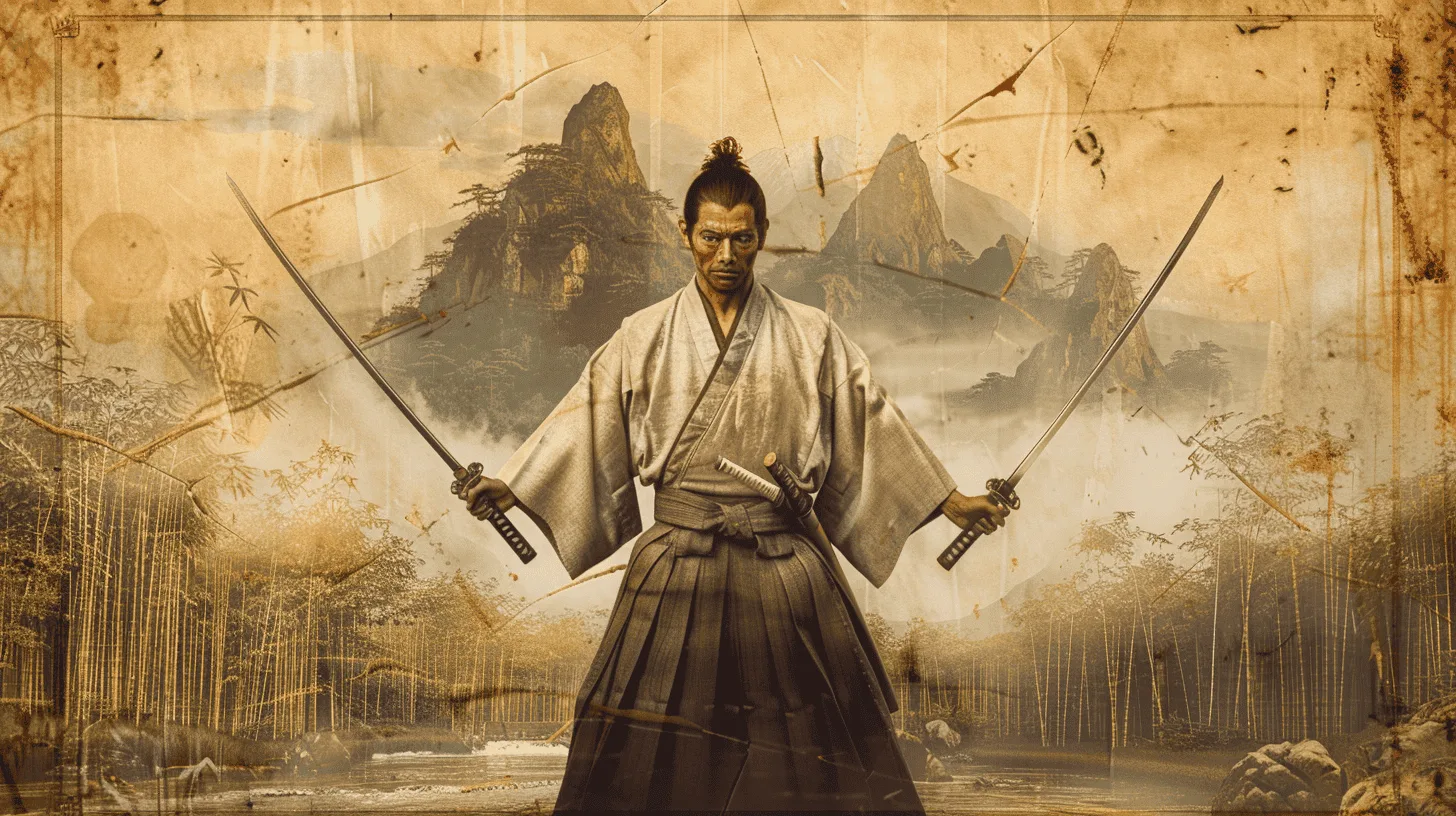
After Sekigahara, Musashi embarked on musha shugyō—the traditional warrior pilgrimage. He traveled Japan challenging various sword schools, fighting duels, and developing his own methods. As a rōnin, he had freedom but also faced economic insecurity and social marginalization. During these years, he formulated his signature Niten Ichi-ryū (“Two Heavens as One”) style, which used both the katana and wakizashi simultaneously—a radical departure from the standard two-handed use of the long sword.
Musashi’s approach went beyond physical technique: he studied opponents’ psychology, exploited their assumptions, and emphasized adaptability over rigid forms. He rejected the notion of favorite weapons and insisted that a warrior must be ready to use whatever circumstances demanded.
The Famous Duels
Several of Musashi’s duels have become legendary. The most significant series was against the Yoshioka school in Kyoto (1604). Musashi fought and killed three members of the family in succession—Yoshioka Seijūrō, his brother Denshichirō, and later faced an ambush by the school’s remaining students. He anticipated the attack and brought allies, destroying the school’s reputation. This demonstrated his willingness to fight unconventionally and his strategic foresight.
The most famous duel was against Sasaki Kojirō on Ganryū Island in 1612. Kojirō wielded an exceptionally long sword (nodachi) and was renowned for his “Tsubame Gaeshi” (swallow reversal) technique. Musashi arrived late to unsettle his opponent, used a wooden sword (bokken) carved from an oar to match Kojirō’s reach, and ended the fight quickly. The psychological and tactical elements—deliberate lateness, unconventional weapon, exploiting the opponent’s expectations—reveal Musashi’s core principle: understanding the opponent’s mind is as important as technical skill.
After the Kojirō duel, Musashi’s life shifted. He struggled to secure permanent service with major lords but began teaching his style. He also cultivated artistic skills in ink painting and calligraphy, embodying the samurai ideal of bunbu ryōdō—the dual path of martial and cultural refinement.
Later Years and Final Legacy (1640s)
In his sixties, Musashi finally entered service with the Hosokawa clan in Kumamoto. In 1643, he withdrew to Reigandō, a mountain cave, to meditate and write. There he composed The Book of Five Rings (Go Rin no Sho), completing it just weeks before his death in 1645. He died peacefully—an unusual end for a lifelong warrior—and left instructions for his disciples. His life spanned the transition from warfare to peace, making him perhaps the last genuinely combat-tested master of classical Japanese swordsmanship.
Niten Ichi-ryū: Revolutionary Martial Innovation
The Two-Sword Style
Musashi’s most visible innovation was fighting with two swords simultaneously. Traditional practice held that only the long sword (katana) should be used with both hands for power; the short sword (wakizashi) was a backup. Musashi saw this as limiting. Why carry two weapons if you only use one? His Niten Ichi-ryū used both to attack and defend at once, creating a fluid, adaptable style.
It required exceptional coordination and produced tactical advantages: simultaneous offense and defense, multiple attack angles, and psychological disruption for opponents accustomed to conventional swordplay.
This innovation reflected a deeper philosophical point: do not limit yourself to one method or resource when you have more available. It applied beyond combat to strategy in all domains.
Core Principles of Musashi’s Fighting Method
Beyond specific techniques, Musashi emphasized principles that could be adapted to any situation. He rejected attachment to favorite weapons, advocating for flexibility. He stressed adaptability over formula—understanding principles rather than memorizing rigid patterns. Psychological warfare was central: disrupting an opponent’s rhythm, exploiting their expectations, and maintaining mental dominance. His concept of hyōshi (timing or rhythm) was crucial—striking when the opponent was off-balance, not just when you were ready.
Musashi also valued direct perception: seeing things as they are, not as you expect them to be. He warned against filtering experience through taught concepts. And he insisted on practical effectiveness over flashy technique. If a move worked in combat, it was valid; if it didn’t, it was useless, regardless of tradition.
Training Philosophy
Musashi’s training approach was equally radical. He believed that practice should approximate real combat as closely as possible. Individual cultivation of skill and mental state formed the foundation. He urged students to study broadly—not just swordsmanship but all martial arts, strategy, and even unrelated disciplines, because every skill offers lessons. Physical training required parallel mental cultivation: discipline, concentration, and emotional control.
Mastery, he taught, was a lifelong commitment, not a goal to be achieved.
The Book of Five Rings: Strategic Philosophy
Context and Composition
In 1643, Musashi retreated to Reigandō cave to write The Book of Five Rings (Gorin no Sho). He intended to preserve his strategic insights for future generations and to demonstrate that his understanding was not merely physical but philosophical. The work is a systematic articulation of the principles he had tested in over sixty duels and decades of reflection.
The Five Books: Structure and Content
The book is divided into five sections, named after elements from Buddhist and Daoist thought:
- The Book of Earth establishes foundations—Musashi’s background, the universal importance of strategy, and the need to master principles before transcending them.
- The Book of Water uses water as a metaphor for adaptability: taking the shape of circumstances, flowing around obstacles, appearing soft yet powerful. It covers mental attitude, positioning, sword handling, and the importance of natural posture over special stances.
- The Book of Fire addresses the moment of conflict. It discusses knowing your environment, reading opponents, tactical approaches, maintaining advantage, and fighting multiple opponents.
- The Book of Wind critiques other schools, using “wind” to represent tradition. Musashi systematically attacks common practices: relying on large or small weapons, emphasizing brute strength, focusing on speed, teaching elaborate techniques, and depending on formal stances.
- The Book of Void is the shortest and most philosophical. It describes the state beyond technique—mind (no-mind) where action flows spontaneously and correctly without conscious deliberation. This is the ultimate goal of training: to internalize skill so deeply that the mind does not interfere with performance.
Core Strategic Principles
Several key ideas thread through all five books. Study all things—do not limit yourself to your specialty; strategy appears in carpentry, commerce, and governance. Perceive that which cannot be seen—develop intuitive understanding beyond the obvious. Adaptability—never commit to a single approach; adjust continuously. Take initiative—seize and maintain the advantage, forcing opponents to react.
Timing—understand rhythm both your own and your opponent’s. Simplicity—complex techniques fail under pressure; direct, simple actions executed properly outperform elaborate maneuvers. Body-mind unity—physical techniques require corresponding mental states; hesitation, fear, or attachment undermine skill. Finally, training as preparation—how you train determines how you perform; practice as you fight.
Modern Relevance and Applications
Martial Arts Influence
Musashi’s direct legacy remains strong in traditional and modern martial arts. In kendo, his emphasis on mental state, timing, and direct striking informs contemporary practice. Traditional kenjutsu schools study Niten Ichi-ryū techniques. In mixed martial arts (MMA), his insistence on adaptability and using whatever works resonates with the sport’s philosophy—fighters must be ready for striking, grappling, and anything else. Many MMA coaches cite Musashi’s strategic principles.
Business and Competitive Strategy
The Book of Five Rings has become a popular reference in business, especially for competitive strategy. Musashi’s focus on studying opponents thoroughly parallels competitive intelligence and market analysis. His principle of flexibility over rigid plans aligns with agile and lean methods. Understanding how competitors think provides advantages, much like Musashi’s psychological warfare. His preference for simplicity supports focused, efficient approaches.
Critics note risks in romanticizing combat, but thoughtful application offers valuable frameworks for competition.
Personal Development and Self-Cultivation
Many readers approach Musashi as a guide to personal growth. His emphasis on consistent, dedicated practice applies to learning any skill. Developing emotional control, focus, and strategic thinking helps manage daily challenges. His discussions of maintaining composure in life-or-death situations offer perspective on managing anxiety. The concept of lifelong learning resonates with modern growth mindset ideas.
The challenge is adapting principles from literal combat to everyday contexts without trivializing the intensity of their origin.
Leadership and Decision-Making
Musashi’s principles inform leadership and high-stakes decision-making. Leaders must act with incomplete information—Musashi’s experience fighting on instinct despite uncertainty parallels strategic decisions. Understanding others’ motivations is crucial for leadership. Seizing initiative and setting the agenda gives leaders an advantage over reactive ones. Maintaining composure under pressure translates directly to crisis leadership.
His method of direct perception—seeing situations as they are—helps leaders avoid cognitive biases and wishful thinking.
Cultural Legacy and Enduring Impact
In Japan, Musashi is a national icon representing dedication to craft and continuous self-improvement. The 1935 novelization of his life by Eiji Yoshikawa became a cultural phenomenon, shaping modern Japanese understanding of the historical figure. Locations like Ganryū Island and Reigandō cave attract tourists and pilgrims. Internationally, Musashi appears in films, manga (such as Vagabond), anime, video games, and business literature. These portrayals spread awareness but sometimes reduce complexity to a simplified icon.
For readers who want deeper engagement, several resources are recommended. The Hyōhō Niten Ichi Ryū website offers information about the contemporary practice of Musashi’s school. The Britannica entry on Miyamoto Musashi provides reliable historical context. The Metropolitan Museum of Art’s samurai collection offers visual context for the warrior culture of his time. For those interested in the philosophical roots, the Stanford Encyclopedia of Philosophy’s entry on Japanese philosophy contextualizes Musashi’s ideas within broader intellectual traditions.
Finally, modern strategic thinkers continue to adapt his principles, as seen in William Scott Wilson’s annotated translation of The Book of Five Rings.
Conclusion: The Enduring Relevance of Musashi’s Way
Miyamoto Musashi lived over four centuries ago in a culture far removed from our own. The skills he mastered—sword fighting—no longer hold practical importance for most people. Yet his ideas continue to resonate because they address fundamental human challenges that transcend historical context. He teaches that adaptability beats rigid excellence: mastering fixed techniques is less important than developing the capacity to respond to novel situations. Mental state determines performance: physical skill requires corresponding mental cultivation.
Direct perception—seeing things as they are, not as we expect them to be—allows effective response. Simplicity under pressure ensures that complex approaches don’t collapse when stakes are high. Continuous practice reminds us that mastery is a lifelong process. The universal principles that appear in one domain often apply elsewhere, so studying broadly enriches understanding. And taking initiative provides decisive advantages over passive reaction.
These principles remain relevant because they address timeless aspects of psychology, learning, performance under pressure, strategic thinking, and self-cultivation. The challenge is thoughtful application: Musashi’s context—a warrior culture where honor mattered more than life—differs profoundly from modern society. But approached critically and adapted thoughtfully, his insights offer powerful frameworks for understanding conflict, strategy, excellence, and personal development. Four hundred years after his death, Musashi still speaks to us not because we need to fight with two swords, but because we still struggle with the same questions he answered through a lifetime of practice and reflection.