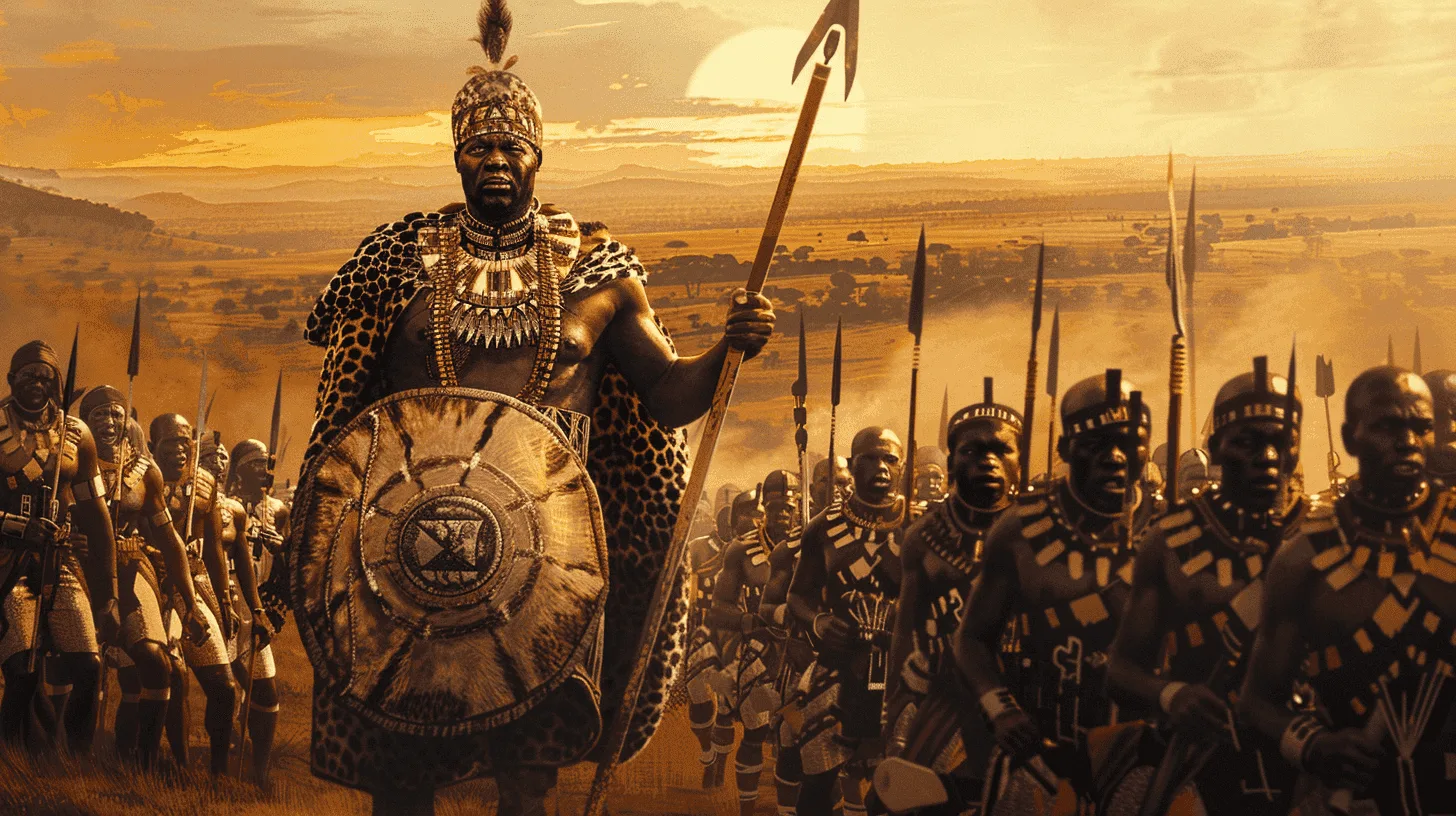
Who Was Shaka Zulu? the Warrior King Who Forged an Empire and Reshaped Southern Africa
The Rise of Shaka Zulu: From Outcast to Empire Builder
In the early decades of the 19th century, a leader emerged from the margins of a small Nguni clan in southeastern Africa and fundamentally rewrote the political map of an entire region. Shaka kaSenzangakhona (circa 1787–1828), known to the world as Shaka Zulu, inherited a minor chiefdom of perhaps 1,500 people and transformed it into the Zulu Kingdom—a militarized state that controlled an estimated 250,000 subjects and dominated territory roughly the size of modern Belgium. His reign lasted barely twelve years, but its consequences echoed across southern Africa for generations.
Shaka’s significance extends far beyond conquest. He revolutionized military tactics, introducing a short stabbing spear, the famous "bull horn" formation, and compulsory age-regiment service that produced a disciplined standing army. His campaigns triggered the Mfecane (or Difaqane)—a period of mass displacement, state collapse, and refugee migration that reshaped the demographic and political landscape from the Cape to the Zambezi. And his legacy remains fiercely contested: celebrated by some as a nation-building genius, condemned by others as a tyrant whose methods caused immense suffering.
Understanding Shaka matters not only for African history but for world history. His reign occurred at a pivotal moment, just as European colonial expansion was intensifying. The political structures he created would later resist British imperialism with startling effectiveness—most famously at the Battle of Isandlwana in 1879. His story also challenges simplistic narratives that portray pre-colonial African societies as static or primitive. The Zulu Kingdom was a sophisticated, dynamic state that responded to environmental pressure, population growth, and trade opportunities with institutional innovation that any military historian would recognize as brilliant.
This article examines Shaka’s rise from illegitimate outcast to absolute monarch, analyzes his military and administrative reforms, explores the controversial Mfecane period, and assesses his complex legacy in both African and global memory.
The World Shaka Was Born Into: Nguni Society Before the Kingdom
Traditional Political Organization
To grasp the scale of Shaka’s achievement, one must understand the world of the late 18th-century Nguni peoples. The region now called KwaZulu-Natal was home to many independent clans sharing language and culture but lacking any centralized political authority. Their system had endured for generations with several defining features.
Small chiefdoms of a few thousand people were the standard political unit, each led by a hereditary chief known as an inkosi. These chiefs possessed limited coercive power. Leadership depended on consensus-building, generosity, and personal prestige rather than the ability to command or punish. People could vote with their feet—if a chief became unpopular, families simply moved to another clan. This fluidity acted as a natural check on chiefly authority.
Age regiments called amabutho organized young men for initiation ceremonies and communal labor, but these were not standing armies. They gathered for specific purposes and then dispersed back to their homesteads. Warfare between clans was ritualized and limited, focused on cattle raiding rather than territorial conquest. Casualties were typically low, and the goal was to demonstrate superiority, not to annihilate opponents.
Cattle formed the basis of wealth and social status. Marriage required the transfer of cattle (lobola), and successful chiefs accumulated followers partly by redistributing cattle generously. A generous leader attracted supporters; a stingy one saw his population dwindle. Land was held communally, with chiefs allocating grazing and agricultural rights, but individual ownership as understood in European systems did not exist.
Pressures Building in the Late 18th Century
By Shaka’s birth around 1787, this traditional system was under strain from multiple directions. Population growth increased competition for agricultural land and grazing in the fertile coastal strip. The region could support only so many cattle and so many people under existing methods. Environmental stress from periodic droughts made resource scarcity more acute, and climate records suggest the late 1700s experienced significant variability. Trade opportunities with Portuguese merchants at Delagoa Bay (modern Maputo) created demand for ivory and cattle, incentivizing more aggressive economic competition and giving ambitious chiefs new sources of wealth independent of traditional redistribution networks. And larger polities were emerging—most notably the Mthethwa confederacy under Chief Dingiswayo, who was experimenting with military reforms and building a coalition of subordinate clans. These pressures created conditions where small-scale political organization was becoming dangerously obsolete. Shaka would accelerate this trend toward larger, more centralized, and more militarized states—but he did not invent it. The seeds of change were already germinating.
Shaka's Early Life: Adversity as a Crucible
Birth and Controversy
Shaka was born to Senzangakhona, chief of the minor Zulu clan, and Nandi, a woman of the Langeni clan. The circumstances were scandalous. According to custom, unmarried couples practiced ukuhlobonga, a form of sexual play meant to avoid pregnancy. When Nandi became pregnant, the Zulu elders claimed it was merely iShaka—an intestinal beetle causing menstrual irregularity. They essentially denied the pregnancy. When the child could no longer be hidden, the forced marriage that followed was considered improper. Shaka grew up marked by this illegitimate status, his very name a reminder of the denial of his existence. This origin story would later fuel both his ambition and his insecurity.
Childhood Hardship
Shaka’s childhood was a catalog of rejection. He faced mockery and exclusion from other children. His mother was treated poorly by the Zulu and eventually forced to return to her own Langeni clan, bringing young Shaka with her. But even among the Langeni, Nandi faced scorn as an unwed mother. The pair moved multiple times, living as dependents on grudging hospitality. Without status or protection, they experienced real poverty. Young Shaka herded goats and cattle for others, performed menial labor, and learned to read people’s intentions carefully—a survival skill that would serve him well in later power struggles.
Despite these hardships, Shaka grew into a tall, physically imposing young man. The psychological impact of his early life appears to have been profound. Later accounts describe him as driven by ambition, resentful of traditional authority, and ruthlessly determined. His obsession with absolute control, intolerance of dissent, and brutal treatment of perceived weakness may well have roots in these formative humiliations. He learned early that the world was not fair and that power, not pleading, commanded respect.
Service Under Dingiswayo
Around 1809, Shaka entered military service with the Mthethwa confederacy. This proved transformative. In Mthethwa service he received systematic military training in the age-regiment system Dingiswayo was developing. He distinguished himself in campaigns, gaining a reputation as a fierce and capable warrior. He reportedly began innovating combat techniques even during this period—experimenting with a shorter, more effective stabbing motion rather than the traditional throwing approach. Chief Dingiswayo recognized Shaka’s abilities and provided mentorship, treating him almost as a protégé. And Shaka observed closely how Dingiswayo incorporated conquered clans, organized military forces, and centralized authority—lessons he would later radicalize and apply with devastating efficiency.
By his mid-twenties, Shaka had transformed from marginalized outcast to distinguished warrior in the region’s most powerful military force. This combination of hardship and training prepared him for the opportunity that came when his father died in 1816. He had learned both what it meant to be powerless and how to wield power effectively.
The Takeover: How Shaka Seized Power (1816–1819)
Becoming Chief of the Zulu
When Senzangakhona died in 1816, succession should have passed to Shaka’s half-brother, Sigujana. But Dingiswayo intervened, using Mthethwa military power to install Shaka as chief after Sigujana was killed. His initial position was modest: leader of perhaps 1,500 people, subordinate to Dingiswayo, and one of many small clan chiefs. But Shaka immediately began transforming the Zulu. He implemented the military reforms he had learned with the Mthethwa, but pushed them further and faster. He eliminated potential rivals within the Zulu clan, consolidating personal authority through execution and exile. And he launched aggressive campaigns against neighboring groups, incorporating defeated clans into an expanding Zulu state rather than simply raiding and withdrawing.
Military Innovations That Changed the Game
Shaka’s military reforms were not merely improvements—they were a revolution in African warfare. The iklwa (stabbing spear) replaced the traditional throwing spear. This short, broad-bladed weapon required warriors to close with enemies for hand-to-hand combat. The tactical implications were enormous: battles became decisive rather than ritualized, warriors could not retreat after throwing their weapons, and superior discipline provided a decisive advantage. The name iklwa derived from the sound it made being pulled from a victim's body, a grim marketing of its effectiveness.
The large war shield (isihlangu) covered most of the body and was used offensively to hook an opponent’s shield, exposing them for a thrust. It was made from cowhide and could be used to deflect incoming spears or to push opponents off balance. The "bull horn" formation (impondo zankomo) featured a main "chest" force that pinned the enemy while fast-moving "horns" encircled them, with "loins" held in reserve to exploit breakthroughs or respond to counterattacks. This required careful coordination and discipline—qualities traditional Nguni armies lacked. The formation allowed Shaka to surround and annihilate larger forces by using speed and maneuver to compensate for numerical disadvantage.
Additionally, Shaka ordered warriors to discard their sandals and toughen their feet through forced marches over thorny terrain. This controversial innovation allowed faster movement and greater endurance. Warriors underwent grueling training runs of up to 80 kilometers a day, carrying full gear. Those who could not keep up faced punishment or death. The result was an army that could cover ground faster than any opponent, appearing where least expected and arriving with devastating speed.
The age-regiment system was transformed from a social institution into a military one. Warriors lived in military barracks rather than home villages. They trained constantly. Marriage was forbidden until military service was completed, often into one’s thirties, keeping warriors focused on their duties. Different regiments developed unit pride through distinctive shield colors and dress. Unlike traditional chiefs who led occasional campaigns, Shaka created a standing army. The entire Zulu state was organized around military needs, with women performing agricultural labor to free men for constant service. Discipline was harsh—cowardice or failure to follow orders meant execution. But warriors who excelled received rewards, status, and shares of captured cattle, creating powerful incentives for loyalty and bravery.
Independence and Confrontation with the Ndwandwe
Around 1817–1818, the regional balance shifted dramatically when Dingiswayo was killed by Zwide, chief of the powerful Ndwandwe clan. The Mthethwa confederacy fragmented. Subordinate clans either sought independence or were conquered by rivals. Shaka seized the moment: he declared Zulu independence, began incorporating former Mthethwa subordinates, and prepared to confront the Ndwandwe, who now aimed to dominate the region. This was the moment that would define his reign.
The conflict between Shaka and Zwide was the struggle for regional supremacy. Two major engagements proved decisive. At the Battle of Gqokli Hill (1818), Shaka used terrain advantages and disciplined defensive tactics to repulse Ndwandwe attacks and then counter-attacked, inflicting heavy losses. He positioned his forces on a hill that forced the Ndwandwe to attack uphill against prepared positions, negating their numerical advantage. The Ndwandwe withdrew but remained a threat. At the Battle of Mhlatuze River (1819), Shaka employed sophisticated strategy: he evacuated civilians and cattle, denied the invaders supplies, conducted scorched-earth tactics, and attacked the weakened, hungry Ndwandwe army with his full force. The battle was fought across a river crossing, and Shaka's forces used the terrain to split the Ndwandwe formation and destroy it piecemeal. The result was a devastating Ndwandwe defeat. Zwide fled, his army shattered, and his state fragmented. By 1819, just three years after becoming chief of 1,500 people, Shaka controlled a kingdom of perhaps 100,000 people—and was growing rapidly.
Building the Zulu Kingdom (1819–1828)
Expansion and Incorporation
After defeating the Ndwandwe, Shaka pursued aggressive expansion in multiple directions. Zulu armies campaigned constantly, attacking neighboring clans with overwhelming force. The pattern was consistent: defeated groups faced a choice between submission or destruction. Most chose submission. But Shaka developed a sophisticated incorporation system. Defeated groups retained some identity but accepted Zulu paramountcy and contributed warriors to Zulu regiments. Warriors from different clans served together in mixed regiments, breaking down old loyalties and building identification with the Zulu state.
Royal homesteads called amakhanda were established throughout conquered territories, serving as administrative centers and military garrisons. These were more than military posts—they were centers of royal authority where tribute was collected, justice was administered, and loyalty was monitored. Captured cattle were redistributed strategically—as rewards to Zulu warriors and as inducements to new subjects. Conquered peoples adopted Zulu language, customs, and identity. The "Zulu" became less an ethnic group than a political identity: anyone who accepted Shaka’s authority and integrated into the state became Zulu, regardless of origin. This was a remarkably modern approach to nation-building, creating unity not through blood but through allegiance.
By the mid-1820s, the Zulu Kingdom controlled approximately 11,500 square miles with a population estimated at 250,000–300,000 people. This was a remarkable expansion in less than a decade. The kingdom stretched from the Indian Ocean coast to the foothills of the Drakensberg mountains, encompassing dozens of previously independent clans.
State Organization and Royal Authority
Shaka concentrated all power in himself, eliminating traditional checks on chiefly authority. The king’s word was law, with no councils or assemblies that could limit royal decisions. Traditional chiefs and elders who might provide alternative authority were marginalized, executed, or reduced to officials deriving their authority only from royal appointment. The network of amakhanda served as military bases, administrative centers, and symbols of royal power. Appointed officials (izinduna) served at the king’s pleasure and could be dismissed or executed for failure or disloyalty. All military forces were under direct royal command. No regional leader controlled independent military forces.
The king controlled cattle distribution—the primary form of wealth—allowing him to reward loyalty and punish opposition economically. Shaka employed networks of informers and conducted arbitrary executions to maintain an atmosphere of fear that discouraged dissent. He also controlled marriage: by delaying permission for warriors to wed, he kept them focused on military service and dependent on his favor for their future family lives. Young women were often married to regiments as a group, further binding warriors to the state.
This system created unprecedented centralized authority, allowing Shaka to mobilize resources on a scale impossible in traditional Nguni societies. But it also meant the entire state depended on the king’s personal authority—a vulnerability that would become critical when that authority wavered. There were no succession mechanisms, no power-sharing arrangements, no institutions that could function independently of the monarch. The kingdom was Shaka, and if Shaka faltered, so could the kingdom.
The Mfecane: Regional Consequences of Zulu Expansion
Shaka’s expansion triggered massive regional upheaval known as the Mfecane ("the crushing") or Difaqane ("the scattering")—a period of warfare, migration, and state formation affecting much of southern Africa in the 1820s and 1830s. The dynamics were complex. Groups fleeing Zulu expansion moved into neighboring territories, creating pressure on the peoples they encountered. This created cascading displacements as each group pushed the next westward and northward. Groups escaping Zulu aggression often adopted Zulu military innovations to survive, creating a feedback loop of increasingly militarized societies. Some refugee groups, led by capable leaders hardened by conflict, established new kingdoms in distant regions.
Among the most significant new states were the Ndebele kingdom in modern Zimbabwe, founded by Mzilikazi—originally a Zulu general who rebelled and led his followers northward—and the Gaza Empire in modern Mozambique, founded by Soshangane. Both adopted Zulu military organization and tactics, extending Shaka’s influence far beyond his direct control. Some areas experienced severe depopulation as people were killed, enslaved, or fled, creating empty lands that would later be claimed by Boer trekkers and British colonizers.
The Mfecane remains controversial among historians. The traditional view emphasizes Zulu aggression as the primary cause. Revisionist historians argue this exaggerates Shaka’s role while downplaying other factors: drought and environmental stress, competition over trade routes, slaving by Portuguese and later Boers, and multiple centers of conflict beyond just the Zulu. The debate matters because explanations of the Mfecane influenced colonial narratives. British and Boer colonizers used accounts of African-caused depopulation to justify their occupation of "empty" lands. The balanced view recognizes that while Shaka’s expansion was a significant factor, the Mfecane resulted from multiple interacting causes—environmental, economic, political, and demographic. Shaka was a catalyst, not the sole cause.
The Dark Turn: Paranoia and Terror (1824–1828)
The Death of Nandi
In 1827, Shaka’s mother Nandi died. Given their close relationship through his difficult childhood and rise to power, her death devastated him. What followed revealed both the extent of his power and his increasingly unhinged psychological state. Shaka declared a year of mourning with horrific requirements: no crops could be planted (creating famine risk), no milk could be used (cows and calves were separated and allowed to die), any woman found pregnant during mourning was executed along with her husband, and thousands of people were executed for allegedly insufficient displays of grief.
Contemporary accounts from European traders at Port Natal describe months of chaos with Shaka ordering arbitrary executions. He reportedly killed people who failed to weep convincingly. He ordered that no one should appear happy or content. The kingdom ground to a halt as agricultural work ceased and people huddled in terror. Exact death tolls are impossible to determine, but estimates range from hundreds to thousands killed during this period. This episode revealed how absolute Shaka’s power had become—he could impose collective suffering on an entire nation based on personal grief—and also how his mental state had deteriorated. The man who had built a kingdom through strategic brilliance was now destroying it through unhinged emotional excess.
Increasing Brutality and Alienation
Even before Nandi’s death, Shaka’s rule had grown increasingly harsh. People could be killed for perceived insults, failure to show proper respect, or simply because the king suspected disloyalty. No one was safe. He ordered military campaigns that seemed designed more to keep warriors occupied than to achieve strategic objectives. The constant aggression began to serve paranoia rather than state-building. By prolonging the age at which warriors could marry—sometimes into their late thirties—he created social tensions. Warriors wanted to settle down with families; Shaka wanted to maintain military mobilization.
The constant military mobilization meant insufficient labor for agriculture and herding. The kingdom that had grown wealthy through conquest was straining under the costs of maintaining a massive standing army. Food production declined as warriors were away from their homesteads for extended periods. Even those who had benefited from Shaka’s rise—military commanders, appointed officials, incorporated clans—grew alienated by the combination of arbitrary terror and unsustainable demands. The fear that had once served to maintain order now bred resentment and conspiracy.
European Contact and Diplomatic Missteps
In 1824, European traders established Port Natal (later Durban) on the coast. Initially, Shaka welcomed them, seeing potential advantages: access to firearms and military technology, possible allies against rivals, and trade opportunities. He granted them land and sought friendly relations, even sending diplomatic gifts. But Shaka failed to grasp the longer-term implications of European presence. He didn’t recognize that these traders were vanguards of eventual colonial expansion. His focus remained on African rivals. He couldn’t imagine that European power would eventually dwarf African kingdoms or that the traders he dismissed as harmless would become the advance guard of empire.
Meanwhile, European accounts of Shaka shaped how the outside world viewed the Zulu—often emphasizing brutality and militarism while downplaying political sophistication, creating stereotypes that would persist for generations. Writers like Henry Francis Fynn and Nathaniel Isaacs produced dramatic narratives that highlighted Shaka’s cruelty while minimizing the sophistication of his state. These accounts became the primary sources for European understanding of the Zulu, shaping perceptions that would later help justify colonial conquest.
Assassination and Immediate Aftermath (1828)
The Conspiracy
By 1828, Shaka had alienated nearly everyone. Warriors exhausted from constant campaigns wanted rest and the ability to marry. People terrified by arbitrary executions wanted security. Officials feared for their lives. Even the royal family saw Shaka as dangerous. A conspiracy formed around Shaka’s half-brothers Dingane and Mhlangana, along with an induna named Mbopa. The plotters recognized that Shaka’s continued rule threatened the kingdom’s survival. On September 24, 1828, while Shaka was receiving delegations and most of his army was away on campaign, the conspirators struck. Accounts vary, but Shaka was stabbed multiple times and died quickly. His reported last words warned that European "swallows" (ships) would eventually come and take the kingdom—a final prophecy of colonial conquest that proved remarkably prescient.
Dingane’s Succession
Dingane succeeded as king and moved quickly to consolidate power. He eliminated his co-conspirator Mhlangana to remove a rival claimant. He maintained the military system Shaka had created but relaxed some of the harshest policies, allowing warriors to marry earlier and reducing arbitrary executions. The kingdom survived Shaka’s death because the institutions he created persisted beyond his personal authority. However, Dingane lacked Shaka’s strategic brilliance and would face new challenges, particularly from Boer trekkers arriving in the 1830s.
Dingane ruled until 1840, when he was overthrown by another half-brother, Mpande, who allied with Boer forces to secure power. Mpande ruled longer than any Zulu king and presided over a period of relative stability. The Zulu Kingdom would persist until finally defeated by British imperial forces in the Anglo-Zulu War of 1879—over fifty years after Shaka’s death. The British victory was hard-won, coming after the devastating defeat at Isandlwana, and required modern weaponry and professional soldiers to overcome the military system Shaka had created.
Legacy and Historical Assessment
Military and Political Achievements
Shaka’s accomplishments were remarkable by any standard. He transformed a minor clan of 1,500 people into a kingdom of 250,000+ in just twelve years. His tactical and organizational innovations revolutionized African warfare and created a military system that proved formidable even against European colonial forces—the Zulu defeated British forces at Isandlwana in 1879, decades after Shaka’s death. The system of royal homesteads, appointed officials, and centralized authority represented sophisticated state organization. And Shaka created a new political identity—"Zulu"—that incorporated diverse peoples and persisted long after his death, becoming a major ethnic and political identity in South Africa. Today, approximately 12 million Zulu-speaking people trace their identity to the kingdom he built.
The Question of Brutality
Assessing Shaka requires confronting his brutality. Thousands died through wars of conquest, arbitrary executions, the mourning period after Nandi’s death, and harsh military discipline. Contextual considerations matter: pre-colonial African warfare was already violent, state-building throughout history has involved violence and coercion, and Shaka’s contemporaries in Europe—figures like Napoleon—also presided over enormous violence. But these considerations do not erase the suffering. The historical consensus views Shaka as simultaneously a military and political genius who achieved remarkable things and a brutal tyrant whose rule caused enormous suffering. Holding both truths simultaneously is the challenge of honest historical assessment.
Shaka in Zulu and South African Memory
Shaka remains a contested figure in South African memory. For many, he represents pre-colonial African state-building capacity and political sophistication. He serves as an icon of Zulu pride and identity, particularly during and after apartheid when his legacy was mobilized to assert African dignity against colonial narratives. Others, particularly from groups that suffered under Zulu expansion, view celebrating Shaka as celebrating violence and authoritarianism. During apartheid, the South African government promoted certain versions of Zulu history to foster ethnic divisions and support the "separate development" ideology of bantustans. In post-apartheid South Africa, Shaka remains symbolically important but controversial—celebrated as part of African heritage while also criticized for brutality that some see as incompatible with contemporary values. Statues, school curricula, and political rhetoric all reflect these ongoing debates.
Historical Sources and Scholarly Debates
Understanding Shaka faces significant source challenges. Oral traditions collected generations after his death preserved important information but also mythologized historical reality. European accounts from traders at Port Natal provide contemporary documentation, but these observers had limited access and understanding, brought cultural biases, and sometimes exaggerated for dramatic effect. Modern scholarship attempts to balance these sources critically, but disagreements persist about exact dates, Shaka’s psychological state, the scale of violence, the relative importance of different causal factors in the Mfecane, and how much credit or blame Shaka personally deserves versus structural factors.
For further reading, historian Carolyn Hamilton’s Terrific Majesty: The Powers of Shaka Zulu and the Limits of Historical Invention provides excellent scholarly analysis of how Shaka’s image has been constructed across different periods. The South African History Online resource on Shaka offers accessible background, while the Encyclopædia Britannica entry provides a solid factual overview. Readers interested in the military aspects should consult Ian Knight’s works on Zulu warfare for detailed tactical analysis.
Conclusion: The Complexity of a Contested Legacy
Shaka kaSenzangakhona remains one of history’s most complex figures. His achievements were genuinely remarkable—building a kingdom from almost nothing, revolutionizing military tactics, creating political institutions that outlasted him, and fundamentally reshaping southern African history. These accomplishments demonstrate strategic brilliance and political skill that ranks him among history’s significant state-builders. Yet these achievements came at enormous human cost. The challenge for modern understanding is resisting simple narratives—either celebrating Shaka as pure hero or condemning him as pure villain.
Shaka was shaped by his context. His innovations succeeded because they addressed real problems of political organization in a competitive, resource-constrained environment. His brutality, while extreme, was not entirely unique in a violent era. His psychological deterioration over time matters for understanding both his achievements and his failures. The man who had overcome childhood rejection to build an empire ultimately destroyed by the paranoia that success could not cure.
Nearly two centuries after his death, Shaka Zulu remains relevant—as a historical figure who reshaped southern Africa, as a symbol in continuing debates about African history and identity, and as an example of how human brilliance and human cruelty can coexist in the same person. Understanding him requires holding multiple truths simultaneously: the achievements were real, the suffering was real, and simple moral judgments fail to capture the full complexity of his life, rule, and legacy. In this complexity lies the true measure of the man who forged an empire from a clan of outcasts.