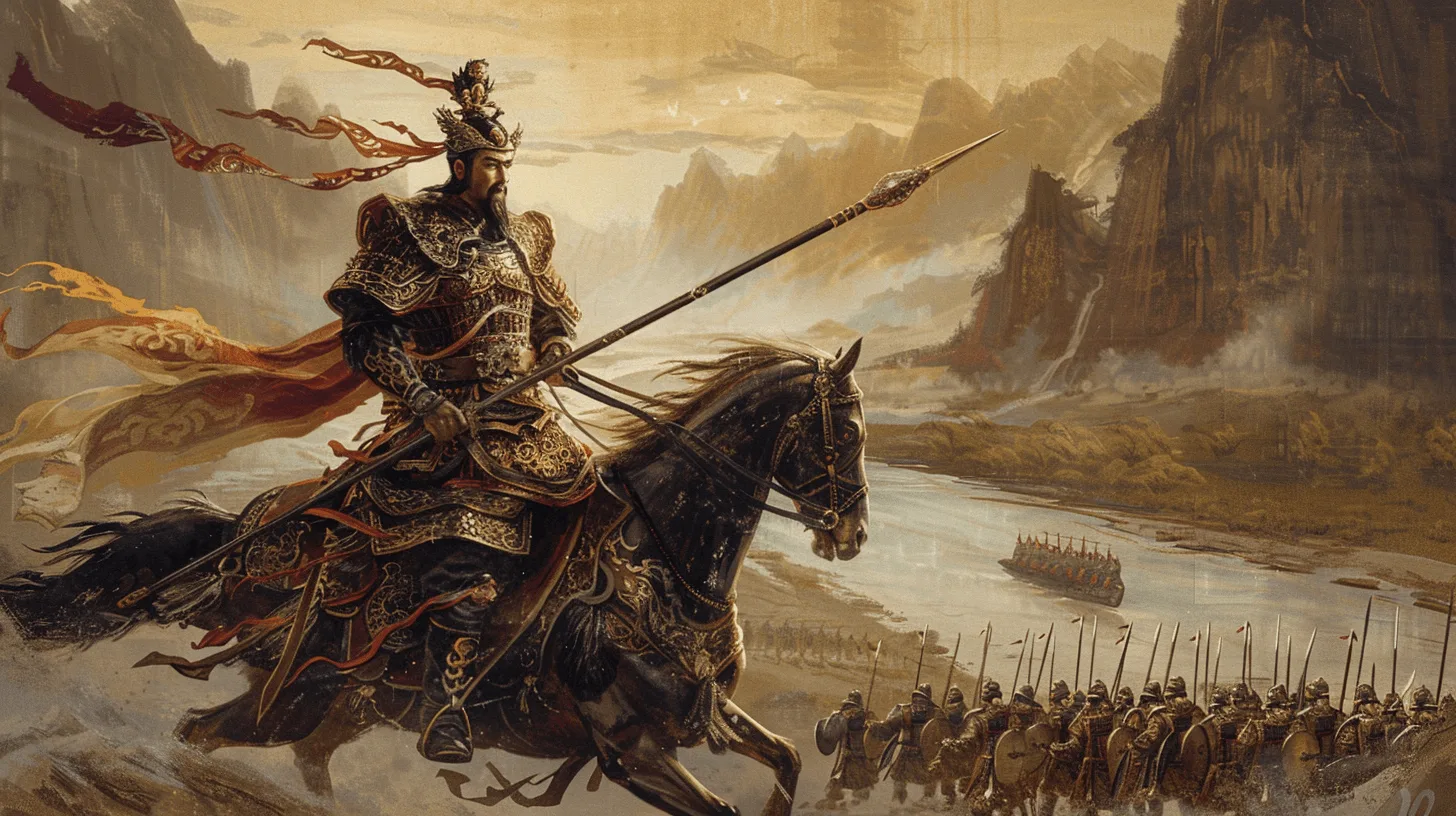
Who Was Zhang Fei? Study Guide for the Fierce Tiger General of Shu Han
Who Was Zhang Fei? The Complete Study Guide to Shu Han's Fierce Tiger General
Few figures in Chinese history embody the tension between heroic virtue and fatal flaw as vividly as Zhang Fei (張飛). Known as the "Fierce Tiger General" of the Shu Han kingdom, Zhang Fei was a warrior of legendary courage whose name still echoes across East Asian culture nearly two millennia after his death. But who was the man behind the myth? This study guide explores the historical Zhang Fei, his military achievements, his devastating character weaknesses, and how he became one of the most recognizable figures in world literature. Whether you are a student of Chinese history, a fan of the Romance of the Three Kingdoms, or simply curious about ancient warrior cultures, this comprehensive guide provides everything you need to understand Zhang Fei's life and legacy.
Historical Context: The Collapse of the Han Dynasty and the Birth of the Three Kingdoms
The Unraveling of Imperial Authority
The late Eastern Han dynasty (25–220 CE) was collapsing under immense internal pressures. By the 160s and 170s CE—the decades of Zhang Fei's birth—the imperial court had become a battleground between corrupt eunuch factions and the scholar-official class. A series of child emperors were manipulated by courtiers, regional governors accumulated independent power, and the tax burden on peasants became unsustainable. Repeated crop failures and famines were interpreted by the population as signs that the dynasty had lost the Mandate of Heaven—the cosmic justification for imperial rule.
The Yellow Turban Rebellion (184 CE)
The Yellow Turban Rebellion of 184 CE was the catalyst that shattered what remained of Han authority. This massive peasant uprising, inspired by a millenarian Taoist movement led by Zhang Jue, swept across eastern China with alarming speed. The Han court was forced to delegate military authority to regional commanders and local strongmen, effectively granting them the power to raise private armies. This expedient saved the dynasty temporarily but created the conditions for the warlordism that would define the next century. It was in response to this rebellion that the young Liu Bei—an impoverished descendant of the imperial family—began recruiting volunteers. Among those who answered his call were a literate warrior named Guan Yu and a butcher and wine merchant named Zhang Fei.
The Fracturing of China
By the 190s CE, the Han emperor was a puppet in the hands of whichever warlord controlled the capital. Regional commanders such as Cao Cao in the north, Yuan Shao in Hebei, Sun Ce and later Sun Quan in the southeast, and Liu Bei (initially without a territory of his own) competed for supremacy. This period of chaos and warfare, lasting roughly from 184 to 280 CE, became known as the Three Kingdoms period, named after the three dominant states that eventually emerged: Wei in the north, Wu in the southeast, and Shu Han in the southwest. For an excellent overview of the entire period, consult the Encyclopaedia Britannica entry on the Three Kingdoms.
Zhang Fei's Origins: From Butcher to Warrior-Brother
Humble Beginnings in Zhuo Commandery
Zhang Fei was born in the 160s CE in Zhuo Commandery, located in modern-day Hebei Province. His family were commoners who made their living as butchers and wine merchants—occupations considered low-status in the Confucian social hierarchy. The work of slaughtering animals and selling liquor was associated with manual labor and a lack of refinement, but it also forged in Zhang Fei a formidable physique and a comfort with violence that would serve him well on the battlefield. His family's modest commercial success meant they could afford to equip him and help finance military recruitment, making Zhang Fei an attractive ally for an aspiring leader like Liu Bei.
The Oath of the Peach Garden: Fact, Fiction, and Meaning
According to the 14th-century novel Romance of the Three Kingdoms, in 184 CE, Liu Bei, Guan Yu, and Zhang Fei met in a peach garden and swore a solemn oath of brotherhood: "We three, though of different surnames, hereby swear brotherhood... We ask not to be born on the same day, in the same month, and of the same year, but we ask to die on the same day, in the same month, and of the same year." This scene is one of the most famous in Chinese literature and has shaped the popular understanding of their relationship for centuries.
Historical evidence, however, casts doubt on the literal accuracy of this event. Chen Shou's authoritative Records of the Three Kingdoms, written in the late 3rd century, does not mention any formal oath. It states simply that Zhang Fei and Guan Yu served Liu Bei as close associates and treated him with the respect due to an elder brother. The elaborate peach garden ceremony is almost certainly a literary invention by the novelist Luo Guanzhong, formalizing what was a deep but informal bond into a ritualized act of sworn brotherhood.
Yet dismissing the oath as mere fiction misses its significance. Whether or not the ceremony occurred, the three men did share an extraordinary bond of loyalty that lasted decades. The oath narrative captures this essential truth symbolically. It became the definitive cultural model of sworn brotherhood (yi 義) in Chinese civilization—the idea that chosen relationships based on shared values and mutual loyalty can be as powerful as, or even more powerful than, biological family ties. This concept would influence Chinese culture, literature, and even secret societies for centuries to come.
The Nature of Their Bond
Whatever the precise historical truth, the relationship among the three men was clearly exceptional. Liu Bei was the acknowledged leader; Zhang Fei and Guan Yu served as his right and left hands, never seriously challenging his authority even when they possessed their own military capabilities. Their skills were remarkably complementary: Liu Bei contributed political vision, charisma, and a claim to legitimacy; Guan Yu provided military competence, literacy, and a sense of honor; Zhang Fei supplied raw martial power, fearlessness, and a willingness to take on the most dangerous tasks. In the difficult early years, when Liu Bei was a wandering commander without a territory, this interdependence forged loyalty strong enough to resist the tempting offers of richer, more powerful warlords like Cao Cao.
The Military Career: The Tiger General in Action
Early Campaigns and the Yellow Turban Suppression
Zhang Fei's military career began during the Yellow Turban campaign. He immediately distinguished himself through personal courage in close combat, leading charges from the front and engaging enemies with exceptional ferocity. Literary sources describe his intimidating appearance—a dark complexion, thick beard, and fierce countenance that could demoralize opponents before a single blow was struck. He reportedly wielded a long spear with great skill, though the famous "Serpent Spear" of literary fame may be a later embellishment.
During the 190s, Liu Bei and his followers served as subordinate commanders to various warlords—first Gongsun Zan, then Cao Cao, then Yuan Shao—always seeking a stable base but never finding one. Zhang Fei fought bravely in these campaigns, but the group remained weak and dependent. These years of service under powerful patrons taught Zhang Fei the realities of military life but also gave him ample experience of battlefield command.
The Battle of Changban (208 CE): A Defining Moment of Courage
Zhang Fei's most celebrated historical exploit occurred at the Battle of Changban. After Cao Cao launched a massive southward campaign to eliminate Liu Bei, the latter was forced to flee with his army and thousands of civilian refugees. Cao Cao's elite cavalry caught up with Liu Bei's rearguard near modern Dangyang in Hubei Province. The situation was desperate: Liu Bei's main force, burdened by refugees, had only a small rearguard to cover the retreat.
Zhang Fei commanded this rearguard, a force of only twenty horsemen, at Changban Bridge. The historical record is terse but remarkable. Chen Shou's Records of the Three Kingdoms states: "Leading twenty horsemen, Zhang Fei stopped at the Dangyang Bridge facing west. Cao Cao's army did not dare to approach." This single sentence confirms that Zhang Fei's tiny force successfully deterred a much larger enemy army, buying critical time for Liu Bei's escape. The enemy's hesitation likely stemmed from fear of an ambush combined with Zhang Fei's personal reputation for ferocity. Whatever the reason, the stand at Changban Bridge became Zhang Fei's signature achievement—proof that courage and reputation could sometimes outweigh numerical odds.
The literary version in Romance of the Three Kingdoms greatly amplifies this episode. In the novel, Zhang Fei stands alone on the bridge, roars a challenge so powerful that it terrifies the enemy army, and causes a Cao Cao officer to die of fright on the spot. While historically dubious, this dramatic portrayal fixed the Changban stand in popular imagination as the epitome of warrior courage. For a deeper analysis of how historical events become literary legends, consider reading this piece on myth-making in Chinese history.
The Conquest of Yi Province and the Establishment of Shu Han
Liu Bei's fortunes changed after the Battle of Red Cliffs (208 CE), where a coalition led by Zhou Yu and Liu Bei defeated Cao Cao's naval invasion. Liu Bei used this victory to begin building his own territory in southern Jing Province. In 214 CE, he launched an invasion of Yi Province (modern Sichuan and Chongqing), the wealthy region that would become the heartland of his kingdom. Zhang Fei played a crucial role: capturing the strategic Jiameng Pass, using his fearsome reputation to intimidate enemy generals into surrender, and helping to suppress resistance during the pacification phase.
When Liu Bei proclaimed himself emperor of Shu Han in 221 CE (claiming legitimate succession from the Han dynasty), Zhang Fei was awarded the rank of General of Chariots and Cavalry and granted the title of Marquis of Xixiang. This recognition placed him among the highest-ranking generals of the new kingdom, a testament to his contributions over four decades of service.
Military Assessment: Strengths and Limitations
To understand Zhang Fei as a commander, one must honestly assess both his formidable strengths and his clear limitations.
Strengths:
- Exceptional personal combat ability. Zhang Fei's courage and physical prowess made him a devastating shock warrior in close combat.
- Unwavering loyalty. He was absolutely committed to Liu Bei and could never be bribed or intimidated into betrayal.
- Inspirational presence. His fierce reputation could terrify enemies and inspire allies.
- Tactical aggression. In offensive operations, his willingness to press the attack could break enemy formations.
Limitations:
- Limited strategic capacity. Zhang Fei was less capable than commanders like Cao Cao or Lu Xun at campaign-level planning and decision-making.
- Unsuitable for defensive operations. His aggressive temperament was better suited for attack than for the patient endurance required in defensive warfare.
- Brutal treatment of subordinates. This flaw created persistent morale problems and would ultimately prove fatal.
- Lack of political acumen. Zhang Fei had little understanding of diplomacy or the broader political context of military operations.
The most effective use of Zhang Fei was as a shock weapon under overall strategic direction—a role that maximized his strengths while minimizing his weaknesses. He was less suited for independent command requiring strategic patience and diplomatic finesse.
The Fatal Flaws: Character Weaknesses and Their Consequences
Excessive Drinking and Its Effects
Historical sources consistently note Zhang Fei's heavy drinking and its destructive consequences. The Records of the Three Kingdoms is remarkably blunt: "Zhang Fei respected gentlemen but did not care for common soldiers. Whenever he drank wine, he would beat and kill his subordinates, yet still keep them close at hand." This passage is devastating in its candor. Drinking amplified Zhang Fei's already volatile temper, led to poor decision-making, and made him dangerously predictable to those around him. Liu Bei repeatedly warned him about both his drinking and his treatment of soldiers. Zhang Fei apparently understood the risks intellectually but could not or would not change his behavior.
Brutal Treatment of Subordinates
This was Zhang Fei's most consequential flaw. He regularly beat his soldiers for minor infractions—sometimes while drunk, sometimes not. He administered severe punishments arbitrarily, without consistency or mercy. This behavior generated deep and lasting resentment among his own troops. The contrast with Guan Yu is instructive: Guan Yu was arrogant toward equals and superiors but treated his soldiers well and commanded genuine loyalty. Predictably, Guan Yu's men remained loyal even after his capture. Zhang Fei's men eventually murdered him.
Liu Bei's advice to both men reveals his understanding as a leader. He told Guan Yu to be less arrogant toward those above him. He told Zhang Fei to be less brutal toward those below him. This asymmetry suggests that Liu Bei recognized each brother's core weakness and understood that character flaws, if uncorrected, would eventually destroy even the most capable commander.
Why Could Zhang Fei Not Change?
This is a deeply human question. Several factors likely contributed. First, Zhang Fei's behavior had been reinforced by decades of success—his brutality had never cost him victory. Second, his temperament may have made restraint genuinely difficult. Third, the culture of the time placed a premium on martial ferocity, making restraint seem like weakness. Whatever the reasons, Zhang Fei's inability to learn this lesson was his undoing and provides a timeless warning about the importance of self-awareness in leadership.
The Assassination: A Violent and Inevitable End
The Context: Guan Yu's Death and the Campaign of Revenge
In 220 CE, Guan Yu was defeated by the forces of Eastern Wu under Sun Quan. He was captured and executed. This event devastated Liu Bei both emotionally and strategically. The loss of his sworn brother was compounded by the loss of Jing Province, a critical territory that had been a hard-won strategic asset. Liu Bei resolved to launch a massive campaign to avenge Guan Yu and recover lost territories. Zhang Fei, as the remaining premier general of Shu Han, was assigned a central role in this campaign.
The Murder: How Fan Qiang and Zhang Da Killed Zhang Fei
As Zhang Fei prepared his troops in Langzhong (modern Sichuan) for the campaign, his years of brutal treatment caught up with him. The Records of the Three Kingdoms records the event in chillingly simple terms: "Before he could set out, his subordinate commanders Fan Qiang and Zhang Da murdered him. They took his head and fled to surrender to Wu."
The immediate circumstances are instructive. Zhang Fei had ordered his subordinate officers Fan Qiang and Zhang Da to prepare their troops for a cross-country march on an impossibly short deadline. When they expressed concerns about the feasibility of this order, Zhang Fei threatened them with severe punishment. Rather than face brutal retribution—which, given his past behavior, might well have meant death—the two officers decided to strike first. They killed Zhang Fei while he slept, decapitated him, and carried his head to Eastern Wu as proof of their defection.
The tragedy was layered. It occurred just as the revenge campaign was beginning, depriving Liu Bei of his most experienced general. It was committed by Zhang Fei's own men, not by enemy action. It was entirely preventable had Zhang Fei heeded Liu Bei's warnings. And it demonstrated that no personal combat prowess protects a commander who creates enemies among his own troops.
Aftermath and Historical Consequences
Zhang Fei's death had far-reaching consequences. The loss of his general was militarily devastating for Liu Bei, who now had to proceed without his most aggressive combat commander. Psychologically, it was crushing—another sworn brother violently killed, compounding the grief over Guan Yu. Liu Bei's subsequent campaign, the Battle of Xiaoting (also known as the Battle of Yiling, 221–222 CE), ended in one of the most decisive defeats in Chinese military history at the hands of the Wu commander Lu Xun. Liu Bei died shortly after, his kingdom permanently weakened by the twin losses of Guan Yu and Zhang Fei.
Historians note the bitter irony: Zhang Fei, who had fearlessly faced enemy armies for four decades, was killed not by worthy opponents but by his own men in his own camp. The assassination vindicated Liu Bei's warnings and became a cautionary lesson cited across Chinese history: martial prowess alone is insufficient if a commander brutalizes those under his command. For more on the broader military history of this period, the World History Encyclopedia's Three Kingdoms entry provides excellent context.
Zhang Fei in Romance of the Three Kingdoms
The Transformation from Historical Figure to Literary Legend
Luo Guanzhong's 14th-century novel Romance of the Three Kingdoms transformed Zhang Fei from a capable but flawed historical general into one of world literature's most memorable characters. The novel gave him a distinctive appearance: a dark complexion, a "leopard-like" head with round eyes, prominent whiskers, and a powerful, intimidating build. It armed him with the Serpent Spear—an 18-chi weapon (roughly 4 meters long) that became his signature. It amplified his military achievements, developed his personality more fully, and made him a figure of enduring popular appeal.
Enhanced Exploits and Dramatic Scenes
The novel greatly embellishes Zhang Fei's military feats. The Changban Bridge stand becomes an elaborate set piece where his roar terrifies an entire army. He fights the legendary warrior Lü Bu to a draw in single combat—an encounter that is probably fictional but establishes him as a match for the era's most feared warrior. He also captures enemy generals through stratagems that showcase surprising cunning, such as pretending to be drunk to lull opponents into complacency before springing an ambush. These episodes create a more well-rounded character than the purely straightforward warrior of historical records.
Character Complexity and Tragic Arc
Importantly, the novel does not whitewash Zhang Fei's flaws. It portrays his violent temper, his heavy drinking, and his harsh treatment of subordinates. The assassination is shown as a direct consequence of his brutality. This combination of admirable loyalty and fatal character weaknesses makes Zhang Fei a genuinely tragic figure in the literary narrative—someone whose great virtues are undermined by an inability to control his worst impulses. The novel also sometimes uses his rough, unrefined nature for comic relief, contrasting his blunt manner with more sophisticated characters and creating moments of humanity amid the epic's grim themes.
The Broader Literary Tradition
Zhang Fei's character in Romance of the Three Kingdoms fits into a larger pattern in Chinese literature and culture: the archetype of the fierce, loyal, but ultimately flawed warrior. This archetype appears in countless Chinese stories, operas, and later novels. It speaks to a cultural recognition that even the most capable individuals can be undone by their own character weaknesses—a lesson with deep resonance in a Confucian culture that emphasized self-cultivation and moral improvement.
Cultural Legacy and Symbolism
The Archetype of Fierce Loyalty (Zhong 忠)
In Chinese culture, Zhang Fei became the definitive archetype of the fierce warrior loyal to his lord. His unwavering devotion to Liu Bei, even in the face of overwhelming odds and tempting offers from more powerful rivals, became his defining characteristic. The concept of zhong (loyalty) is central to Confucian ethics, and Zhang Fei embodies it in its most martial form—not the scholar's cultivated loyalty to principles, but the warrior's visceral loyalty to a leader he has chosen to follow.
Worship, Art, and Performance
Unlike Guan Yu, who became a deity (Guandi) worshiped across East Asia, Zhang Fei never achieved widespread religious veneration. His brutal character flaws made him less suitable as a moral exemplar for mass worship. However, he appears extensively in traditional Chinese arts. In Peking opera and other forms of Chinese opera, he is portrayed with distinctive black face paint (the jing or painted-face role type) symbolizing fierce straightforwardness, honesty, and strength. In traditional painting and sculpture, artists emphasize his intimidating appearance and powerful build. He appears in countless folk stories, shadow puppet plays, and oral traditions that extend far beyond the literary tradition of Romance of the Three Kingdoms.
Symbolic Meanings
Zhang Fei symbolizes several important values in Chinese culture:
- Loyalty (zhong 忠): Unwavering commitment to one's chosen lord and cause.
- Righteousness (yi 義): The willingness to fight for just causes and protect the weak.
- Courage (yong 勇): The physical and moral bravery to face overwhelming odds.
- The warrior ideal: The fusion of martial prowess with moral purpose.
But he also serves as a cautionary example of how even great virtues can be undermined by character flaws. His story raises fundamental questions about leadership: personal prowess does not automatically translate to command effectiveness; brutal management of subordinates can destroy even the most capable general; and character matters as much as courage. Perhaps the most poignant aspect of Zhang Fei's legacy is recognizing how much more he could have accomplished had he controlled his worst impulses.
Zhang Fei in Modern Popular Culture
Zhang Fei's influence extends far beyond traditional Chinese culture into modern global entertainment. He appears as a playable character in the Dynasty Warriors video game series, where he is portrayed as a powerful, aggressive fighter wielding his iconic spear with devastating effect. In the Romance of the Three Kingdoms strategy game series, he typically has extremely high combat and strength stats balanced by low intelligence and politics scores—reflecting the historical assessment of his limitations. In Total War: Three Kingdoms, he is a legendary general with exceptional combat abilities whose personality traits create realistic management challenges for players. These games have introduced Zhang Fei to a global audience unfamiliar with the original historical and literary sources.
He appears in numerous Chinese television dramas and films. The definitive 84-episode 1994 television adaptation of Romance of the Three Kingdoms portrays him following the novel's characterization—fierce, loyal, and temperamental. More recent productions, including the 2010 remake and various films, continue to reinterpret his character for modern audiences. Through these media, Zhang Fei's legacy extends far beyond Chinese-speaking cultures, gaining global recognition that continues to evolve with each new adaptation.
Historical Assessment and Modern Perspectives
Modern historians recognize Zhang Fei's genuine military capabilities while acknowledging his serious character flaws. The historical evidence supports his effectiveness as a tactical commander. The consistent emphasis on his brutality and drinking across multiple independent sources appears reliable and not merely literary invention. He was primarily a tactical fighter rather than a strategic thinker, best employed as an instrument of shock action under overall strategic direction. His unwavering loyalty to Liu Bei is absolutely historical and fundamentally important to understanding his actions.
In contemporary China, Zhang Fei remains a culturally familiar figure that most people encounter through school curricula covering Three Kingdoms history or through reading Romance of the Three Kingdoms in excerpted form. His name appears in brand names, restaurant chains, and metaphorical references ("He's like Zhang Fei" meaning fiercely loyal but temperamental). Tourist sites associated with him, such as his tomb in Langzhong and various battle sites, attract visitors interested in Three Kingdoms history. While admired for his loyalty and courage, modern Chinese discussions also acknowledge his flaws more critically than purely celebratory traditional accounts. This balanced assessment reflects a broader trend in Chinese historiography toward more nuanced evaluation of historical figures.
For additional resources on the broader historical context of the Three Kingdoms period, the Khan Academy's materials on Han dynasty history provide a solid foundation.
Conclusion: The Fierce Tiger's Enduring Legacy
Eighteen centuries after his violent death, Zhang Fei remains one of ancient China's most memorable warriors—not because he changed the course of history or was the era's finest commander, but because his story captures something essential about leadership, loyalty, and the tragic consequences of character flaws. The historical Zhang Fei was genuinely an exceptional warrior: courageous, loyal, and significant in establishing the Shu Han kingdom. But he was also deeply flawed: brutal toward subordinates, prone to violent outbursts when drunk, unable to control his temper, and limited in strategic sophistication.
The literary Zhang Fei of Romance of the Three Kingdoms amplified both dimensions—making him more impressive in his feats and more tragic in his downfall. This transformed figure has dominated Chinese popular culture for centuries and, through modern media, has achieved global recognition. The "Zhang Fei" we remember exists simultaneously as a historical figure, a literary character, a cultural symbol, and a pop culture icon—each layer meaningful, none wholly superseding the others.
What makes Zhang Fei's story endure is its human truth. He was not a flawless hero or a simple villain, but a man of immense capability undone by his own failure to master himself. His life demonstrates that courage without wisdom, loyalty without self-control, and martial prowess without humanity are ultimately insufficient. In this, his story transcends its specific historical context to speak to universal questions about the relationship between virtue and effectiveness, the importance of self-awareness in leadership, and the tragic consequences of character flaws uncorrected. The Fierce Tiger General of Shu Han still has much to teach us, if we are willing to learn.