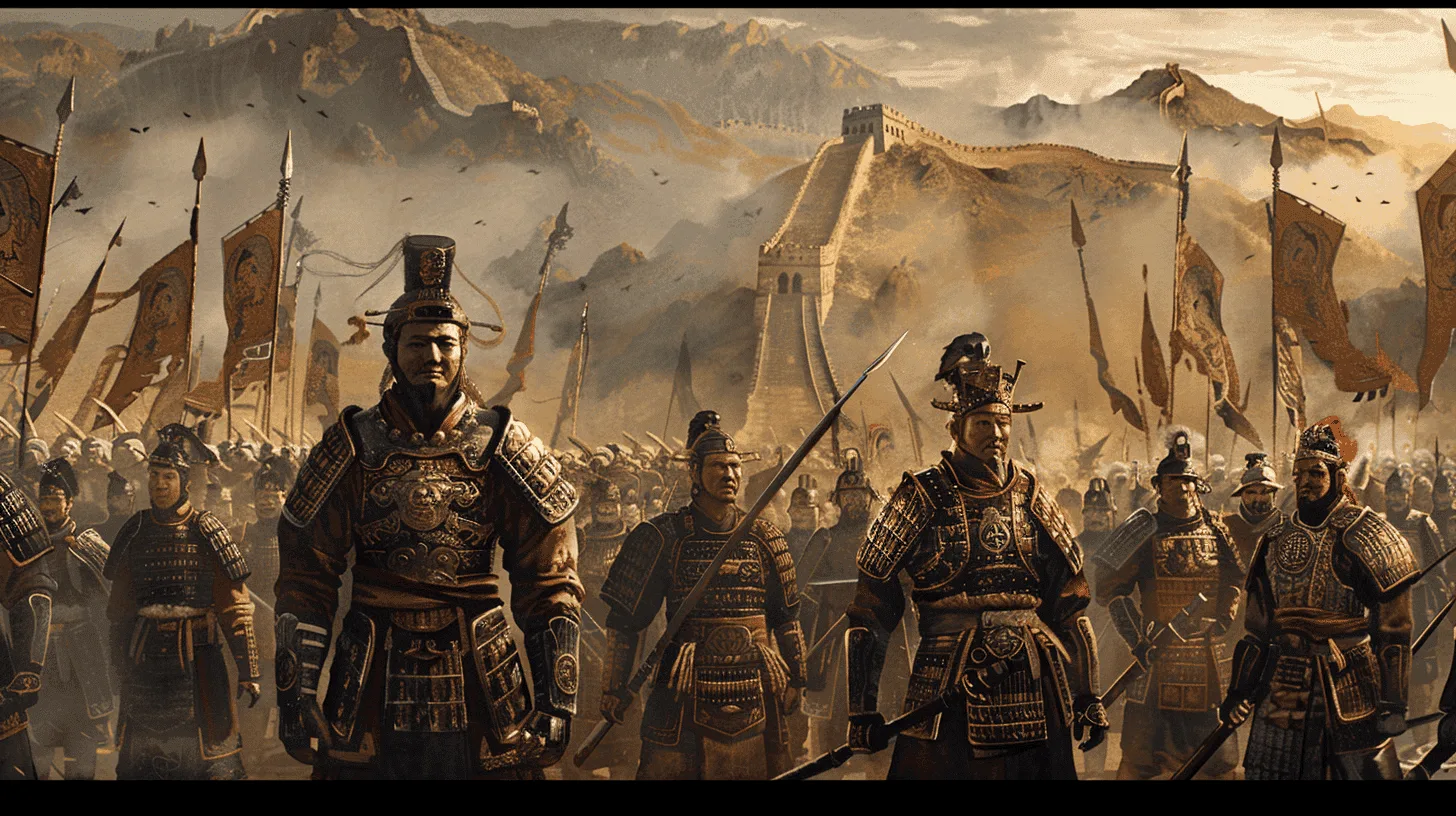
Who Were Qin Shi Huang's Generals? the Military Leaders Who Unified China
Introduction: The Architects of China's First Empire
In 221 BCE, after centuries of relentless warfare, a single ruler achieved what had seemed impossible: the unification of China's warring kingdoms under one imperial banner. That ruler was Ying Zheng, who declared himself Qin Shi Huang, the First Emperor of Qin. Yet this monumental transformation was not his alone to claim. Behind the emperor's grand vision stood a cadre of brilliant military commanders whose strategic genius, battlefield prowess, and unwavering loyalty made unification a reality.
These generals were far more than mere soldiers executing orders. They were master tacticians who conquered vast territories, innovative defenders who secured borders against formidable enemies, and shrewd administrators who transformed military victories into lasting political control. Their names—Wang Jian, Meng Tian, Wang Ben, and Li Xin—may not echo through history as loudly as the emperor they served, but their contributions were equally vital to creating the unified China that would shape Asian civilization for millennia.
Without their military brilliance and strategic vision, Qin Shi Huang's sweeping reforms, standardization efforts, and centralized government would have collapsed under the weight of resistance and rebellion. This comprehensive guide explores the lives, campaigns, and legacies of these extraordinary commanders. You will discover how they employed innovative tactics, navigated treacherous political waters, and ultimately shaped the course of Chinese history through their conquests and leadership.
Let us step back into the brutal, brilliant world of ancient China and meet the men who built an empire.
Historical Context: The World Qin Shi Huang's Generals Inherited
To appreciate what Qin Shi Huang's generals accomplished, you must understand the chaotic world they faced. Ancient China was not a unified nation waiting to be led—it was a fractured landscape of rival kingdoms engaged in centuries of brutal, existential warfare.
The Warring States Period: Centuries of Conflict
For more than 250 years, from approximately 475 to 221 BCE, China endured what historians call the Warring States Period—an era of near-constant warfare among seven major states and numerous smaller territories. This was not a time of occasional skirmishes; these states fought massive battles involving hundreds of thousands of soldiers. The Battle of Changping in 260 BCE, for example, reportedly resulted in 450,000 casualties when Qin decisively defeated Zhao. Entire generations grew up knowing nothing but war.
The major combatants included:
- Qin: Occupying the western frontier, initially considered semi-barbaric by eastern states, but growing increasingly powerful through military reforms and ruthless efficiency
- Chu: The largest state in the south, rich in resources and population, but plagued by internal divisions
- Zhao: A northern state known for adopting cavalry tactics from nomadic peoples
- Wei: A central state that pioneered military innovations but gradually declined
- Han: A smaller central state caught between larger neighbors
- Yan: A northern state on the empire's frontier
- Qi: An eastern coastal state known for commerce and scholarship
What made this period particularly brutal was a total war mentality. States increasingly abandoned traditional codes of conduct, employing deception, massacre, and scorched-earth tactics. Technological innovation—iron weapons, crossbows, cavalry formations, and advanced siege equipment—drove an arms race that escalated the violence. Paradoxically, this violent era also produced some of China's greatest philosophical traditions—Confucianism, Daoism, and Legalism—as thinkers grappled with how to create a stable society amid chaos.
The Rise of Qin: From Frontier Kingdom to Dominant Power
Qin's path to supremacy began long before Qin Shi Huang took the throne. The state transformed itself through radical reforms implemented in the 4th century BCE by Lord Shang Yang, a Legalist philosopher and administrator. These reforms created the foundation for Qin's military success. Shang Yang abolished aristocratic privilege, replacing it with a system where military success determined rank and rewards. Even peasants could rise to positions of power through battlefield accomplishments. He dismantled the old feudal system and replaced it with commanderies directly controlled by the king, eliminating the independent power bases that weakened other states. Legalism's harsh laws and severe punishments created a disciplined, obedient population that could be efficiently mobilized for war. Land reforms and irrigation projects increased food production, supporting a larger army. The Qin army became a permanent, well-trained force rather than a seasonal levy of farmers.
By the time Ying Zheng inherited the throne in 246 BCE at age 13, Qin was already the strongest state in China. His early reign was precarious—power was initially held by his chancellor, Lü Buwei, and later threatened by a palace eunuch named Lao Ai who led a failed rebellion. At age 22, Zheng took full control after suppressing the rebellion and centralizing authority. Over just nine years, from 230 to 221 BCE, his generals systematically conquered all six rival states—a speed of conquest unprecedented in Chinese history.
The Qin Military System: Foundation of Success
Understanding Qin's military organization helps explain how their generals achieved such spectacular results. At its height, the Qin army numbered approximately 600,000 to 1,000,000 soldiers—a massive force for ancient times. Universal conscription meant all able-bodied men were subject to military service, creating a huge manpower pool. Qin armies integrated infantry, cavalry, chariots, and crossbowmen into coordinated fighting forces using a combined arms approach. They used standardized iron weapons, powerful crossbows, and advanced bronze casting techniques, and developed an extensive road network and supply system that allowed armies to campaign far from home.
The emperor commanded overall strategy, while generals led major campaigns, supported by officers commanding divisions, regiments, and companies. Strict discipline and a clear chain of command ensured orders were executed. Qin generals pioneered combined infantry-cavalry operations, employed sophisticated siege warfare techniques, and favored deception, speed, and concentration of force. This military system provided the framework within which Qin's greatest generals operated, giving them the tools they needed to conquer China.
Wang Jian: The Patient Strategist Who Conquered the South
If you had to choose the single most important general in Qin's unification, Wang Jian would be the leading candidate. His patient, methodical approach to warfare achieved victories where more aggressive commanders failed. Unlike generals who sought glory through daring attacks, Wang Jian built his reputation on never losing. His consistent reliability made him invaluable to Qin Shi Huang, who needed commanders he could trust with massive armies far from the capital.
Wang Jian came from a military family and rose through the ranks based on merit rather than aristocratic connections. His early campaigns demonstrated a careful, calculating approach that prioritized sustainable victory over flashy battlefield heroics. He emphasized thorough preparation and intelligence gathering, was willing to wait for optimal conditions rather than forcing battle, and focused on logistics, supply lines, and troop welfare. He preferred strategic positioning over direct assault and showed genuine concern for his soldiers' lives, which earned their fierce loyalty.
The Campaign Against Zhao (229–228 BCE)
Wang Jian's methodical brilliance shone during the conquest of Zhao, one of Qin's most formidable opponents. Zhao occupied strategic territory in northern China and possessed excellent cavalry forces trained in nomadic warfare techniques. Despite suffering devastating defeat at Changping decades earlier, Zhao remained a formidable military power.
Rather than launching immediate attacks, Wang Jian first secured supply lines and established fortified positions. He used Qin's superior logistics to maintain his army in enemy territory while Zhao struggled with food shortages. He employed psychological warfare, using spies and propaganda to weaken Zhao's morale and sow distrust among their commanders. He isolated Zhao's capital by cutting supply routes and forging alliances with smaller neighboring states. When Wang Jian finally attacked, Zhao's defenses had been so thoroughly undermined that conquest was relatively straightforward. The capital fell in 228 BCE, eliminating one of Qin's most dangerous rivals. Wang Jian understood that battles are won before swords are drawn—through preparation, positioning, and patience.
The Conquest of Chu (224–223 BCE): Wang Jian's Masterpiece
The campaign against Chu represents Wang Jian's greatest achievement and one of the most fascinating military episodes in Chinese history. Chu was enormous—the largest of the warring states in territory and population, with vast resources, experienced armies, and rugged terrain that favored defenders. Qin first sent a younger general, Li Xin, with 200,000 troops to conquer Chu, but Li Xin's aggressive campaign overextended his supply lines, and Chu counterattacked, routing his forces and nearly destroying his army.
This embarrassing defeat forced Qin Shi Huang to turn to Wang Jian, who was semi-retired. The old general agreed to take command but made an extraordinary demand: he wanted 600,000 troops—nearly the entire Qin military. He explained that Chu could not be defeated through clever tactics alone; its size and resources meant that only overwhelming force, properly supplied and patiently employed, could guarantee victory.
Rather than immediately invading, Wang Jian spent months building infrastructure—supply depots, roads, and logistical networks to support a massive army deep in enemy territory. He led his huge army into Chu but then ordered them to build fortified camps and trenches, creating a defensive position rather than attacking. His army spent months in defensive positions, resting, training, and improving fortifications while the Chu army exhausted itself preparing for attacks that never came. Chu commanders were baffled—they had a massive Qin army in their territory, but it was not attacking. Chu forces became demoralized and complacent. After nearly a year of waiting, Wang Jian detected that Chu forces had lowered their guard. At that perfect moment, he launched a devastating, coordinated assault. The surprised Chu forces crumbled, and within months the largest of the warring states fell to Qin.
Wang Jian turned conventional military wisdom upside down. He understood that patience and preparation trump aggression and speed. He prioritized his soldiers' lives and morale, achieved decisive victory with relatively low casualties, and eliminated Qin's most dangerous rival with minimal risk.
Wang Jian's Legacy
After conquering Chu, Wang Jian retired with honor and wealth. Unlike many successful generals throughout Chinese history, he avoided the paranoia and execution that often befell military heroes. He was shrewd politically as well as militarily—during his campaigns, he frequently sent requests to Qin Shi Huang for land and rewards for his family. By constantly asking for rewards, Wang Jian showed he cared about wealth and comfort, not political power, reassuring the suspicious emperor that his greatest general was not plotting to usurp the throne.
His campaigns became case studies in Chinese military classics, and his emphasis on logistics influenced Chinese military doctrine for centuries. Wang Jian demonstrated that the greatest victories come not from daring heroics but from thorough preparation, strategic patience, and deep understanding of both military logistics and human psychology. For additional context, the Encyclopaedia Britannica entry on Wang Jian provides a useful overview of his campaigns and historical significance.
Meng Tian: Builder and Defender of the Great Wall
While Wang Jian was Qin's greatest conqueror, Meng Tian became its most important defender, tasked with securing the newly unified empire's most vulnerable frontier. He came from a distinguished military family—his grandfather Meng Ao and father Meng Wu were both respected Qin generals—but he still had to prove himself through his own accomplishments.
After unification in 221 BCE, Qin Shi Huang faced a new challenge: defending an empire that stretched from the Yellow Sea to the Tibetan plateau. The northern frontier was particularly problematic. The Xiongnu, a confederation of nomadic peoples, were masters of mounted warfare, able to strike quickly and disappear before defenders could respond. Their raids disrupted agriculture, destroyed infrastructure, and captured civilians as slaves, while also undermining confidence in the new central government. The Xiongnu controlled the strategically important Ordos region, which jutted into Chinese territory.
The Great Wall Campaign (215 BCE)
In 215 BCE, Qin Shi Huang assigned Meng Tian to secure the northern border. This mission had two components: military action against the Xiongnu and construction of defensive fortifications. Meng Tian led an army of 300,000 troops north into Xiongnu territory. Rather than chasing raiders across the steppes where infantry could never catch cavalry, he fortified key strategic locations controlling access to Chinese territory. He launched coordinated campaigns that pushed the Xiongnu out of the Ordos region, established a network of military outposts and garrisons, and incorporated cavalry units into his army to develop infantry-cavalry cooperation. These operations successfully pushed the Xiongnu north, creating a buffer zone between the nomadic steppes and China's agricultural heartland.
With the Xiongnu temporarily subdued, Meng Tian turned to the massive engineering project that would define his legacy: connecting and expanding existing defensive walls into a comprehensive frontier defense system. The Qin Great Wall stretched approximately 5,000 kilometers across mountains, deserts, and plateaus. Meng Tian mobilized hundreds of thousands of workers—soldiers, peasants, and prisoners. The wall was built from tamped earth, wood, stone, and fired bricks, depending on available materials, and included watchtowers, garrison stations, beacon towers for signaling, and gates for controlled passage. He established efficient supply chains, clear command hierarchies, garrison rotations, engineering standards, and communication systems using beacon towers that could transmit signals hundreds of kilometers.
Building the wall came at tremendous human cost. Hundreds of thousands of workers labored in harsh conditions—brutal winters, scorching summers, and remote locations far from their homes. Many died from exhaustion, disease, and accidents. From a military perspective, the wall and garrison system reduced nomadic raids and provided greater security for northern populations, but the immense resources devoted to the project also contributed to popular resentment that would help topple the dynasty shortly after Qin Shi Huang's death.
Meng Tian's Tragic End
Despite his loyal service, Meng Tian met a tragic fate. When Qin Shi Huang died in 210 BCE, the emperor's chief eunuch, Zhao Gao, and chancellor Li Si conspired to place the pliable Prince Huhai on the throne instead of the designated heir, Prince Fusu. Prince Fusu had been serving under Meng Tian on the northern frontier, and this association made Meng Tian a threat. Zhao Gao forged orders commanding both Prince Fusu and Meng Tian to commit suicide. Fusu complied immediately, but Meng Tian requested a proper trial. The new emperor had him executed in 210 BCE.
According to historical records, before his death Meng Tian reflected on his greatest sin—not military failure or political intrigue, but the construction of the Great Wall, which had brought suffering to so many people. Whether this actually happened or was added by later historians, the story reveals how even great achievements could be viewed as crimes when they caused tremendous suffering. Meng Tian's life demonstrates the precarious position of military commanders in autocratic systems, where even exemplary service could not protect against court intrigue. The World History Encyclopedia entry on Meng Tian offers a concise summary of his life and legacy.
Wang Ben: The Conqueror Who Extended Qin's Reach
While less famous than Wang Jian and Meng Tian, Wang Ben played a crucial role in Qin's conquests and the consolidation of imperial power. He was Wang Jian's son, inheriting his father's military talent and strategic thinking, but had to establish his own reputation through demonstrated ability.
The Conquest of Yan (226–222 BCE)
One of Wang Ben's most significant campaigns was the conquest of Yan, a northern state that had attempted to assassinate Qin Shi Huang. In 227 BCE, Yan sent an assassin named Jing Ke to murder the Qin ruler. The attempt failed dramatically, but it infuriated Qin Shi Huang and guaranteed Yan would be targeted. Wang Ben led a swift punitive expedition, employing advanced siege techniques including siege towers, battering rams, and undermining walls. When Yan's ruler fled to remote northeastern territories, Wang Ben pursued relentlessly. It took several years to completely eliminate Yan resistance, but his persistence ensured no rival power base could survive. After conquest, he oversaw the establishment of Qin commanderies in former Yan territory, transforming military victory into administrative control.
The Conquest of Qi (221 BCE): The Final Victory
Wang Ben had the honor of conquering the last independent state, Qi, in 221 BCE, completing the unification wars. Qi was located on China's eastern coast and had pursued a policy of neutrality with Qin, hoping to survive while its neighbors were destroyed. Once all other states were conquered, Qi stood alone. Wang Ben led the final campaign, which was remarkably swift because Qi's military forces were unprepared and undermanned. With this victory, the Warring States Period officially ended, and Qin Shi Huang could declare himself emperor of all China.
Campaigns Toward Central Asia
After unification, Wang Ben led expeditions into regions west and northwest of China's traditional boundaries. He sought to eliminate potential threats from nomadic peoples, gain access to valuable resources including horses and metals, control key sections of what would later become the Silk Road, and create buffer zones between China's heartland and external threats. He used a combination of military force and diplomatic integration—force against those who resisted, cooperation for those who submitted. He established commanderies, garrison networks, and early efforts to extend Qin culture and administration into frontier regions.
After the conquest campaigns, Wang Ben transitioned to an administrative role, establishing commandery governments, suppressing local resistance, implementing Qin laws, and coordinating with civilian officials to integrate new regions. This administrative role was just as important as battlefield victory—conquest means nothing if territories cannot be held and integrated into the empire.
Li Xin: Aggressive Commander and Cautionary Tale
Li Xin's career illustrates both the opportunities and dangers of military command under Qin Shi Huang. His aggressive style brought spectacular early successes but also one of Qin's most significant military defeats. He rose quickly through the ranks by favoring rapid campaigns and bold attacks, leading from the front to inspire troops, trying unconventional approaches, and bringing youthful energy compared to older generals.
The Campaign Against Chu: Overconfidence and Disaster
Li Xin's career reached its peak and then crashed during his campaign against Chu. After successfully conquering several smaller states, he confidently told Qin Shi Huang he could conquer Chu with just 200,000 troops—contrasting sharply with Wang Jian's assessment that 600,000 were necessary. The emperor preferred Li Xin's aggressive confidence over Wang Jian's cautious demands.
Li Xin's campaign started brilliantly—his forces moved quickly, captured cities, and pushed deep into Chu territory. But his rapid advance overextended his supply lines, and his 200,000 troops were spread across a huge area, occupying cities and garrisons in conquered territory. Chu commanders recognized the vulnerability, massed their forces, and launched a devastating counterattack. Li Xin's army was routed, suffering heavy casualties. He barely escaped with his life. The defeat showed that Qin could be defeated and emboldened other states to resist. It forced Qin Shi Huang to turn to Wang Jian and grant him the massive army he had requested.
Lessons from Li Xin's Career
Li Xin's story offers important lessons. Belief in victory is essential, but overconfidence leads to disaster. Brilliant tactics mean nothing without logistics. Li Xin's aggressive style worked against smaller opponents but failed against a large, resilient state like Chu. His desire to prove himself against older generals may have led to poor strategic judgment. Wang Jian's caution and experience proved far more effective than youthful aggression.
Interestingly, Li Xin's career did not end with the Chu disaster. While his reputation was damaged, Qin's meritocratic system and need for capable commanders meant he was not executed. He served in subsequent campaigns, though never again with independent command of such a large army. Later Chinese military writers used his campaign as a case study in what not to do—a cautionary tale about the dangers of overconfidence and poor logistics.
Archaeological Evidence: The Terracotta Army
Much of what we know about Qin military organization comes from spectacular archaeological discoveries. In 1974, farmers digging a well near Xi'an made one of the 20th century's most significant discoveries: the Terracotta Army buried near Qin Shi Huang's massive tomb complex. Over 8,000 life-sized terracotta soldiers have been discovered, each unique with individual facial features. The army includes infantry, cavalry, chariots, and officers, arranged in battle formations that reveal how Qin armies organized for combat.
The warriors show detailed armor types, weapon configurations, and military dress. The unique facial features suggest the army may represent actual soldiers. Real weapons were buried with the figures, including bronze swords that remain sharp after 2,000 years, showing evidence of chrome plating—a technology not reinvented until the 19th century. Crossbow trigger mechanisms show remarkable precision, and standardized parts could be interchanged between different weapons, demonstrating assembly-line production methods. This technological sophistication gave Qin generals better-equipped armies than their rivals. The Wikipedia article on the Terracotta Army provides additional information about this extraordinary find and its ongoing archaeological importance.
Primary Historical Sources: Sima Qian
Our understanding of Qin generals comes primarily from written historical sources, most importantly the Shiji (Records of the Grand Historian) written by Sima Qian during the Han Dynasty, approximately 109–91 BCE. Sima Qian had access to state archives and interviewed people who remembered the late Qin period. His work includes detailed biographies of Wang Jian, Meng Tian, and others, providing personal details, campaign descriptions, conversations with Qin Shi Huang, and assessments of character.
The Shiji was written about 100 years after Qin's fall during the Han Dynasty, which creates potential bias—the Han viewed Qin as a cautionary tale of tyranny. Many Qin records were destroyed when the dynasty fell, and some stories include dramatic details that may be reconstructed or embellished. Despite these limitations, the Shiji remains invaluable. Modern historians cross-reference it with archaeological evidence, inscriptions, and other texts such as the Zhanguo Ce and Qin legal documents discovered at archaeological sites. These diverse sources allow a more nuanced understanding of Qin generals and their world.
The Legacy of Qin Shi Huang's Generals
The generals who unified China left legacies extending far beyond the short-lived Qin Dynasty. Their strategies and innovations influenced Chinese military thought for centuries—Wang Jian's emphasis on logistics became a core principle in Chinese military classics, the combined arms warfare they pioneered became standard practice, and the merit-based promotion system influenced later dynasties. Meng Tian's Great Wall strategy—combining fortifications with garrison networks—influenced Chinese frontier defense for centuries.
Their political and administrative legacy was equally profound. The commandery system they established became the foundation for how Chinese empires governed territory for the next 2,000 years. Their techniques for incorporating defeated states influenced later dynasties' expansion, and the tension between military commanders' power and emperors' paranoia became a recurring theme in Chinese history.
In Chinese cultural memory, each general occupies a unique position. Wang Jian is remembered as the epitome of patient, methodical strategy. Meng Tian is forever associated with the Great Wall, representing both achievement and human cost. Li Xin serves as a cautionary tale about overconfidence. Together, they represent the founding of imperial China, the transition from feudal warfare to centralized empire, and the complex relationship between military power and political authority.
Conclusion: The Men Who Built an Empire
When Qin Shi Huang declared himself China's first emperor in 221 BCE, he stood atop an achievement that had seemed impossible—unifying the Middle Kingdom under centralized rule that would define Chinese civilization for millennia. This unprecedented achievement was not the work of one man. Behind the first emperor stood a cadre of brilliant military commanders who transformed his ambitions into reality through strategic genius, tactical innovation, and sheer determination.
Wang Jian, the patient strategist who understood that wars are won through preparation and logistics as much as battlefield heroics. Meng Tian, the defender who secured the northern frontier and oversaw construction of the Great Wall. Wang Ben, who delivered the final victories completing unification and pushed Qin's borders westward. Li Xin, whose overconfidence against Chu provided a cautionary lesson about hubris and poor logistics.
These generals operated within a revolutionary military system—meritocratic promotion, standardized equipment, sophisticated logistics, and strict discipline based on Legalist philosophy. Yet their legacy is complex. The same ruthless efficiency that enabled unification contributed to the dynasty's rapid collapse. The harsh Legalist system created obedience but also resentment. The massive projects secured borders but exhausted resources and caused immense suffering.
Today, over 2,000 years later, the Terracotta Army still stands in silent formation—a stunning testament to the military power these generals commanded. The Great Wall continues to snake across mountains, tangible evidence of Meng Tian's grand project. And Sima Qian's accounts of their campaigns have been preserved through centuries of historical transmission. These generals did more than conquer territory—they helped create the concept of unified China itself. The commandery system they established, the borders they secured, and the military traditions they developed influenced every subsequent Chinese dynasty. Modern China, despite radical transformations over two millennia, still bears the imprint of what these ancient commanders achieved. For further reading, the Encyclopaedia Britannica entry on Qin Shi Huang provides an excellent overview of the emperor's reign and the broader historical context in which his generals operated.