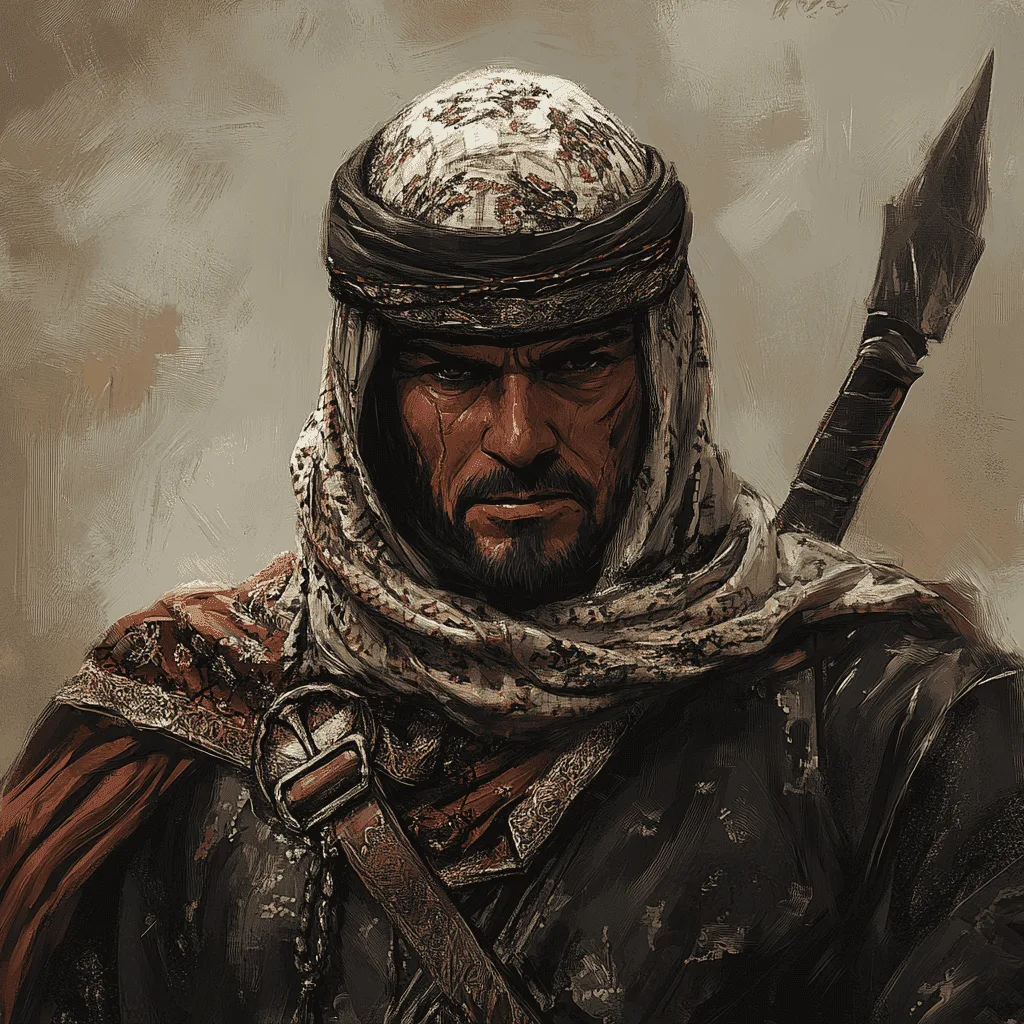
Saladin: The Warrior Sultan Who Defied the Crusaders

Shop on Amazon

Who Was Saladin? The Warrior Sultan Who Defied the Crusaders

Introduction

Saladin, born Ṣalāḥ ad-Dīn Yūsuf ibn Ayyūb in 1137 CE, stands as one of the most remarkable figures in medieval history. As the founder of the Ayyubid Sultanate, this Kurdish warrior-statesman transformed the political landscape of the Middle East during the turbulent era of the Crusades. His recapture of Jerusalem in 1187 CE sent shockwaves throughout Christian Europe and established him as Islam’s most effective defender against Western invasion.

What makes Saladin’s story truly compelling isn’t just his military genius—it’s the rare combination of battlefield prowess and moral leadership that earned him admiration from both allies and adversaries. Medieval European chroniclers, even while chronicling his victories over Christian armies, praised his chivalry and sense of justice. This warrior sultan who defeated the Crusaders became, paradoxically, a symbol of honor in Western literature.

Today, Saladin’s legacy resonates across cultures and centuries. His life offers timeless lessons about leadership, strategic thinking, religious tolerance, and the power of uniting divided people toward a common purpose. Understanding who Saladin was means exploring not just the battles he won, but the principles he embodied and the lasting impact he made on world history.

The Rise of Saladin: From Scholar to Sultan

Early Life and Background

Born in 1137 CE in Tikrit, Iraq, Saladin came from a noble Kurdish family deeply embedded in the military and political networks of the medieval Islamic world. His father, Najm ad-Din Ayyub, served as governor of Tikrit under the powerful Zengid dynasty, which controlled significant portions of Syria and Mesopotamia. This privileged upbringing provided young Saladin with access to both military training and scholarly education—a combination that would prove essential to his future success.

The family’s fortunes shifted when they relocated first to Mosul, then to Damascus, centers of Islamic culture and learning. Unlike many sons of military families who eagerly pursued warfare, the young Saladin displayed a contemplative nature. Historical sources describe him as deeply interested in Islamic theology, philosophy, and Persian poetry. He spent considerable time studying religious texts and engaging with scholars, developing the intellectual foundation that would later inform his governance.

This scholarly inclination set Saladin apart from typical military commanders of his era. While he would become one of history’s greatest generals, his education in Islamic jurisprudence and ethics shaped his approach to leadership. The emphasis on justice, mercy, and proper conduct in Islamic teachings became core principles that guided his treatment of both subjects and enemies throughout his career.

Military Apprenticeship Under Shirkuh

Saladin’s transformation from scholar to soldier came through his uncle, Asad ad-Din Shirkuh, a renowned general serving Nur ad-Din, the Sultan of Syria. Shirkuh recognized potential in his nephew and took him under his wing, teaching him the arts of warfare, strategic thinking, and military leadership. This mentorship proved invaluable—Shirkuh was one of the era’s most skilled tacticians, and his lessons formed the foundation of Saladin’s military education.

The political landscape of the 1160s created urgent opportunities for ambitious military leaders. Egypt, ruled by the declining Shi’a Fatimid Caliphate, had become a prize coveted by multiple powers: the Sunni Zengids of Syria, the Latin Crusader kingdoms, and various internal Egyptian factions. Recognizing Egypt’s strategic importance, Nur ad-Din dispatched Shirkuh to secure the region for the Zengid dynasty.

In 1164 CE, Saladin accompanied his uncle on the first of three military expeditions to Egypt. These campaigns exposed the young soldier to the complexities of medieval warfare—not just battlefield tactics, but also the intricate political maneuvering required to navigate competing interests. Egypt’s political instability created a volatile environment where military skill alone proved insufficient; success demanded diplomatic acumen, strategic patience, and the ability to build coalitions among fractious groups.

Seizing Power in Egypt

The turning point in Saladin’s career came in 1169 CE following Shirkuh’s unexpected death shortly after being appointed vizier (chief minister) of Egypt. To everyone’s surprise, including perhaps his own, the 31-year-old Saladin was elevated to the position of vizier by the Fatimid Caliph Al-Adid. This appointment placed a Sunni outsider at the head of a predominantly Shi’a government—a precarious position that required extraordinary political skill to maintain.

Saladin faced immediate challenges on multiple fronts. The Fatimid court viewed him with suspicion as an agent of the Sunni Zengids. Meanwhile, Crusader forces in the Kingdom of Jerusalem watched Egypt’s instability with keen interest, ready to exploit any weakness. Additionally, Saladin technically served two masters: the Fatimid Caliph in Egypt and his nominal overlord Nur ad-Din in Syria, whose interests didn’t always align.

Shop on Amazon

Over the next two years, Saladin executed a masterful consolidation of power. He systematically replaced Fatimid military commanders and administrators with his own loyal followers, primarily Kurds and Turks who owed allegiance to him personally. He strengthened Egypt’s defenses against Crusader attacks while carefully managing his relationship with Nur ad-Din. When the aging Caliph Al-Adid died in 1171 CE, Saladin made his decisive move.

Rather than appointing a new Fatimid Caliph, Saladin abolished the Fatimid Caliphate entirely, declaring Egypt’s allegiance to the Abbasid Caliphate in Baghdad. This bold action accomplished multiple objectives: it brought Egypt back into the Sunni fold, legitimized his own rule under Abbasid authority, and effectively made him the independent ruler of Egypt. The Ayyubid Dynasty had begun.

The Path to Muslim Unity

With Egypt secured as his power base, Saladin turned his attention to a more ambitious goal: unifying the fragmented Muslim territories to mount an effective resistance against the Crusader states. Since the First Crusade (1096-1099 CE), Christian forces had established four major states in the Levant: the Kingdom of Jerusalem, the County of Tripoli, the Principality of Antioch, and the County of Edessa. These Crusader states survived largely because Muslim rulers remained divided, often fighting each other rather than the common enemy.

Nur ad-Din’s death in 1174 CE created the opportunity Saladin had been waiting for. The Zengid realm descended into succession disputes, leaving a power vacuum in Syria. Saladin moved quickly and decisively. He marched north from Egypt and captured Damascus without bloodshed in November 1174, presenting himself as the rightful heir to Nur ad-Din’s anti-Crusader mission. The people of Damascus, recognizing his military strength and religious legitimacy, welcomed him.

The following decade saw Saladin engaged in what historians call his “wars of unification”—campaigns against fellow Muslim rulers who resisted his authority. These conflicts created a moral dilemma that Saladin addressed through careful framing: he portrayed himself not as a conqueror but as a unifier preparing the Muslim world to reclaim Jerusalem. His campaigns targeted:

Aleppo (1174-1183) – A prolonged struggle against Zengid rivals who claimed Nur ad-Din’s legacy Mosul and northern Mesopotamia (1182-1186) – Securing his eastern flank and gaining control of vital resources Various smaller emirates – Absorbing independent rulers through both military pressure and diplomatic marriages

Throughout these campaigns, Saladin demonstrated the strategic patience that characterized his leadership. Rather than destroying rival Muslim armies completely, he often incorporated defeated forces into his own military, turning former enemies into allies. He used marriage alliances to cement political relationships and recognized the Abbasid Caliph’s authority to gain religious legitimacy for his rule.

By 1186 CE, Saladin had accomplished what no Muslim leader had achieved since the Crusades began: he controlled a unified realm stretching from Egypt through Arabia and Syria to Mesopotamia. This consolidated power base provided the military resources, economic strength, and political legitimacy necessary to challenge the Crusader states effectively. With the Muslim world finally united under his leadership, Saladin turned his full attention toward his ultimate objective—the liberation of Jerusalem.

The Recapture of Jerusalem: Saladin’s Greatest Triumph

Strategic Context: Why Jerusalem Mattered

For nearly ninety years, Jerusalem had remained under Christian control following the brutal conquest of 1099 CE, when Crusader forces massacred much of the city’s Muslim and Jewish population. The loss of Al-Quds (Jerusalem) represented not merely a military defeat but a profound spiritual wound to the Islamic world. As the third holiest site in Islam, home to the Al-Aqsa Mosque and the Dome of the Rock, Jerusalem held immense religious and symbolic significance that transcended political considerations.

By the 1180s, the Kingdom of Jerusalem had become the most powerful Crusader state in the Levant, though internal divisions plagued its leadership. The kingdom’s military strength rested primarily on three elements: heavily armored European knights, formidable castle fortifications, and the military orders—the Knights Templar and Knights Hospitaller—whose warrior-monks provided disciplined, permanent military forces. The Crusader strategy relied on defensive warfare, using their castles as strongholds while avoiding open battle unless holding clear advantage.

Saladin recognized that conventional siege warfare against the Crusaders’ castle network would drain his resources without achieving decisive results. He needed to force the Crusader army into open battle on terrain favoring his mobile cavalry forces. The opportunity came when Raynald of Châtillon, a reckless Crusader lord known for violating truces, attacked a Muslim caravan in 1187. This violation gave Saladin the justification he needed to launch a full-scale invasion.

Shop on Amazon

The Battle of Hattin: A Masterclass in Strategy

The decisive confrontation came on July 4, 1187 CE, at the Horns of Hattin, twin hills overlooking the Sea of Galilee. This battle showcased Saladin’s strategic brilliance and fundamentally altered the balance of power in the Holy Land. His campaign plan demonstrated sophisticated understanding of both enemy capabilities and environmental factors.

Saladin’s strategy unfolded in carefully orchestrated phases:

Phase One—Provocation and Bait: Saladin’s forces attacked and besieged the castle of Tiberias, whose lady, Eschiva of Bures, was married to Raymond of Tripoli, one of the kingdom’s most powerful nobles. This attack achieved multiple objectives: it threatened a significant Crusader fortress, it provoked the honor-bound knights who couldn’t ignore a noblewoman in danger, and it positioned Saladin’s army near terrain favorable to his tactical preferences.

Phase Two—Forcing the March: King Guy of Lusignan faced an agonizing decision. Raymond of Tripoli himself, the most experienced military mind among the Crusaders, counseled patience. He argued that Saladin wanted to draw them into the waterless interior where his mobile forces held advantage. Raymond understood that the Crusaders’ strength lay in defensive positions, not open-field battles in hostile territory.

However, other nobles, particularly the impetuous Gerard de Ridefort (Grand Master of the Knights Templar) and Raynald of Châtillon, pressed for immediate action. They questioned King Guy’s courage and commitment, making political calculations that proved disastrous. Lacking the political capital to resist these demands, Guy ordered the entire Crusader army—approximately 20,000 men including 1,200 heavily armored knights—to march from their well-supplied position at Sephoria toward Tiberias.

Phase Three—The Waterless Trap: Once the Crusader army committed to the march, Saladin executed his masterstroke. Muslim cavalry forces harassed the Christian column continuously, slowing their advance while preventing them from reaching water sources. The date of the march—July 4th in the Middle Eastern summer—meant temperatures exceeding 100°F (38°C). Heavily armored knights, wearing full chain mail and metal helmets, suffered terribly in the heat.

As the exhausted Crusader army approached the Horns of Hattin on the evening of July 3rd, they realized they had been outmaneuvered. Saladin’s forces controlled all nearby water sources. The Crusaders spent a torturous night on the arid plateau, listening to Muslim soldiers taunting them while drums beat throughout the darkness. Knights and foot soldiers alike were desperately thirsty, demoralized, and increasingly aware they had marched into a trap.

See also  Who Was Julius Caesar? Complete Historical and Literary Study Guide

Phase Four—The Destruction: At dawn on July 4th, Saladin’s forces attacked from all directions. Muslim archers rained arrows into the Crusader ranks while cavalry charged repeatedly, preventing any organized response. Saladin’s commanders set fire to the dry grass surrounding the Christian position, adding choking smoke to the misery of heat and thirst.

The Crusader heavy cavalry, normally their most devastating weapon, proved nearly useless. Horses were too weak from thirst to charge effectively. Knights could barely move in their armor. Infantry troops broke ranks, fleeing toward mirages of water or simply collapsing from heat exhaustion. The True Cross, Christianity’s most precious relic believed to be from Christ’s crucifixion, fell into Muslim hands—a psychological blow as devastating as the military defeat.

By afternoon, the battle had become a slaughter. King Guy and his surviving nobles gathered on the Horns of Hattin for a final stand, but surrender was inevitable. When the fighting ended, the Crusader field army had effectively ceased to exist. Saladin’s forces captured nearly every significant Crusader noble, including King Guy himself. The Knights Templar and Hospitaller prisoners, numbering around 200, were executed on Saladin’s order—a rare exception to his usual mercy, justified by their oaths to perpetually fight Muslims.

Jerusalem’s Peaceful Surrender

With the Crusader army destroyed, the road to Jerusalem lay open. Saladin’s forces swept through Palestine like a tidal wave, capturing city after city: Acre, Nablus, Jaffa, Sidon, Beirut, and Ascalon all fell within weeks. By September 1187, Saladin’s army surrounded Jerusalem, trapping the remaining Crusader defenders inside.

Shop on Amazon

The defense of Jerusalem fell to Balian of Ibelin, one of the few Crusader nobles who had avoided capture at Hattin. Balian faced an impossible situation—the city held thousands of civilians but few trained soldiers. He improvised by knighting every able-bodied man, including adolescent boys, but these makeshift defenders stood no chance against Saladin’s veteran army. After a siege lasting less than two weeks, with Muslim siege engines beginning to breach the walls, Balian requested negotiations.

The subsequent surrender negotiations revealed the character that made Saladin legendary. He initially demanded unconditional surrender, intending to slaughter the Crusader population in retaliation for the massacre of 1099. Balian responded with a desperate threat: if denied honorable terms, the defenders would destroy the Dome of the Rock and Al-Aqsa Mosque, slaughter all Muslim prisoners, and kill their own families before dying in a final suicidal assault that would leave Jerusalem a smoking ruin.

This threat forced Saladin to reconsider. After consulting with his religious advisors and commanders, he agreed to terms that shocked the medieval world with their generosity:

Ransom for Freedom: Christians could purchase their freedom at fixed rates—10 dinars for men, 5 for women, 1 for children. These were reasonable sums that middle-class families could afford.

Provisions for the Poor: When many poor Christians couldn’t pay, Saladin allowed approximately 15,000 to leave freely. Some sources indicate he paid ransoms from his own treasury to free additional prisoners.

Safe Escort: Christian refugees received safe conduct to Christian-held territories, with Muslim soldiers protecting them from banditry.

No Forced Conversions: Unlike the Crusader conquest, which had forced Jews and Muslims to convert or die, Saladin permitted religious freedom.

Protection of Holy Sites: Christian churches were converted to mosques or other Islamic uses, but Christian pilgrimage rights were eventually restored.

On October 2, 1187, Saladin entered Jerusalem peacefully. The contrast with the Crusader conquest eighty-eight years earlier could not have been starker. Where Christian soldiers in 1099 had waded through blood “up to their ankles” (according to Crusader chronicles), Saladin’s conquest involved no massacre. This restraint earned him admiration even from his enemies—Christian chroniclers struggled to reconcile their image of Muslims as barbaric infidels with Saladin’s obvious nobility and mercy.

The recapture of Jerusalem represented the pinnacle of Saladin’s career. He had accomplished what Muslim leaders had attempted unsuccessfully for nearly a century: he had reclaimed Islam’s third holiest city through military brilliance combined with moral authority. The news sent shockwaves through both the Islamic and Christian worlds, fundamentally altering the trajectory of the Crusades and cementing Saladin’s place in history.

Conflict with the Third Crusade: Testing Saladin’s Limits

Europe’s Response and the Siege of Acre

The fall of Jerusalem ignited fury across Christian Europe. Pope Gregory VIII issued a papal bull calling for immediate crusade, framing Jerusalem’s loss as divine punishment for Christian sins. Three of Europe’s most powerful monarchs took up the cross in response: Richard I “the Lionheart” of England, Philip II Augustus of France, and Frederick Barbarossa of the Holy Roman Empire. This represented the most formidable military coalition Europe had assembled since the First Crusade.

Shop on Amazon

Tragedy struck before the crusade properly began when Frederick Barbarossa, perhaps the most experienced commander of the three, drowned crossing a river in Anatolia in 1190. His death shattered German morale, and most of his forces returned home. The Third Crusade would ultimately become a contest primarily between Richard the Lionheart and Saladin—two military geniuses whose mutual respect would become legendary despite their bitter conflict.

The Siege of Acre (1189-1191) became the Third Crusade’s first major test. This vital Mediterranean port city had fallen to Saladin after Hattin, but its strategic importance made it the Crusaders’ primary target. Guy of Lusignan, released by Saladin on his promise never to fight Muslims again (a promise he promptly broke), initiated the siege in 1189 with the ragtag remnants of his forces. For nearly two years, the siege dragged on in what became a brutal war of attrition.

The situation created an unusual military scenario: Crusaders besieging Acre while Saladin’s army besieged the besiegers from the landward side. Disease, starvation, and constant skirmishing killed thousands on both sides. Neither force could gain decisive advantage until Richard and Philip arrived with fresh troops and advanced siege equipment in 1191.

Richard’s arrival transformed the siege. His siege engines battered Acre’s walls relentlessly while his naval forces blockaded the harbor, cutting off relief. On July 12, 1191, Acre’s exhausted defenders surrendered. The terms seemed straightforward: the garrison’s lives would be spared in exchange for ransom payments, return of Christian prisoners, and restoration of the True Cross captured at Hattin.

What followed shocked the medieval world and remains one of the darkest episodes of the Crusades. When Saladin delayed the first ransom payment, possibly due to logistical difficulties in assembling the required gold and prisoners, Richard made a horrifying decision. On August 20, 1191, he ordered the execution of approximately 2,700 Muslim prisoners—soldiers and civilians alike—within sight of Saladin’s camp. The massacre took hours, with bound prisoners led out in groups and beheaded or speared to death.

Richard’s stated justification was that he couldn’t spare troops to guard prisoners while marching toward Jerusalem. Strategically, he wanted to terrorize Muslim defenders of other cities into surrender. But the massacre outraged both Muslims and many Christians, hardening the war into a fight for survival that made negotiated settlement much more difficult. Saladin reportedly executed some Christian prisoners in retaliation, though on a much smaller scale.

The Battle of Arsuf: Tactical Brilliance Meets Discipline

After securing Acre, Richard began his march south along the Mediterranean coast toward Jaffa, eventually aiming for Jerusalem. Saladin faced a dilemma: Richard’s army, though numbering only about 10,000 effective fighting men, was highly disciplined and included England’s finest warriors. Saladin commanded larger forces, but he needed to prevent Richard from reaching Jerusalem without losing his own army in a disastrous pitched battle.

Saladin adopted a harassment strategy, launching constant raids on the Crusader column as it marched. Muslim cavalry would gallop close, fire arrows, then retreat before the Crusader knights could respond—classic hit-and-run tactics designed to exhaust the enemy and provoke them into breaking formation. Richard, however, proved an exceptionally disciplined commander. He kept his infantry in tight formation, with crossbowmen providing covering fire while heavily armored knights marched in the center, protecting their horses’ strength for a decisive moment.

The frustration of continuous harassment without being able to strike back tested Crusader morale severely. Knights chafed under Richard’s orders to maintain formation, desperate to charge the enemy. Saladin calculated that eventually the Crusaders would break discipline, allowing his forces to isolate and destroy separated units.

On September 7, 1191, near the town of Arsuf, Saladin launched his main assault. Muslim forces attacked in waves, with thousands of cavalry and infantry pressing the Crusader column from multiple directions. The sound of drums and war cries created psychological pressure while arrows darkened the sky. Crusader knights, particularly the Knights Hospitaller guarding the rear, absorbed tremendous punishment while Richard continued ordering them to hold formation.

Finally, despite Richard’s commands, some Hospitallers broke ranks and charged. Recognizing that he had lost control, Richard brilliantly converted a near-disaster into victory. He immediately ordered a general charge by all his cavalry, transforming the unauthorized attack into a coordinated assault. The mass charge of heavily armored knights smashed into Saladin’s left flank with devastating effect, breaking the Muslim lines and sending them into retreat.

Shop on Amazon

The Battle of Arsuf demonstrated both commanders’ exceptional abilities. Saladin had executed a complex, coordinated assault that nearly broke Crusader discipline. Richard had maintained control of his forces under extreme pressure, then showed the flexibility to adapt when circumstances changed. The battle secured the coastal road for the Crusaders and enhanced Richard’s reputation as one of history’s great battlefield commanders.

However, Arsuf was not the decisive victory Richard needed. Saladin’s forces retreated in good order, remaining capable of continued resistance. More importantly, Richard recognized a troubling reality: he had won a tactical victory but remained no closer to his strategic objective of recapturing Jerusalem.

The Road Not Taken: Jerusalem Remains Muslim

Following Arsuf, Richard’s campaign increasingly resembled a chess game where both players could see the approaching stalemate. Richard captured Jaffa and rebuilt its fortifications, establishing a secure base. He maneuvered inland, even coming within sight of Jerusalem in January 1192. But taking the Holy City proved impossible due to Saladin’s scorched-earth strategy and the logistical realities of medieval warfare.

Saladin had destroyed wells, burned crops, and poisoned water sources along the routes approaching Jerusalem. This forced the Crusaders to carry all their supplies, drastically limiting how long they could maintain a siege. Jerusalem’s fortifications had been strengthened significantly, with walls repaired and supplies stockpiled. Even if Richard captured the city, holding it seemed unlikely—his lines of communication stretched dangerously long, and Saladin’s forces controlled the surrounding countryside.

Richard’s military instincts told him the truth: besieging Jerusalem would result in a catastrophic failure that might destroy his entire army. On two occasions, he advanced to within sight of the city, and both times he turned back rather than commit to a siege he couldn’t sustain. These decisions showed Richard’s strategic wisdom but demoralized his followers, many of whom had taken crusading vows specifically to pray in Jerusalem.

Internal politics further complicated Richard’s position. News arrived from England that his brother John was plotting to seize the throne in Richard’s absence. French King Philip II had already returned to Europe and was reportedly threatening English territories. Richard needed to return home, but leaving without achieving his crusade’s primary objective—reclaiming Jerusalem—represented an admission of failure.

The Treaty of Jaffa: Honorable Enemies Make Peace

By summer 1192, both leaders recognized that continuing the war served neither side’s interests. Despite their conflict, Richard and Saladin had developed genuine mutual respect. When Richard fell seriously ill during the campaign, Saladin sent his personal physician to treat him. When Richard’s horse was killed in battle, Saladin sent him replacement mounts. These gestures of chivalry between enemies became legendary in medieval romance literature.

See also  Baybars Study Guide: The Mamluk Sultan Who Defended the Middle East in the 13th Century

Negotiations proceeded through intermediaries, particularly Richard’s diplomatic mission led by Bishop Hubert Walter and Saladin’s brother al-Adil. The talks revealed both leaders’ pragmatism and willingness to compromise. On September 2, 1192, they concluded the Treaty of Jaffa, establishing a three-year truce with the following terms:

Territorial Division: Crusaders retained a coastal strip from Tyre to Jaffa, ensuring their continued presence in the Holy Land but limiting them to a fraction of their former kingdom.

Jerusalem Status: The city remained under Muslim control, avoiding the humiliation of loss that Saladin could not accept politically or religiously.

Christian Pilgrimage Rights: Unarmed Christian pilgrims received guaranteed safe passage to visit Jerusalem and other holy sites—a critical concession that addressed European religious concerns while maintaining Muslim sovereignty.

Shop on Amazon

Trade and Commerce: The treaty allowed merchants of all faiths to travel and trade freely, recognizing the economic benefits of peace for both sides.

Prisoner Exchanges: Remaining prisoners of war were to be released or ransomed according to agreed-upon terms.

The treaty represented a diplomatic victory for both leaders, allowing each to claim success. Saladin had defended Jerusalem and maintained Muslim control of the Holy Land’s interior. Richard had secured the Crusader states’ survival and ensured Christian access to holy sites. Neither side won completely, but neither lost decisively—a pragmatic outcome that saved countless lives and demonstrated that negotiated settlement between Christian and Muslim powers was possible.

Remarkably, Richard and Saladin never met face to face despite years of conflict. They communicated through letters and intermediaries, developing a relationship built on mutual respect that transcended their religious and political opposition. Medieval romances later embellished this relationship, creating legends of their chivalric interactions that influenced European literature for centuries.

The Third Crusade ended in September 1192 with Richard’s departure for Europe. Though he had failed to reclaim Jerusalem, his military accomplishments were impressive: he had never lost a battle, had secured the Crusader states’ survival, and had proven himself Saladin’s equal in strategy and courage. For Saladin, the crusade had tested his empire’s limits, but he had successfully defended Islam’s most precious prize against Europe’s greatest warrior.

Less than six months after the treaty, on March 4, 1193, Saladin died in Damascus, his health broken by years of campaigning. His death marked the end of one of history’s most remarkable military and political careers, though his legacy would long outlive him.

Leadership and Legacy: The Many Dimensions of Saladin

Governance and Administrative Excellence

While Saladin’s military achievements captured medieval imagination, his success ultimately rested on his abilities as an administrator and reformer. Building and maintaining an empire stretching from Egypt to Mesopotamia required more than battlefield victories—it demanded systematic governance, economic management, and institutional reforms that could outlast individual rulers. Saladin excelled in these less glamorous but equally crucial aspects of leadership.

Upon consolidating power in Egypt, Saladin inherited a state whose administrative apparatus had become corrupt and inefficient under the declining Fatimid Caliphate. He implemented comprehensive reforms that transformed Egypt into his empire’s economic powerhouse:

Tax Reform: Saladin restructured the tax system to reduce corruption by standardizing collection procedures and appointing honest officials directly accountable to his government. He reduced taxes on peasants and small merchants while ensuring that wealthy landowners paid appropriate amounts, helping to stimulate economic activity while increasing revenue. These reforms helped Egypt’s agricultural sector recover from years of exploitation under Fatimid rule.

Military Organization: Rather than relying solely on temporary levies raised for specific campaigns, Saladin developed a professional standing army supported by the iqta system—a feudal-like arrangement where military commanders received land revenues in exchange for maintaining equipped troops. This system provided military continuity while ensuring forces remained battle-ready without constant new recruitment.

Centralized Authority: Saladin worked systematically to consolidate power under the Ayyubid dynasty by replacing potentially disloyal governors with family members and trusted commanders. His brothers and sons received governorships of key provinces, creating an administrative network bound by blood loyalty. While this approach created succession problems after his death, it provided stability during his reign.

Shop on Amazon

Legal and Judicial Reforms: Saladin strengthened the qadi (Islamic judge) system by appointing respected legal scholars to courts throughout his domains. He emphasized application of Sharia law fairly and consistently, building public confidence in his justice system. His personal involvement in hearing grievances and dispensing justice became legendary, with common people reportedly able to petition him directly.

Economic Development: Understanding that military power required economic foundation, Saladin invested in infrastructure that facilitated trade and commerce. He improved harbor facilities in Egyptian ports, maintained caravanserais (traveler’s inns) along trade routes, and protected merchant caravans from banditry. The economic prosperity this generated provided tax revenues that funded his military campaigns and public works.

These administrative reforms transformed Saladin’s realm from a collection of conquered territories into a coherent empire capable of sustained military operations. His governmental innovations provided the organizational framework that allowed him to mobilize resources for the long campaign to reclaim Jerusalem and later resist the Third Crusade.

Religious Tolerance and Interfaith Relations

One of Saladin’s most remarkable qualities, especially by medieval standards, was his approach to religious diversity and interfaith relations. In an era characterized by religious fanaticism on both sides of the Christian-Muslim divide, Saladin demonstrated pragmatic tolerance that earned respect even from those who opposed him.

His treatment of conquered Christian populations set a precedent that contrasted sharply with Crusader practices. After recapturing Jerusalem, he allowed:

Freedom of Worship: Christian communities in his territories could maintain their churches and practice their faith without persecution. While some churches were converted to mosques, particularly in Jerusalem, many remained operational. Christian clergy retained their positions, and religious services continued.

Jewish Communities: Saladin encouraged Jews to return to Jerusalem after nearly ninety years of exclusion under Crusader rule. Jewish communities flourished in his realm, with many Jews serving in administrative and commercial roles. His personal physician, Moses Maimonides, was a Jewish scholar whose philosophical and medical works influenced medieval thought across cultural boundaries.

Protected Status (Dhimmi): Following Islamic legal traditions, Saladin granted Christians and Jews dhimmi status—protected religious minorities who paid special taxes (jizya) in exchange for religious freedom and exemption from military service. While discriminatory by modern standards, this system represented greater tolerance than most medieval Christian kingdoms showed toward religious minorities.

Diplomatic Relations: Saladin maintained regular diplomatic contact with Christian rulers, including Crusader states during peacetime. He negotiated trade agreements, prisoner exchanges, and truces that demonstrated his willingness to coexist with Christian powers when warfare wasn’t necessary.

This tolerance stemmed partly from Islamic teachings about People of the Book (Christians and Jews as fellow monotheists), but also from Saladin’s pragmatic recognition that diverse populations required accommodating governance. His empire included millions of non-Muslims whose cooperation was essential for economic prosperity and political stability. Harsh religious persecution would have provoked rebellions and undermined his rule.

Contemporary Christian chroniclers, even while fighting against him, praised Saladin’s chivalry and fairness. These accounts helped create his legendary reputation in medieval European literature, where he appeared as the model of knightly virtue despite being Islam’s champion. This remarkable cross-cultural admiration demonstrated how Saladin’s character transcended religious conflict.

Shop on Amazon

Patronage of Knowledge, Architecture, and Medicine

Beyond warfare and governance, Saladin understood that lasting civilizations required intellectual and cultural excellence. He became a generous patron of learning, supporting scholars, building educational institutions, and fostering the scientific and philosophical achievements that characterized Islamic Golden Age civilization.

Educational Institutions: Saladin founded and funded numerous madrasas (Islamic schools) throughout his empire. These institutions taught not only religious studies but also mathematics, astronomy, medicine, and philosophy. Notable examples include the Salahiyya Madrasa in Jerusalem and several major institutions in Cairo. These schools trained the administrative and religious personnel who ran his empire while advancing Islamic scholarship.

Medical Care and Hospitals: Understanding healthcare’s importance for public welfare, Saladin invested heavily in medical infrastructure. He founded hospitals in Cairo and Jerusalem that provided free care to all regardless of religion or social status. These institutions, called bimaristans, represented the era’s most advanced medical facilities, featuring separate wards for different illnesses, staff physicians, and pharmaceutical dispensaries. The Al-Nasiri Hospital in Cairo, built under Saladin’s patronage, became one of the medieval world’s premier medical centers.

Architectural Legacy: Saladin commissioned significant architectural projects, particularly fortifications that combined military utility with aesthetic achievement. The Citadel of Cairo, begun in 1176, became one of medieval Islamic architecture’s masterpieces—a massive fortress complex that served as government headquarters while showcasing architectural innovation. He also restored and strengthened Jerusalem’s walls and renovated the Dome of the Rock, demonstrating his commitment to preserving Islamic holy sites.

Support for Scholars: Saladin’s court attracted leading intellectuals of the Islamic world. Philosophers, historians, poets, and scientists received patronage that allowed them to pursue their work. The legal scholar Baha ad-Din ibn Shaddad, who wrote the most detailed contemporary biography of Saladin, benefited from this patronage. Al-Qadi al-Fadil, Saladin’s chief administrator, was also a renowned poet and prose stylist whose works influenced Arabic literature.

Libraries and Manuscript Production: Saladin supported the copying and preservation of manuscripts, expanding libraries and ensuring that classical works remained accessible. This cultural patronage helped preserve knowledge that might otherwise have been lost during the Crusades’ turbulent period.

This investment in education, healthcare, and culture reflected Saladin’s understanding that military conquests alone don’t build enduring civilizations. His patronage created institutional foundations that outlasted his military achievements, contributing to the intellectual vitality that made medieval Islamic civilization a center of learning when much of Europe languished in relative intellectual stagnation.

Personal Character and Generosity

Perhaps what most distinguished Saladin from other medieval rulers was his personal character—qualities that made him not just respected but genuinely beloved by his subjects and admired by his enemies. Historical sources, both Muslim and Christian, consistently describe his generosity, humility, and personal piety.

Legendary Generosity: Saladin’s charitable giving became famous throughout his lifetime. He gave away enormous sums to the poor, funded hospitals and schools from personal wealth, and paid ransom for prisoners who couldn’t afford their freedom. This generosity wasn’t political calculation but reflected his deep religious conviction about helping the less fortunate. His treasurer famously complained that Saladin made financial administration impossible by constantly giving away state funds.

Personal Simplicity: Despite ruling an empire, Saladin lived relatively simply. He dressed modestly, ate plain food, and avoided the luxury that characterized many medieval courts. This ascetic lifestyle contrasted sharply with both the lavish Fatimid caliphs he replaced and the ostentatious displays of many Crusader lords. His simplicity resonated with common people who saw him as approachable rather than distant.

Religious Devotion: Saladin was deeply pious, praying regularly and consulting religious scholars about the Islamic legal and moral dimensions of his decisions. However, his piety didn’t become extremism—he applied religious principles with mercy and pragmatism rather than harsh literalism. This balanced approach earned respect from religious scholars while maintaining practical effectiveness in governance.

Shop on Amazon

Justice and Accessibility: Saladin made himself accessible to petitioners seeking justice, personally hearing grievances even from common people. Stories circulated of his investigating claims of official corruption and punishing governors who abused their authority. This personal involvement in justice, while time-consuming, built genuine loyalty among his subjects who saw him as their protector against injustice.

Death and Legacy: When Saladin died on March 4, 1193, in Damascus, his treasury held barely enough to pay for his funeral expenses. Despite controlling an empire’s wealth, he had given away virtually everything to charitable causes, military expenses, and supporting his followers. His will directed that what little remained be distributed to the poor.

This poverty at death became the ultimate testament to his character. Medieval chroniclers noted the stark contrast: Saladin had conquered vast territories, commanded enormous armies, and could have lived in unimaginable luxury, yet he died owning almost nothing. His wealth existed in the loyalty he inspired and the legacy he left—treasures that proved far more valuable than gold.

See also  Benkei Study Guide: The Legendary Warrior Monk of 12th Century Japan

Enduring Historical Impact

Saladin’s influence extended far beyond his lifetime, shaping political, military, and cultural developments in both the Islamic world and Europe. His legacy manifests in several distinct areas:

Symbol of Islamic Unity: For Muslims, Saladin represents the ideal of unity overcoming division. His success in unifying fractured Muslim territories inspired later leaders facing external threats. Modern political movements throughout the Middle East have invoked Saladin’s memory when calling for unity against perceived enemies, though often simplifying his complex legacy for political purposes.

Model of Chivalric Leadership: Paradoxically, Saladin became a hero in medieval European literature despite being the Crusaders’ greatest opponent. Works like Walter Scott’s The Talisman presented him as embodying chivalric ideals—courage, honor, mercy, and courtesy—sometimes more perfectly than Christian knights. This cross-cultural admiration was unprecedented and revealed Europeans’ grudging respect for an enemy who defeated them while maintaining moral authority.

Military Strategic Legacy: Military historians study Saladin’s campaigns as examples of strategic patience, psychological warfare, and adaptive tactics. His victory at Hattin demonstrated how understanding terrain, climate, and enemy psychology could overcome numerical and technological advantages. His conduct during the Third Crusade showed how a defensive strategy combined with diplomatic flexibility could successfully resist a militarily superior force.

Template for Muslim-Christian Coexistence: Saladin’s treatment of defeated enemies and religious minorities provided a historical precedent for interfaith relations. During modern conflicts between Muslim and Christian populations, both sides have looked to Saladin-era precedents as examples of coexistence, though historical reality was more complex than romantic legend suggests.

National Symbol: Multiple modern nations claim Saladin’s legacy. Egypt, Syria, and Iraq all reference him in nationalist narratives, with monuments, institutions, and even military equipment named after him. This reflects not only his historical importance but also his continued symbolic power in Middle Eastern politics.

Contrast with Modern Conflicts: Perhaps most importantly, Saladin’s legacy poses challenging questions about the nature of conflict and reconciliation. His ability to wage effective war while maintaining moral principles, to defeat enemies without dehumanizing them, and to build lasting peace through negotiation rather than total victory offers lessons that transcend his historical period. In an era of absolutist thinking and dehumanizing rhetoric, Saladin’s example suggests alternative approaches to seemingly intractable conflicts.

The complexity of Saladin’s legacy defies simple categorization. He was simultaneously a warrior who killed thousands in battle and a humanitarian who showed mercy to defeated enemies. He was a religious champion who fought Crusaders and a pragmatist who negotiated with them. He was a Kurdish outsider who became Islam’s defender. These apparent contradictions reveal a multidimensional leader whose greatness lay precisely in balancing competing demands—military necessity with moral principle, religious conviction with practical tolerance, ambition with humility.

Shop on Amazon

Why Saladin Still Matters: Lessons for Modern Times

Leadership Beyond Warfare

Saladin’s story resonates today because it demonstrates that effective leadership requires more than military strength or political cunning. His success stemmed from an unusual combination of qualities:

Strategic Patience: Rather than seeking quick victories, Saladin spent years building the foundation for success. His systematic unification of Muslim territories before challenging the Crusaders showed understanding that premature action often leads to failure. Modern leaders facing complex challenges can learn from his willingness to prepare thoroughly rather than rushing to action.

Moral Authority: Saladin’s greatest weapon wasn’t his army but the legitimacy he earned through just governance and ethical conduct. His treatment of conquered populations, particularly after recapturing Jerusalem, demonstrated that how you win matters as much as whether you win. This principle applies to conflicts from corporate competition to international relations—victories achieved through immoral means often prove pyrrhic.

Adaptive Strategy: Saladin showed remarkable flexibility in adjusting tactics to circumstances. Against the Crusader army at Hattin, he used mobility and environmental factors to overcome superior armor. Against Richard the Lionheart, he switched to defensive warfare and scorched-earth tactics when facing a more skilled opponent. This ability to adapt rather than rigidly following predetermined plans explains his consistent success despite facing different challenges.

Diplomatic Sophistication: Saladin recognized that not all problems require military solutions. His willingness to negotiate with Richard, including the Treaty of Jaffa that ended the Third Crusade, showed wisdom that pure warriors lack. He understood that sustainable peace requires accommodation, not total victory—a lesson that remains relevant in modern conflicts where “winner-take-all” approaches often perpetuate violence.

Interfaith Relations and Religious Tolerance

Perhaps Saladin’s most relevant legacy for contemporary society lies in his approach to religious diversity. In an era when religious extremism drives much conflict, his example offers important lessons:

Principled Coexistence: Saladin was deeply devout—his faith motivated his campaign to reclaim Jerusalem and guided his daily life. Yet this religious conviction didn’t prevent him from respecting other faiths or negotiating with religious enemies. He demonstrated that strong religious identity and interfaith tolerance aren’t contradictory but complementary.

Beyond Tolerance to Respect: Saladin didn’t just tolerate religious minorities; he actively protected them and recognized their contributions to society. His court included Christian and Jewish advisors, his armies sometimes allied with Christian forces against mutual enemies, and his treaties acknowledged Christian religious needs. This went beyond mere tolerance to genuine respect for religious others.

Rejecting Dehumanization: Medieval warfare was often characterized by viewing enemies as subhuman infidels deserving no mercy. Saladin rejected this dehumanization, treating captured Crusaders with dignity and recognizing shared humanity across religious divides. His ability to fight fiercely in battle while respecting defeated enemies afterward offers a model for conducting necessary conflicts without descending into genocidal hatred.

Religion as Motivation, Not Excuse: Saladin’s religious conviction motivated him to reclaim Jerusalem and defend Muslim territories, but he didn’t use religion as an excuse for atrocities. His conduct even in war remained constrained by Islamic ethical principles. This contrasts sharply with leaders throughout history who invoke religious language while committing acts that violate their faith’s ethical teachings.

The Burden of Unity: Leading Diverse Coalitions

One of Saladin’s greatest challenges was maintaining unity among diverse followers with competing interests—Muslim factions that had spent decades fighting each other, ethnic groups including Kurds, Arabs, and Turks, and religious communities following different Islamic schools of thought. His success in holding this coalition together offers lessons for modern leaders:

Shop on Amazon

Shared Purpose Over Shared Identity: Saladin couldn’t appeal to ethnic nationalism—he wasn’t Arab in an Arab-dominated culture. Instead, he united diverse groups around a shared objective: defending Islam against external threat. This principle applies to any diverse coalition where demographic or ideological unity is impossible.

Balanced Distribution of Benefits: Saladin ensured that different factions within his empire received appropriate rewards and recognition. Military victories benefited multiple groups, preventing any single faction from dominating. This balance maintained coalition cohesion when purely hierarchical control might have provoked rebellions.

Leading by Example: Saladin’s personal humility, simplicity, and willingness to share hardship with his troops built genuine loyalty. He didn’t demand sacrifices from others that he wouldn’t make himself. This authentic leadership style created bonds stronger than those built through coercion or material rewards alone.

Institutional Foundations: Saladin built administrative and military institutions that functioned beyond personal loyalty. His governmental reforms created systems that survived his death, even though his empire fragmented among his heirs. Creating institutional foundations rather than relying solely on personal authority ensures that achievements outlast individual leaders.

Understanding History Through Multiple Perspectives

Finally, Saladin’s legacy demonstrates the value of examining history from multiple perspectives. He appears heroic in Islamic sources for defending Muslim territories and reconquering Jerusalem. European sources, despite fighting against him, praised his chivalry and honor. Modern historians recognize both his achievements and the limitations of medieval warfare’s brutal realities.

This multifaceted legacy teaches important lessons about historical interpretation:

Heroes and Villains Oversimplify: Saladin was neither the perfect Muslim hero of romantic legend nor the infidel enemy of Crusader propaganda. He was a complex human being who made brilliant decisions and tragic mistakes, showed great mercy and occasional cruelty, embodied high ideals and pragmatic calculation. Historical figures rarely fit neat categories.

Context Matters: Saladin’s actions must be understood within 12th-century contexts. His treatment of enemies was remarkably humane by medieval standards while falling far short of modern human rights principles. Judging historical figures solely by contemporary standards obscures what made them exceptional in their own times.

Legacy Evolves: Different eras emphasize different aspects of Saladin’s legacy depending on contemporary concerns. During the colonial period, Middle Eastern nationalists emphasized his resistance to foreign invasion. During interfaith dialogue movements, his religious tolerance receives attention. During conflicts, his military genius becomes focal. Understanding how historical memory evolves reveals as much about the present as about the past.

Conclusion: The Warrior Sultan’s Enduring Legacy

Saladin’s life presents a remarkable case study in leadership, strategy, and the complex relationship between moral principles and political necessity. Born into modest nobility, he rose to become sultan of Egypt, unified the divided Muslim world, reclaimed Islam’s third holiest city, and successfully defended his conquests against Europe’s greatest warrior-king. His achievements would justify historical significance based on military and political accomplishments alone.

Yet what truly distinguishes Saladin and explains his enduring reputation is the manner in which he achieved these victories. He demonstrated that military success and moral authority need not be mutually exclusive—that effective leadership requires both strategic brilliance and ethical conduct. His treatment of conquered populations, particularly after recapturing Jerusalem, set standards that influenced warfare and diplomacy for centuries.

Shop on Amazon

In an era defined by religious conflict, Saladin showed that deep faith and interfaith respect could coexist. Fighting in the name of Islam, he nonetheless treated Christian and Jewish communities with dignity, negotiated with religious enemies, and ultimately found common ground with Richard the Lionheart despite their bitter conflict. This example of principled coexistence remains relevant as modern societies grapple with religious diversity.

Saladin’s administrative reforms, patronage of learning, and institutional innovations remind us that lasting historical impact requires more than battlefield victories. His investments in education, healthcare, and public welfare created foundations that outlived his military conquests. His empire eventually fragmented among his heirs, but the institutions he established and the precedents he set continued shaping the Middle East for generations.

Perhaps most importantly, Saladin’s legacy transcends the Muslim-Christian divide. His reputation as a chivalrous and honorable leader earned respect even from his enemies, becoming the rare historical figure admired across cultural and religious boundaries. This cross-cultural appeal demonstrates that certain leadership qualities—courage, justice, mercy, and honor—resonate universally despite different religious and cultural frameworks.

Over eight centuries after his death, Saladin remains a compelling figure precisely because his life poses enduring questions about the nature of leadership, the possibility of moral warfare, and the potential for finding common humanity even amid bitter conflict. His example doesn’t provide simple answers to these questions, but it demonstrates that leaders can wage necessary wars without abandoning ethical principles, can serve their communities without exploiting them, and can achieve greatness while maintaining humility.

The warrior sultan who defied the Crusaders left a legacy far richer than military conquests—he left an example of leadership that continues challenging and inspiring people worldwide. In studying his life, we discover not just history but timeless lessons about the kind of leadership that achieves lasting significance while maintaining moral integrity.

For readers seeking to understand this remarkable period in medieval history, the following resources provide deeper exploration:

Understanding Saladin means grappling with complexity—recognizing both his achievements and limitations, appreciating his moral leadership while acknowledging medieval warfare’s brutal realities, and seeing how one individual’s choices shaped history across civilizations. His story reminds us that the most important historical figures are often those who defy simple categorization, whose legacies challenge us to think more deeply about leadership, ethics, and the possibilities for human excellence even in difficult times.

Hall of Ancient Warriors Logo

Leave a Comment