Table of Contents
The Rage of Achilles: An Introduction
The first word of Homer's Iliad—μῆνις (mēnis), "rage"—announces the epic's core subject. This is not a poem about the Trojan War itself, nor about the heroic deeds of all the Greek warriors, though those fill its pages. The Iliad is fundamentally about the rage of Achilles, the greatest warrior of the Greek army, and how his anger sets in motion a cascade of destruction that kills thousands, destroys his closest friend, and ultimately redefines what it means to be human, mortal, and heroic.
Composed around the eighth century BCE and set during the legendary Trojan War (traditionally dated to 1200 BCE), the Iliad remains Western literature's foundational text. But it is no ancient relic studied only by scholars—it is a psychologically complex exploration of anger, honor, mortality, friendship, grief, and the search for meaning in a violent world where death is certain and glory offers the only chance at immortality.
Understanding Achilles' rage matters because it reveals timeless truths about how pride and anger can destroy what we love most, how grief transforms us, and how the pursuit of honor can both elevate and devastate. The poem asks fundamental questions: What gives life meaning when death is inevitable? Can anything justify war's suffering? How do we respond when dishonored? What price is worth paying for eternal fame?
This guide explores Achilles' character, the origins and evolution of his rage, the relationships that define him, the major themes woven through the narrative, and why this 2,800-year-old poem still resonates with modern readers who will never fight with bronze spears but know what it feels like to be angry, dishonored, and facing mortality.
The Origins of Achilles' Rage: Honor and Insult
Honor in Homeric Society
To understand why Achilles reacts so explosively when Agamemnon takes Briseis, you must grasp the value system of Homeric warrior culture. Honor (timē) was not personal pride—it was social currency, a warrior's entire identity. Honor was made visible through tangible markers: war prizes (gera) like captive women and armor; public recognition (kleos, fame); respect from peers; and martial excellence (aretē). The quality and quantity of these markers reflected a warrior's worth. In this system, a public insult to honor demanded response.
Accepting dishonor without reaction meant accepting lower status—life without honor was not worth living.
This explains Achilles' extreme response. When Agamemnon takes Briseis, it is not primarily about losing a woman he cares for (though the poem suggests he did care). It is about the public declaration that Agamemnon can take Achilles' prize—that Agamemnon's honor outweighs Achilles', even though Achilles is the superior warrior. Modern readers might see a petty dispute over a slave woman, but Homer's audience understood the stakes: Achilles' entire social identity was under assault.
The Quarrel: Agamemnon and Achilles
The poem opens in medias res—in the ninth year of the war. The Greek army, led by King Agamemnon of Mycenae, has besieged Troy but cannot achieve decisive victory. The catalyst for the quarrel unfolds in stages:
- Agamemnon's prize: He receives Chryseis, daughter of a priest of Apollo. When her father offers ransom, Agamemnon refuses arrogantly.
- Apollo's plague: The offended priest prays to Apollo, who sends a devastating plague on the Greeks. For nine days, soldiers die because Agamemnon refuses to yield.
- The assembly: Achilles calls an assembly. The prophet Calchas, protected by Achilles, reveals the cause: Apollo demands Chryseis returned.
- Agamemnon's concession and compensation: Agamemnon agrees to return Chryseis—but insists on replacing her with Achilles' prize, Briseis, to avoid appearing diminished.
- Achilles' reaction: He considers killing Agamemnon but is restrained by Athena. Instead, he launches a verbal assault, calling Agamemnon shameless and cowardly. He declares he will no longer fight for the Greeks.
Why does Achilles react so intensely? The injustice is clear: Achilles has fought harder than Agamemnon yet is dishonored by rank overriding merit. The hypocrisy stings: Agamemnon solves his own crisis by stealing from someone else. The public nature of the insult—before the entire army—makes acceptance impossible. If Achilles accepts this, the precedent allows others to take from him at will.
Achilles' rage is not irrational within the cultural context—it is a calculated response to a serious threat. The problem is that his chosen response (withdrawal) will cause catastrophic consequences for everyone, including himself. The poem thus establishes a tragic framework: a justified grievance leads to an overreaction that spirals into far greater harm than the original insult.
Achilles' Appeal to His Mother
Unable to challenge Agamemnon without destroying the army's unity, Achilles turns to his divine mother, Thetis, a sea goddess. Homer shows the great warrior weeping like a child—vulnerability even in the mightiest hero. Achilles asks Thetis to convince Zeus to aid the Trojans, proving the army needs him. Thetis goes to Zeus, who reluctantly agrees. This divine intervention ensures that Achilles' withdrawal will have devastating consequences—the Greeks will suffer terrible losses, demonstrating Achilles' indispensability and the magnitude of Agamemnon's insult.
This sets up the tragic irony: Achilles gets what he asks for—proof that he is essential and that dishonoring him was catastrophic—but the cost will be his closest friend's life and his own eventual death. The mechanism of the plot is now in motion: Zeus's promise means that for Achilles to be vindicated, his own army must suffer, and that suffering will eventually demand his return to battle under circumstances he cannot control.
The Consequences: War Without Achilles
The Greeks' Declining Fortune
With Achilles refusing to fight, the Greeks begin losing ground to the Trojans under their champion Hector, son of King Priam and the noblest warrior on the Trojan side. In Books 2 through 8, the Trojans push the Greeks back from Troy's walls toward their ships on the beach. Greek heroes who had been winning glory—Diomedes, Ajax, Odysseus—find themselves fighting desperately just to hold positions. The absence of one man proves decisive, validating Achilles' claim to supreme warrior status.
Homer uses this decline to illustrate the interdependence of the Achaean coalition. Even the strongest collective force falters when its key component withdraws. The poem also introduces a series of minor characters whose deaths underscore the cost of the quarrel: men who would have lived had Achilles been fighting now fall to Trojan spears. The psychological weight on Achilles' eventual return grows heavier with each casualty.
The Embassy to Achilles (Book 9)
As the situation becomes desperate, Agamemnon sends an embassy offering extravagant compensation: return of Briseis (with an oath he never touched her), seven additional captive women, twenty bronze tripods, seven cities after the war, choice of Agamemnon's daughters as a bride, and status equal to Agamemnon's honor. This is an enormous apology—yet Achilles refuses.
His response reveals how deeply the insult wounded him and how his rage has evolved. He questions the entire value system that brought him to Troy: "The same honor waits for the coward and the brave. They both go down to death" (Book 9). He announces he is leaving—sailing home to live a long, peaceful, obscure life rather than dying young for fame. This challenges the heroic code itself.
Achilles suggests that life might be worth more than glory—a shockingly un-heroic sentiment that reveals psychological complexity. But he does not leave. His threats to sail home remain unfulfilled, showing he is not entirely convinced by his own argument. He stays at Troy, still refusing to fight but unable to abandon the quest for glory.
This ambivalence is crucial to understanding Achilles. He is not a simple man of action driven by single-minded rage; he is torn between his desire for honor and his growing awareness of its cost. The embassy scene marks the first crack in the heroic facade, a moment when Achilles peers into an alternative life and hesitates on the threshold.
The Turning Point: The Death of Patroclus
The Relationship Between Achilles and Patroclus
Patroclus is Achilles' closest companion, described with an intimacy that suggests a bond deeper than ordinary friendship. Whether their relationship was romantic or a profound platonic friendship, the text makes clear that Patroclus is the person Achilles loves most. Patroclus serves as companion, moral conscience (more compassionate than Achilles), mirror and contrast (more human, less godlike), and emotional anchor. Without him, Achilles becomes something inhuman—pure destructive rage.
Ancient audiences would have recognized the hetairos (companion) relationship as the deepest bond possible outside family. Patroclus is older than Achilles and acts as a steadying influence. When Achilles withdraws, Patroclus is the only one who can approach him without fear. Their interaction in Book 16—where Patroclus weeps for the suffering Greeks and Achilles, moved, gives his permission—shows the tenderness that underpins the epic's violence.
Patroclus Enters Battle (Book 16)
As the Trojans push the Greeks back to the ships and begin setting them on fire, Patroclus begs Achilles to return to battle or at least let Patroclus wear his distinctive armor to frighten the Trojans. Achilles agrees—Patroclus can wear the armor and defend the ships, but must return immediately once the Trojans retreat. Achilles warns specifically against pursuing the Trojans toward their city.
This reveals something crucial: Achilles' care for Patroclus competes with his rage at Agamemnon. He will not rejoin the battle himself (that would mean surrendering his honor-claim), but he will risk his closest friend to protect the Greek army. Patroclus succeeds brilliantly—driving the Trojans back, killing numerous warriors. But he ignores Achilles' warning. Caught up in battle-fury, he chases the Trojans toward Troy's walls, killing Sarpedon, son of Zeus, along the way.
This transgression—hubris in its purest form—seals his fate.
The Death of Patroclus
At Troy's walls, Apollo intervenes—striking Patroclus and knocking Achilles' helmet from his head. In his stunned, exposed state, Patroclus is wounded by a minor Trojan warrior, then finished off by Hector, who takes Achilles' armor as a prize. Patroclus' last words predict Hector's own death at Achilles' hands—his dying prophecy hangs over the rest of the poem.
When news reaches Achilles, his response is overwhelming, almost inhuman grief. He tears his hair, covers himself in ashes, rolls in the dirt, and screams so loudly his mother hears him beneath the sea. The Greeks have to restrain him from killing himself in his anguish. Homer spares nothing in depicting the physicality of grief: Achilles becomes unrecognizable, his beauty marred by dirt and tears. This is not dignified sorrow; it is primal, animal mourning.
The Transformation of Rage
Patroclus' death transforms Achilles' anger from wounded pride over dishonor into something much darker. Before, Achilles' withdrawal was calculated to prove his worth and punish those who dishonored him. After, his rage becomes grief-fueled destruction. He is no longer concerned with honor or glory—he wants revenge, wants to kill Hector, wants to make the Trojans suffer. He acknowledges he will die soon after killing Hector (as prophesied) but does not care.
The tragic irony is devastating: Achilles' original rage at Agamemnon led to his withdrawal, which led to the Greeks' desperate situation, which led to Patroclus entering battle, which led to his death. Achilles' rage killed his closest friend—the exact outcome he tried to avoid by withdrawing. Homer makes the causal chain explicit—Achilles recognizes his responsibility. His recognition does not diminish his fury; it redirects it toward Hector while also turning inward as self-loathing and guilt.
This psychological depth—the simultaneous recognition of fault and the inability to stop the destructive spiral—makes Achilles a profoundly modern character. He knows he is to blame, yet he cannot forgive himself, and so he vents his pain outward. The Iliad here becomes a study in the pathology of unresolved grief.
Achilles' Return: Divine Armor and Terrible Vengeance
Reconciliation with Agamemnon (Book 19)
Achilles tells the Greeks he will rejoin the battle. Agamemnon repeats his offer of compensation, now also offering explicit apology and claiming Zeus clouded his judgment. Achilles accepts—but does not care. The gifts, the apology, the restoration of honor that would have satisfied him in Book 9 now mean nothing. He is not fighting for honor anymore; he is fighting for revenge, because remaining alive without avenging Patroclus is unbearable.
The original quarrel that drove the entire plot is resolved, but it no longer matters. Achilles has moved beyond it to something darker.
This scene underscores how grief can void all prior concerns. The epic's central conflict—the honor dispute—becomes trivial in the face of loss. Homer suggests that the things we fight over (status, prizes, public recognition) pale in comparison to what we truly value (love, friendship, life itself). But Achilles learns this lesson too late; the insight does nothing to save him from further destruction.
New Armor from the Gods (Book 18)
Because Hector took Achilles' armor from Patroclus' body, Achilles needs new equipment. His mother Thetis goes to Hephaestus, the divine craftsman, who forges extraordinary armor. The Shield of Achilles receives extensive description—decorated with scenes of human life in peace and war, agriculture and festivals, justice and celebration. This elaborate depiction of civilized life sits ironically on equipment Achilles will use for brutal slaughter. The shield represents everything Achilles is fighting for (Greek civilization) and everything he is sacrificing (the peaceful life he could have lived).
It is one of Western literature's first great examples of symbolic irony.
The shield's microcosm of the human world—showing birth, death, work, conflict, and ritual—stands in stark contrast to the narrow purpose of the armor itself. As Achilles straps on the shield, he is literally carrying the weight of the entire human condition, yet his own humanity is at its most diminished. The shield functions as a moral reminder to the audience: the world Achilles fights to preserve is the same world his rage now threatens to destroy.
Aristeia: Achilles' Rampage
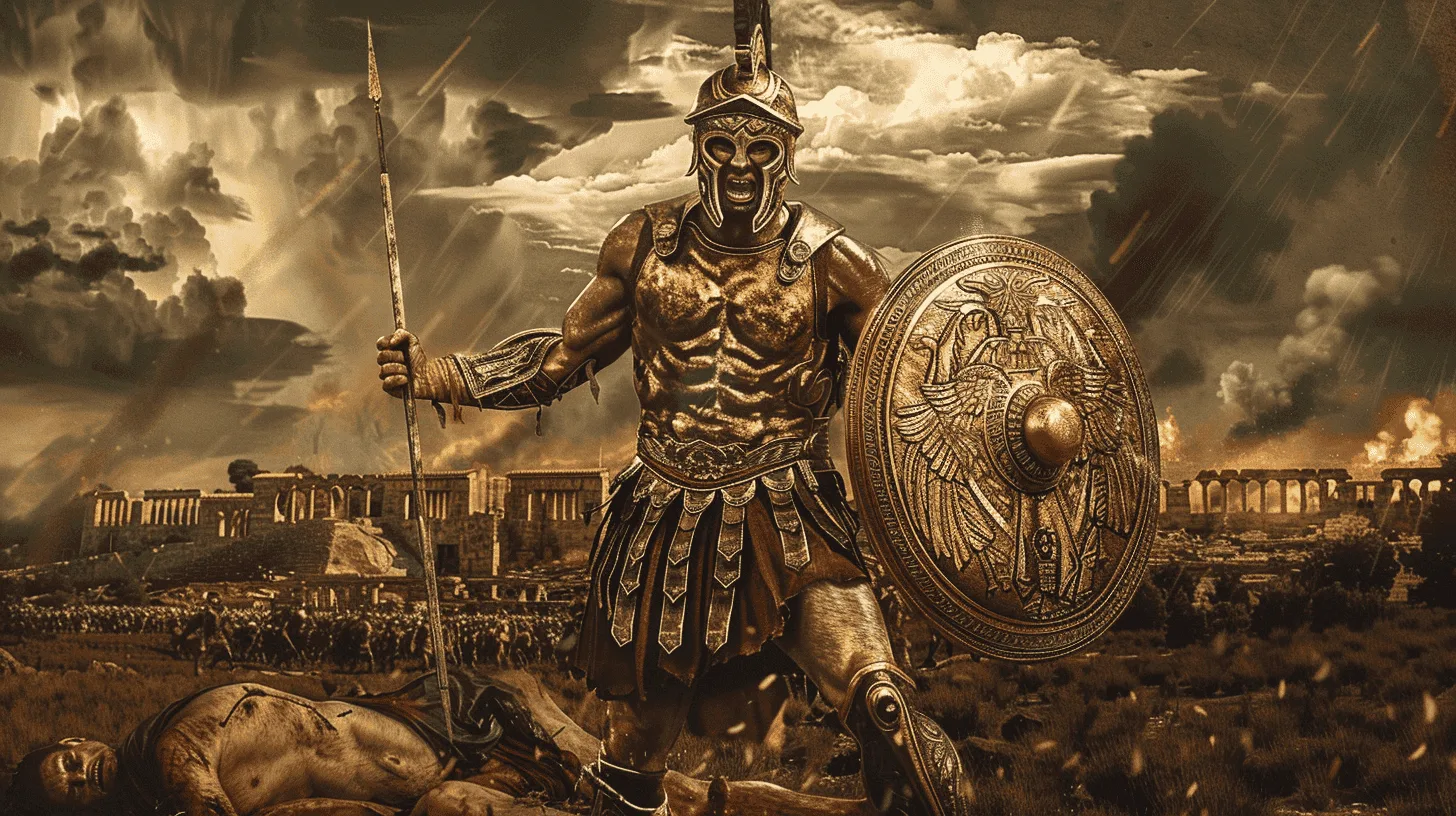
Books 20–22 describe Achilles' return to battle, where he fights with superhuman fury. His aristeia (finest hour) is unlike any other in the poem: he kills so many Trojans that the Scamander River becomes clogged with corpses; the river god himself attacks Achilles, angry at the pollution. Multiple gods intervene—some to protect him, others to stop him from slaughtering every Trojan. Homer describes Achilles in terms of forces of nature—raging fire, destructive storms, wild beasts. His humanity seems stripped away, leaving only destructive force.
He captures twelve young Trojan nobles alive, intending to sacrifice them on Patroclus' funeral pyre—an act of ritualized murder that would have shocked Homer's audience as going beyond acceptable warfare.
Achilles has become what he hated: a force of indiscriminate destruction, no longer distinguishable from the war itself. The gods who usually uphold order are themselves divided, with Apollo and others trying to restrain him while Athena and Hera urge him on. The cosmic disruption mirrors the psychological: Achilles has broken through all human limits, and the universe cannot contain him without intervention.
The Duel with Hector (Book 22)
The rampage drives all Trojans back inside their city walls—except Hector, who stands outside alone, determined to face Achilles. Hector feels responsibility for the disaster—he ignored advice to retreat earlier, leading to heavy Trojan losses. His wife Andromache and father Priam beg him to come inside, making the scene emotionally devastating. When Achilles appears, Homer describes him in terrifying terms—blazing like the sun, wearing divine armor, unstoppable as death. Hector runs—not from cowardice, but because he is simply human facing something beyond human.
He and Achilles circle Troy's walls three times before Athena tricks Hector into standing and fighting. The duel is brief—Achilles kills Hector.
Hector's dying words ask Achilles to return his body to Priam for proper burial. Achilles refuses with shocking brutality—he wishes he could eat Hector's flesh raw and promises to feed the corpse to dogs. He drags Hector's body behind his chariot back to the Greek camp. This desecration horrified Homer's audience—proper burial rites mattered immensely in Greek culture, and denying them to enemies was considered going too far even in war.
Desecration and Excess
At Patroclus' funeral, Achilles sacrifices the twelve Trojan captives on the pyre. The poem's language makes clear this is excessive, a violation of proper conduct. For days afterward, Achilles continues dragging Hector's body around Patroclus' tomb, unable to find satisfaction. Apollo protects the corpse from corruption, but Achilles' behavior disturbs even the gods. This excessive vengeance reveals something crucial: killing Hector does not ease Achilles' grief or guilt.
Revenge does not bring Patroclus back or undo Achilles' role in his death. The rage driving him persists because its real target—his own failure—cannot be destroyed through violence.
This is the deepest tragedy of the poem: Achilles learns that revenge is hollow, but he has no other way to process his pain. He is trapped in a cycle of rage that offers no exit. The gods themselves must intervene to break the cycle—not because Achilles deserves mercy, but because the moral order demands that even the worst grief must find a limit.
The Resolution: Priam's Supplication
The Embassy of Priam (Book 24)
The gods, disturbed by Achilles' continued desecration of Hector's corpse, send Thetis to tell Achilles he must return the body. Apollo and other gods argue that Achilles' behavior exceeds even justified vengeance. Priam, King of Troy, makes the dangerous journey alone at night to the Greek camp, entering Achilles' tent with divine assistance.
The supplication scene is one of the most powerful moments in Western literature. Priam, an old king, kneels before his son's killer and begs for Hector's body. He reminds Achilles of his own father, Peleus, who will soon mourn Achilles the way Priam mourns Hector. "I have endured what no one on earth has ever done before—I put to my lips the hands of the man who killed my son" (Book 24). Achilles weeps—for Patroclus, for his own coming death, for his father who will lose him, for the shared human condition of mortality and grief.
He returns Hector's body and grants an eleven-day truce for funeral rites. The rage that drove the entire poem finally breaks in the face of shared grief and recognition of common humanity.
The Meaning of the Reconciliation
Why does Achilles relent? Shared mortality unites them both facing death. Divine command insists he return the body. Exhaustion sets in—revenge has not healed his grief. Priam's courage and dignity demonstrate a kind of heroic excellence Achilles can respect.
His mother's counsel reminds him that he too will need mercy, that excessive rage destroys the one who holds it. The scene does not undo the tragedy—Patroclus remains dead, Hector remains dead, Achilles will soon die, Troy will fall. But it offers a moment of grace: recognition that enemies are still human, that grief is universal, that mercy matters even in war.
Achilles regains his humanity here by recognizing the humanity of another. The poem ends not with triumph but with mourning, not with victory but with burial. The final scene—the funeral of Hector in Troy—shows the Trojans weeping, and the reader understands that grief is the only shared experience that connects all people. The rage of Achilles, which began with a personal insult, ends in a shared human understanding that transcends enmity.
Major Themes and Their Modern Resonance
The Nature and Cost of Rage
The Iliad is an exploration of anger—its causes, expressions, and consequences. Homer shows rage as understandable (Achilles' initial anger is justified), destructive (it harms the person who loves him), transformative (it changes who he is), and self-consuming (excessive rage perpetuates itself). For modern readers, the poem's exploration remains relevant: How do we respond to genuine injustice? When does justified anger become destructive? How do we find resolution when rage consumes us?
Honor, Glory, and the Meaning of Life
The heroic code values honor and glory above even life itself. Achilles famously faces a choice: a long, peaceful life without fame, or a short, glorious life dying young at Troy with eternal fame. He chooses the second—but the poem questions this value system. When Achilles tells the embassy he is leaving, he articulates doubts about whether glory justifies death. Later, Odysseus encounters Achilles' ghost in the underworld, and Achilles says he would rather be a living slave than a dead king—suggesting regret.
For modern readers, this resonates with questions about achievement versus relationships, public recognition versus private fulfillment.
Mortality and the Human Condition
Death hangs over the Iliad constantly—not as abstract concept but as imminent reality. The gods contrast with humans through immortality; they cannot die, so they cannot truly understand human existence. Mortality gives human choices weight. Because life is short, what we do matters. Homer treats mortality with dignity and tragedy—the poem's refrain ("so-and-so, whom his mother and father cherished") reminds readers that every corpse was someone's beloved child.
For modern readers, the poem's meditation on mortality remains powerful: How do we find meaning knowing we will die? What legacy matters?
Friendship, Love, and Human Connection
The relationship between Achilles and Patroclus provides the emotional anchor for the poem's second half. Patroclus' death devastates Achilles more than any dishonor from Agamemnon because it strikes at what actually matters—not abstract honor but the person he loves. Other relationships—Hector and Andromache, Priam and Hecuba—show how war destroys not just individuals but the connections between people. This emphasis on relationship as what truly matters contrasts with the poem's official value system of honor and glory, suggesting Homer recognized that human connection sustains us.
The Tragedy of War
While the Iliad contains thrilling battle scenes, it is fundamentally anti-war in overall perspective. Homer shows war as wasteful (brilliant young men die before living full lives), arbitrary (who lives and dies often depends on chance or divine whim), brutalizing (war strips away humanity), and universal in suffering (both Greeks and Trojans suffer; there are no purely good or evil sides). For modern readers familiar with war's reality, Homer's portrayal resonates: the gap between propaganda and reality, the permanent damage to survivors, the way war destroys everything regardless of who wins.
Literary and Historical Significance
Oral Tradition and Homer's Artistry
The Iliad emerged from centuries of oral poetic tradition before being written down in the eighth century BCE. Oral composition influenced structure: formulaic language ("swift-footed Achilles") helped poets memorize; type scenes (arming for battle) provided pattern; ring composition (mirrored repetition) created satisfying structure. Yet within these traditional forms, Homer achieves remarkable psychological depth and moral complexity. The characterization of Achilles—proud, angry, vulnerable, loving, vengeful, capable of mercy—demonstrates narrative art that rivals anything in later literature.
Influence on Western Literature
The Iliad's impact cannot be overstated. Virgil's Aeneid positions itself as Rome's answer to Homer. Classical Greek tragedy drew extensively on the Troy cycle. Medieval romance appropriated Trojan War material. Renaissance and modern literature continuously return to Homer—from James Joyce's Ulysses to countless novels and plays.
The archetype of the angry, flawed yet sympathetic hero that Achilles represents influences countless later characters, from Shakespeare's tragic heroes to modern antiheroes.
Archaeological and Historical Context
The Trojan War probably has some historical basis—a Bronze Age city called Troy (at Hissarlik in modern Turkey) was besieged and destroyed around 1200 BCE. Archaeological excavations have revealed the reality of Mycenaean Greek culture that forms the poem's setting. The material culture Homer describes reflects a real historical world, though mixed with later elements. The poem's power does not depend on whether events "really happened"—its psychological insights, moral complexity, and artistic achievement make it literature, not history, though it incorporates historical memories.
Reading the Iliad Today
Accessibility and Translation
Ancient Greek is difficult for most modern readers. Fortunately, excellent translations make the poem accessible:
- Robert Fagles (1990) balances accuracy with readability and poetic power.
- Richmond Lattimore (1951) is more literal, closer to the Greek structure.
- Robert Fitzgerald (1974) offers elegant verse translation.
- Caroline Alexander (2015) is direct and powerful with extensive notes.
Each translation makes interpretive choices; reading multiple translations reveals nuances. For those interested in the Greek itself, the Perseus Digital Library provides the original text with word-by-word parsing.
Why Read the Iliad in the 21st Century?
For modern readers, the Iliad offers: psychological insight that rivals modern literature; moral complexity without simple answers; beautiful language even in translation; cultural foundation for understanding Western literary tradition; timeless themes of anger, grief, mortality, meaning, honor, love; and a challenge to its own culture's values that remains urgent. Questions about whether glory justifies death, whether honor matters more than life, whether war achieves anything worth its cost—these are as relevant today as in ancient Greece.
Criticisms and Limitations
The Iliad is not perfect. Women are largely prizes, victims, or mourners with limited agency—feminist readings critique this marginalization. Battle scenes can be repetitive and graphically brutal. The honor culture and casual acceptance of slavery require understanding a value system very different from modern Western values. The poem is long (15,693 lines), and some sections can feel tedious.
The constant divine intervention can feel arbitrary. These limitations do not negate the poem's value, but readers should approach it critically, understanding that ancient literature reflects ancient values and contexts.
Conclusion: The Enduring Power of Achilles' Rage
The Iliad begins with rage and ends with mercy. Achilles starts as the Greeks' greatest warrior, consumed by wounded pride over a dishonored gift. He ends as a man who has lost everything that mattered, facing his own approaching death, capable of recognizing shared humanity even in his enemy. The journey between these points explores how justified anger can become self-destructive, how the pursuit of glory can blind us to what actually gives life meaning, how grief transforms us more profoundly than pride, how violence perpetuates itself but cannot ultimately satisfy, and how mercy and recognition of shared humanity offer the only real resolution to rage.
Achilles is one of literature's most complex characters—neither hero nor villain but something more human: capable of greatness and pettiness, love and hatred, courage and cowardice, brutality and mercy. His flaws make him relatable; his excellence makes him aspirational; his tragedy makes him unforgettable. Homer offers no simple moral lessons—instead, he presents the full complexity of human existence: the competing values, impossible choices, and inevitable tragedies that define life.
Two thousand eight hundred years after its composition, the Iliad remains relevant because these fundamental human experiences have not changed. Achilles' rage—its origins in wounded pride, its transformation through grief, its resolution in mercy—maps a journey that remains psychologically authentic and emotionally powerful. Reading the Iliad means encountering yourself in the characters—recognizing your own capacity for rage, your own quest for meaning, your own fears of death, your own deep loves, your own ability to show mercy. It is a poem about war, but ultimately it is a poem about what it means to be human, mortal, and seeking significance in a world where death is certain and meaning must be made, not given.
Additional Resources
For deeper engagement, consider these resources:
- The Center for Hellenic Studies offers freely accessible scholarly resources, including discussions of Homeric poetry and Greek culture.
- The Perseus Digital Library provides the original Greek text and multiple translations with vocabulary tools and commentary.
- Scholarly articles on Achilles' rage—such as those found in JSTOR by keywords "Achilles rage Iliad"—offer deeper analysis of the poem's psychological and ethical dimensions.
- A useful companion for first-time readers is Britannica's entry on the Iliad, which provides concise historical and literary context.
- For a modern perspective on the poem's themes, consider reading The War That Killed Achilles by Caroline Alexander, which examines the poem's anti-war stance through its narrative structure.