Table of Contents
Introduction: The Timeless Strategy of Miyamoto Musashi
You are holding one of history's most influential strategy texts, written by a man never defeated in over sixty duels. The Book of Five Rings is not another martial arts manual collecting dust on a shelf—it is a profound guide to decision-making and personal mastery that has shaped samurai warriors and modern business leaders alike.
But let's be honest: Miyamoto Musashi's 17th-century classic can feel impenetrable on first reading. The language is terse, the concepts abstract, and you may wonder what ancient sword-fighting techniques have to do with 21st-century life. How do lessons about two-sword combat translate to boardrooms, sports fields, creative studios, or personal development journeys?
The answer is simpler than you think. Musashi was not really writing about swords—he was writing about universal principles of strategy, adaptability, and mastery that apply to any competitive or challenging endeavor. Whether you are navigating corporate politics, pursuing athletic excellence, building a business, or simply trying to live more intentionally, his insights offer timeless wisdom that has only grown more relevant with time.
This comprehensive study guide will help you understand not only what Musashi wrote, but why it matters and how to apply his principles to modern life. We will explore the historical context that shaped his thinking, break down each of the five scrolls in detail, examine practical applications far beyond martial arts, and provide actionable frameworks for implementing his strategies in your own pursuits. By the end, you will have a working knowledge of one of humanity's great works on strategy—and a path for walking the Way yourself.
Who Was Miyamoto Musashi? The Man Behind the Legend
Before diving into the book itself, understanding Musashi's extraordinary life provides essential context for his teachings. This was not a philosopher theorizing from a comfortable study—this was a warrior who tested every principle in life-or-death situations. His biography reads like a legend, yet every detail is grounded in historical record.
Early Life and the Making of a Warrior
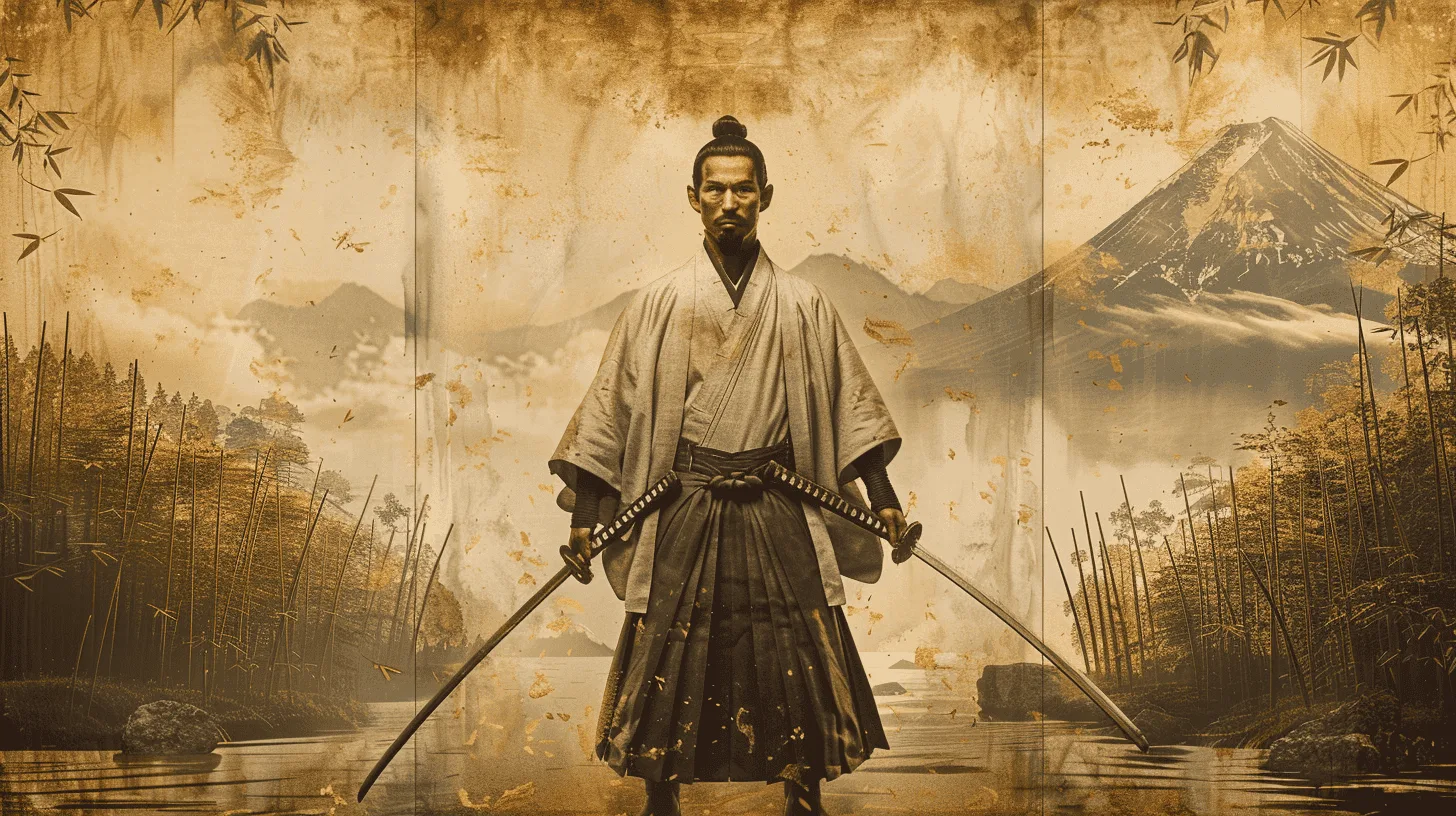
Miyamoto Musashi was born around 1584 in Harima Province (modern-day Hyōgo Prefecture), Japan, during one of the most turbulent periods in Japanese history. His given name was Shinmen Takezō, and his early life was marked by violence, upheaval, and the constant presence of death that defined the Warring States period.
Formative experiences that shaped his philosophy:
- First duel at age 13: Musashi killed his first opponent, Arima Kihei, a trained swordsman, when he was just 13 years old. The fact that he survived this encounter as a boy against an adult warrior shaped his confidence and approach to combat for the rest of his life. This early victory taught him that technique and tradition matter less than will and adaptability.
- Participation in the Battle of Sekigahara (1600): As a teenager, Musashi fought in this decisive battle that effectively ended the Warring States period and established the Tokugawa shogunate. His side lost, forcing him to flee and live as a rōnin (masterless samurai). This experience of defeat and survival taught him lessons about timing, alliance, and the unpredictability of conflict that he would later codify in his writing.
- Years of wandering (musha shugyō): He spent much of his early adulthood traveling throughout Japan, challenging other swordsmen as part of the warrior tradition of testing oneself through combat. This period was the crucible in which his philosophy was forged—each duel refined his understanding and eliminated what did not work.
- Development of two-sword technique: Musashi developed his distinctive Niten Ichi-ryū style, involving both a long sword (katana) and short sword (wakizashi) used simultaneously. This unconventional approach gave him tactical advantages that opponents trained in single-sword schools could not easily counter, embodying his principle of using whatever gives you an edge.
The Undefeated Record: Over 60 Duels
What sets Musashi apart is his documented record: over 60 duels fought, zero defeats. These were not practice matches or controlled sparring sessions—they were fights to the death with sharpened blades. No other historical figure in the martial tradition comes close to this record with such reliable documentation.
Notable duels that defined his legacy:
- Versus Sasaki Kojirō (1612): Perhaps his most famous duel, fought on Ganryu Island. Kojirō was considered one of Japan's greatest swordsmen, known for his "swallow cut" technique and an unusually long sword. Musashi arrived late to the duel (likely to irritate his opponent and disrupt his rhythm), used a wooden sword carved from an oar, and killed Kojirō with a single strike. The unorthodox weapon choice and psychological tactics exemplified his core approach: use every advantage available, follow no rigid form, adapt perfectly to circumstances.
- Versus the Yoshioka School: In Kyoto, Musashi fought members of the Yoshioka family in a series of duels that culminated in him defeating the family heir and dozens of retainers in a single encounter. This demonstrated not just technical skill but strategic thinking about positioning, timing, and psychological warfare.
- Multiple duels in his teens and twenties: He fought countless opponents during his warrior pilgrimage, refining his techniques through practical experience rather than formal instruction. Each victory added to his understanding of what worked under real pressure.
Why this record matters for the book: Every principle in The Book of Five Rings was tested in situations where failure meant death. This is not abstract theory—it is empirically validated strategy from someone who survived the ultimate pressure test dozens of times. When Musashi says to maintain a certain stance or strike at a particular moment, he is speaking from direct experience, not speculation.
Later Life: From Warrior to Sage
Around age 50, Musashi largely retired from dueling and turned to other pursuits, revealing a Renaissance-man breadth that surprises many who think of him only as a swordsman.
- Painting: He became an accomplished ink painter, with works still displayed in Japanese museums today. His paintings show the same principles as swordsmanship—economy of movement, essential simplicity, decisive action. Each brushstroke is deliberate and cannot be undone, much like a sword cut.
- Calligraphy: His brushwork was considered masterful, applying the discipline and focus developed through martial training to the art of writing. The connection between the sword and the brush is a recurring theme in Japanese aesthetics.
- Sculpture: Musashi carved Buddhist sculptures and worked with various crafts, further demonstrating that mastery in one domain can transfer to others when the underlying principles are understood.
- Teaching: He took students and served as advisor to powerful lords, sharing his strategic insights beyond combat. His students were expected to internalize his teachings through practice, not just intellectual understanding.
Writing The Book of Five Rings (1643–1645): In 1643, at approximately age 60, Musashi retreated to Reigando Cave in Kumamoto to write his masterwork. He died in 1645, shortly after completing it, wanting to distill decades of experience into a guide for future generations. The book was written as instruction to his students, particularly Terao Magonojō, during the peaceful Tokugawa period when major battles were over and the samurai class needed to redefine its purpose.
Historical Context: The Samurai Era That Shaped Musashi
Understanding the world Musashi inhabited is crucial for grasping why his principles developed as they did and why they remain relevant today.
The Warring States Period (Sengoku Jidai, 1467–1615) created an environment where martial skill was not sport—it was survival. Japan was fractured into competing domains, alliances shifted constantly, and innovation in tactics and weapons was rewarded while tradition for its own sake could be fatal. Social mobility was possible through military achievement, and the threat of death was a constant companion. This environment produced a pragmatic, results-oriented approach to combat that Musashi embodied perfectly.
Bushido—The Way of the Warrior: The samurai followed a code of conduct called Bushido, though it was less formalized in Musashi's time than it became later. Core principles include loyalty (chūgi), honor (meiyo), courage (yūki), respect (rei), honesty (makoto), and self-discipline (jisei). These principles permeate The Book of Five Rings, though Musashi emphasizes practical effectiveness over ceremonial propriety. He was interested in what worked, not what looked proper.
The transition to peace: By the time Musashi wrote his book, the Tokugawa shogunate had established a stable peace that would last over 250 years. He was writing for a generation that would fight fewer real battles but still needed to understand strategy—which partially explains why his principles translate so well beyond combat. He was already thinking about strategy as a universal discipline, not just a military one.
Overview: The Structure of The Book of Five Rings
Musashi organized his book around five elements from Buddhist and Taoist philosophy: Earth, Water, Fire, Wind, and Void (or Sky). Each element represents a different aspect of strategy, building from concrete fundamentals (Earth) through practical application (Water, Fire) to comparative analysis (Wind) and ultimately transcendent mastery (Void).
The five scrolls form a progressive curriculum that takes the reader from beginner to master:
- Earth: "Here is what you need to know to start your journey"
- Water: "Here is how to adapt these principles fluidly in any situation"
- Fire: "Here is how to apply them in the heat of actual combat and high-pressure situations"
- Wind: "Here is how others do it and why my approach differs"
- Void: "Here is what lies beyond technique and conscious thought"
Musashi explicitly states the book is for serious students willing to commit years to mastery. Understanding comes through dedicated practice, not passive reading. This is not a book you read once and absorb—it is a text you study, practice, and return to repeatedly as your own understanding deepens.
The Earth Scroll: Foundation of Strategy
The Earth Scroll establishes fundamental principles. Like earth itself, these are solid, unchanging truths about strategy that form the basis for everything that follows. Without this foundation, all advanced techniques are built on sand.
Core Concepts
Strategy as a Way of Life: Musashi declares that strategy (hyōhō) is not just about fighting—it is a comprehensive approach to living. "The Way of strategy is the Way of nature." Success in combat, business, art, or any endeavor follows the same natural principles of timing, positioning, and adaptation. This is perhaps the most important insight for modern readers: strategy is not a set of techniques but a way of thinking that applies to everything.
The Carpenter Metaphor: Musashi uses carpentry to explain strategy in a way that would resonate with his contemporaries. Both require selecting the right tools, understanding materials, planning before acting, balancing individual skill with organizing others, and years of dedicated practice. A master carpenter does not hammer away randomly—he assesses the wood, plans the structure, and executes with practiced skill. Strategy requires the same thoughtful approach. The choice of carpentry is deliberate: it is a practical, humble craft that everyone understands, making the principles accessible.
Practical Principles for Daily Life
- Know the Way in all things: Study widely—not just swordsmanship but architecture, carpentry, commerce, art, and philosophy. Broad knowledge reveals universal principles that apply across domains. The more you understand about different fields, the better your strategic thinking becomes in your primary field.
- Develop the right tools and know how to use them: Large sword for open spaces, short sword for close quarters, both together when circumstances demand. Having tools is not enough—you must master their use through deliberate practice until they become extensions of your body.
- Timing is everything (hyōshi): Every action has a rhythm and timing. Strategy means understanding and controlling it—the rhythm of your own actions, your opponent's actions, and the overall situation. Musashi considered timing so fundamental that he returns to it in every scroll.
- Direct your gaze broadly and see distantly: Your eyes should see broadly (peripheral awareness) while your mind sees distantly (strategic implications). Observe immediate details, but simultaneously perceive the deeper strategic meaning of what you observe.
- Master the basics through constant practice: Daily, consistent practice of fundamentals matters more than collecting advanced techniques. Practice until techniques become unconscious and automatic, freeing your conscious mind for higher-level strategic thinking.
Ultimate lesson: The foundation of all strategy is understanding basic principles thoroughly before adding complexity. Most failures come from weak fundamentals, not lack of advanced techniques. Build your foundation before building your house.
The Water Scroll: Fluidity and Adaptation
If Earth establishes foundations, Water teaches flexibility. Water adapts to any container, flows around obstacles, yet possesses tremendous power over time. This scroll is where Musashi's philosophy becomes truly distinctive and where his insights become most applicable to modern life.
The Metaphor of Water in Depth
- Adaptability: Water takes the shape of any container. Your strategy should adapt to circumstances rather than forcing one approach onto every situation. What works in one context may fail in another.
- Flow: Water does not fight obstacles—it flows around them. Do not meet force with force when flexibility serves better. There is no virtue in confrontation when a path around the problem exists.
- Power: Water seems gentle and yielding but can carve canyons over time and sink ships in an instant. Flexible strategy accumulates tremendous force through persistence and timing.
- Naturalness: Water flows along the path of least resistance naturally, without strain or effort. Mastered technique should feel the same way—natural, not forced or mechanical.
- Clarity: Still water reflects perfectly without distortion. A clear mind perceives reality accurately without being colored by preconceptions or emotions.
Core Principles for Fluid Strategy
- Adopt a flexible stance (kamae): Your position should be naturally balanced and ready to move in any direction. Do not become attached to any one stance—they are positions you pass through, not places you lock into. Ultimate mastery means you are in all stances and no stance simultaneously, ready to respond to whatever comes.
- Develop powerful yet controlled execution: Power flows from the whole body—legs through hips through torso through arms—not just from isolated muscles. Economy of motion means no wasted movement. Decisive commitment means half-hearted actions fail—when you act, act fully.
- Master multiple approaches: Different situations require different approaches. Develop diverse capabilities and the wisdom to know which to apply when. A single tool, no matter how well mastered, will not solve every problem.
- Maintain proper distance (ma-ai): Close enough to strike, far enough to defend. Control distance to control the engagement—physically, temporally, psychologically, and strategically. In modern terms, this means understanding the boundaries and dynamics of any competitive situation.
- Perceive rhythm and disrupt it: Recognize patterns in how opponents act, match their rhythm to understand them, then break it while maintaining your own. "The important thing in strategy is to suppress the enemy's useful actions but allow his useless actions." This is as true in negotiation and competition as it is in combat.
- The spirit of no-design (munen musō): Act without preconceived notions. Respond to reality as it is, not as you think it should be. Fixed plans become liabilities when circumstances differ from expectations.
Ultimate lesson: True mastery is fluid adaptation, not rigid technique. Practice techniques until they are deeply internalized, then transcend them, responding naturally to circumstances without conscious thought interfering with action.
The Fire Scroll: The Heat of Battle
Fire represents the energy, chaos, and pressure of actual combat. If Water teaches technique, Fire teaches application under real pressure—where theory meets reality and everything you have practiced is put to the test. This is the scroll for high-stakes situations.
Core Principles for High-Pressure Performance
- Assess the situation rapidly: Before engaging, assess the space, opponent, and circumstances. This assessment must happen almost instantly—there is no time for lengthy analysis. Trained warriors see and understand in moments what beginners miss entirely because their practice has trained their perception.
- Seize and maintain initiative (sen wo toru): Take the lead and keep it. Make opponents react to you rather than you reacting to them. There are three types of initiative: anticipating intentions and striking preemptively (sen-sen-no-sen), countering at the moment of attack (sen-no-sen), and allowing the attack to develop then countering perfectly (tai-no-sen). The common thread across all three: you control the flow of engagement, not your opponent.
- Crush the enemy's spirit: Before physical victory comes psychological defeat. Demonstrate superiority, disrupt rhythm, be relentless, use unexpected tactics. In modern competitive contexts, demonstrating clear superiority often leads opponents to concede without prolonged conflict. Psychological dominance precedes practical victory.
- Strike when you perceive advantage: Attack decisively when you have genuine advantage—when the opponent is distracted, unbalanced, or when environmental factors favor you. Do not attack randomly or out of frustration. Wait for the opening, then commit fully.
- Fight on multiple levels simultaneously: Attack physically, psychologically, strategically, and environmentally. Opponents cannot defend everything at once. In business, this means competing on product, price, service, brand, and distribution simultaneously.
"Becoming the Enemy": One of Musashi's most sophisticated ideas—to defeat an enemy, you must think as they think, see as they see, understand their perspective completely. Study opponents before and during engagement; intuit their intentions by observing small cues; understand their strengths, weaknesses, and patterns. This practice leads to the ability to predict what they will do before they know themselves.
Ultimate lesson: When pressure intensifies and chaos erupts, mastery reveals itself. All training aims toward performing optimally when stakes are highest. Those who have trained deeply respond fluidly; those with shallow preparation collapse. You do not rise to the occasion—you fall to the level of your training.
The Wind Scroll: Understanding Other Schools
Wind represents movement, perspective, and critical thinking. This scroll examines other martial arts schools and why Musashi believes his way is superior—but the deeper purpose is developing the ability to think critically about any system or approach. This is the scroll for learning how to learn.
Musashi's Critiques and Their Modern Relevance
- Overemphasis on specific techniques: Rigid memorization creates inflexibility. Master fundamental principles that adapt naturally to any situation. In modern terms, learn principles, not procedures.
- Obsession with specific weapons: Attachment to specific tools creates dependency. Train with various weapons and use whatever circumstances provide. In business, do not become dependent on a single tool, platform, or approach.
- Fixation on visual style over substance: What looks good in demonstration often fails in real combat. Favor practical effectiveness over aesthetic appeal. Results matter more than appearance.
- Excessive complexity: Simple, direct approaches are usually most effective. Complexity creates more failure points and slows execution. The best strategy is often the simplest one that works.
- Teaching without combat experience: Theoretical knowledge without practical testing produces misunderstanding. Test everything through actual application. Do not trust advice from people who have not done what they teach.
- Overreliance on speed or strength: These are temporary advantages that fade with age. Strategy and skill last a lifetime. Develop capabilities that improve with experience, not decline with age.
Deeper lesson: Do not accept any teaching (including Musashi's) without critical evaluation. Test ideas against reality. Question assumptions. Think independently. The goal is not to follow a master but to become one yourself through your own understanding.
The Void Scroll: The Way of Emptiness
The Void (or Sky/Emptiness) Scroll is the shortest and most enigmatic of the five. It addresses what lies beyond technique—intuition, spontaneity, and mastery that transcends conscious thought. This is the scroll that separates competent practitioners from true masters.
Understanding "Void" (Kū)
"Emptiness" in Eastern philosophy does not mean nothingness or absence. It means freedom from fixed form—pure potential and unlimited possibility. It represents freedom from attachment to any particular approach, pure awareness of reality as it is, spontaneous response without hesitation, integration of all teachings into natural action, and transcendence of conscious technique.
Core Concepts for Transcendent Mastery
- The spirit of no-form: Ultimate mastery means not being locked into any particular form. You are all forms and no form simultaneously—pure adaptability that responds perfectly to each unique situation. This only comes after mastering forms thoroughly, not by skipping to formlessness prematurely.
- Knowing without thinking (munen musō): At the highest level, you do not consciously think about what to do—you simply know and act. This results from deep practice where knowledge becomes intuitive, like master musicians who do not think about individual notes but express the music directly. The thinking happens in practice; in performance, there is only action.
- The Way that is no-Way: True mastery means following no rigid path yet perfectly embodying "the Way." Internalize principles so deeply that you act with perfect appropriateness in each situation, following no rules yet never being wrong. This is the paradox at the heart of all mastery.
Ultimate lesson: The highest mastery looks like simplicity because it involves no wasted motion, no unnecessary technique—just pure, direct, natural effectiveness. The Void clarifies that techniques are tools to transcend, not ends in themselves. The goal is not to know many techniques but to need none.
Applying Musashi's Principles Beyond Combat
Business and Leadership Strategy
- Foundation first: Ensure business fundamentals are solid—product quality, financial health, team capability—before pursuing aggressive growth strategies. Weak foundations collapse under pressure.
- Seize initiative: Proactive companies shape markets rather than merely responding to them. Innovation beats imitation. First movers often define the competitive landscape.
- Study competitors deeply: Analyze their strategies, strengths, and weaknesses. Learn from their successes and failures. Understand their thinking well enough to predict their moves.
- Attack on multiple fronts: Compete on product, price, distribution, customer experience, and brand simultaneously. Force competitors to divide their attention and resources.
- Adaptive execution: Business environments change constantly. Adapt strategy to circumstances rather than rigidly following plans. When the map does not match the territory, follow the territory.
- Intuitive decision-making: Experienced leaders develop intuition based on deep pattern recognition from years of practice. Research supports that deliberate practice builds this kind of expert intuition.
Sports and Athletic Performance
- Master basics obsessively: Elite athletes obsessively practice fundamental skills—LeBron James still practices basic shooting form. Fundamentals are not beneath you; they are the foundation of everything.
- Read and react: Great athletes read defenses, anticipate movements, and adapt in real time. They do not run predetermined patterns regardless of circumstances.
- Flow state: The "zone" athletes experience mirrors Musashi's concept of natural, unconscious technique. It comes from deep practice, not from trying harder.
- Mental toughness: Maintain composure under pressure. Train so that response becomes automatic regardless of circumstances. Panic is the enemy of performance.
- Study opponents extensively: Elite teams extensively study opponents' tendencies and weaknesses. They do not prepare in general; they prepare specifically for who they face.
Personal Development and Self-Mastery
- Identify your core principles: What are the fundamentals of living well—health, relationships, purpose, continuous learning? Define these clearly before pursuing specific goals.
- Daily practice over occasional intensity: Personal development requires consistent practice, not occasional bursts of enthusiasm. Small daily actions compound into dramatic results over time.
- Flexible mindset: Approach life with adaptability rather than rigid expectations. Attachments to specific outcomes create suffering and blind you to better paths.
- Seize initiative in your life: Proactively address problems rather than waiting for them to worsen. The best time to solve a problem is before it becomes a crisis.
- Question assumptions constantly: Think independently. Do not accept conventional wisdom uncritically. Much of what "everyone knows" is wrong, and the rest is incomplete.
- Transcend techniques and systems: Personal development systems are tools, not ends. The goal is to live naturally and effectively without needing to rely on external frameworks.
Translations, Editions, and Further Study
Choosing the right translation matters more for this book than for most classics. The terse, poetic quality of Musashi's original Japanese presents significant challenges for translators, and different translations emphasize different aspects of the text. Several excellent translations exist, each with distinct strengths:
- William Scott Wilson (1998 and 2012): Balances accuracy with readability while including extensive commentary and historical context. This is the best choice for serious students who want depth.
- Thomas Cleary (2005): Emphasizes accessibility and philosophical clarity. Best for readers who want a straightforward translation they can read in a sitting.
- Victor Harris (1974): Historically significant as the first widely available English translation, though the language may feel dated to modern readers.
Companion texts that complement Musashi's teachings:
- Musashi's Dokkōdō (The Way of Walking Alone) — a short, twenty-one-article code of personal discipline written shortly before his death
- Hagakure by Yamamoto Tsunetomo — a classic text on samurai philosophy and the warrior's code
- The Unfettered Mind by Takuan Sōhō — a Zen monk's teachings on the relationship between martial arts and enlightenment
- Sun Tzu's The Art of War — the foundational text of strategic thought from ancient China
- Marcus Aurelius's Meditations — a Stoic emperor's personal reflections on discipline, duty, and mastery of self
Conclusion: Understanding the Book of Five Rings by Musashi
Over 350 years after Musashi wrote The Book of Five Rings in a cave overlooking the sea, his teachings remain powerfully relevant. He articulated universal principles about strategy, adaptation, and mastery that transcend any specific context—principles that work whether you are fighting with swords, competing in business, pursuing athletic excellence, or simply trying to live an intentional life.
Musashi's principles were empirically tested in life-or-death situations, giving them an unusual credibility that abstract philosophy cannot match. His emphasis on adaptability over rigid technique is particularly relevant in our rapidly changing world, where the ability to pivot and adapt often matters more than deep expertise in a single approach. He reminds us that true mastery requires years of dedicated, deliberate practice—there are no shortcuts to genuine capability. And he points toward something beyond mere technical proficiency: a state where action becomes natural, intuitive, and effortless, where the practitioner and the practice become one.
Your path forward:
- Commit to the Way—practice these principles seriously, do not just read about them. Reading without practice yields knowledge without capability.
- Start with fundamentals. Build your foundation before adding complexity.
- Practice daily. Consistency matters more than intensity.
- Test everything. Do not accept any teaching uncritically, including Musashi's.
- Study broadly. Universal principles reveal themselves across domains.
- Maintain flexibility. Adapt to circumstances rather than forcing them.
- Embrace the journey. Mastery is a lifelong path, not a destination.
- Find your own way. Musashi's principles are guides, not rules. Internalize them deeply, then transcend them to develop your unique approach.
The Book of Five Rings is not a historical curiosity or a martial arts manual for specialists. It is a guide to strategic excellence as relevant today as when it was written—perhaps more so, given the complexity and pace of modern life. The question is not whether the book has value, but whether you will do the work required to extract that value. Will you merely read about the Way, or will you walk it?