Table of Contents
Introduction: The Sauk War Leader Who Defied an Empire
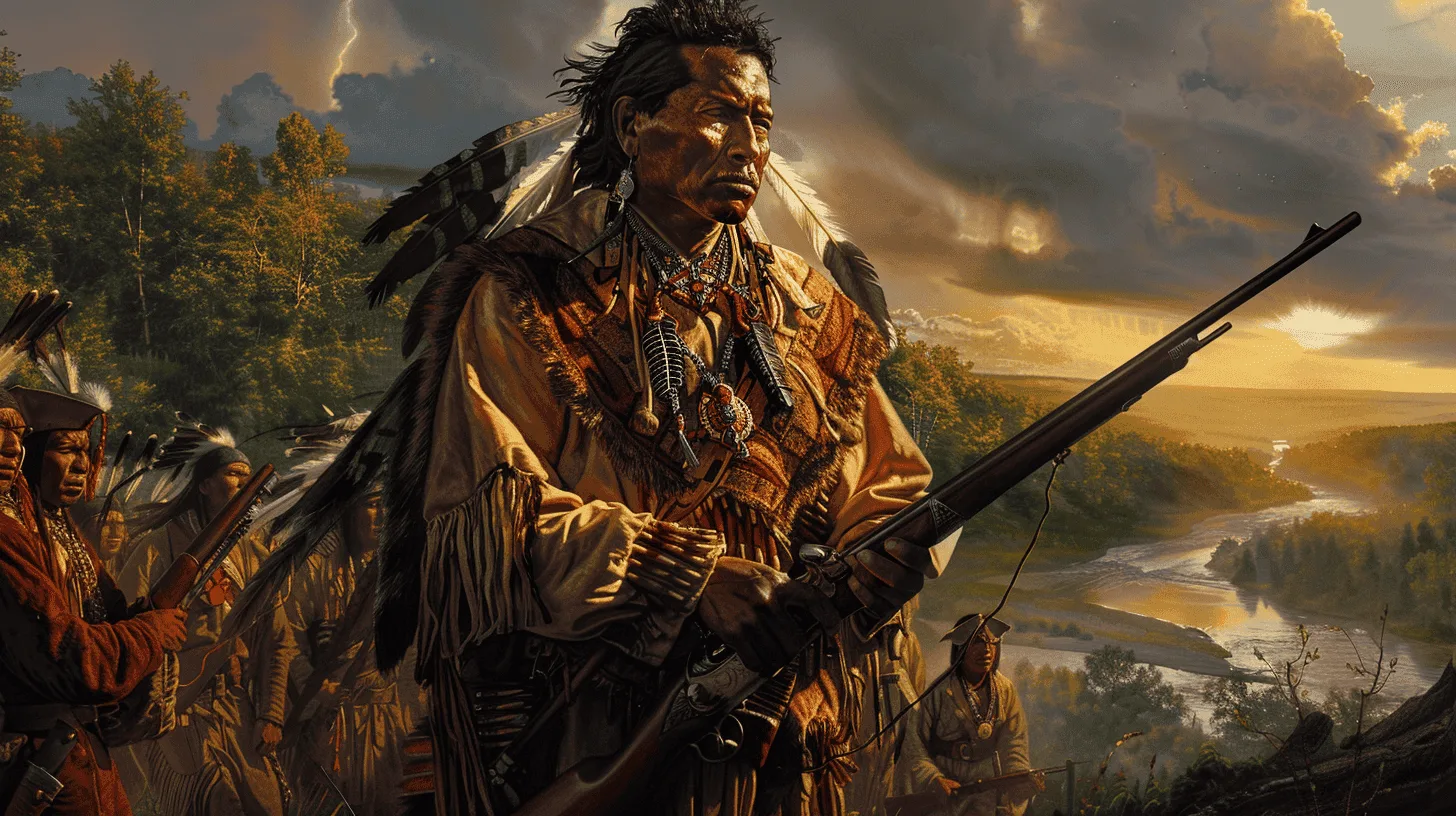
Black Hawk (Makataimeshekiakiak, “Black Sparrow Hawk” in Sauk) was not a hereditary chief but a war leader whose fierce defense of Sauk lands made him one of the most powerful symbols of Native American resistance in the 19th century. Born in 1767 at Saukenuk—a sprawling village at the confluence of the Rock and Mississippi Rivers in present-day Illinois—he spent his life fighting to protect his people from the relentless tide of American westward expansion.
Black Hawk is best known for leading the Black Hawk War of 1832, a fifteen-week conflict that ended in catastrophic defeat for his people but forever etched his name into the history of indigenous resistance. Though the war was brief and the defeat devastating, Black Hawk’s eloquent autobiography, published after his capture, preserved his voice and perspective for future generations. His story is a window into the broader tragedy of Native American dispossession—a process driven by fraudulent treaties, military force, and the unbreakable determination of settlers who saw indigenous lands as their own.
This expanded guide covers Black Hawk’s early life, the fraudulent 1804 Treaty of St. Louis, the collapse of diplomacy, the brutal war, his post-war captivity, and his complex legacy that continues to shape how we remember the American frontier.
The World of the Sauk: Black Hawk’s People and Homeland
Who Were the Sauk and Fox?
The Sauk (Sac) and Meskwaki (Fox) were Algonquian-speaking peoples who had long occupied the Great Lakes and Upper Mississippi regions. By the 1700s they were so closely allied that American officials often called them simply “Sac and Fox.” The Sauk lived a seasonal, semi-nomadic life: they raised corn, beans, and squash in large river-valley villages during the warmer months, then dispersed into smaller hunting camps in winter to pursue deer, elk, and bison. This cycle required vast territories—fields for farming, forests for game, and rivers for fish.
Saukenuk, Black Hawk’s birthplace, was the heart of Sauk life. At its peak it held 4,000–6,000 residents in more than a hundred lodges. Cornfields stretched for miles, and burial grounds held generations of Sauk ancestors. The village sat at a strategic river junction, a hub of trade and diplomacy. For Black Hawk, Saukenuk was not just a home; it was the physical and spiritual foundation of his people.
The village’s location also gave the Sauk access to trade networks linking French, British, and later American posts, making it a center of cultural exchange as well as conflict.
Becoming a Warrior and Medicine Man
Black Hawk’s father, Pyesa, was a respected medicine man and warrior. Following tradition, young Black Hawk was trained in the arts of war and survival: bow, tomahawk, and later firearms, along with tracking, forest craft, and the tactics of ambush and retreat. He killed his first enemy at age 15, earning the right to paint his face and wear eagle feathers signifying warrior status. By his early twenties he had fought in campaigns against the Osage and other rival tribes, building a reputation for courage and leadership.
But Black Hawk was also a medicine man. He learned to heal, to interpret dreams, and to commune with the spirit world. This spiritual authority gave him influence far beyond mere military prowess. In Sauk society, a leader who combined martial skill with spiritual power could command respect across clan lines—a role Black Hawk would fill in the years to come. His dual training shaped his worldview: he saw resistance not just as a political act but as a sacred duty to protect the land given by the Great Spirit.
The British Alliance and the War of 1812
European rivalries shaped Black Hawk’s early worldview. British traders from Canada provided guns, ammunition, cloth, and metal tools in exchange for furs. This economic bond naturally drew the Sauk into alliance with the British. When the War of 1812 erupted between the United States and Great Britain, Black Hawk led Sauk warriors to fight alongside British forces. He participated in raids and battles along the Mississippi, proving his tactical skill and earning the respect of British commanders.
One notable engagement was the capture of Fort Madison in 1813, where Black Hawk’s warriors tested the young American fortifications.
The Treaty of Ghent (1814) ended the war but ignored Native American interests entirely. The British abandoned their indigenous allies; the Americans saw no reason to honor promises made by native peoples who had sided with the enemy. For Black Hawk, this betrayal was a bitter lesson: European powers would sacrifice indigenous partners for their own strategic advantage without hesitation. This experience fueled his later distrust of American treaties and promises.
The Treaty of St. Louis: The 1804 Fraud That Laid the Groundwork for War
The root cause of the Black Hawk War can be traced to a single document: the 1804 Treaty of St. Louis. In that treaty, a small delegation of Sauk and Fox leaders supposedly ceded all tribal lands east of the Mississippi River—roughly 50 million acres covering much of present-day Illinois, Wisconsin, and Missouri. The circumstances of the signing are deeply suspicious. Historical accounts indicate that the delegates were plied with alcohol, and that the men who signed lacked the authority to cede land. Treaty-making among the Sauk required consensus from the full council; a few intoxicated individuals could not bind the entire nation.
Furthermore, the compensation was laughably small: $1,000 worth of goods annually, plus vague promises of peace and protection.
Black Hawk and the vast majority of Sauk leaders rejected the treaty outright. They argued that it was fraudulent, that the signatories had no power to alienate tribal territory, and that the land remained theirs by right of occupation and inheritance. For three decades the Sauk continued to live on their ancestral lands, planting crops and burying their dead, despite American claims to ownership. This fundamental legal and moral disagreement simmered for years, but as American settlement pressed ever closer, it became explosive. The U.S. government consistently upheld the treaty as valid, ignoring Sauk protests and citing it as legal justification for removal.
Growing Tensions: Settlement, Leadership Rivalries, and the Road to War
American Invasions and Settler Encroachment
After the War of 1812, the floodgates of American settlement opened. Illinois became a state in 1818, and thousands of farmers, speculators, and adventurers poured into the region. Each spring, when Black Hawk’s band returned to Saukenuk from their winter hunt, they found more settlers on their land, more forests cleared, more game gone. Cornfields were plowed under, burial mounds desecrated. The Sauk could no longer sustain themselves on a shrinking homeland.
Violence flared sporadically—horses stolen, cabins burned, murders on both sides. American authorities, citing the 1804 treaty, demanded the Sauk evacuate to lands west of the Mississippi. Black Hawk refused, insisting that the treaty was a fraud and that he would defend his people’s right to their graves and fields.
Keokuk vs. Black Hawk: The Great Leadership Divide
The Sauk became politically divided. Keokuk, a civil chief, believed military resistance was suicidal. He counseled negotiation and relocation: the Sauk should accept payment for their eastern lands, move west, and preserve their people through adaptation. American authorities preferred him and recognized him as the principal chief, even though he lacked hereditary status. Black Hawk saw Keokuk’s path as betrayal.
He insisted that the 1804 treaty was invalid, that their ancestors’ graves must not be abandoned, and that surrender without a fight was dishonorable. “I looked upon them as a weak and cowardly set,” he later said, “who had listened to the white men.”
This rift deepened as the years passed. Black Hawk gathered a loyal following—the “British Band”—that shared his resolve to hold their homeland. But on the other side, Keokuk’s accommodationist approach won favor with U.S. Indian agents, who funneled supplies and recognition only to him. It was a classic strategy of divide and conquer, and it worked. The split weakened Sauk unity and left Black Hawk’s band isolated when war came.
Forced from Saukenuk, 1829–1831
In 1829 the U.S. government issued an ultimatum: all Sauk and Fox must leave their eastern lands by the spring of 1831. When Black Hawk’s band returned from winter hunting that year, they found settlers living in their lodges, their fields fenced, their burial grounds plowed. Outraged, Black Hawk appealed to local authorities, but no one listened. Facing a large militia force with artillery, he reluctantly agreed to cross the Mississippi—into what is now Iowa. But he made it clear this was a retreat, not a surrender.
He intended to return.
The winter of 1831–32 was harsh for the exiles. They were crowded onto insufficient reservation lands, with poor soil and limited game. Starvation loomed. Black Hawk began to plan his return. He sought alliances with other tribes and even sent emissaries to the British in Canada, hoping for arms and support.
These overtures would later be used by American authorities to paint him as a British agent, justifying a harsher response.
The 1832 Black Hawk War: Fifteen Weeks of Fire and Blood
The Decision to Cross Back: A Gamble on Allies
In April 1832, Black Hawk led his band—about 1,500 people, including roughly 600 warriors and 900 women, children, and elderly—back across the Mississippi into Illinois. He hoped to establish a village and plant crops while negotiating from a position of presence. He also believed he had promises of support from the Winnebago, Potawatomi, and even the British in Canada. A Winnebago prophet named Wabokieshiek (White Cloud) had assured him that spirits favored his cause. These hopes were illusory.
The British did not come, and other tribes stayed neutral or actively sided with the Americans. But Black Hawk could not know that yet.
American authorities interpreted the crossing as an act of war. The governor of Illinois, John Reynolds, mobilized the state militia. Regular army troops under General Henry Atkinson joined them. Black Hawk found himself suddenly facing a much larger force that had no interest in negotiation. The stage was set for a conflict that would be short, brutal, and one-sided.
Stillman’s Run: A Victory That Doomed the Band
The first clash came on May 14, 1832, at Stillman’s Run. Black Hawk sent a small peace delegation under a white flag, but nervous militia members opened fire, killing the delegates. In the melee that followed, Black Hawk’s warriors routed the entire militia force—killing several soldiers and sending the rest fleeing in panic. It was a tactical victory, but strategically it was a catastrophe. The war was now on in earnest, and the only possible outcome was the total destruction of Black Hawk’s band.
The militia’s panicked retreat spread alarm throughout the frontier, galvanizing public opinion in favor of a war of extermination. Illinois officials demanded federal action, and more troops were dispatched.
The Long Retreat: Wisconsin Heights and the Struggle for Survival
Realizing he could not win a pitched battle, Black Hawk began a desperate retreat north toward the Wisconsin River, hoping to cross the Mississippi and escape. His warriors waged a brilliant guerrilla campaign, ambushing pursuing columns, using rivers and forests to delay the American advance, and protecting the noncombatants who moved with them. The most notable engagement was the Battle of Wisconsin Heights on July 21, 1832. Black Hawk’s rearguard held off far superior numbers long enough for the women, children, and elderly to cross the Wisconsin River. It was a disciplined, effective action that saved many lives—but it could not change the outcome.
By this point the band was starving. They had been on the move for weeks, unable to hunt, with disease spreading among the exhausted, malnourished people. American forces, supported by allied Sioux and other tribes, hunted them relentlessly. The retreat turned into a running battle through swamps and forests, with the Sauk leaving a trail of dead and abandoned belongings.
The Massacre at Bad Axe: A Slaughter of the Defenseless
The war reached its horrific climax on August 1–2, 1832, at the Battle of Bad Axe on the Mississippi River. Black Hawk’s band finally reached the water and attempted to surrender or escape across it. Instead of mercy, they faced a massacre. American regulars and militiamen opened fire with rifles and artillery. The steamboat Warrior raked the crowd with a deck cannon.
Those who jumped into the river were shot as they swam. Sioux warriors on the far bank killed anyone who made it across. Estimates put the dead at 150–300, mostly women and children. American losses were fewer than ten. It was not a battle; it was a killing field.
Survivors were taken prisoner, but many later died from wounds or exposure.
Black Hawk himself slipped away in the chaos and was not captured until weeks later, but his world was destroyed. The war was over.
Aftermath: Captivity, Autobiography, and a New Kind of Fame
Imprisonment and the Eastern Tour
Captured in late August 1832, Black Hawk and other leaders were imprisoned at Jefferson Barracks in Missouri, then transported to Fortress Monroe in Virginia. Rather than executing him, President Andrew Jackson ordered a tour of Eastern cities to “show him the power of the United States.” Black Hawk visited Baltimore, Philadelphia, New York, and Washington. Instead of intimidation, he became a celebrity. Crowds lined the streets to see the famous “Indian warrior.”
Artists like George Catlin and Charles Bird King painted his portrait. Newspapers covered his every move.
This fascination reflected a deep ambivalence. Many Americans, especially in the East far from the frontier, romanticized Native Americans as “noble savages” while supporting policies that destroyed them. Black Hawk bore this curiosity with dignity, but his writings reveal a sharp awareness of the irony. He was treated as a living museum piece, a relic of a “vanishing” race, even as he spoke of the injustices done to his people.
“Life of Black Hawk”: The Autobiography That Shaped History
In 1833 Black Hawk dictated his life story to interpreter Antoine LeClaire and editor J.B. Patterson. Published as Life of Ma-ka-tai-me-she-kia-kiak, or Black Hawk, it is one of the earliest Native American autobiographies. In it, Black Hawk presents his version of events: the fraudulent treaty, the broken promises, the determination to defend his people. The book became a bestseller and went through multiple editions. It remains a primary source of enormous historical importance, though scholars caution that it was filtered through editors and shaped for a white audience.
Despite these limitations, it preserves Black Hawk’s voice and provides a counterpoint to American triumphalist narratives. The autobiography also includes vivid descriptions of Sauk culture, spirituality, and the emotional toll of loss.
Final Years and Death
After his release, Black Hawk was sent back to Iowa, where he lived under Keokuk’s authority—a deliberate humiliation. He spent his last years in obscurity, watching his people struggle to adapt to reservation life. He died on October 3, 1838, at about age 71. He was buried in traditional Sauk fashion on a sitting platform, but his grave was later vandalized, his skeleton stolen and displayed. It was eventually destroyed in a fire.
Even in death, he was not allowed the dignity of a final resting place. The theft of his remains was a final act of desecration, reflecting the deep disrespect American society held for Native peoples.
Legacy: From Enemy to Symbol
In the 19th century, Black Hawk was remembered as a noble but defeated warrior, a symbol of the “vanishing Indian.” His story was used to justify the triumph of civilization. In the 20th century, historians reevaluated the Black Hawk War as an example of forced removal and broken treaties. The American Indian Movement and other indigenous rights activists reclaimed Black Hawk as a hero of resistance. Today, his name dots the Midwest: towns, counties, parks, and even the UH-60 Black Hawk helicopter bear it.
But commemoration is contested. Some indigenous leaders argue that monuments built by non-Natives appropriate his name while ignoring the ongoing struggles of Native peoples. The sites of the war remain complicated spaces, where stories of defeat and survival collide. What is not contested is the power of his story to force a reckoning with a painful past. Modern historians continue to analyze the war’s impact on U.S.-Native relations, and Black Hawk’s autobiography is studied in classrooms as a key text of indigenous experience.
Frequently Asked Questions About Black Hawk
Was Black Hawk a chief?
No—he was a war leader and medicine man. Civil chiefs like Keokuk held political authority, but Black Hawk led by force of character and military success.
Why did he fight when defeat was certain?
He believed the 1804 treaty was a fraud, that he had allied support, and that accepting dispossession without resistance was dishonorable. For him, principle outweighed prudence.
What happened to Saukenuk?
It is now under the city of Rock Island, Illinois. Most of the site was destroyed by urban development, though some archaeological remnants remain. Plaques and markers commemorate the village’s location.
Does the Black Hawk helicopter have any connection?
Only in name. The Sikorsky UH-60 Black Hawk was named after the Sauk leader as an honorific, but the helicopter’s role in the 1993 Mogadishu battle is unrelated to his story.
How accurate is his autobiography?
It is filtered through interpreters and an editor, so scholars use it carefully. But it remains an irreplaceable source for the Sauk perspective on the conflict and for details of their culture.
Conclusion: What Black Hawk Teaches Us Today
Black Hawk’s story is not just a tragedy of the past; it is a mirror held up to the foundations of American expansion. The fraudulent treaties, the broken promises, the military campaigns that killed women and children, and the later romanticization of those who resisted—all are part of a pattern that continued for another century across the continent. Understanding Black Hawk means understanding that the land we occupy was taken by force and fraud, and that the peoples who lived here fought with desperate courage to keep it.
His resistance failed militarily, but it succeeded in bearing witness. His autobiography ensures that future generations can hear the voice of someone who refused to go quietly. Nearly two hundred years after the massacre at Bad Axe, Black Hawk challenges us to remember honestly, to honor those who resisted, and to work toward justice for the descendants of those he tried to lead.
For further reading, see the National Park Service’s Black Hawk War page, Smithsonian Magazine article on the war, and the full text of Black Hawk’s autobiography at Project Gutenberg. Additionally, the Encyclopædia Britannica entry offers a concise overview of his life and legacy.